


Description
Fume Hood Occupancy Sensor for Automatic Sash Control
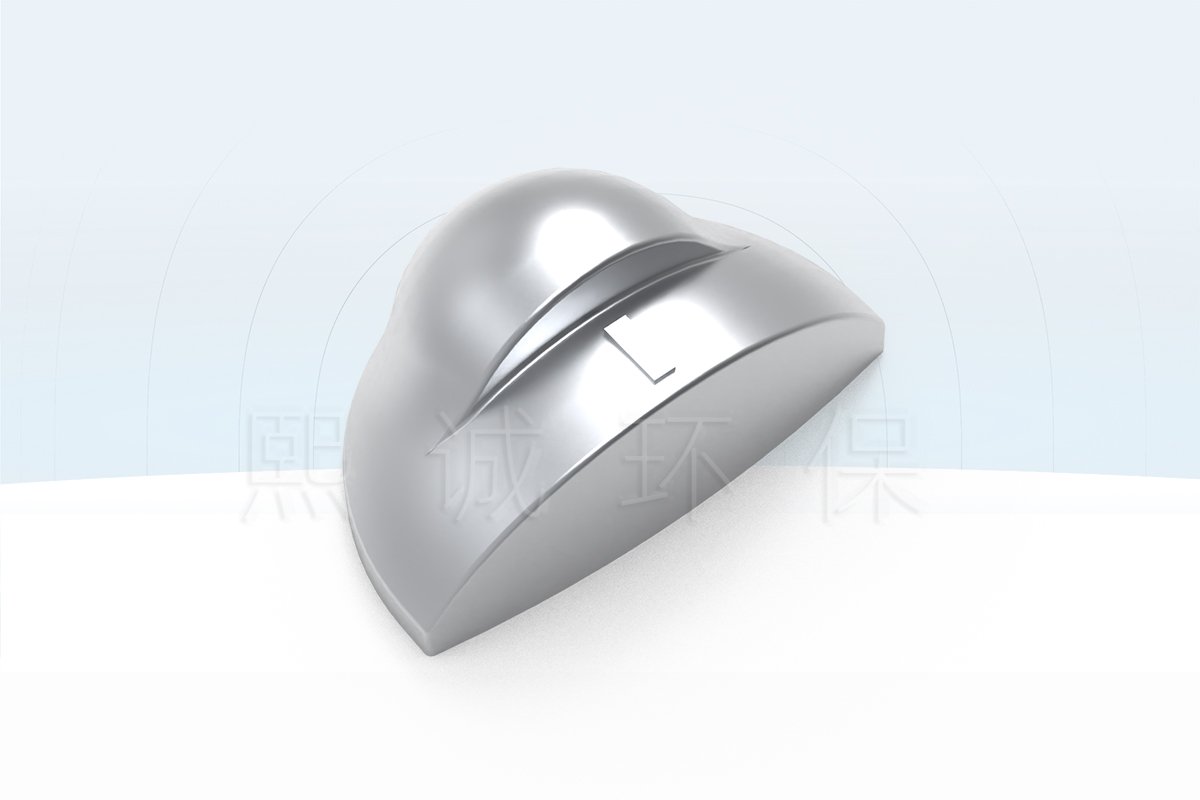
This fume hood occupancy sensor detects movement in the working zone in front of a laboratory fume hood. Its 24.125 GHz microwave sensing element supplies a switching signal that an automatic sash controller can use to recognize operator activity, maintain an open-sash period or begin a closing sequence after the programmed conditions have been satisfied.
The sensor is intended for movement-based automation. It is not a continuous static-presence detector and it is not the protective device that checks for an obstruction in the sash travel path. A complete automatic sash system normally uses this microwave occupancy input together with a dedicated sash safety sensor, sash-position feedback, the drive motor and the controller’s timing and alarm logic.
Choose This Sensor When
- The automatic sash sequence requires a non-contact indication that a person is moving within the operator zone.
- A 12-24 V AC/DC sensor with a simple switching output can be accepted by the selected sash controller.
- The mounting position allows the microwave field to cover the approach and working area without looking directly at moving sash parts.
- The installer can adjust angle and sensitivity, then verify detection with real walking paths and actual hood operation.
Do Not Select It as the Only Safety Input
A person who becomes motionless may no longer be detected after approximately 0.5 seconds. For that reason, the sensor must not be used by itself to prove that the sash opening is clear or that nobody remains at the hood. The automatic sash sequence must include a separate anti-pinch or obstruction sensor wherever closing movement could contact a person or object.
Key Product-Family Data
- Microwave frequency: 24.125 GHz
- Supply: 12-24 V AC/DC
- Reference detection field: approximately 4 m wide x 2 m deep at 2.6 m mounting height
- Adjustable tilt: 0-90 degrees
- Output hold time: 1.5 seconds
- Protection and temperature: IP54, -20 to +65 deg C
Key Specifications and Electrical Interface
The values below define the standard microwave occupancy sensor configuration. Final placement still depends on the hood width, sensor height, surrounding movement and the input requirements of the automatic sash controller.
| Specification | Value |
|---|---|
| Detection method | 24.125 GHz microwave motion detection |
| Dimensions | 116 x 70 x 48 mm |
| Power supply | 12-24 V AC/DC, non-polarized |
| Switching output | Non-polarized, maximum 50 mA |
| Current consumption | Less than 8 mA standby; less than 15 mA while sensing |
| Adjustable tilt | 0-90 degrees |
| Factory sensing angle | Approximately 40-50 degrees |
| Reference detection area | Approximately 4 m wide x 2 m deep at 2.6 m mounting height |
| Maximum mounting height | 3.5 m |
| Output hold time | 1.5 seconds |
| Operating temperature | -20 to +65 deg C |
| Protection rating | IP54 |
| Microwave power density | Less than 5 mW/cm2 |
Terminal Assignment
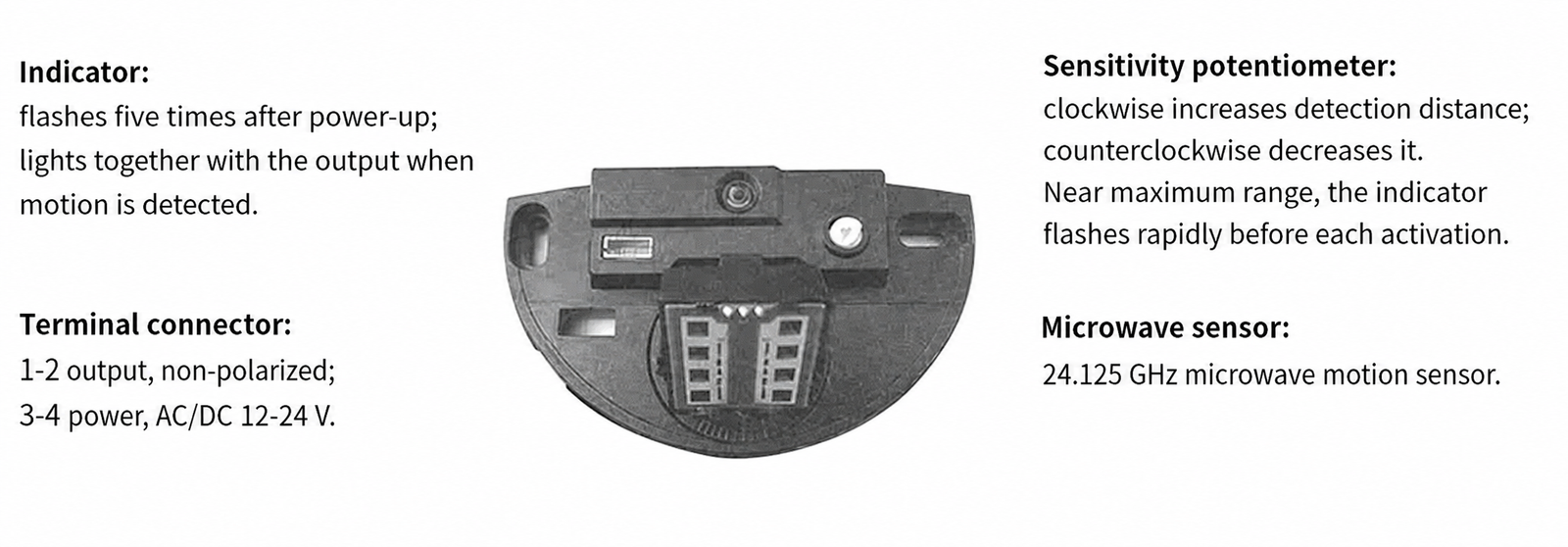
Terminals 1 and 2 provide the non-polarized switching output. Terminals 3 and 4 receive the non-polarized 12-24 V AC/DC supply. The controller input must be compatible with the sensor’s switching output and 50 mA maximum output current.
Indicator and Sensitivity Control
The indicator flashes five times after power is applied. It illuminates with the output when movement is detected. Turning the sensitivity potentiometer clockwise extends the sensing distance; turning it counterclockwise reduces the field. When adjustment reaches the upper limit, the indicator flashes more quickly before each activation.
Use the Reference Field as a Starting Point
The 4 x 2 m field is a reference measured at a 2.6 m mounting height, not a fixed boundary for every installation. Target size, movement direction, conductivity, mounting angle and nearby moving objects change the effective detection zone. Commission the actual hood rather than relying only on the nominal field.
How Microwave Occupancy Detection Behaves
A microwave occupancy sensor transmits low-power radio energy and responds to changes in the reflected signal caused by movement. This makes it useful for detecting an operator approaching, leaving or moving in front of a fume hood. It also means the word “occupancy” must be interpreted correctly: the sensor recognizes motion within the field, not an indefinitely stationary person.
Movement Is the Detection Condition
Detection distance can vary with the strength and direction of movement, the electrical characteristics of the target and body size. A person walking directly into the field may be detected differently from someone moving only slightly at its edge. Smaller users can require a lower mounting position or a carefully tilted field.
Static Presence Is Not Guaranteed
If a detected person remains still longer than the response delay, approximately 0.5 seconds under the stated product conditions, the switching output may clear even though the person is still in the operator zone. The sash controller must therefore use appropriate delays and independent obstruction protection instead of treating a cleared motion signal as proof that the opening is safe to close.
Detection and Safety Fields Serve Different Jobs
The microwave field can support energy-saving sash automation by identifying operator movement. An infrared sash safety sensor monitors the closing path for an obstruction. These two inputs are complementary: one informs the controller about activity in front of the hood, while the other protects the moving sash zone.
Set the Smallest Effective Field
Excessive sensitivity can extend detection into adjacent aisles, neighboring hoods or moving equipment and cause repeated activations. Start at a lower setting, walk every required approach path and increase sensitivity only until the intended zone is covered consistently.
Installation and Detection-Zone Setup
Mount the sensor horizontally and securely on the fume hood cross frame, with a clear view of the intended operator zone. Keep the mounting height at or below 3.5 m. A lower mounting height generally improves the ability to detect smaller people and makes it easier to confine the field to the hood frontage.
Cover the Full Working Width
The detection field should cover the practical approach and working width, not merely the centerline of the sash. If one sensor cannot cover a wide opening without extending too deeply into the laboratory aisle, use more than one sensor or revise the mounting position rather than relying on maximum sensitivity.
Avoid Moving Equipment in the Field
Do not aim the field at the moving sash, door mechanism, fans, flexible curtains, plants or other objects that move without an operator. Movement from the hood itself can be interpreted as occupancy and repeatedly reset the automatic closing timer.
Complete the Electrical Connection
Connect terminals 3 and 4 to the 12-24 V AC/DC supply and terminals 1 and 2 to the compatible controller input. Because both pairs are non-polarized, polarity is not assigned, but the circuit still requires secure terminals, suitable cable routing and confirmation that the controller is configured for a switching input.
Adjust Angle Before Increasing Sensitivity
Set the sensing angle, then test the field from the center and both sides of the hood. Change the 0-90 degree tilt to place the field where people actually stand. Increase sensitivity only after the mechanical angle is correct. This reduces unwanted detection beyond the hood and improves repeatability.
Integration with an Automatic Fume Hood Sash System
The microwave presence signal is one input in an automatic sash system. The controller combines it with sash position, timing rules, safety inputs and motor commands to decide when movement is permitted. The exact sequence must be defined for the laboratory’s operating procedure and validated on the assembled hood.
Typical Signal Sequence
When the sensor detects movement, its output can identify operator activity and reset the controller’s inactivity timer. After movement is no longer detected, the controller waits for the programmed delay and checks the safety input before commanding the sash drive. A renewed occupancy signal should interrupt or reset the sequence according to the selected control logic.
Required Companion Components
A complete system can include an automatic fume hood sash controller, a 24 V sash drive motor, sash-position feedback and a dedicated infrared sash safety sensor. Each component has a separate function and should be tested both individually and as part of the complete movement sequence.
Relationship to Ventilation Control
The occupancy output may also be available to a higher-level control sequence, but it does not measure face velocity, airflow or containment. Any ventilation setback or sash-dependent airflow strategy requires a separate fume hood controller, airflow sensor, control valve or damper, balancing and performance verification.
Define the Fail Response
The control design should define what happens after power loss, a disconnected sensor, a permanently active signal or a signal that never appears. A loss of occupancy detection must not silently authorize sash movement without the required safety checks.
Commissioning and Troubleshooting
Commission the sensor with the sash drive enabled only after its field and electrical output have been checked. Record the final mounting height, angle, sensitivity position, controller input and inactivity delay so the setup can be reproduced during maintenance.
Detection Coverage Test
Walk toward the hood from the center and both sides, then move within the normal working zone. Confirm that the indicator and controller input change together. Repeat with a smaller user if the laboratory must accommodate a wide range of operator heights.
Static-Operator Test
Stand still within the field and observe when the output clears. Verify that the controller delay and anti-pinch input prevent an unsafe closing command. This test confirms the movement-based limitation under the actual installation rather than assuming continuous presence detection.
Repeated or Unexpected Activation
If the sensor triggers repeatedly, check whether it sees sash movement, a fan, a loose bracket, vibration or another moving object. Re-aim the field, secure the base and reduce sensitivity. Clean dirt from the enclosure and remove water droplets or use appropriate rain protection where moisture reaches the sensor.
No Detection or No Controller Response
If the indicator does not illuminate, verify the 12-24 V supply and terminals 3-4. If the indicator operates but the controller does not respond, check terminals 1-2, cable continuity and the controller’s switching-input configuration. Low supply voltage, loose connectors and an incorrectly assigned controller input should be corrected before changing sensitivity.
Acceptance Record
Document all covered paths, excluded zones, output timing and safety-interlock behavior. Recheck the field after the hood, sash, ceiling services or nearby equipment is moved because those changes can alter reflections and unwanted motion within the sensing area.
Product Selection Summary
Select this fume hood occupancy sensor when an automatic sash controller requires movement-based operator-zone input and the installation can be commissioned around a 24.125 GHz microwave field. The standard configuration provides 12-24 V AC/DC power, a non-polarized switching output, adjustable angle and sensitivity, and an IP54 enclosure.
Information Required for Selection
Provide the hood width, sensor mounting position and height, normal operator approach paths, nearby moving equipment, required detection width and depth, controller input type, supply voltage, desired inactivity delay and details of the separate sash safety sensor. Include a front elevation or installation photograph when the hood frame or surrounding services may affect the field.
What the Configuration Should Confirm
The selected arrangement should confirm sensor quantity, mounting location, field direction, electrical interface, controller logic and the acceptance tests for movement detection, static-person behavior, false activation and obstruction protection. Wide hoods or unusual aisle layouts may require more than one sensor.
Frequently Asked Questions
Does this sensor detect a person who remains completely still?
Not reliably. It is a microwave motion sensor. The output may clear after a stationary period of about 0.5 seconds, so the automatic sash sequence needs a suitable delay and independent anti-pinch protection.
Can this product replace an infrared sash safety sensor?
No. It detects movement in the operator zone. An infrared sash safety sensor checks the closing path for a person or object and serves a different safety function.
What detection area should be expected?
The reference field is approximately 4 m wide by 2 m deep at a 2.6 m mounting height. The actual field depends on angle, sensitivity, target movement, body size and surrounding objects and must be verified on site.
Why does the sensor trigger when nobody is using the hood?
The field may include the moving sash, a fan, vibration, loose mounting, moving objects or water on the cover. Correct the angle, secure the bracket, reduce sensitivity and remove or exclude the unwanted movement.
Can one sensor cover a wide multi-section hood?
Only if the tested field covers every required approach path without extending into unrelated traffic. Where one field is too narrow or too deep, use multiple sensors or revise the placement.
Contact the Xicheng Engineering Team Today
Send the fume hood width, sensor mounting height, operator-zone layout, controller input, supply voltage and automatic sash sequence. We will review the sensor location, detection coverage and integration requirements for the selected hood.
Shenzhen Office: No. 34 Zhenxing Road (Shengtaian Heavy Industrial Park B), Loucun, Guangming New Dist, Shenzhen, Guangdong, China
WhatsApp: +86 18126478161
Engineering Mailbox: fanalax34@gmail.com