


Description
Key Specifications and First Selection
A mobile lab bench is a complete laboratory work surface on a mobile base, not a shelving cart with a convenient top. The selection starts with the work being moved: the mass and footprint of each instrument, centre of gravity, local load points, any retained liquid, the expected route, threshold and ramp conditions, and the process for stopping and stabilising the bench at its destination. A worktop, frame and four casters alone do not establish that a loaded assembly can be pushed, turned, parked and put back into service safely.
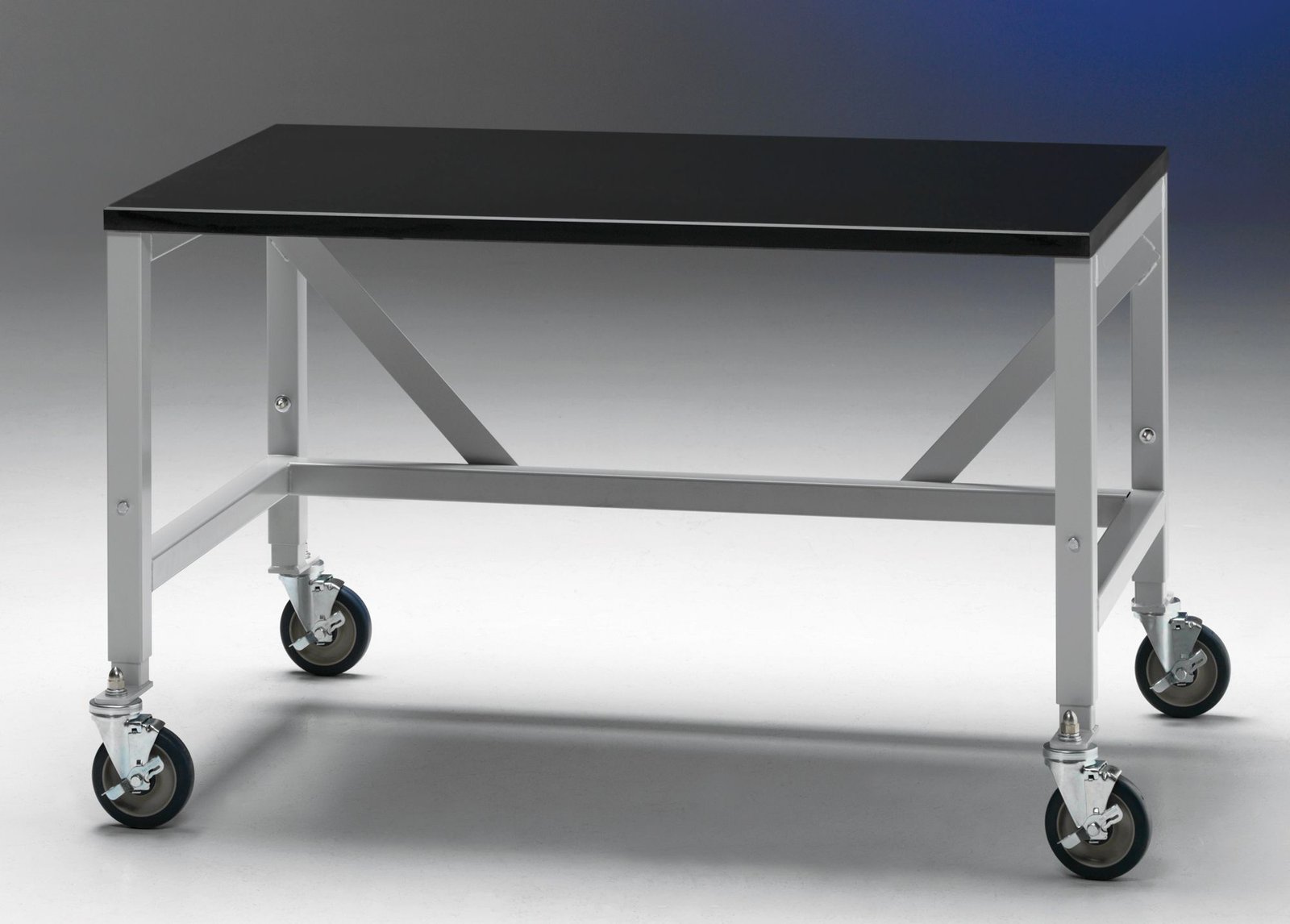
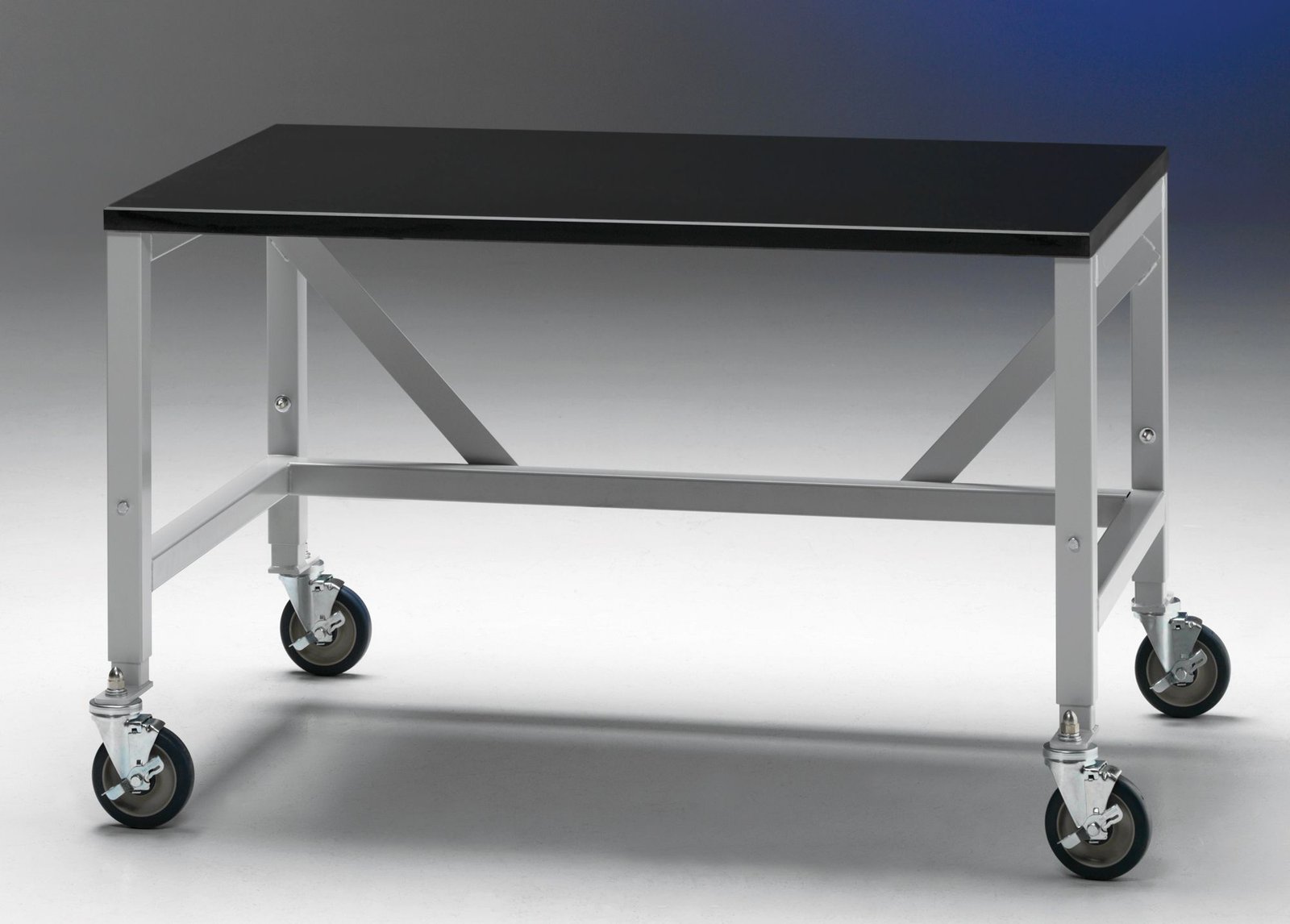
The controlled reference used for early layout work is a 48 x 30 in (1219 x 762 mm) mobile equipment table with 28.75-35.75 in (730-908 mm) adjustable working height, a 1.25 in (31.8 mm) solid epoxy worktop, a 1.75 in square coated-steel frame, 5 in non-marking polyurethane casters with toe locks and 800 lb (363 kg) published static capacity. Those values describe one equipment-table arrangement. They do not transfer automatically to a lighter mobile lab table, a bench with shelves, a service upright, drawers, a different worktop, a different caster set or an assembly that is moved while loaded.
| First selection field | Reference equipment-table arrangement | Buyer must define | Why it changes the selection |
|---|---|---|---|
| Working surface | 48 x 30 in / 1219 x 762 mm epoxy-top table | Usable work area, equipment footprint and service clearances | Length and depth must fit both the work and the route |
| Working height | 28.75-35.75 in / 730-908 mm adjustable reference | Operator posture, instrument height and final use position | Fixed, indexed and adjustable-height constructions differ |
| Base and movement | Four 5 in locking polyurethane casters | Floor finish, thresholds, slopes, route and moving frequency | Caster size and brake style affect mobility and parking stability |
| Static loading | 800 lb / 363 kg published reference | Equipment mass, local loads, centre of gravity and moving condition | Static capacity is not a full-load transport rating |
A bench is not a laboratory cart
A mobile laboratory bench provides a continuous worktop and structural base for sustained laboratory work or equipment support. A laboratory cart is intended primarily for transferring trays, supplies or small equipment between locations. The difference matters because a workbench may need a selected worktop, equipment anchoring, controlled height, a stable parked condition, optional uprights and service interfaces. Do not use the cart category to select a movable equipment platform, and do not assume that a rolling bench is suitable for material transfer without checking its dynamic condition.
First decisions before selecting a model
Separate three tasks from the outset: moving the bench, parking and levelling it, and performing the laboratory work. The project should identify whether the bench travels empty or carries equipment, whether casters remain loaded after parking, whether levelling feet transfer weight off the wheels, and whether an instrument must be restrained during movement. These answers affect the frame, caster set, braking, floor contact, clearances and the final equipment layout more than a general bench colour or nominal length.
Information needed for a useful quotation
Provide the preferred length, depth and working height; worktop material and thickness; equipment list with mass, dimensions, base points and centre of gravity; expected static and moving conditions; floor type, route, thresholds, ramps, doors and lift details; caster or levelling preference; shelves, cabinets or uprights; and any power, data, gas, vacuum or water interface. The resulting configuration can then distinguish the stationary working condition from the move-and-reposition condition.
Product Scope and Configuration Boundary
The mobile laboratory bench combines a selected worktop, structural frame, mobile base and caster or levelling arrangement. Optional shelves, under-bench storage, service uprights, power and data can be added only where their mass, connection route and effect on stability are defined. The final supply scope should state which of these parts are included rather than treating a staged room photograph as a universal package.
Mobility, parking and work are separate conditions
Movement begins with released brakes and an unobstructed route. Parking begins after the bench has been positioned, caster brakes have been applied and any selected levelling support has been engaged. Laboratory work begins only after the worktop is stable, equipment is secured as required and service connections have been checked. A published bench load may apply to a static, evenly distributed condition; it should not be converted into a promise for moving a high-centre-of-gravity instrument, crossing a doorway threshold or operating while the casters are carrying the full load.
What is included only by selection
An epoxy, phenolic, ceramic, stainless-steel or compact laminate worktop is a material choice, not a standard combination. Open frames, shelves, double-tier uprights, drawer units, mobile cabinets, guard rails, power strips, data outlets and service hubs are configuration items. Each needs a defined location and an independent check of clearances, load, weight distribution and access. An optional upright can be useful for local organisation, but it also changes the centre of gravity and the overhead clearance needed during movement.
What the bench does not replace
This page does not describe a fume hood, laboratory cart, mobile sink, fixed wall bench, continuous electric height-adjustable workstation or precision anti-vibration table. It does not provide universal chemical resistance, ESD control, cleanroom qualification, fire protection, vibration performance or a complete building-service system. Those duties require a purpose-built product or an independently defined selected configuration.
Service interfaces require a disconnect-and-reconnect plan
Power, data, process gas, vacuum, water and drainage may be possible around a mobile laboratory workstation, but the connection strategy must be selected before the bench moves. The plan should identify a safe isolation point, approved flexible connection where applicable, cable or hose routing, stored slack, protection from caster travel, disconnect sequence and functional recheck after repositioning. A hard-piped or permanently connected process interface changes the product from a freely mobile bench into a coordinated installation task.
Dimensions, Load and Mobility Conditions
The outside dimensions must be checked against both the working zone and the route used to move the bench. A compact mobile lab table may fit under a worktop yet fail at a door opening once hands, cables, caster sweep and turning space are included. A larger mobile laboratory workstation may have a suitable surface area but require a lift, corridor and door review because its frame, optional shelving and parked position occupy different envelopes.
Reference size families
Published market arrangements include 48, 60 and 72 in lengths at 30 in depth for mobile equipment workstations; 48, 60, 72 and 96 in length options at 24, 30 or 36 in depth for heavier epoxy-top tables; and 1000-1800 mm lengths at 600-900 mm depths for welded-frame mobile laboratory tables. These are useful planning families, not one combined fixed-size range. Final outer dimensions, work height, leg positions and all attachments must be read from the selected drawing.
| Reference configuration family | Published size or height fields | Associated construction field | Boundary for use |
|---|---|---|---|
| 48 x 30 in equipment table | 1219 x 762 mm; 730-908 mm work-height reference | 31.8 mm epoxy top, 1.75 in steel frame, 5 in casters | 800 lb static capacity belongs only to this arrangement |
| Mobile workstation family | 48 / 60 / 72 in length; 30 in depth; 78 in overall height with upright | Two-tier shelf arrangement, 3 in casters and selected levelling support | Overall height includes the upright and changes route clearance |
| Heavy epoxy-top table family | 48 / 60 / 72 / 96 in length; 24 / 30 / 36 in depth | 1 in epoxy top, selected 30/36 in or 30-36 in legs, 4.25 in casters | 1500 lb published static uniform load is family-specific |
| Welded-frame mobile table family | 1000-1800 mm length; 600-900 mm depth; 916 mm height | 16 mm compact laminate and 40 x 40 x 1.5 mm steel frame | No fixed page-wide load value is assigned |
Static load, local load and moving load
Static uniformly distributed load, local point load, caster rating and moving load describe different conditions. A 363 kg static reference is not an instruction to put the same mass on a small footprint, near one edge or high above the worktop. It also does not establish the mass that can be moved across uneven flooring. The equipment base, local supports, centre of gravity, acceleration, turning, threshold impacts and braking must be reviewed together.
Centre of gravity and equipment restraint
The lowest and widest equipment layout is normally easier to manage than a tall configuration on a narrow base. Record the equipment height, mass distribution, offset from the bench centreline and any upper shelving before selecting the caster and frame arrangement. Where a piece of equipment can slide, tip, swing or shift during movement, define its restraint method and the procedure for release and re-securing. Do not move a connected, liquid-filled, rotating or vibration-sensitive instrument simply because the bench itself has lockable casters.
Route and parked-position review
Confirm doorway width, handle clearance, lift dimensions and capacity, corridor turns, floor transitions, ramps, drain covers, thresholds and the free space needed to turn the bench. At the final location, check that casters can be locked, levelling supports adjusted if provided, doors and cabinet drawers opened, service access preserved and egress kept clear. The bench envelope during movement can be wider than its worktop because hands, brakes, casters and attached equipment project beyond it.
Worktop, Frame, Casters and Leveling Support
The worktop is selected from the laboratory task, while the base is selected from the equipment load and mobility plan. Keeping those choices separate prevents a description such as “chemical-resistant mobile bench” from obscuring the actual worktop material, thickness, edge treatment, support points, frame and caster condition. Epoxy, phenolic, compact laminate, ceramic and stainless-steel tops have different manufacturing, support, cutting and cleaning requirements; their performance should not be transferred from one material to another.
Worktop selections
Solid epoxy tops are commonly used where a homogeneous resin surface and selected laboratory cut-outs are required. Phenolic or compact-laminate tops offer a different balance of thickness, mass and machining. Ceramic worktops require their own handling and joint arrangement, while stainless-steel worktops are selected around grade, gauge, finish, reinforcement and any integral sink or backsplash. The chemical list, temperature, cleaning method, equipment base, local loading and opening details should determine the selected top rather than a general material label.
Frame and support geometry
Published structures include 1.75 in coated-steel square frames, 18-gauge welded steel construction, 40 x 40 x 1.5 mm welded steel frames and larger modular steel systems. These are separate arrangements, not interchangeable values. Confirm the frame section, wall thickness, weld or bolted connection, cross members, underside clearance, local reinforcement and attachment points on the selected drawing. A frame that supports a uniformly distributed worktop may need a different layout for a concentrated instrument base or a cantilevered service upright.
Caster and leveling arrangement
Casters may be 3, 4.25 or 5 in in published bench configurations and may use toe locks, total locks, swivel brakes or dedicated levelling mechanisms. Some arrangements use a foot-operated levelling caster that stabilises the bench after positioning; others retain casters under the parked load. The final assembly should state wheel diameter, tread material, number, swivel and brake function, caster mounting, combined permitted condition, levelling travel and whether the support feet take the load when parked.
Four component checks should appear on the selected drawing and quotation. The worktop needs its material, local supports, edge detail and cut-outs confirmed against the laboratory duty. The frame needs its section, connections, cross rails, underside clearance and equipment base recorded. The casters need their wheel size, tread, brake, mounting and moving condition stated. The parked-support arrangement needs its floor condition, adjustment range and operating procedure defined. These are separate decisions because no single wheel rating establishes material compatibility, frame stiffness or parked stability.
Shelves, cabinets and uprights
Shelves, storage and service uprights can turn a mobile bench into a mobile laboratory workstation, but each has its own load and stability effect. Shelf height changes the centre of gravity; drawers can open during movement; a cabinet changes under-bench clearance; and a power or gas upright changes the route and service plan. Include these options only when their location, mass, clearance and retained equipment are recorded in the layout.
Applications, Configuration and Product Fit
A mobile lab bench is suited to laboratories that need to reposition a complete work surface or equipment platform without treating each move as furniture removal. Typical configurations support flexible teaching rooms, instrumentation areas, sample-preparation zones, pilot spaces, serviceable equipment islands and changing project layouts. The decision remains driven by the actual instrument, surface duty, movement route and service connection, not merely by the existence of four casters.
Equipment tables and mobile workstations
An open mobile equipment table is appropriate when the equipment footprint, worktop, lower-frame clearance and access path define the task. A mobile laboratory workstation is appropriate when selected uprights, shelves, local power or organised working accessories are required in the same movable unit. The workstation form should not be selected by appearance alone: its full height, upper mass, cables and attachments must be evaluated as part of the moving and parked envelope.
General laboratory reconfiguration
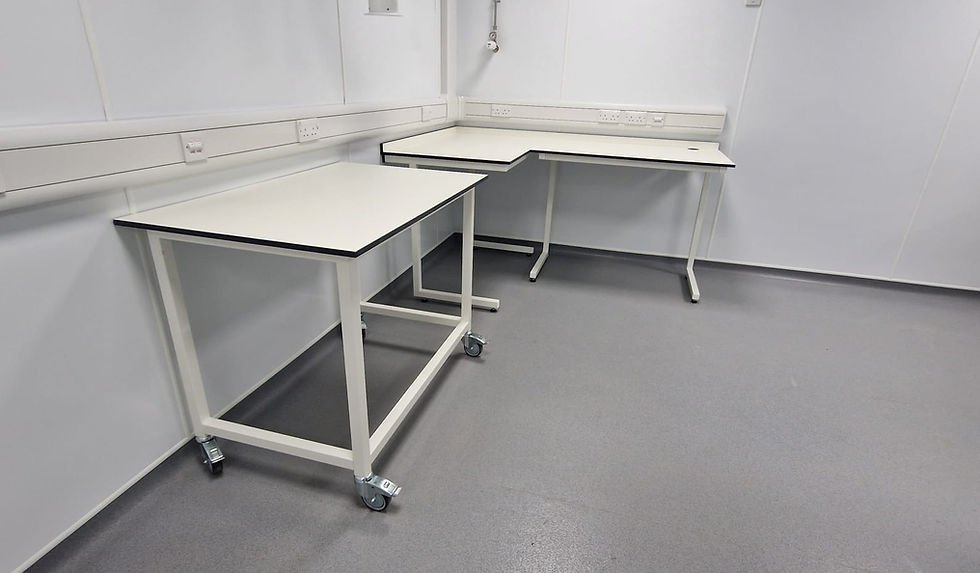
For teaching laboratories and multi-purpose rooms, mobile lab tables can create temporary work zones and release floor space when a layout changes. The useful configuration is one with a clear route, controlled storage, a parking plan and a worktop suitable for the expected process. Where several benches are parked together, preserve aisle width, egress, door swing, electrical access and the ability to apply and inspect each locking or levelling feature.
When another product is a better fit
Use a Laboratory Wall Bench for a permanent perimeter work zone with fixed service coordination, or a Laboratory Island Bench when a central two-sided work surface is required. An Anti-Vibration Balance Table is the appropriate direction for a sensitive balance or instrument where movement and ordinary caster bases conflict with the measurement duty. A Laboratory Instrument Table is preferable when the instrument itself, rather than room reconfiguration, defines the support and service requirements.
Keep utility work independent from movement
Mobile benches can be positioned near power or data points, but a fixed electrical, water, gas, vacuum or drainage connection cannot be treated as a simple accessory. Specify the interface, shutoff or isolation point, connection method, required slack, routing, protection and recheck procedure. The bench should only move under the conditions defined for the selected services and equipment; it is not an alternative to a fixed wet bench or permanently connected laboratory installation.
Selection summary
Choose a mobile bench when the work requires a complete, stable working surface that can be deliberately repositioned and stabilised at a new location. Choose a fixed bench when service permanence, high point load, vibration control or continuous operation make mobility unnecessary or unsuitable. Choose a cart when the primary duty is material transfer rather than sustained equipment support or laboratory work.
Planning, Installation and Commissioning
Before delivery, confirm the bench dimensions, working height, worktop, frame, caster assembly, brakes, levelling components, equipment attachments and all selected storage or upright modules. Confirm whether the bench is shipped assembled, whether it must pass through a particular door or lift and whether the worktop or upright must be removed for transport. A product drawing should identify the final external envelope, local reinforcement, caster centres, parking footprint and positions of any service interface.
Installation and first-use checks
At installation, inspect the frame, worktop, caster mounting, brake function, levelling adjustment, fasteners and surface condition. Place the bench in its intended working position, apply the specified parking arrangement and check that it sits stable on the actual floor. Install equipment using the approved mounting or restraint method, then verify cable, hose and service clearance through the complete working and service range. The bench should not be put into normal use based only on a visual check that the casters are present.
Movement procedure
Define the route and movement procedure for the actual installed bench. The procedure should state whether equipment must be removed or secured, which services must be isolated, who releases brakes and levelling supports, the maximum permitted route condition, the required operators, the parking and re-levelling sequence, and the recheck required before laboratory work resumes. A locked caster is a parking feature, not a substitute for a move plan.
| Planning item | Project input | Decision produced | Confirmation before release |
|---|---|---|---|
| Equipment and load | Mass, base dimensions, centre of gravity, liquid or vibration condition | Worktop, frame and restraint approach | Static and moving conditions kept separate |
| Room route | Doors, lift, turns, ramps, thresholds and floor finish | Bench envelope, caster selection and delivery method | Clear moving path and destination access |
| Parked condition | Brake type, levelling support, floor and work requirement | Stabilisation and first-use procedure | Bench remains stable before equipment operation |
| Services and options | Power, data, gas, vacuum, water, storage and uprights | Included components and connection scope | Disconnect, routing and recheck plan defined |
Maintenance and change control
Inspect the worktop, frame, caster tread, swivel action, brakes, levelling elements, fasteners, shelf supports and any service routing on the laboratory’s maintenance schedule. Review the configuration whenever the equipment mass, worktop cut-outs, upright system, service connection, floor route or intended movement frequency changes. A bench that remains suitable for light manual work may require a new assessment after a heavy or taller instrument is added.
Frequently Asked Questions
Is a mobile lab bench the same as a laboratory cart?
No. A mobile laboratory bench is a complete work surface and structural base selected for sustained laboratory work or equipment support. A cart is primarily intended for moving supplies or trays. The worktop, frame, casters, parked condition and equipment restraint should be selected for the actual bench duty.
Can the bench be moved while fully loaded?
Only when the selected construction and project move plan support that condition. Static uniform capacity does not prove safe movement of a concentrated, tall, liquid-filled or connected load. Define the equipment mass, centre of gravity, restraint, floor route, thresholds, slope and operator procedure before setting a moving condition.
Are locking casters enough to stabilise laboratory equipment?
Not always. A brake can prevent rolling or swivelling according to its selected design, but it does not establish floor level, local frame deflection, vibration control, equipment restraint or the load path through a selected levelling support. Some projects need a separate levelling or support arrangement after the bench is parked.
Which worktop material should be selected?
Choose the worktop from the chemicals, temperature, cleaning process, impact exposure, equipment base, local load and required cut-outs. Epoxy, phenolic, compact laminate, ceramic and stainless steel are different material systems and should not be treated as interchangeable.
Can power or process services be added to a mobile workstation?
They can be included only with a defined connection, isolation, routing, slack and recheck plan. A hard-piped or permanently connected service changes the installation requirement and may limit normal movement.
Contact the Xicheng Engineering Team Today
Send the preferred bench size, worktop duty, equipment schedule, static and moving load condition, caster or levelling requirement, room route, selected accessories and any service-interface details. The engineering team will return a mobile laboratory bench configuration discussion and pricing proposal within 24 hours.
Shenzhen Office: No. 34 Zhenxing Road (Shengtaian Heavy Industrial Park B), Loucun, Guangming New Dist, Shenzhen, Guangdong, China
WhatsApp: +86 18126478161
Engineering Mailbox: fanalax34@gmail.com