


Description
Key Specifications and First Selection
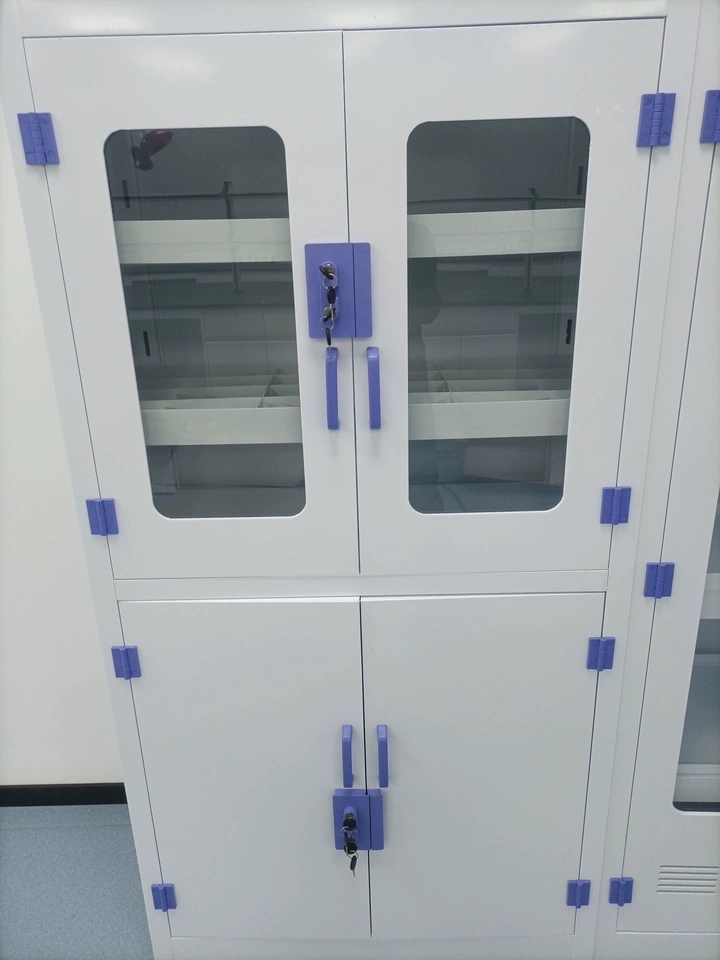
A laboratory glassware cabinet should be selected by the vessels it must organize, the condition in which they enter the cabinet and the usable room space around it. The cabinet shown here is a closed PP storage format for clean flasks, beakers, cylinders, bottles and similar laboratory glassware that needs visible, separated and dust-reduced storage. It is not an airflow device and it is not a substitute for a dedicated chemical cabinet, a safety cabinet or an active drying cabinet.
The fastest selection check is practical rather than cosmetic. List the tallest vessel, the widest vessel, any fragile or long-necked pieces, the likely number of users and whether the cabinet receives fully dry items or items that have only been drained after washing. Then compare that list with shelf spacing, door opening, access side, drip-control approach and the available floor-to-wall fixing location. A cabinet that matches only its external footprint can still be unsuitable when tall glassware cannot clear a shelf, doors cannot open in the aisle or residual moisture has no controlled path.
| Selection field | Published reference | What must be confirmed | Why it affects the installation |
|---|---|---|---|
| External cabinet envelope | 900 x 450 x 1800 mm reference | Delivery path, room footprint and overhead clearance | External dimensions do not define usable internal space or door swing |
| Cabinet shell | 8 mm PP in the reference arrangement | Required material, weld construction and exposed-part compatibility | The full assembly may include different transparent panels and hardware |
| Storage layout | Four split doors with adjustable perforated shelf positions | Vessel height, access zones and number of shelf levels | A nominal cabinet size can be arranged differently for the inventory |
| Operating boundary | Enclosed clean-glassware storage | Wet-item handling, drainage and any special storage duty | Perforated shelves do not create active drying or chemical containment |
Start with the storage duty, not the word cabinet
Glassware cabinets are often placed close to a wash area, a laboratory wall bench or a preparation zone because staff need vessels within reach of routine work. That proximity does not mean each cabinet should receive dripping items or serve as the drying stage. When washed glassware is still wet, define who drains it, where drip water is collected, when the cabinet is cleaned and whether a separate Glassware Drying Rack should handle the open drying stage before storage. This decision protects the shelf surfaces, floor and nearby casework as well as the stored vessels.
Read the dimensions as separate planning fields
For the published reference arrangement, 900 x 450 x 1800 mm describes the overall cabinet envelope. A related arrangement of the same nominal exterior size lists 820 x 370 x 1640 mm as usable internal reference space. Neither set of dimensions should be treated as the door opening, transport package, plinth clearance or final shelf opening. Those measurements answer different questions and must be confirmed on the selected arrangement. This distinction matters particularly when the cabinet is installed between fixed benches, below services or beside an existing Laboratory Wall Bench.
What belongs in an early quotation request
Provide the intended vessel list, largest vessel height and diameter, preferred shelf count, whether viewing windows are wanted, whether a lock is required, the wall-side fixing condition, available installation width and height, the preferred door opening direction, and the required delivery destination. For a wet-work room, also identify the expected amount of residual water and whether a nearby PP Laboratory Sink or Stainless Steel Laboratory Sink is part of the same work sequence. Those facts allow the cabinet layout to be discussed before an exterior size is treated as a finished specification.
Product Scope and Storage Boundary
What the PP glassware storage cabinet supplies
A PP glassware storage cabinet is a floor-standing, enclosed storage assembly. The reference format combines a polypropylene cabinet shell, separate upper and lower door zones, selected transparent viewing panels, adjustable internal shelf positions and a locking arrangement. It gives laboratory staff a defined place to separate clean vessels by type, size, user group or process step while keeping the contents visible enough for routine identification. The cabinet can be specified with a different shelf layout, door arrangement or accessory set when the actual vessel inventory requires it.
The primary value is orderly physical storage. Tall cylinders, narrow-necked flasks and small bottles create different placement issues, so a cabinet needs more than a headline shelf count. The selection should address vertical clearance, side-to-side stability, the gap between stored items, how often staff open each door zone and whether users need a clear view of the contents before opening the cabinet. The four-door reference layout creates separated access areas; it should not be assumed to be the only available door pattern or the right pattern for every laboratory.
Storage cabinet versus glassware drying equipment
Perforated shelves can help a small amount of residual water move away from the immediate vessel contact area. That is a passive physical feature, not a claim of drying rate, air exchange, filtered exhaust or temperature control. If clean vessels are stored only after full drying, the cabinet can be selected around organization and visibility. If the routine requires vessels to remain inverted while water drains, the process may need an open Glassware Drying Rack, a drip tray, a defined drain connection or another purpose-specific drying arrangement before the cabinet becomes the storage location.
An active drying cabinet normally has a defined energy input, air movement or thermal sequence. This PP glassware storage cabinet does not claim those functions. A buyer should therefore avoid using a door window or shelf perforations as a basis for a drying-time expectation. The relevant project question is simpler: what condition must the glassware reach before it is put away, and how will any remaining water be managed without wetting the cabinet base, floor or adjacent laboratory furniture?
Storage cabinet versus chemical or safety cabinet
The words PP, cabinet and laboratory do not automatically make an enclosure suitable for corrosive reagents, flammable liquids, toxic materials, controlled substances or any regulatory storage duty. Such uses require a separate review of the stored material, the required protective function, the complete exposed component set, relevant local requirements and the room’s ventilation design. Clean or routine laboratory glassware is the defined starting duty here.
This boundary also prevents a common installation mistake: placing process chemicals in the same visible cabinet used for clean vessels simply because space is available. Separate storage zones reduce handling confusion and make the actual purpose of the cabinet clear to the people using the room. Where a project needs both vessel storage and chemical storage, identify each duty as a distinct line item rather than relying on one general cabinet label.
Configuration scope
The reference arrangement establishes an overall size and construction direction, while the final layout can address shelf location, shelf perforation pattern, door and window configuration, handles, locking, feet, anchoring method and any selected ventilation connection. Transparent panels, hardware and accessory parts are specified as part of the selected assembly; a material name for the cabinet shell alone does not define every exposed component.
Before approval, distinguish the four dimensions that are often compressed into one number: external envelope, usable internal space, clear access opening and delivered package size. The cabinet may fit the planned room footprint but still require a different door arrangement when its opening sweep conflicts with a bench, aisle or other cabinet. The same principle applies to a laboratory with a central Laboratory Island Bench: circulation around the island must remain workable while doors are open and glassware is being retrieved.
Cabinet Layout, Doors and Glassware Fit
Plan the internal arrangement around real vessels
The usable cabinet layout begins with the item inventory. Glassware rarely has one uniform height: low beakers and sample bottles occupy a different shelf zone from volumetric flasks, graduated cylinders, reagent bottles or long-necked vessels. A practical layout reserves tall positions for the few items that need them instead of setting every shelf at a tall pitch and losing storage efficiency for smaller pieces. It also keeps fragile items away from the path of frequently accessed doors and handles.
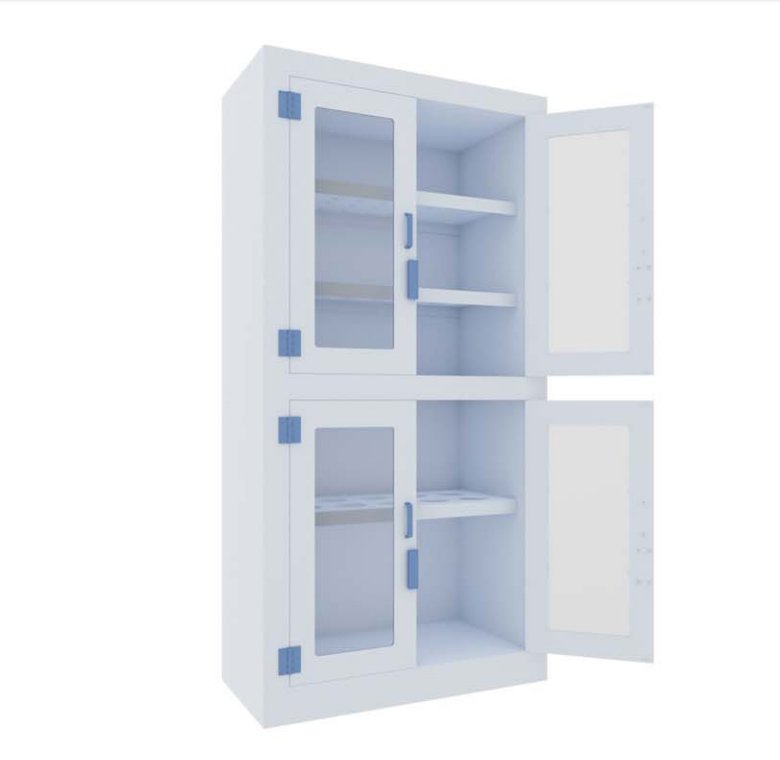
The published 900 x 450 x 1800 mm reference arrangement has four split doors and adjustable perforated shelf positions. A related configuration gives 820 x 370 x 1640 mm as an internal reference. These values provide a useful starting envelope, but the final shelf openings depend on the selected shelf quantity, their spacing, the base detail and the door arrangement. Submit the largest vessels and the number of each type before treating internal dimensions as a finished capacity calculation.
Door zones and access behavior
Split doors make it possible to open only the zone needed for a particular group of vessels. That can reduce disturbance to nearby stored items and helps staff keep category-based storage visible. The upper viewing panels in the reference format also allow a contents check without opening the door, but panel location and transparent-panel specification remain configuration items. A fully opaque door, a larger viewing panel or a different split pattern may be more suitable depending on light exposure, inventory labeling and the cleaning routine.
Door opening requires real room clearance. Check the open door path against the laboratory aisle, nearby drawers, sink access, wall services, emergency egress and the edge of any work surface. The required clearance is not the same as the 450 mm cabinet depth. It changes with door width, hinge arrangement and the person retrieving glassware. A plan that only leaves the cabinet’s closed footprint can create a daily obstruction after installation.
A layout request that can be evaluated
The configuration request should identify four layout fields together:
- Door arrangement: four split doors are shown in the reference format, while the final opening zones are chosen from aisle width, access side and user flow.
- Shelf positions: adjustable locations are selected from the tallest and shortest vessel types and the quantity to be stored.
- Viewing sections: upper transparent panels are selected around visibility, labeling and panel requirements rather than assumed from the cabinet title.
- Internal reference envelope: 820 x 370 x 1640 mm is published for a related configuration; final internal clearances are checked with the selected shelf pitch and door layout.
Keep stored groups stable and legible
Cabinet capacity is more useful when each shelf has a clear storage rule. One shelf may be assigned to clean beakers, another to volumetric glassware and another to bottles or consumables that are compatible with the storage duty. Where staff share the cabinet, label zones based on the laboratory’s own inventory system rather than relying on a general door label. This reduces searching, lowers the chance of crowding items at the front edge and makes replenishment easier to manage.
Avoid making the shelf surface solve every handling problem. Large round-bottom vessels, fragile narrow bases or irregular equipment may need an individual support, a tray or a different storage method. The supplier can review the cabinet layout, but the laboratory should define whether each item is stored upright, inverted, capped, in a tray or within a protective holder. That definition informs the actual shelf opening and drainage arrangement.
Perforated Shelves, Passive Drainage and Cleaning
Why shelf design matters to a glassware storage cabinet
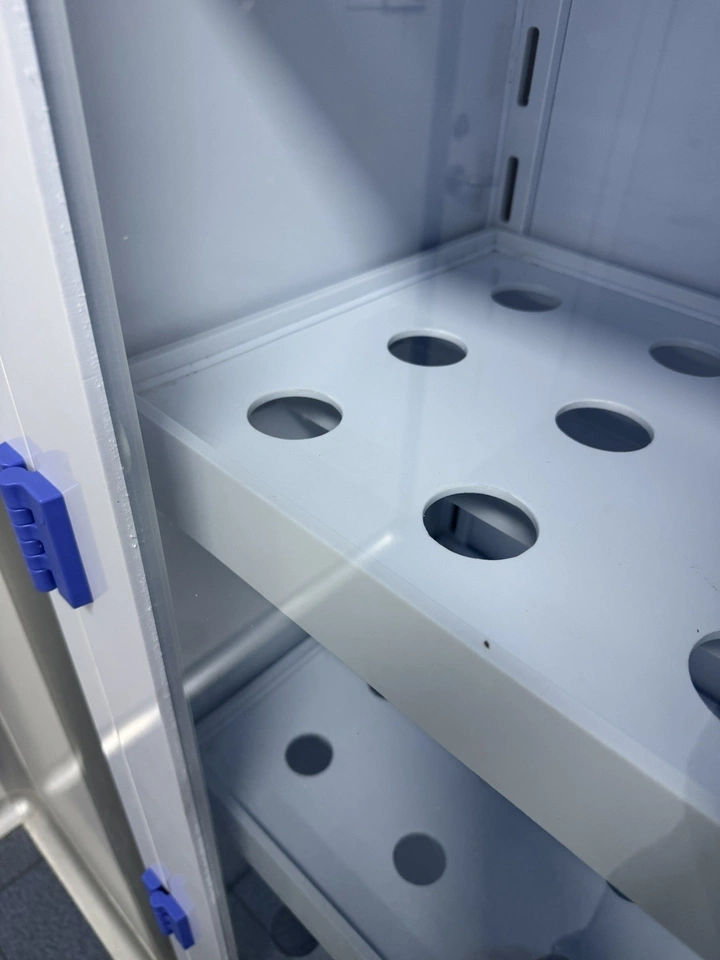
The shelf is the part of a glassware storage cabinet that directly affects daily handling. In the reference PP arrangement, shelf surfaces use a perforated pattern and sit within adjustable side locations. The perforations can reduce the area of direct contact beneath an item and allow a small amount of residual water to move through the shelf rather than pooling immediately under a vessel. The raised shelf edge visible in the selected detail helps define the shelf surface, but it does not make a shelf a liquid-retention tray or a guarantee against every spill.
The function should be described accurately. A perforated shelf is useful for organized storage and for a controlled passive-drainage approach where the surrounding cabinet design and cleaning routine are appropriate. It is not a drying mechanism. It does not set a moisture-removal time, prove an airflow path or replace a dedicated drainage plan. When recently washed glassware will enter the cabinet, define where water is allowed to go, whether a removable collection arrangement is required and how the lower cabinet is inspected and cleaned.
Select shelf spacing from the highest real use case
A shelf opening must be high enough for the tallest item assigned to that zone, including any protective cover, tray or holder used in routine handling. The largest item should not be placed against the top surface merely because it fits when tilted. Leave an allowance for safe placement, removal and visual checking. At the same time, do not set every opening to the height of the tallest cylinder if most of the cabinet stores shorter beakers or bottles. Adjustable shelf positions make it possible to reserve one or two taller zones while keeping efficient smaller-item storage elsewhere.
Shelf count alone is also not a capacity promise. The safe arrangement depends on the item base, local point loads, whether vessels are concentrated at the front, whether a tray distributes the load and how the door is used. Any required shelf loading, anchoring or seismic condition should be stated in the project request rather than inferred from a nominal cabinet size.
Manage wet glassware as a process step
The most reliable sequence is to decide whether the cabinet receives completely dry vessels or only drained vessels. Fully dry items can be stored by category and access frequency. Drained but still wet items need a separate rule for residual water: a designated drip stage, a collection surface, defined cleaning access and a review of the lower cabinet condition. The correct choice may be a nearby Glassware Drying Rack above a wet-work area, followed by cabinet storage once the glassware is ready.
Do not direct untreated water toward a floor, electrical component, incompatible base material or an unknown void within the cabinet. If a drain, tray or vent connection is requested, its location, material and cleaning access must be established for the selected configuration. An optional opening or connection point does not establish that an entire installation has a drainage system.
The shelf-and-drainage decision is made through four connected checks. First, select perforated shelf surfaces and any tray or drip arrangement without claiming a drying rate. Second, set the adjustable shelf positions from the tallest, widest and most fragile vessel types. Third, define whether the cabinet receives dry-only or drained items and prevent an uncontrolled water path. Finally, establish the inspection and cleaning access required for the selected door and shelf arrangement.
Cleaning without overstating material performance
PP is often selected for laboratory furniture where a washable polymer cabinet construction is desired. The required suitability still depends on the actual cleaning chemicals, exposure duration, temperature, transparent-panel material, fasteners, lock components and any accessory parts. A general PP cabinet description should never be read as a blanket compatibility statement for every cleaning agent or laboratory process. Provide the planned cleaner, concentration, contact pattern and temperature for review when the duty is not routine dry storage.
For normal operation, staff should remove broken glass promptly, avoid loading shelves with unknown liquid residue and keep shelf holes clear enough to inspect. If the use pattern changes from clean glassware storage to chemical handling, process sample retention or wet drying, re-evaluate the cabinet duty rather than extending a storage claim beyond its boundary.
PP Construction, Viewing Panels and Hardware
Cabinet shell and welded construction direction
The reference PP glassware storage cabinet uses an 8 mm polypropylene cabinet shell. This establishes the construction direction for a floor-standing polymer casework assembly intended for clean glassware storage. The final cabinet is selected as an assembly, not as a sheet-thickness number alone. Door panels, transparent windows, hinges, handles, locks, fasteners, feet and optional connection pieces can have different material and dimensional requirements from the PP cabinet body.
The construction review starts at the interfaces. Check where the cabinet contacts the floor, how it is anchored to the wall or supporting structure, how the doors align with the case, whether shelves can be repositioned with the planned vessel layout and whether cleaning can reach the corners and lower region. These details determine whether the chosen material remains practical in the installed room.
Viewing panels and doors
Transparent upper-door panels in the reference layout allow a quick contents check. They are useful for reducing unnecessary door opening and supporting category-based storage, especially when shelf labels are arranged behind the window. The transparent-panel material and thickness are not universal values on this page. Published configurations use different panel details, so the final drawing and material schedule must identify the selected window assembly.
Door configuration affects more than appearance. A split door layout can separate high-frequency access from lower storage, while a different door layout may suit a narrow aisle, a wall recess or a laboratory that stores one type of vessel in each vertical bay. Hinge side, handle position, locks and opening restraint should be reviewed together with the room plan. A locking detail may control casual access, but it is not a claim of regulated hazardous-material security.
Hardware, feet and optional features
Hardware is part of the finished cabinet selection. The correct review includes hinges and fasteners, handles, lock cylinder, levelling or support feet, wall-fixing components, transparent-panel seals and any specified vent or drainage accessory. Optional features should be documented as supplied scope, not implied by the product title. A cabinet can have a clean PP body yet still need its non-PP parts checked for the actual cleaning and room conditions.
| Assembly element | Reference configuration direction | What is selected per project | Selection boundary |
|---|---|---|---|
| Cabinet case | 8 mm PP welded shell | Overall cabinet size and internal division | PP shell does not define every component material |
| Doors and windows | Split door zones with viewing panels where selected | Panel type, thickness, opening side and visibility area | Window specification is not universal across configurations |
| Shelves | Adjustable perforated positions | Shelf number, pitch, edge detail and vessel support method | No fixed load rating is stated without the selected arrangement |
| Hardware and installation parts | Hinges, handles, locks and support/anchoring provisions | Complete hardware set and wall/floor fixing method | Access control and anchoring are distinct functions |
Material boundary for the actual room
The selection question is not merely whether PP is a familiar laboratory material. It is whether the complete assembly matches the actual storage duty. Clean glassware, routine wash-down, general laboratory cleaners, persistent chemical contact, high temperature and exterior exposure impose different demands. When the cabinet is close to a wet sink, its lower area and floor interface require particular attention. When it sits in a dry preparation room, the priorities may instead be dust control, viewing panels and shelf organization.
State the actual room use in the request. Include cleaning products, whether wet items enter the cabinet, nearby process materials, required window visibility, need for locking and any building rule that affects anchoring. That information lets material details be selected as a coherent cabinet rather than as unrelated option names.
Installation, Anti-Tip Planning and Room Coordination
Place the cabinet as a working storage point
The installation of a PP laboratory glassware cabinet begins with the working sequence. In a wash-and-preparation area, staff may move from a PP Laboratory Sink or Stainless Steel Laboratory Sink to a drying stage and then to closed storage. In a dry teaching or analytical room, the cabinet may sit beside a Laboratory Wall Bench so common vessels can be retrieved without crossing an aisle. Both locations can work, but they require different water-control and circulation decisions.
The cabinet needs a stable base, a suitable wall or structure for the selected anti-tip arrangement, enough clearance to open the doors, and a delivery path that accommodates the actual delivered dimensions. Floor irregularity, skirting, floor drains, wall services, overhead obstructions and nearby worktop overhangs should all be checked before a nominal cabinet footprint becomes a final layout. The 1800 mm reference height is not a substitute for verifying the room’s available height, lifting method or installation access.
Anti-tip and access planning
Tall cabinets can become less stable when doors are open, when shelves are loaded unevenly or when staff retrieve items from the upper area. The project should therefore define the selected wall-fixing or anti-tip provision, the supporting wall condition and any local building or facility requirement. Avoid treating a cabinet foot or a nominal depth as proof that no restraint is required. The fixing method must suit the actual wall, the supplied cabinet design and the laboratory’s operating rules.
Door access is a second safety and usability check. Mark the fully open door path on the plan. It must not block an egress route, trap a person between the cabinet and an Laboratory Island Bench, interfere with a sink user or conflict with another cabinet door. If the aisle is limited, a different door layout or cabinet location may be more useful than reducing the planned shelf count.
Project-ready input list
| Planning item | Why it is needed | Information to provide | Result to confirm |
|---|---|---|---|
| Room and delivery route | Cabinet must enter and stand in the actual room | Door openings, corridor turns, ceiling height and final location | Delivery/installation approach and external envelope check |
| Glassware inventory | Shelf spacing is driven by the stored items | Vessel sizes, quantities, fragile items and storage orientation | Shelf pitch, compartment layout and access zones |
| Wall and floor condition | Tall cabinets need an appropriate installation method | Wall construction, floor level, skirting and permitted anchors | Selected anti-tip or fixing provision |
| Operating duty | Storage conditions affect drainage and cleaning details | Dry-only or drained items, cleaner and nearby wet-work equipment | Drainage, cleaning and material-interface review |
Applications, Related Products and Selection Boundary
Suitable applications
This laboratory glassware cabinet can be considered for educational laboratories, analytical laboratories, quality-control rooms, preparation rooms, development laboratories and wash-up support areas where the primary duty is closed storage of clean non-hazardous vessels. The layout is particularly useful where staff benefit from seeing the stored categories through selected upper viewing panels and where shelves need to be adjusted for a mixed collection of glassware sizes.
The cabinet should not be selected from the product name alone when the real duty is chemical storage, fire-protected storage, controlled drying, biological containment or high-security storage. Each of those duties needs a separate product and a separate scope review. The same distinction applies to heavy laboratory equipment: a vessel-storage shelf arrangement is not automatically the correct support format for equipment with concentrated loads or special vibration requirements.
Related product boundary
Use the Glassware Drying Rack where open peg drying and drip handling are the primary task. Use a PP Laboratory Sink or Stainless Steel Laboratory Sink for the wet-work station itself. Use bench casework for under-worktop support and a PP glassware storage cabinet for the vertical enclosed storage stage. These product roles can form one room solution, but each remains a separate item with its own material, installation and operating boundary.
Frequently Asked Questions
Is a PP glassware storage cabinet a glassware drying cabinet?
No. The cabinet is an enclosed storage format for clean laboratory glassware. Perforated shelves can support a passive drainage approach where the cabinet and process are arranged for it, but they do not establish heating, forced air, drying time or controlled airflow. Use a separate drying solution when the process requires active drying performance.
What is the published reference size?
The published reference arrangement is 900 x 450 x 1800 mm external with an 8 mm PP cabinet shell, split doors and adjustable perforated shelf positions. A related arrangement lists 820 x 370 x 1640 mm as an internal reference. Confirm external envelope, usable internal dimensions, door opening, delivery dimensions and selected shelf layout separately for the project.
Can wet glassware be placed directly inside?
The laboratory must define the wet-item procedure first. Recently washed glassware may require a dedicated draining stage, a drip collection arrangement and a cleaning routine before storage. Do not assume that shelf perforations alone provide a complete drainage system or make the cabinet an active drying unit.
Can the cabinet store laboratory chemicals?
The page is for clean glassware and non-hazardous vessel storage. Corrosives, flammables, toxic materials, controlled substances and other chemical duties need their own compatibility, protective-function and local-requirement review. Do not extend a general PP cabinet description to a chemical-storage claim.
What information is needed to configure the shelves and doors?
Provide the largest and smallest vessels, quantities, whether items are stored upright or inverted, the desired number of shelf zones, door-opening preference, room dimensions, wall condition, need for viewing panels and lock requirement. Include wet-work conditions and cleaning methods when applicable.
Contact the Xicheng Engineering Team Today
Send the glassware inventory, preferred cabinet location, available room dimensions, largest vessel sizes, door-opening requirement and any wet-storage or cleaning conditions. The engineering team will return a configuration discussion and pricing proposal within 24 hours.
Shenzhen Office: No. 34 Zhenxing Road (Shengtaian Heavy Industrial Park B), Loucun, Guangming New Dist, Shenzhen, Guangdong, China
WhatsApp: +86 18126478161
Engineering Mailbox: fanalax34@gmail.com