




Key Takeaways
- Compare class and process fixity before size. A `portable vs full size ductless fume hood` decision turns on the filtration class of the device and on how fixed your process is, not on how wide the cabinet happens to be.
- Mobility is bought with retesting. Relocation is a named test trigger, so the more often a unit moves, the more often it needs third-party recertification.
- Capacity is a declared retention figure. Retention is stated in grams or ounces for a specific chemical, and the secondary stage has to match the primary.
- Nominal width is not the working opening. Side panels consume part of the overall width, and the real criterion is whether the required face velocity is reached at the widest opening.
- Approval covers only the declared conditions. A change of process or chemicals calls for a new approval, and the extra test request and the filter and waste costs sit on the user side.
Small laboratories and retrofit projects rarely get to choose a fume hood from a clean sheet. Space, budget and a short chemical list decide most of the constraints before anyone opens a catalog. A ductless fume hood is a fume hood that carries a DH III filtration system and returns filtered exhaust to the laboratory work area, and the phrase portable vs full size ductless fume hood describes how most buyers first frame the choice between two shapes of that same device. That framing is the problem. Size is the last question the standards and the institutional policies let you answer, because the words used to describe the device and the fixity of the process decide what the unit is permitted to do.
Portable vs Full Size Ductless Fume Hood: The Comparison Buyers Get Wrong
Comparison tables usually sort ductless units by width. Buyers then conclude that a wider cabinet is a stronger cabinet, and that a smaller one is a compromise to be apologized for later. The classification behind ductless equipment does not work that way. A laboratory manager who starts with dimensions ends up comparing two objects that may not even belong to the same product category.
Why the size question is not the first question
The first question is whether you are specifying a ductless fume hood or a light-duty ductless enclosure, because the two do not carry the same capabilities, capacities or safety features. Size cannot answer that question; the filtration class and the intended application do. Buyers who search using terms like benchtop ductless hood selection usually arrive with a footprint in mind and leave with a purchase order that names the wrong device.
A single portable unit in a teaching laboratory and a full-size unit in a dedicated procedure room can both be correct purchases, for entirely different reasons. One is chosen because the work moves; the other because the work does not. That difference is a question about the process, not about the bench.
Direct answer: choose the portable form when, choose the full-size form when
Choose the portable form when the process is fixed, the quantities are small, the unit shares a bench with other work, and the same device has to serve more than one station across the year. Choose the full-size form when the process runs continuously, when the working opening has to accommodate larger apparatus, and when the unit needs service room that a bench-top footprint cannot provide.
Neither form resolves a process that keeps changing. A full-size ductless hood is still a ductless hood, so it goes through the same approval and testing cycle as a bench-top unit. What actually changes with size is retention capacity, working opening and service room, and those three are measurable quantities rather than claims about safety.
What a ductless hood is in a laboratory, and what the filtered air returns to
SEFA 9-2026 defines a ductless fume hood as a laboratory fume hood with a DH III filtration system that returns exhaust to the laboratory work area. The last clause matters more than it reads. The air leaves the enclosure clean enough to be breathed in the same room, which is why the classification and the testing record carry the weight they do.
The same standard splits ductless filtration into three classes. DH I handles nontoxic chemicals, nuisance odors and particulates. DH II is built for manufacturer-approved toxic contaminants up to filter breakthrough. DH III adds secondary protection beyond primary breakthrough, and it is the class a ductless fume hood must use.
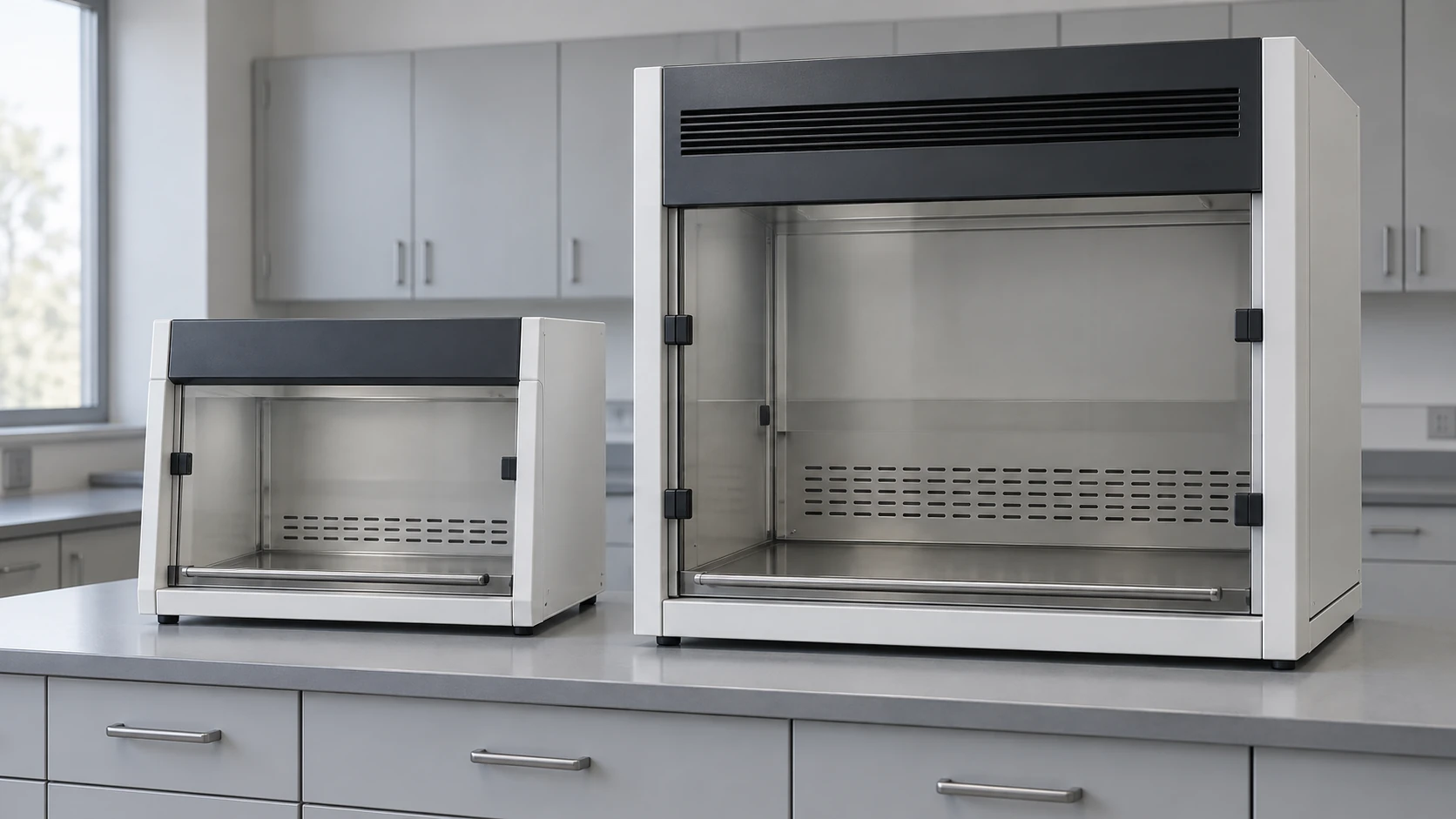
A bench-top enclosure that circulates air across a carbon bed is therefore not automatically a ductless fume hood. When the small portable class is part of the comparison, the industry handbook’s description of it is worth having at hand: a ventilated enclosure that is usually less than 15 cubic feet of working space, often built from alternative materials for mounting on a tabletop, and used primarily in educational laboratories to control nuisance contaminants or small microscale experiments. That figure describes the customary size of the class rather than the capacity of any unit, and the handbook attaches its own qualification to the use of the device: do not use this product for anything but nuisance vapor protection, unless otherwise certified by your Chemical Hygiene Officer.
The three names buyers mix up: ductless fume hood, ductless enclosure, fume extractor
The naming problem is written into the trade. A ventilated enclosure that filters and recirculates air is not automatically a ductless fume hood, and the industry standard lists light-duty enclosures as a separate category with limited applications, which is why the same piece of equipment can be listed under one name and approved under another. The consequences of that mix-up are set out in the section on device classification, where the standard’s own wording is quoted in full.
Procurement documents inherit whatever name the requester used. When the word on the requisition is wrong, the quotations that come back are not comparable, because the bidders are pricing different classes of equipment. Getting the name right before the request goes out costs nothing and prevents a specification that cannot be approved as written. Placing the ductless classes inside the wider range of laboratory containment equipment helps here, and the full range of hood types shows where each one sits.
What this article decides, and the four judgments it hands over
Four judgments decide the purchase. First, the class of device you are specifying. Second, whether your process is fixed enough for the institutional policy that applies to ductless equipment. Third, the retention capacity you can declare for the chemicals in use. Fourth, the working opening and the service room your installation can actually provide.
You can decide the shape of your own project by answering those four in order, and the rest of this article supplies the inputs for each. The next section takes the first of them seriously by examining what the word portable buys, and what it cannot change once the unit is approved.
What “Portable” Actually Buys, and What It Cannot Change
Portability is a real benefit, and the sales argument for it is not dishonest. A portable filtered fume hood mounts on a bench or a cart, plugs into a general-purpose outlet, and needs no duct run, so it can be bought and used without a construction project. What the sales argument leaves out is that the benefit and the obligation arrive in the same package.
The two things mobility actually buys: no duct run and one unit across stations
The first thing mobility buys is the absence of an exhaust connection. A ducted installation needs a route to the roof or an exterior wall, an exhaust fan sized for the run, and a permit or a landlord’s consent before any of it happens. A ductless unit avoids that chain entirely, which is why retrofit projects and leased buildings reach for it first.
The second thing mobility buys is shared use. One unit can serve two or three teaching stations in sequence instead of one fixed position serving one operator, and equipment budgets in small laboratories depend on that arithmetic. The value is concentrated in buildings where stations are idle at different times.
What mobility does not change: the device class, the approval and the capacity
Mobility does not change the filtration class of the device, and it does not change what the device is permitted to do. A DH III unit and a light-duty enclosure remain what they are whether they sit on casters or on a bench, and the classification decides which applications the unit may be approved for.
Mobility also does not remove the approval. Institutional policies that govern ductless equipment attach to the device and its declared use rather than to the position of its plug. A unit that was approved for a fixed chemical list stays approved for that list when it moves; it does not become approved for anything new.
Relocation as a verification trigger: the premise this article rests on
Relocation is one of the events that trigger testing, and SEFA 9-2026 lists it alongside initial installation and major repair. The same standard places responsibility for maintaining the test plan on the facility EHS officer rather than on the operator or the supplier, which is why the testing question belongs in the project budget from the start.
Two independent sources agree on this point, and the two are worth separating. One is a testing-frequency clause in a standard; the other is an industry handbook that describes the same trigger in its own language. Neither is a regulation that applies everywhere, and neither should be described as one.
Who may move the unit, and what the move invalidates before it is tested again
Anyone can physically push a bench-top unit to another room. What changes at the moment of the move is the evidence: the containment and airflow results recorded for the previous position no longer describe the unit in its new one. Institutional policy typically answers this by requiring fresh certification, and at least one major research university requires the certification to be performed by a third-party contractor.
The obligation is not elective, and it is not satisfied by a visual check. A unit that has moved and has not been re-tested should be treated as out of service until a passing test exists, because an untested enclosure is an unknown rather than a working one.
The comparison below puts the two sides of the same property in one place, because reading them together is what prevents the benefit from being mistaken for a free one.
| What mobility buys | What mobility triggers |
|---|---|
| No duct run, no roof penetration, no exhaust fan | Fresh containment testing after each relocation |
| Purchase without a construction project | Third-party certification where institutional policy requires it |
| One unit shared across several stations | A test plan maintained by the facility EHS officer |
| Rapid redeployment when a room changes use | New evidence before the unit returns to service |
| Lower installed cost than a ducted path | Test and recertification costs carried by the user side |
You can determine the size of that trade in your own project before you commit to a portable form, because the number of moves you expect is knowable. The next section explains which class of device you are actually buying, and it is the judgment that has to come before any of these obligations can be sized.
Classify the Device Before You Compare Sizes
Manufacturers describe ductless products with overlapping words, and the overlap is where buying mistakes begin. Classification comes from the filtration system inside the unit and from the applications the manufacturer has approved for it, not from the footprint or the marketing name on the brochure.
Ductless filtration categories, and why a ductless fume hood is DH III by definition
SEFA 9-2026 sets out three filtration classes for ductless equipment. DH I is designed to control nontoxic chemicals, nuisance odors and particulates. DH II is designed to filter manufacturer-approved toxic contaminants up to filter breakthrough, without providing secondary containment past that point. DH III filters manufacturer-approved toxic contaminants beyond primary breakthrough by adding secondary protection.
The same standard states that ductless enclosures may use any filtration type while ductless hoods must use DH III filtration. That sentence is the definitional anchor of this article. A unit with a single filtration stage can still be a legitimate piece of equipment, but it cannot be called a ductless fume hood, and the applications it may be approved for are correspondingly narrower.
| Class | Designed to control | Secondary protection | May be called a ductless fume hood |
|---|---|---|---|
| DH I | Nontoxic chemicals, nuisance odors, particulates | Not provided | No |
| DH II | Manufacturer-approved toxic contaminants up to breakthrough | Not provided beyond breakthrough | No |
| DH III | Manufacturer-approved toxic contaminants beyond breakthrough | Provided by a matched secondary stage | Yes — required for a ductless fume hood |
The misnaming risk: a light-duty ductless enclosure is not a ductless fume hood
SEFA 9-2026 warns that ductless enclosures are occasionally incorrectly referred to as ductless fume hoods, and that these light-duty enclosures have limited applications and do not offer the same capabilities, capacities, and safety features. The same note adds that ductless enclosures must be reviewed and approved for each application before specification or use.
That warning describes a procurement consequence rather than a vocabulary preference. A requisition that names the wrong class will attract quotations for equipment of a different class, and the comparison that follows will look like a price difference when it is really a specification difference. The per-application approval requirement is the mechanism that catches the error, provided the request reaches the reviewer with the intended use written out.
The process-fixity test: fixed process and small quantities of known chemicals
Institutional policies on ductless equipment converge on the same condition: use should be limited to a consistent process involving small quantities of a fixed group of known chemicals. One large research university phrases it that way, and comparable language appears in the chemical hygiene policies of other institutions that permit ductless units at all.
That condition converts into three questions you can answer about your own work. Does the chemical list change between runs. Are the quantities small enough that the manufacturer’s approved range covers them with margin. Can you write down the process so that a reviewer can compare it against the approval later. A negative answer to any of the three is a signal to revise the plan rather than to buy a bigger cabinet.
Open a text file and write four lines. Line one lists every chemical that will be handled in the enclosure. Line two states the largest quantity of each one that will be present at the same time. Line three describes each procedure in one sentence, including whether heat is applied. Line four names the person who will report a change to the safety function. That file is the process description an approver needs, and you can assemble it in an afternoon.
What counts as a change that voids the approval
Any change in processes and chemical use has to be reviewed and approved by the institutional safety function, and users are expected to report changes in use rather than to judge them alone. Modifying the local exhaust arrangements without approval is prohibited outright, because a change made to the system can create unsafe conditions that no one has evaluated.
Practical triggers include a new solvent family, a new acid, a larger working volume, a different heating method, and a shift from occasional to daily use. Each of those alters the loading that the filtration stage has to absorb, and each therefore falls inside the change clause rather than outside it.
Institutional positions differ: why the same device gets different answers
Institutions do not agree on ductless equipment, and the disagreement is documented. One university states that ductless fume hoods are not acceptable alternatives to externally ventilated fume hoods because they do not offer the same level of protection. Another permits them with the approval of its environmental health and safety group, within stated limitations. A third publishes inspection and repair procedures that acknowledge their presence. The broader institutional position is worth reading in full before you build a case: the institutional position on ductless hoods covers the range of those stances.
Both positions have to be presented side by side, because a requester who reads only the favorable one will be unprepared for the answer that comes back. The practical reading is that the device class is a necessary condition and your own institution’s policy is the one that decides.
Once the class is settled you can select the pathway that applies to your device, and the next step is the one that most relocation plans underestimate. The section that follows deals with what has to happen after a unit moves, and with who carries the obligation.
Will Relocation Trigger a New Certification?
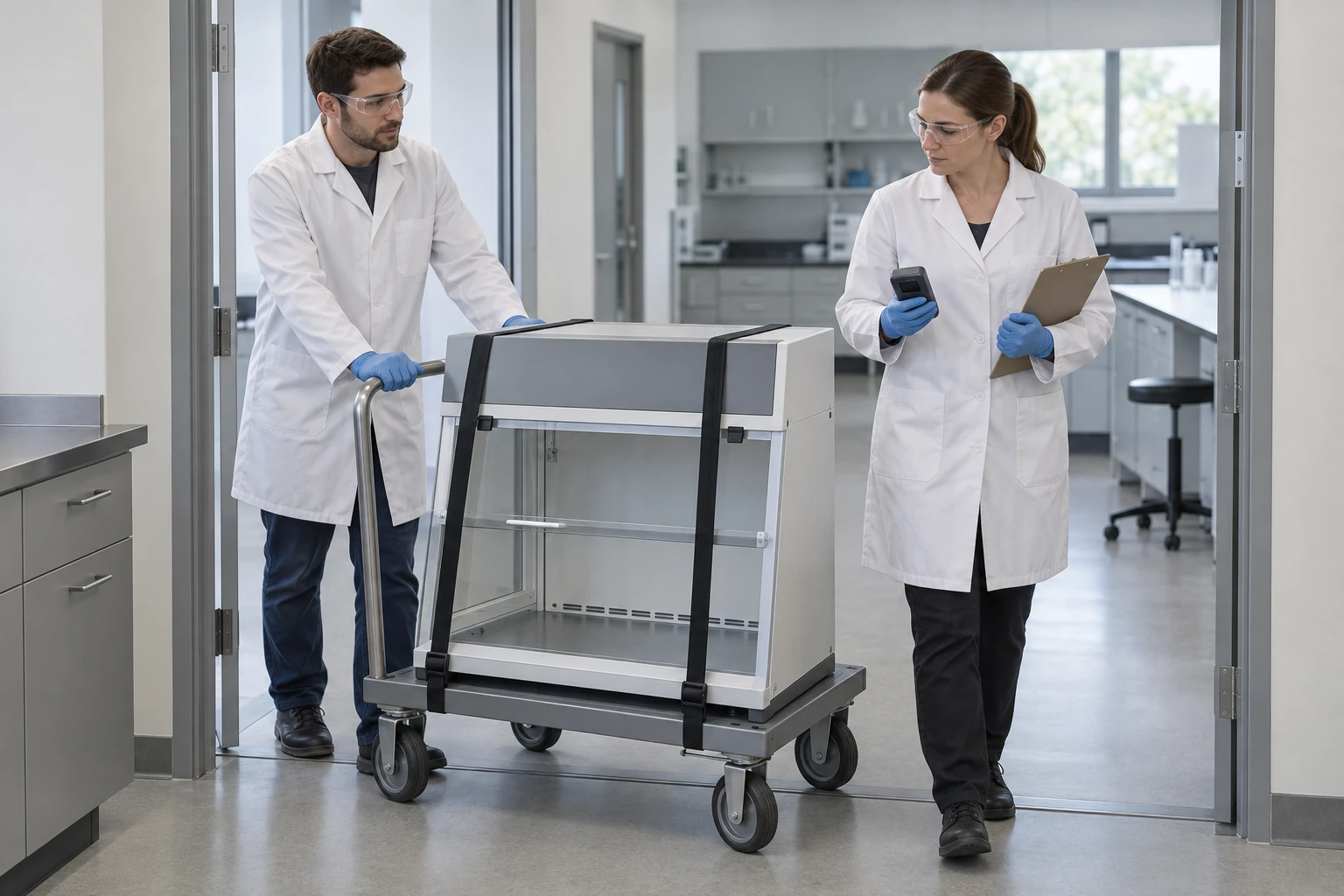
Movement is the event that quietly invalidates a test record. Institutions that permit ductless equipment rarely leave the question open, and the answer they give is consistent enough to plan against, even though the underlying requirements come from different levels of authority.
Relocation as a named test trigger, from two independent sources
SEFA 9-2026 lists the events that should trigger testing, and relocation of the hood or enclosure appears on that list along with initial installation and major repair or refurbishment. The clause assigns responsibility for establishing test plans to the user’s facility EHS officer, which keeps the obligation with the institution rather than with the manufacturer.
The SEFA Desk Reference describes the same trigger independently, which matters because two sources that agree are stronger evidence than one source repeated. Both are guidance rather than statute, so the correct description is that a standard and a handbook recommend re-testing after a relocation, while an institution may convert that recommendation into a binding condition of use.
Third-party recertification to ASHRAE 110: what institutional policy requires
At least one major research university states plainly that new fume hoods and fume hoods that have been relocated must be certified to ASHRAE 110 by a third-party contractor. That sentence is institutional policy, not a national requirement, and it should be quoted as such when it is used to justify a project cost.
The distinction matters when you write the relocation clause into a project plan. A portable form of a fixed ductless fume hood moves more often than a permanent installation, and each move under such a policy produces a certification event with a contractor, a scheduled visit and a record.
Pass or fail: what happens to a unit that does not pass, and when it may be used again
Certification is a pass or fail event rather than a report. Where a unit fails, institutional policy is that hazardous materials must not be handled in it, and that work may resume only after the unit has been recertified. Some policies go further and require a physical tag that marks the unit as out of service until the tag is removed.
The record has a practical use beyond compliance. A dated certification sheet tells the next operator whether the enclosure in front of them has been verified since it moved, which is the one question a visual inspection cannot answer.
| Event | Triggers testing | Who operates or owns it | Record kept |
|---|---|---|---|
| Initial installation | Yes — before first use | Installer, then facility safety function | As-installed test report |
| Relocation of the unit | Yes — named test event | Third-party contractor where policy requires it | Dated certification sheet on the unit |
| Major repair or refurbishment | Yes | Repair provider, then safety function | New certification before reuse |
| Any change of process or chemicals | Yes — review and approval, then retest | Institutional safety function with the user | Updated approval and test record |
| Routine periodic check | Yes — on the institution’s schedule | Institutional safety function | Current sticker or record within its validity window |
Annual recertification and the state-level face velocity example
Institutional programs typically recertify exposure control devices on a schedule, and several large universities recertify annually. A failed annual check removes the unit from service on the same terms as a failed relocation test, so the annual cycle is a floor rather than a substitute for event-driven testing.
Face velocity thresholds illustrate how much authority varies by location. California’s Title 8 section 5154.1 requires an exhaust system that provides an average face velocity of at least 100 feet per minute with a minimum of 70 feet per minute at any point, and universities in that state write those figures into their own certification criteria. Those numbers are a state requirement applied through institutional policy, and they should never be presented as a national standard for ductless equipment. The provision itself is published by the state at California Code of Regulations Title 8, section 5154.1, so the wording can be checked rather than taken on report.
You can decide how many certification events your project will carry over its first three years by counting expected moves and adding the annual cycle. The next section deals with capacity, which is the quantity buyers most often confuse with cabinet size, and the section after it covers the opening that the certification test actually measures.
Capacity Is a Declared Chemical Retention, Not a Cabinet Size
Three different numbers get called capacity in the course of one purchase conversation, and they are not interchangeable. The title of a product listing, the width of the working opening and the amount of a specific chemical the filter can hold are three separate quantities, and only the last one belongs in the approval.
Three different measurements buyers call “capacity”
The first number is the overall width of the unit, which is what the price list sorts. The second is the working opening, which is the aperture the airflow has to protect and is not the same as the overall width. The third is retention, which describes how much of a named chemical the filtration stage can hold before breakthrough.
Confusing the three produces a spec sheet that looks complete and answers nothing. A buyer who requests “a capacity of four feet” has asked for a width, and the supplier who answers with a width has not stated anything about how the unit will perform on the chemicals in the process.
| Quantity | What it measures | Typical unit | Who states it | Usable as capacity |
|---|---|---|---|---|
| Overall cabinet width | Envelope including side panels | Feet or inches | Manufacturer’s product literature | No |
| Working opening | Aperture the airflow must protect | Feet or inches | Manufacturer’s dimensional drawing | No |
| Retention | Amount of a named chemical held before breakthrough | Grams or ounces | Manufacturer’s test documentation | Yes — this is the declared capacity |
Declared retention in grams or ounces: who states it, and what it covers
SEFA 9-2026 requires manufacturers to provide as-manufactured test results showing retention capacities in grams or ounces for each compatible filter type. The class of the figure matters as much as its size: retention is specific to a chemical and a filter type, so a single headline number cannot describe a unit that will see a mixed solvent list.
Retention also has a defined endpoint. The relevant definition is the amount of a specific chemical a filter can retain before reaching saturation or breakthrough, and past that point the stage stops doing its job. A declaration is therefore a statement about a bounded quantity rather than a service life, and it is a manufacturer’s figure rather than a number you derive yourself. Whether a given stage can retain a given chemical at all is a separate question about hazard form, and it is answered in the material on how activated carbon and HEPA capture different hazard forms.
Primary and secondary stages: why the retention figures must match
DH III equipment carries a secondary stage, and SEFA 9-2026 states that the secondary filter must be of the same media, efficacy, and capacity as the primary filter. That requirement keeps the second stage from becoming decorative: a secondary stage with less retention than the primary would be exhausted first, and the equipment would lose its protection exactly when the primary begins to fail.
For a buyer, the practical form of the requirement is a question to the supplier. Ask for the retention figure of the primary stage and the retention figure of the secondary stage for the same chemical and the same filter type, and compare them. If the two figures are not the same, the configuration does not meet the definition of the class you are specifying.
Saturation detection and face velocity monitoring as configuration items
SEFA 9-2026 treats saturation detection and face velocity monitoring as requirements for DH II and DH III systems, with continuous, automatic and audible or visual indication for the saturation device. Both items belong on the specification rather than on the options list, because neither can be added by the operator after the fact.
Read the acceptance criteria carefully when you compare quotations. The recognized performance criteria for these devices include concentrations tied to threshold limit values, and those figures describe when the device should signal, not what concentration is acceptable in the room. Treating a device threshold as a room limit inverts the requirement and produces a specification that no supplier can meet honestly. The classification and testing language quoted throughout this article comes from SEFA 9-2026, the industry standard for ductless fume hoods and enclosures, and the retention and monitoring requirements above are its requirements rather than this site’s expectations.
You can determine whether a quotation has actually stated capacity by checking whether it names a chemical and reports grams or ounces for both filtration stages. When a supplier needs the process description first, filter selection explains how the media is matched to the chemicals, and the boundary between a declared retention figure and a service interval is drawn in the material on how filter life is judged. Which stage comes first, how the opening is measured, and how much room the unit needs in service come next, and those are the questions the following section answers.
The Working Opening, the Service Space and the Worked Example
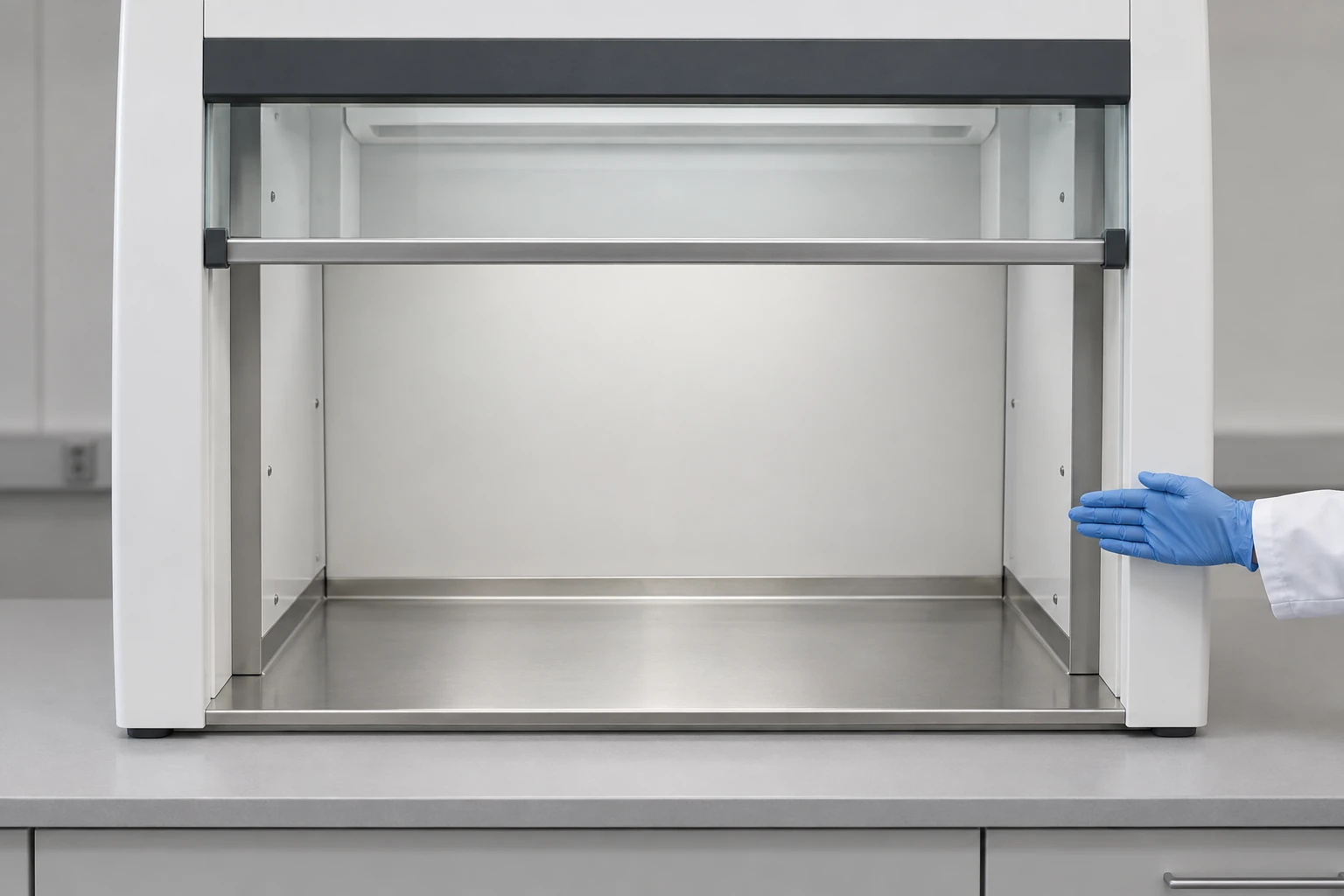
Two numbers decide whether a unit fits a task and a room, and neither is the number on the price list. The working opening decides whether the apparatus in front of you can be worked on inside the airflow, and the service space decides whether the equipment can be maintained and re-tested where it stands.
Nominal width versus working opening: the side panel detail
The SEFA Desk Reference explains how hood size is generally determined, and the explanation is worth reading before any dimension is copied into a specification. A five foot hood includes the width of the face and the side panels and is not a measure of the opening width. Side panels range in width from two to eight inches depending on the design and the hood manufacturer.
That statement describes a ducted bench-top hood rather than a ductless enclosure, so use it as a geometric fact rather than as a rule about ductless equipment. The geometric point survives the transfer: whenever a unit is described by an overall dimension, part of that dimension is structure rather than aperture. Ask for the opening figure separately, and ask which measurement it refers to.
| Measurement | What it includes | Typical unit | Use it for |
|---|---|---|---|
| Nominal size | Face plus side panels | Feet or inches | Shipping, bench space, procurement description |
| Working opening | The aperture behind the face | Feet or inches, or as a sash position | Airflow verification and operator practice |
| Service footprint | Clearance needed to test and to change filters | Feet or inches | Room layout and installation feasibility |
The service footprint row is deliberately qualitative in this table. No standard or institutional document reviewed for this article states a numeric clearance requirement for ductless enclosures, so the row names the purpose rather than a figure. Where a number is needed, it should come from the manufacturer’s installation instructions for the specific unit. The geometric point about side panels is drawn from the SEFA Desk Reference, the industry recommended-practice handbook, which states the panel dimension as an observation about hood construction rather than as a sizing rule.
The opening criterion: the required face velocity has to be reached at the widest opening
Verification criteria tie the airflow requirement to the opening rather than to the cabinet. The relationship runs in one direction: the required airflow has to be achievable at the working opening, and a hood may be certified at a reduced sash opening only when the maximum opening is posted on the sash or the frame.
That posting requirement is the part buyers overlook. If the required airflow is reachable only with the sash partly closed, the unit carries a label that tells every operator how far to close it. A specification that omits the maximum-open condition invites an operator to work at an opening the unit was never shown to protect. The threshold figures themselves belong to a separate subject, and what the face velocity requirement means is where that system is set out in full.
Service space judged by what has to be done in place: retesting and filter changes
The field test protocol for ductless equipment covers face velocity verification, base containment verification with smoke or flow visualization, filter seal and instantaneous removal verification, and monitoring systems operation verification. Each of those four items has to be physically performable at the installed location, which turns service space into a question with a definite answer rather than a preference.
Ask whether a person can stand in front of the unit with a smoke source and see the full face, whether the filters can be removed without first moving the enclosure or dismantling the bench, and whether the monitoring alarm can be triggered from the front. A location that fails any of the four has a space problem, and a larger cabinet will not repair it. The field test protocol described here is the same one that governs what acceptance testing involves at installation, which is why the acceptance record and the relocation record look alike.
Power, in-cabinet wiring and monitoring after a move
The SEFA Desk Reference states that electrical receptacles should be readily accessible and that all electrical wiring should be isolated and physically separated from vapors handled within the hood interior after installation. The requirement exists because a ductless unit returns filtered air to the room rather than exhausting it, so the interior and the occupants share the same atmosphere.
After a relocation, three things need re-checking rather than assuming. The circuit the unit now shares with other equipment, the physical separation of in-cabinet wiring, and the functioning of the saturation detection and face velocity monitors. None of those were verified at the old location in a way that transfers to the new one.
Worked example: a teaching laboratory moves one portable unit twice a year
A secondary teaching laboratory operates two student stations and owns one bench-top ductless unit that both stations share. The chemical list is fixed, the quantities are small, and the unit moves between two rooms once per semester, so it relocates twice a year. The laboratory is writing its purchase justification and its operating procedure at the same time.
The first judgment is the class of the device. Because the unit is used for small quantities of a fixed group of known chemicals, it sits inside the typical institutional condition for ductless equipment, and the class it must carry to be called a ductless fume hood is DH III. If the unit under consideration carries only one filtration stage, it is a light-duty enclosure and requires per-application approval rather than being specified as a hood.
The second judgment is the relocation obligation. Two moves a year means two event-driven certifications a year on top of the routine annual check, and a policy in this institution’s state may require certification by a third-party contractor to ASHRAE 110 after each move. The budget line for those tests belongs in the purchase proposal, because a unit that has moved and has not been re-tested cannot ethically be used with hazardous materials.
The third judgment is the opening and the capacity. The retention figure is requested for each chemical in the teaching list, in grams or ounces, for the primary and the secondary stage, and the two are compared before the order is placed. The opening is checked against the largest apparatus a student will place inside, with the requirement that the specified face velocity is reachable at that widest working opening rather than only with the sash lowered.
The fourth judgment is the service space and the utilities. The chosen bench allows a tester to see the whole face with a smoke source, allows filter removal without moving the enclosure, and keeps the electrical receptacles accessible with wiring separated from the interior airstream. The saturation detector and the face velocity monitor are specified as built-in items rather than as add-ons.
The outcome is a decision record that reads as follows: a DH III bench-top ductless unit is approved for a fixed teaching chemical list in small quantities; the unit may be shared across both stations; and each of the two annual moves triggers a third-party certification to ASHRAE 110 before the unit returns to service, with the test cost carried by the department requesting it.
Change one input and the answer moves. If the laboratory decides to rotate three different solvent sets through the year, the process is no longer fixed and the approval has to be reissued before the unit can be used, whatever its size. If the stations multiply to five and the apparatus grows, the limit becomes the opening and the retention declaration rather than the bench footprint, and the answer shifts toward the larger cabinet for capacity and service room rather than for safety. If the second room cannot provide the clear access needed for smoke testing and filter changes, the room has to be changed rather than the unit.
You can determine your own answer with the same four checks in the same order, and the smaller form does not remove any of them. The next section covers who signs, who pays and who keeps the record, and that allocation is what turns these four checks into an approvable specification.
Who Approves, Who Pays and Who Owns the Record
Ductless equipment sits at the intersection of three parties with different responsibilities, and the purchase only proceeds smoothly when each party’s deliverable is named in advance. The user supplies facts, the institution sets limits, and the record belongs to whoever has to prove the unit was verified when it mattered.
You supply the process data, not a cabinet size
The approving function needs a chemical list, expected quantities, the described procedures and the intended location. A request that arrives as a model number and a footprint cannot be assessed against a condition written around consistent processes and known chemicals, so it comes back with questions rather than with a decision.
Writing the process description once also makes every later step cheaper. The same document supports the retention request to the supplier, the change-control obligation when a procedure is edited, and the test plan that the facility safety function maintains over the life of the unit.
The approving function sets the approved range and its limits
Approval is a bounded decision. The institutional reviewer decides whether ductless equipment is acceptable for the requested use, which chemicals and quantities are covered, and what limitations attach to the approval. Those limits are the reason a unit can be both approved and restricted at the same time.
The scope of the approval is also the scope of permission. Once the approved range is issued, the users are expected to report changes in use rather than to interpret the boundary themselves, and unauthorized modification of the local exhaust arrangements is prohibited rather than merely discouraged.
The extra test request and the filter and waste costs fall on the user side
At least one university states that any additional inspections outside the scheduled annual program are the responsibility of the person or department requesting them, and institutional documents on ductless equipment place filter replacement and hazardous waste disposal costs on the using department. A relocation test is exactly that kind of additional inspection.
The practical consequence is a budget line rather than a technical constraint. Because relocation triggers testing, a portable unit with a frequent moving pattern carries recurring costs that a permanently installed unit does not, and those costs belong in the comparison that precedes the purchase. Scheduled inspections are the institutional baseline; what a routine inspection covers is the reference for that baseline, and everything beyond it is requested work.
Why an approval covers only the conditions that were declared
An approval is a statement about the conditions in the request rather than about the equipment in the abstract. If the declared process changes, the statement no longer describes the operation that is happening, and the documentation that makes the installation defensible stops matching the bench.
That is why change control is written into institutional policy rather than left to judgment. A new solvent, a larger volume, a different heating method or a shift to daily use each alters the loading on the filtration stage, and each therefore requires a fresh review before the work continues under the old approval.
You can decide the division of labor for your own project by naming the deliverable of each party: the process description from the user, the approved range from the institutional reviewer, the test plan from the facility safety function, and the test and consumable costs from the requesting department. The next section looks at what the larger cabinet actually adds, so that the remaining comparison rests on retention and service room rather than on reputation.
Full-Size Ductless Fume Hood: Where the Real Capacity Lives
The larger cabinet is not a safer version of the smaller one; it is a different set of quantities. Buyers who expect a full-size unit to solve an approval problem end up paying for space they never use, while buyers who ignore the larger envelope can end up unable to hold the filter load their process requires.
What the larger envelope actually adds: retention capacity, opening and service room
The first thing the larger envelope adds is room for more filtration media, and therefore a larger declared retention for a named chemical. The declaration is still chemical-specific and still comes from the manufacturer’s test documentation, but a bigger internal volume can hold more media without changing the principle behind the figure.
The other two additions are dimensional. A wider cabinet can offer a larger working opening for larger apparatus, and a deeper or taller unit can leave more service room for smoke testing, filter changes and monitoring checks. Those are the three real differences, and a portable vs fixed ductless fume hood comparison is decided by them rather than by the shape of the enclosure.
What it does not add: an exemption from approval or retesting
The class requirement does not relax with size. A full-size ductless hood carries the same DH III definition as a bench-top one, and the same distinction between a hood and a light-duty enclosure applies whatever the footprint.
The testing obligations do not relax either. Relocation remains a named trigger, the annual cycle remains a floor, and a unit that fails certification cannot be used with hazardous materials regardless of its dimensions. Size changes what the unit can hold and how comfortably it can be serviced; it does not change the conditions under which the unit may be used.
Why a wider cabinet does not widen the retention figure
Retention is declared for a specific chemical and a specific filter type, so a wider cabinet does not produce a general capacity figure that covers any chemical list. The question to put to a supplier is not how large the unit is but how many grams or ounces of each chemical in the process the proposed configuration will retain, and what the matching figure is for the second stage.
This is the point where a purchase can go wrong in either direction. A buyer who assumes that width equals capacity may under-specify the media for a demanding application, and a buyer who assumes that only the largest model is acceptable may pay for media and service space that the process never needed.
When the full-size form is the cheaper decision over its service life
The full-size form tends to be the cheaper decision over its service life when the unit stays in one place, when the process involves enough material that the media has to be sized carefully, and when the working opening has to accommodate apparatus that will not fit a bench-top aperture. In those conditions the recurring relocation and certification costs of the portable pattern disappear, and the larger installation earns its price.
The portable pattern wins on the same arithmetic when the work moves between rooms or stations, when several users share one unit, and when the process is fixed enough that a single approved chemical list covers everything the unit will see. The decision follows the moving pattern and the media sizing rather than the marketing category.
You can determine which side of that trade your project sits on before you request quotations, and the two fields that decide it are the number of expected relocations and the retention your chemical list requires. The final section gathers both, together with the class and process statements, into the seven fields you hand to a supplier or an approver.
Portable vs Full Size Ductless Fume Hood: The Seven Fields to Hand Over
The whole comparison collapses into one page, and the page is short on purpose. Each field records a fact that a supplier or an approver will ask for, and each one has an owner who can supply it without a further meeting.
Field 1 and 2: the device class and the process fixity statement
Field one is the device class you are specifying: a ductless fume hood carrying DH III filtration, or a light-duty ductless enclosure requiring per-application approval. Write the class, not the model name, because the class is what the approval attaches to.
Field two is the process fixity statement. List the fixed group of known chemicals, the maximum quantity of each present at once, and the procedures in plain language. If any part of that statement cannot be written confidently, the fixity condition is not met yet, and the correction belongs in the process plan rather than in the equipment order.
Field 3 and 4: the change triggers and the relocation and retest clause
Field three names the change triggers that will send the unit back for review: a new chemical family, a larger volume, a different heating method, a shift in frequency of use, and any modification to the exhaust arrangement. Naming them in advance makes the reporting obligation routine instead of adversarial.
Field four states the relocation and retest clause for the specific unit. Record how often the unit is expected to move, that each move is a test event, who performs the certification, and who pays for it. Where the institutional policy requires a third-party contractor, say so in the field rather than discovering it after the move.
Field 5 and 6: the working opening and the service space judgment
Field five records the working opening in the terms the certification uses, together with the requirement that the specified face velocity is reachable at the widest opening the work requires. If the unit can only meet the criterion at a reduced opening, the maximum opening is posted and the field states that posting condition.
Field six records the service space judgment in words that a facilities reviewer can check: a tester can see the whole face with a smoke source, filters can be removed without moving the enclosure, and the monitoring alarm can be triggered from the front. No numeric clearance value is written here, because no authority reviewed for this article states one, and inventing a number would make the field unusable.
Field 7: power, in-cabinet wiring and monitoring
Field seven covers the utilities: the receptacle the unit will use and whether it stays accessible, confirmation that in-cabinet wiring is isolated and physically separated from the vapors handled inside, and the presence of saturation detection and face velocity monitoring as built-in items. Each of the three has to be re-confirmed after any move rather than assumed from the original installation.
Your next step: hand the seven fields to the supplier and to your approver
Send the seven fields to the supplier with the request for retention figures, and send the same page to the institutional reviewer with the request for an approved range. The two requests then arrive with the same facts attached, which is what makes the resulting quotation comparable and the approval answerable on the first pass.
You can write this page today and decide your own specification with it, and the discipline of writing it is the whole method behind this comparison. Where the portable pattern fits your moving schedule and your chemical list, a bench-top unit rated to the right class with the right media and the right monitoring will do the work, and the specification you can hand over is the one in this section: portable benchtop ductless fume hood. Where the process stays in one room and the media has to be sized generously for it, a full-size ductless fume hood is the configuration that matches the retention and the service room the work requires. Both paths start from the same move: stop comparing cabinet dimensions, and decide the portable vs full size ductless fume hood question on class, fixity, retention and opening instead.
Frequently Asked Questions
Can I move a portable ductless hood to another room?
Yes, and the move itself is a testing event rather than a storage decision. Where institutional policy applies, the relocated unit is certified again, and at least one university requires that certification to be performed by a third-party contractor.
A unit that has moved should stay out of service with hazardous materials until a passing certification exists. Waiting for the scheduled annual check is not equivalent to acting on the move, because the annual cycle and the event-driven requirement are two separate obligations.
How often do ductless hoods need to be recertified?
Recertification follows the institution’s schedule, and several large universities recertify exposure control devices annually. Relocation and major repair trigger additional testing outside that cycle rather than replacing it.
No single national interval applies to every jurisdiction, so the schedule to plan against is the one published by your own institution. What is consistent across the policies reviewed here is the event-driven layer: a move or a major change produces a fresh certification on its own terms.
Does a ductless hood need to be certified at all?
Yes, where ductless equipment is permitted, certification is a pass or fail event rather than an optional report. A unit that fails certification is taken out of service for hazardous work, and some policies require a physical tag to keep it out of use until it passes.
The scope of this article covers the relationship between certification and movement, and the testing method itself belongs with the separate material on acceptance testing and airflow requirements.
Do I need a full-size unit if I run mixed processes?
Buy the fixity first, not the cabinet. Mixed processes conflict with the institutional condition that limits ductless use to a consistent process involving small quantities of a fixed group of known chemicals, so the first step is to define the process and obtain a fresh approval for it.
Only after that does size enter the picture, and then it enters through retention and the working opening rather than through a general claim about safety. A larger cabinet does not exempt the unit from approval, testing or the established chemical limits.
Are these units allowed in my institution at all?
Institutions differ, and the difference is documented rather than incidental. Some state that ductless hoods are not acceptable alternatives to externally ventilated hoods, others permit them with approval and stated limitations, and others publish inspection and repair procedures for them.
The answer that governs your project is the one issued by your own environmental health and safety function for your declared use. Two institutions can reach opposite conclusions about the same model, and neither is a mistake.
How much does relocation testing add to the project?
This article does not quote an amount, because no reviewed authority publishes a figure for it. What the reviewed sources do establish is who carries it: additional inspections outside the scheduled program are the responsibility of the department requesting them, and filter replacement and hazardous waste disposal sit with the using department.
That makes the cost estimable without a price list. Multiply the expected number of moves by the cost of one third-party certification in your institution’s market, and add the consumable and disposal lines that accompany the media the process requires.
Leave a Reply