




Key Takeaways
- Face velocity is the average speed of air entering the fume hood at the sash plane, and fume hood face velocity requirements come from your institution and your hazard, not from one universal number.
- OSHA 1910.1450 does not set a fixed fpm value — “typically 60-100 fpm” appears in non-mandatory guidance — while institutional acceptance ranges such as 80-120 fpm for hazardous-chemistry certification come from campus EHS policy.
- Face velocity is a flow check, not a containment proof: averages hide point deviations, turbulence above roughly 125-150 fpm is itself a hazard, and only ASHRAE 110 tracer-gas testing verifies containment.
- In testing cited by NEBB, over 80% of hoods that failed containment testing still showed their prescribed face velocity — the flow number alone cannot predict safety.
- An alarm or controller reading confirms airflow, not containment: actuator position is diagnostic information, not proof of face velocity, and a controller does not prove the hood contains.
Laboratory fume hood specifications almost always include a face velocity number — 60, 80, 100, or 120 fpm — and almost never explain where that number comes from or what it can and cannot prove. That is the trap: no single face velocity requirement applies to every laboratory, “OSHA says 100 fpm” is a myth the regulations do not support, and a hood that meets its face velocity number can still fail to contain. The fume hood face velocity requirements that matter for your project separate who sets the number (standards, agencies, your institution), what the number means at design, in operation, and at acceptance testing, and what the number does not prove. You will leave with the attribution, the acceptance ranges, the measurement and record fields, and the questions to ask before you certify anything.
Direct Answer: What Face Velocity Is and What the Numbers Mean
Face velocity is the average speed of air entering the fume hood through the sash opening, measured in feet per minute (fpm) at the plane of the sash. The common fume hood face velocity requirements you will see — 60, 80, 100 and 120 fpm — are not one universal rule: each number belongs to a context. 60–100 fpm is the acceptable general-work range in institutional guidance such as Northwestern’s handbook; 80–120 fpm is the certification range for hazardous-chemistry work in that same guidance and in the Z9.5 language industry guides quote; and acceptance bands such as 80–150 fpm (Stony Brook) couple a lower and an upper bound, because too much velocity creates turbulence that can defeat containment. OSHA’s laboratory standard requires hoods to work properly but sets no fixed fpm value.
| Face velocity context | Typical value | Where it comes from |
|---|---|---|
| General lab work, acceptable average | 60–100 fpm | Institutional guidance (Northwestern handbook, 2011) |
| Hazardous-chemistry certification | 80–120 fpm | Institutional guidance + Z9.5 language quoted by industry guides |
| Minimum recommended operation | 60 fpm | Labconco (standards-based minimum; SEFA high-performance ≤60 fpm) |
| Light-hazard non-carcinogenic work | as low as 50 fpm | Institutional guidance (Northwestern) |
| Institutional acceptance band | 80–150 fpm | University policy (Stony Brook, 2025); fail below 70 or above 160 fpm |
| Turbulence risk threshold | roughly 125–150 fpm | Research cited by Northwestern (>125 fpm) and Labconco (>150 fpm) |
The right starting point is therefore whose number applies to my hood and my hazard, not which number is correct. Your institution’s EHS policy and your chemical hygiene plan are the authority for your acceptance band; the standards and product guidance exist to help you question and verify it, not to replace it.
Which Standards, Policies and Authorities Apply
Four layers write the number on your specification, and confusing them is how wrong numbers get adopted. The federal layer (OSHA) requires functioning hoods but sets no fpm value. The standards layer (Z9.5, NFPA 45, SEFA) defines performance, monitoring and testing language. The institutional layer (your campus EHS policy) sets the acceptance band you actually follow. The project layer (your design basis and commissioning plan) turns that band into a setpoint and a test.
| Layer | Authority | What it actually does | Example |
|---|---|---|---|
| Federal | OSHA 29 CFR 1910.1450 | Requires hoods to function properly; no fixed fpm requirement | (e)(3)(iii) equipment-performance requirement |
| Standards | ANSI/AIHA Z9.5; NFPA 45; SEFA | Performance, monitoring, testing and inspection language | Z9.5 average 80–120 fpm (industry-quoted); NFPA 45 annual inspection |
| Institutional | University/campus EHS | Sets the acceptance band you follow | Stony Brook 80–150 fpm; Northwestern 60–100/80–120 fpm |
| Project | Design basis, commissioning plan | Turns the band into a setpoint and a field test | Your hood’s target and your acceptance procedure |
OSHA 1910.1450: What It Actually Requires
OSHA’s laboratory standard requires that “fume hoods and other protective equipment are functioning properly and specific measures shall be taken to ensure proper and adequate performance of such equipment” — the language lives in 29 CFR 1910.1450 and its non-mandatory guidance rather than in a fixed velocity number. The non-mandatory Appendix A describes adequate face velocity as typically 60–100 fpm, and OSHA’s Technical Manual explains how to measure face velocity (grid the opening, measure at the center of each area, average the readings) without prescribing a universal value. When someone tells you “OSHA requires 80–120 fpm,” that range comes from industry and institutional language, not from the regulation itself.
The practical consequence is that OSHA gives you the duty — a hood that performs — and your institution gives you the number. A lab that cites “OSHA” as the source of its 100 fpm rule is usually citing institutional practice; the defense of that number lives in the chemical hygiene plan and the campus EHS policy, which is where you should verify it.
Z9.5, NFPA 45 and SEFA: The Standards Layer
The most-quoted standard language comes from ANSI/AIHA Z9.5 (Laboratory Ventilation), which industry guides cite as requiring an average face velocity of 80–120 fpm with no single measurement more than ±20% from the average, and flow-measuring devices on new and remodeled hoods. Z9.5 is a consensus standard whose full text must be purchased to verify; when a guide quotes it, the quote is the guide’s reading, not the standard you need to verify — treat the 80–120 fpm and ±20% language as industry-quoted guidance and confirm project requirements with your design team and EHS.
NFPA 45 (fire protection for laboratories) adds inspection and identification duties: hoods and exhaust systems are inspected and tested when installed or modified and at least annually, and each hood carries identification showing the last inspection date, the average face velocity, and the responsible inspector — a log is acceptable in lieu of a sign. SEFA, the laboratory furniture association, calls 100 fpm acceptable standard practice with 75–125 fpm acceptable in certain situations, which is where the “100 fpm default” in many specifications originates.
Institutional Policy: The Number You Actually Follow
Your campus EHS policy is the layer that binds. Northwestern’s chemical fume hood handbook accepts an average face velocity of 60–100 fpm depending on hood type and hazard, certifies hoods for hazardous chemicals at 80–120 fpm, permits 50 fpm for minimally hazardous non-carcinogenic materials, and warns that studies show turbulence above 125 fpm pushes contaminants into the breathing zone. Stony Brook’s policy accepts 80–150 fpm and fails any hood below 70 fpm or above 160 fpm, requires permanently installed airflow monitors with digital face-velocity display and audible/visual alarms on new or remodeled hoods, and inspects annually and after modifications.
The two policies differ because policy is local: your number is the one your institution publishes in its chemical hygiene plan or fume hood policy, and it should carry the same structure — an acceptance band, a measurement method, a monitoring requirement, and an inspection schedule. If your institution has no written number, that gap is a question for EHS, not a license to pick 100 fpm from the brochure.
Design Target vs Operating Reading vs Acceptance Test
The same number appears in three different roles, and each role has its own rules. A design target is what the project specifies for the system to achieve — the setpoint the controls are built around. An operating reading is what the hood’s instrument shows during a given moment of use, which fluctuates with sash position, room conditions, and traffic. An acceptance test is the documented, measured proof performed at installation, annually, or after a modification, judged against the institutional band and the ±20% point-deviation limit quoted from Z9.5-style language. Treating a live gauge reading as proof of acceptance — or a design target as proof of performance — is how false confidence enters the record.
| Role | What it is | Who produces it | How it is verified |
|---|---|---|---|
| Design target | Setpoint the system is built around | Project engineer / design basis | Control and balancing design |
| Operating reading | Live instrument value during use | Hood’s airflow monitor | Compare against alarm logic, not certification |
| Acceptance test | Documented measurement against the band | Tester / EHS / commissioned vendor | Average of grid points, point deviation within ±20% |
The distinction matters most for the average-versus-point rule. Acceptable language (as quoted from Z9.5 by industry guides) requires an average within 80–120 fpm and no single point more than ±20% from that average: a hood averaging 98 fpm with one grid point at 55 fpm fails the point rule even though its average looks healthy, because the point deviation signals turbulence or a blocked area rather than a uniform flow field. The same logic applies to institutional bands such as Stony Brook’s 80–150 fpm range, where the failure thresholds of 70 fpm and 160 fpm are point and band checks, not marketing numbers.
Fume Hood Face Velocity Requirements by Condition
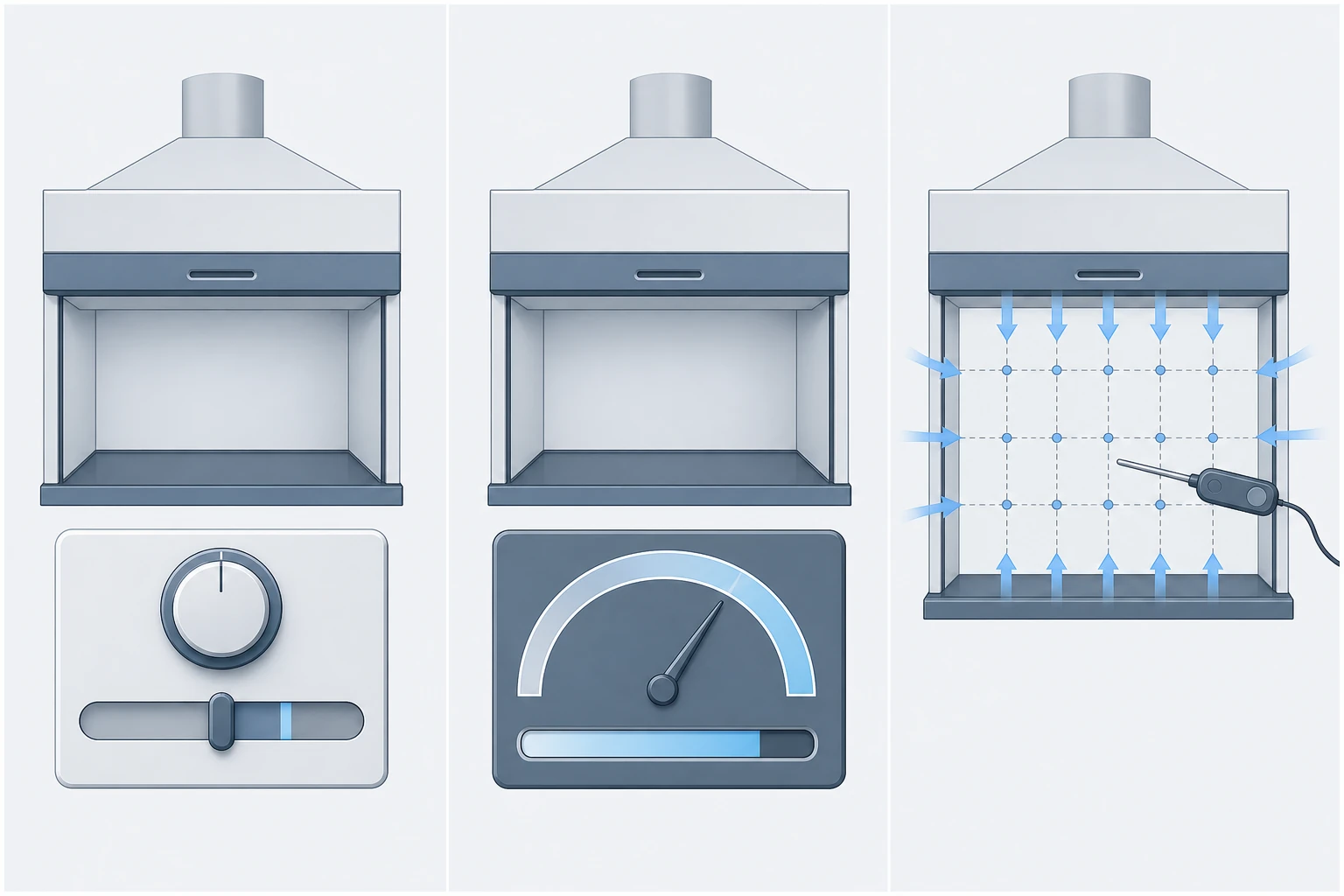
Common Institutional Ranges: 60, 80, 100 and Beyond
The values you will meet cluster around four numbers, each with a traceable context. 60 fpm is the minimum recommended operating level — standards-based per Labconco, and the acceptable lower end of the general-work range in guidance such as Northwestern’s 60–100 fpm band. 80 fpm is the lower bound of the hazardous-chemistry certification range (80–120 fpm) and of acceptance bands such as Stony Brook’s 80–150 fpm. 100 fpm is the historical default and the standard-practice value SEFA cites, which is why so many specifications default to it. Above those, roughly 125–150 fpm is where turbulence research puts the risk of contaminants being pushed back into the breathing zone (Northwestern cites studies above 125 fpm; Labconco warns above 150 fpm).
| Condition | Typical requirement | Source class |
|---|---|---|
| General lab work | 60–100 fpm average | Institutional guidance (Northwestern) |
| Hazardous-chemistry certification | 80–120 fpm average, ±20% point | Institutional + industry-quoted Z9.5 |
| Minimum recommended operation | 60 fpm | Standards-based manufacturer guidance (Labconco) |
| Light-hazard, non-carcinogenic | down to 50 fpm | Institutional guidance (Northwestern) |
| Institutional acceptance band | 80–150 fpm (fail <70 or>160) | University policy (Stony Brook) |
| Turbulence risk | above roughly 125–150 fpm | Research cited by Northwestern; Labconco |
None of these is “the” requirement for you. Pick the row that matches your hazard class and hood type, then confirm the band with your institution — the table exists to make that conversation specific, not to end it.
Hood Type Changes the Number: CAV, VAV and High-Performance Units
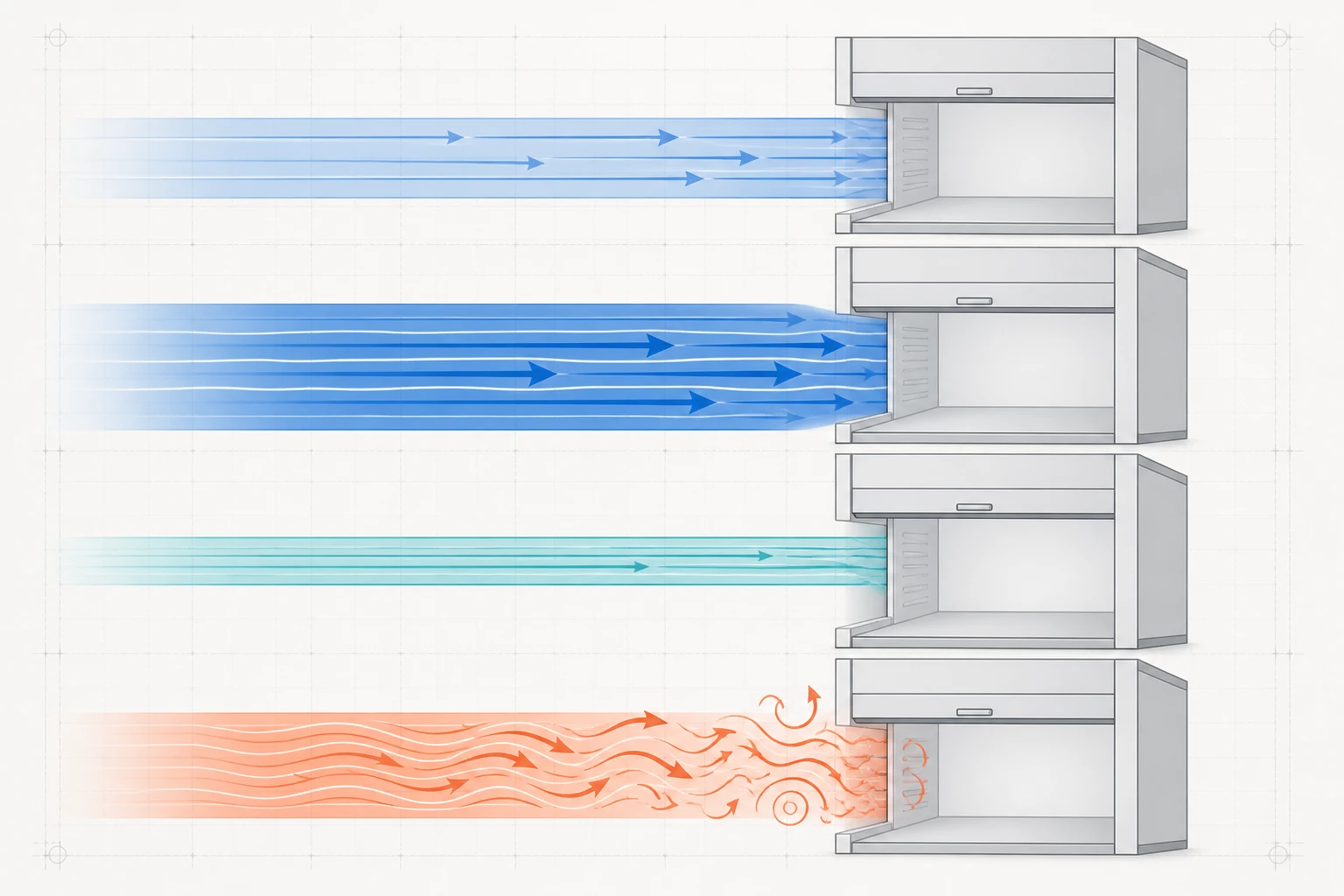
The hood’s airflow architecture changes what a face velocity number means, and that is separate from the requirements question. A constant-volume (CAV) hood exhausts a fixed airflow, so its face velocity rises as the sash lowers — the number is a function of sash position, which is why institutions tie requirements to a working sash height (Stony Brook specifies typical working sash of 12–18 inches). A variable-volume (VAV) hood closes a control loop that maintains a constant face velocity across sash positions, which is the mechanism behind VAV-specific setpoints such as the 80 fpm design point seen in institutional design guidance — the hood is deliberately operated at a lower number than a CAV installation because the control holds it steady.
High-performance (low-velocity) hoods renegotiate the number under SEFA’s definition: a hood claiming the label must meet ASHRAE 110 containment ratings (4.0 AM 0.05 / 4.0 AI/AU 0.10) at a face velocity of 60 fpm or less with the vertical sash fully open. That is why institutional policies such as Stony Brook’s add an exception: high-performance and low-velocity units may have different face velocity requirements, and the acceptance band must be re-checked against the hood’s actual containment performance rather than inherited from the general range.
Ductless Hoods and the Face Velocity Reference
Ductless (filtered, recirculating) hoods face the same measurement discipline with a different system boundary: face velocity is still measured at the sash plane, and the unit’s reference figure — XICHENG’s ductless family lists 0.4–0.6 m/s to be verified on site at the stated sash opening — is a screening/acceptance reference for the specific configuration, not a universal constant. Return air re-enters the room, so institutions frequently require separate EHS approval for recirculating hoods (Stony Brook requires a hazard review for ductless units), and the face velocity check does not replace the filter-feasibility and chemical-match decision. The ducted vs ductless fume hood selection guide covers that decision in full.
What Face Velocity Leaves Unproven
Face Velocity Is Not Containment
Face velocity is a flow measurement: speed times sash opening is the air volume moving into the hood, and that volume has more to do with dilution than with containment. The strongest evidence comes from testing practice: in data cited by NEBB, over 80% of hoods that failed an ASHRAE 110 containment test still showed their prescribed face velocity at the time of failure. A hood can average 96 fpm and still have readings deviating 40 fpm from that average — the average hides the turbulence that defeats containment.
Containment failures are rarely caused by the flow number itself. NEBB attributes failures roughly 25% to hood design or lab layout, 50% to room conditions (supply-exhaust balance, cross-drafts, doors), and 25% to user work practices. A hood that meets its face velocity number can fail containment when the room starves it of makeup air, a door opens beside it, or the sash is used badly — which is why the flow check and the containment check are different questions answered by different tests.
What an Alarm or Controller Reading Tells You
An airflow alarm or a face velocity controller reading proves that air is moving at the measured point; it does not prove that the system will contain under all conditions. XICHENG’s FHC11 face velocity controller states the boundary precisely: actuator position is diagnostic information, not proof of face velocity, and the controller regulates the damper — it does not replace the rest of the exhaust system, and its low-velocity alarm identifies an abnormal condition rather than correcting its cause. The alarm tells you the measured value left the configured window; the reason it left the window (sash height, fan failure, blocked duct, damper at its limit) is a separate diagnosis.
Design your monitoring logic accordingly: treat the alarm as the trigger for the verification procedure, not as the verification itself. When the alarm sounds, the correct response is to confirm the reading with a reference instrument at the grid points, check room conditions, and — for ductless units — treat the filter state as a separate question that a pressure or airflow signal cannot answer.
ASHRAE 110: The Test That Separates Flow from Containment
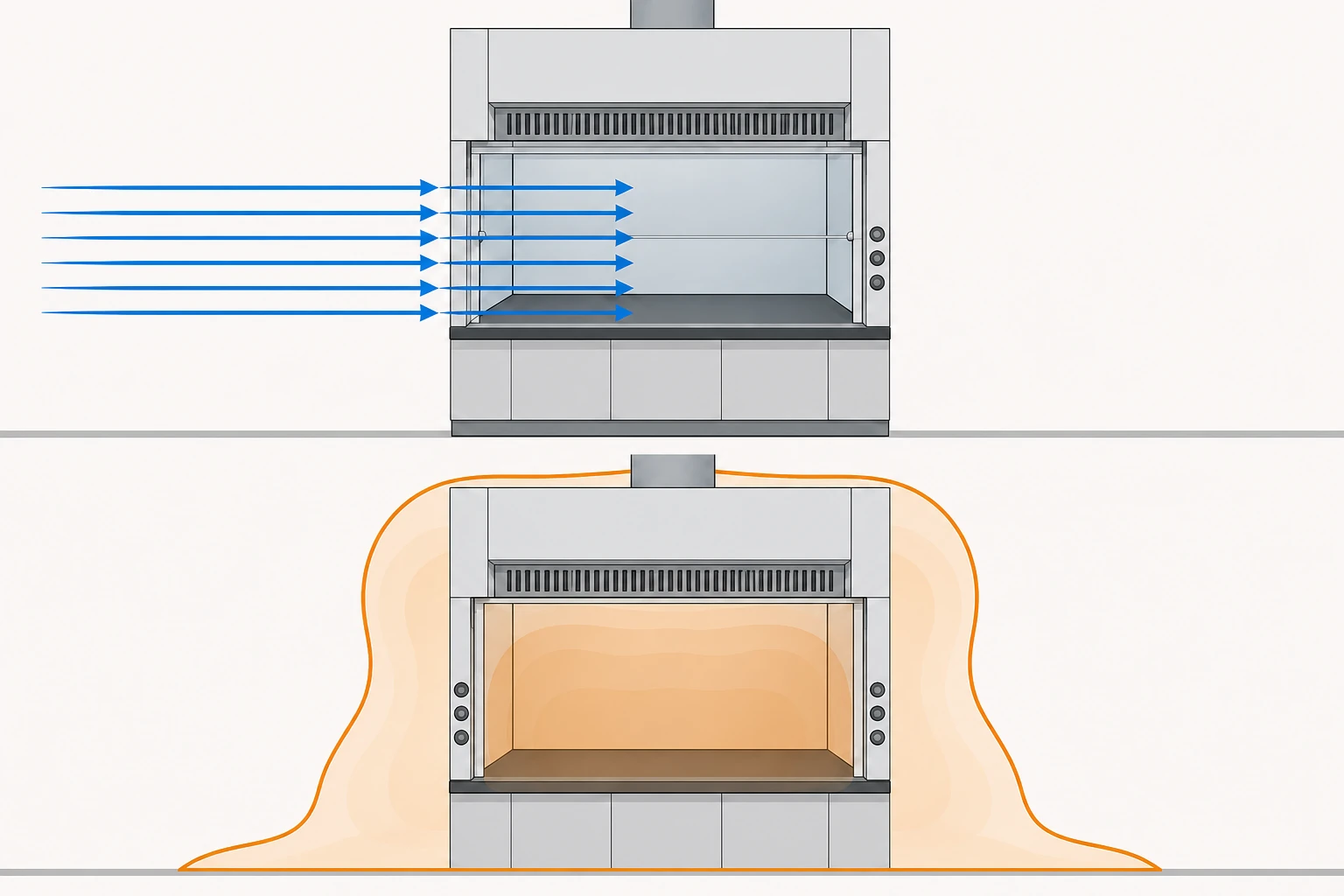
Containment is verified by tracer-gas testing under the ASHRAE 110 protocol — the industry’s method using sulfur hexafluoride release and a manikin-mounted sensor — and the protocol is deliberately not a simple pass/fail: it rates hoods under As Manufactured (AM), As Installed (AI), and As Used (AU) conditions, and a rating such as 4.0 AM 0.05 refers to a 4 L/min release with an average detected concentration limit of 0.05 ppm in the tested state. AI and AU ratings legitimately allow higher detection because installed rooms contain cross-drafts and equipment that the AM lab test excludes.
That is the boundary: face velocity is the number you can read on a gauge every day, and ASHRAE 110 is the number that tells you whether the enclosure contains — measured at installation, annually, and after modifications, by someone with the tracer-gas rig and the protocol, not by a gauge on the wall. When the acceptance question is about safety rather than flow, the tracer-gas test is the answer the fume hood face velocity requirement cannot give.
Measuring and Documenting Fume Hood Face Velocity Requirements
How Face Velocity Is Measured
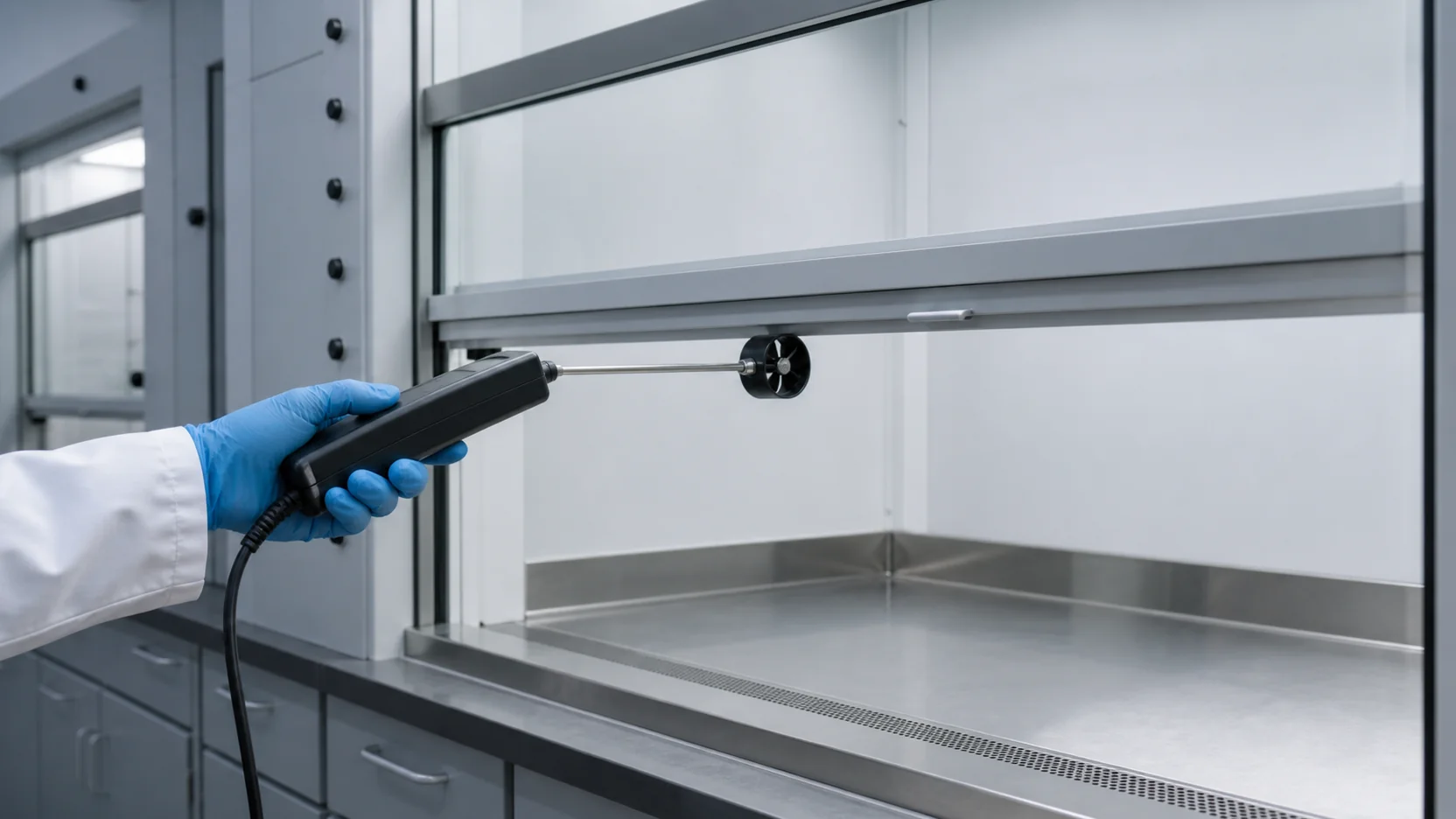
The accepted field method is a grid measurement, described in OSHA’s Technical Manual: divide the sash opening into imaginary equal areas, measure the velocity at the center of each area, and average all readings for the reported face velocity. Smoke provides a fast qualitative check — time a smoke plume over a known distance (a 2-foot travel in 2 seconds equals 60 fpm) — and a portable anemometer confirms the numbers, with the caveat that probe orientation matters: NEBB reports that a 30% yaw in probe angle can drop accuracy by as much as 20%, so the probe must face the airflow squarely and readings should be taken only in the flow plane.
| Measurement step | What you do | What it protects against |
|---|---|---|
| Grid the opening | Equal imaginary areas across the sash plane | Unrepresentative single-point readings |
| Measure each point center | Anemometer/velometer, probe square to flow | Yaw-induced error (up to 20% at 30% yaw) |
| Average and check points | Average vs band; each point within ±20% of average | Hidden point deviations (e.g. 96 fpm average, 40 fpm deviation) |
| Record with context | Sash height, date, test conditions, instrument | Context-free numbers that cannot be defended later |
Field Acceptance Records: What to Keep
The documentation is what makes an acceptance defensible, and the standard layers prescribe its content. NFPA 45-style inspection practice expects each hood to carry identification showing the last inspection date, the average face velocity, the fan serving the hood, and the responsible inspector (a maintained log is an accepted alternative). The retention schedule follows the inspection triggers: upon installation, at least annually, and after any modification to the hood or its exhaust system — with OSHA’s laboratory guidance calling for ventilation evaluation on installation and reevaluation whenever local ventilation changes.
| Record field | Why it matters |
|---|---|
| Average face velocity at the tested sash height | The number your institution’s band is judged against |
| Point readings and deviation | Proves the ±20% point rule, not just the average |
| Inspection date and trigger | Installation / annual / post-modification |
| Inspector and protocol | NFPA 45-style identification field; ASHRAE 110 when containment is the question |
| Instrument and conditions | Defends the record against challenge |
Worked Example: Does This Hood Pass Its Acceptance Test?
A laboratory certifies its hoods for hazardous-chemistry work, so the band is 80–120 fpm with the ±20% point rule. The tester grids the 6-ft hood opening into ten equal areas and records: 94, 101, 88, 97, 105, 91, 99, 102, 90, 96 fpm. The average is 96.3 fpm — inside the 80–120 fpm band. The point rule then asks whether every point stays within ±20% of the average (about 77 to 115 fpm at this average): the minimum reading is 88 fpm and the maximum is 105 fpm, so all ten points pass. The hood is accepted, and the record carries the ten readings, the sash height at test, the instrument, the date, and the inspector.
| Check | Value | Decision |
|---|---|---|
| Institutional band | 80–120 fpm average | Average 96.3 fpm → within band |
| Point rule | Each point within ±20% of average (≈77–115 fpm) | Range 88–105 fpm → passes |
| Record | Readings, sash height, instrument, date, inspector | Complete → defensible |
Now change one reading: the corner point is 59 fpm instead of 88. The average drops slightly but the point rule fails — 59 fpm is outside ≈77–115 fpm — so the hood fails even though the average still looks acceptable. The failure points the tester toward a blocked baffle, a damaged sash seal, or a room imbalance, which is exactly why the point rule exists: an average alone would have certified a hood with a real defect. This is the decision chain an acceptance test should run, and it is the same chain your institution’s band and your record fields exist to support.
When Specialist Review Is Required
Some questions cannot be answered with a handheld gauge, and knowing where the line sits prevents both false certification and unnecessary expense.
| Situation | Who does it | The reference that applies |
|---|---|---|
| Containment question (safety verdict) | Certified tester with tracer-gas rig | ASHRAE 110 protocol (4 L/min release, 0.05 ppm AM limit in SEFA-quoted ratings) |
| Hood or exhaust modification | Testing agency + EHS | Re-test at installation/change triggers |
| Acceptance failure with healthy average | Room-condition diagnosis (balance, cross-drafts, doors) | ±20% point rule; NEBB attributes ~50% of failures to room conditions |
| New or remodeled facility | Air-balance / commissioning engineer | Band + point verification, 60–100 fpm or 80–120 fpm as applicable |
| Ductless or specialty unit (high-performance, perchloric, radioisotope) | EHS hazard review | Institutional approval + specialty requirements |
The responsibility split is simple: EHS and testing agencies certify; the lab verifies day to day; nobody’s gauge replaces the tracer-gas test.
Next Steps: Name Your Number, Verify It, and Record It
Your sequence is now short and specific:
| Step | What you do | The reference you use |
|---|---|---|
| 1 | Find your institution’s face velocity requirement and write down the band, sash height, and failure thresholds | Chemical hygiene plan / campus policy (60–100 fpm or 80–120 fpm rows apply to your hazard) |
| 2 | Run or commission a grid measurement; check average and every point | Band plus ±20% point rule |
| 3 | Record the audit field set and schedule re-tests | Average, points, date, inspector, instrument; installation / annual / post-modification |
Your next step is the policy call: name your band from the CHP, book the grid test, and schedule the annual re-test. When your question is containment rather than flow, book the ASHRAE 110 tracer-gas test and stop relying on the gauge for that answer.
For the control side of the same discipline, the fume hood face velocity controller page documents how closed-loop face-velocity feedback, low-velocity alarms, and damper control fit into the exhaust system, and the fume hood airflow monitor covers the monitoring layer; the ductless vs ducted fume hood comparison covers the system-level choice when recirculating units are on the table. Fume hood face velocity requirements end where containment testing begins — measure the flow, verify the band, and let the tracer-gas test carry the safety verdict. Before you buy or certify anything, your next step is the policy call: name your institution’s band, verify the grid readings, and let the tracer-gas test carry the safety verdict.
FAQ
- What is a good face velocity for a fume hood? — The useful answer is conditional: 60–100 fpm covers general laboratory work in institutional guidance, 80–120 fpm is the hazardous-chemistry certification range, and your institution’s acceptance band (for example 80–150 fpm at Stony Brook) is the number you actually follow.
- Is 100 fpm required by OSHA? — No. OSHA 29 CFR 1910.1450 requires fume hoods to function properly but sets no fixed face velocity; “typically 60-100 fpm” appears in non-mandatory Appendix A language, and the 100 fpm default comes from institutional and SEFA-type practice, not from the regulation.
- What happens if face velocity is too high? — Above roughly 125–150 fpm, research cited by Northwestern and manufacturer guidance from Labconco warn that turbulence can push contaminants out of the hood and into the breathing zone — too high is a hazard, not extra safety.
- What is the difference between face velocity and capture velocity? — Face velocity is the average speed of air through the sash opening of an enclosed hood; capture velocity is the air speed needed at a specific emission source to draw it into an open capture hood, and the two belong to different measurement contexts.
- How often should fume hoods be tested? — On installation, at least annually, and after any modification to the hood or exhaust system; OSHA’s laboratory guidance also calls for ventilation evaluation whenever local ventilation changes.
Leave a Reply