




Key Takeaways
- Start with the chemical list, not the brochure. A ductless fume hood is a self-contained filtered enclosure that returns air to the room; a ducted fume hood exhausts it outdoors. The ducted vs ductless fume hood decision comes down to what you run, how much, and what your institution allows.
- The filter must match every chemical you run. Carbon beds adsorb compatible vapors, HEPA captures particles only, and low-molecular-weight solvents such as methanol are poorly retained by ordinary carbon.
- Check institutional policy before you buy. Some EHS programs ban ductless hoods outright — Berkeley and UW–Madison are two verified examples — and NFPA 45 treats a filtration hood as no substitute for a chemical fume hood that captures flammable or hazardous vapors.
- Compare lifetime cost, not first cost. Ductless avoids ductwork but adds filter, monitoring and management costs; ducted adds building exhaust, HVAC energy and commissioning.
- An airflow alarm does not prove the carbon still works. A defensible ductless installation needs a chemical-aware filter-change or breakthrough plan, not just a pressure gauge.
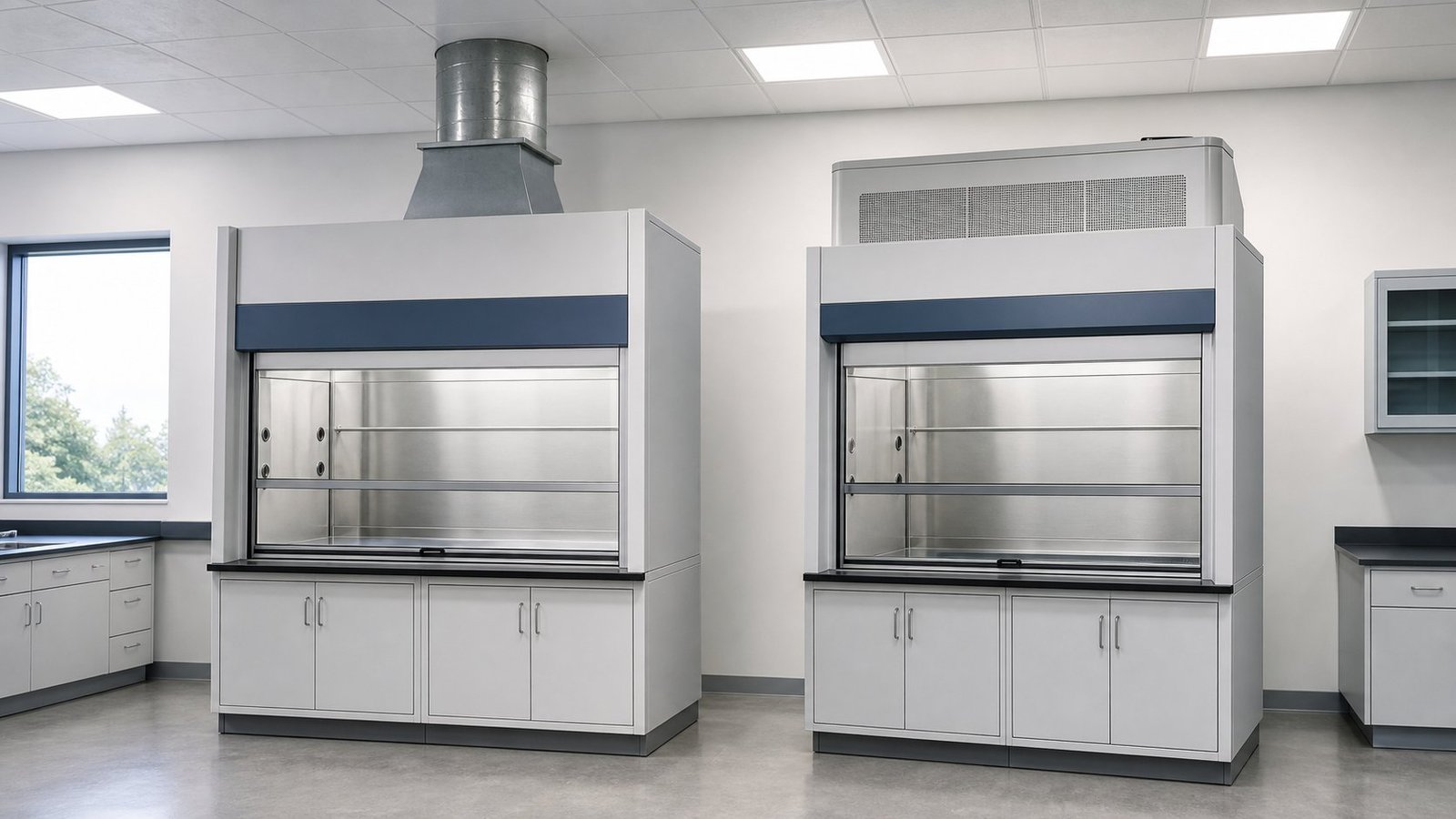
Laboratory equipment catalogs call two very different machines “fume hoods.” A ducted fume hood pulls contaminated air through building ductwork and exhausts it outdoors. A ductless fume hood filters the air inside the cabinet and returns it to the room. The mistake buyers make is choosing between them on first cost or installation convenience, when the real decision runs on chemistry, institutional policy, and life-of-installation cost. The selection path has five gates — chemical compatibility, institutional approval, airflow mechanism, decision matrix, and cost and monitoring structure — then two worked example projects. Every claim below is sourced to campus EHS programs, the NFPA 45 standard, or manufacturer technical references; where numbers are screening references rather than rules, the text says so. The ducted vs ductless fume hood decision, done right, ends with a checklist for EHS and any supplier — not a price comparison.
Direct Answer: Choose Ducted When…, Choose Ductless When…
Choose a ducted fume hood when the process involves strong oxidizers, reactive or water-reactive chemicals, heated perchloric acid, radioisotopes, acid digestion, or unknown or very long chemical lists — or when your institution requires outdoor discharge. Choose a ductless fume hood only when every chemical and particulate can be matched to a documented filter, the quantities and release rates fit a sustainable filter plan (manufacturer screening scale: roughly 500 mL per chemical, about 10 chemicals per application, 2–3 hr of use per day), the room can accept the treated return air, and your EHS program permits recirculating hoods.
| If your project looks like this… | The decision leans |
|---|---|
| Exclusion-register chemistry: strong oxidizers, reactive chemicals, heated perchloric acid, radioisotopes, acid digestion | Ducted, or a specialty exhaust cabinet |
| Volumes beyond the ~500 mL (≈0.5 L) per chemical screening scale, or more than 2–3 hr of hood use per day | Ducted, until the filter load is reassessed |
| A short, documented chemical list inside screening range, and a room that can accept treated return air | Ductless, pending the policy gate |
| An institution that bans recirculating hoods, or that requires 100–150 fpm face-velocity acceptance for hood work | Ducted |
The direct answer is deliberately conditional, because the ducted vs ductless fume hood question has no universal winner: in this decision, one answer is a function of your chemicals and your institution, not of the brochure. A ducted system removes the contaminant from the building; that is its decisive advantage and its decisive cost. A ductless system keeps the contaminant inside the cabinet until the filter holds it; that works only while the filter actually matches the chemistry and is replaced on evidence, not on a calendar guess. The two gates that follow — chemical fit, then institutional policy — turn this direct answer into a decision you can defend in writing.
The First Gate: Your Chemical List Decides Whether Filtering Is Even Possible
Filter Fit Is a Chemical-by-Chemical Decision, Not a Product Label
A ductless fume hood is a recirculating enclosure whose containment rests on two filter mechanisms: adsorptive media such as activated or impregnated carbon for vapors, and HEPA media for particles (Labconco’s ductless-hood guidance treats the chemistry-driven media choice as the core selection step). The label “carbon + HEPA” is not a promise that any chemical is safe — carbon capacity shifts with concentration, humidity, temperature, and contact time, so the same filter can be adequate for one solvent load and inadequate for another.
The practical consequence is that a ductless hood is selected chemical-by-chemical, one compound at a time. Methanol and other low-molecular-weight solvents are classically the ones ordinary carbon retains poorly, which is why vendor selection guides flag them as a filter-feasibility test case rather than a routine load. If any chemical on your list fails the media check, the ductless option fails the first gate regardless of price, footprint, or schedule.
The Exclusion Register: Chemicals That Push You to Ducted
Seven chemical and operational categories recur in institutional safety guidance as incompatible with recirculation: strong oxidizers, reactive or water-reactive chemicals, heated perchloric acid, radioisotopes, acid digestion procedures, and high-toxicity, flammable, explosive, or carcinogenic operations (Penn EHRS restricts strong oxidizers and reactive chemicals from rooms with recirculating air systems; Virginia EHS lists high-toxicity, flammable, explosive and carcinogenic chemicals as unsuitable for ductless use). These categories are exclusion gates because a filter failure is not a graceful event: the contaminant is returned to the room the moment the media is exhausted, bypassed, or mismatched.
For heated perchloric acid the exclusion is absolute in practice — the hazard demands dedicated wash-down ductwork, not a filter bank. Acid digestion procedures carry the same routing: the combination of concentrated acids, heat, and evolving gases sits outside what carbon/HEPA recirculation is designed to carry. If your list includes any of these, the chemical gate already answers the question: ducted (or a specialty exhaust cabinet), and the remaining sections explain the facility consequences you will need to budget.
Screening References, Not Rules: Volume and Chemical-List Limits
Manufacturer screening references give a scale for “small, known, filter-friendly” work (Labconco’s ductless-hood guidance; similar limits appear in distributor comparison guides):
| Screening reference | Typical manufacturer scale |
|---|---|
| Volume per chemical | Roughly 500 mL (≈0.5 L) |
| Chemicals per application | About 10 |
| Use per day | 2–3 hr |
These figures are screening references, not regulatory values — different manufacturers define different filter classes — but they reveal the shape of the decision: a ductless installation is defensible when the chemical universe is small, stable, and well documented, and becomes indefensible as the list grows, volumes rise, or the chemistry changes without re-review.
The quantity dimension matters as much as the list. A large volume at a low release rate can exhaust a carbon bed over months; a small volume with heating can break through quickly. That is why the quantities, frequency, temperature, and mixture behavior of your specific operations are the input fields any qualified filter assessment needs — from EHS, from the manufacturer, or from both.
A “no” anywhere pushes you to ducted and closes the first gate.
The Second Gate: Institutional Policy and Who Approves
Some Institutions Ban Ductless Hoods Outright
Institutional policy can override the chemical analysis before it reaches a vendor. Two verified examples set the tone: Berkeley’s EHS ductless fume hood standard states that ductless fume hoods are not permitted on campus, and UW–Madison’s EHS chemical safety guidance states the same for the University of Wisconsin system. Both are public research universities with mature EHS programs, which means a laboratory planner anywhere should treat “no ductless” as a live possibility in their own institution, not as an exotic exception.
The institutional check is cheap and decisive: read the campus chemical hygiene plan before contacting any supplier. Policies cluster in two shapes — outright prohibition, or case-by-case EHS approval with documented chemical review. Both shapes exist on real campuses, so quoting a manufacturer’s capability sheet is not evidence your institution will allow the installation.
Where Ductless Is Allowed: EHS Approval and What It Requires
Where ductless is permitted, approval is not a rubber stamp. The typical approval package asks for:
| Approval artifact | What it documents |
|---|---|
| Chemical inventory | Every compound, with the filter class proposed for each |
| Quantities and frequency | Volume and use per day against the screening scale (roughly 500 mL per chemical, 2–3 hr per day) |
| Monitoring and replacement plan | The signal or schedule that will demonstrate continued performance |
| Face-velocity acceptance | The installed-hood check against the institutional reference (100–150 fpm where specified) |
That documentation burden is a real operating cost from day one, because it repeats whenever the chemistry changes.
This is the point where the decision stops being a purchasing choice and becomes a compliance record: the same folder that gets the hood approved is the folder that defends the installation two years later when the carbon bed’s condition is questioned.
NFPA 45 and the “Not a Substitute” Boundary
NFPA 45, the standard for fire protection in laboratories, draws the boundary the sustainability debate often misses: a recirculating filtration device is not a substitute for a chemical fume hood when the job is capturing flammable or hazardous vapors (Berkeley’s standard cites NFPA 45 on exactly this point). The standard’s definitional boundary matters because “fume hood” insurance and inspection language may assume outdoor discharge; a ductless unit that carries the name without the function can create a gap between what the paperwork claims and what the room actually gets.
Read together with the exclusion register, NFPA 45’s boundary means ductless is a containment supplement for compatible, documented, low-volume chemistry — never the fire-safety catch-all for the general laboratory. If your process relies on the hood to protect against a flammable solvent fire scenario, the policy gate answers ducted.
Airflow Mechanism: Where the Air Goes and What the Room Carries
The mechanism decides what each option costs to build and what the building must provide — so it belongs before the decision matrix and the cost section.
Ducted: Building Exhaust, Ductwork, Fan and Makeup Air
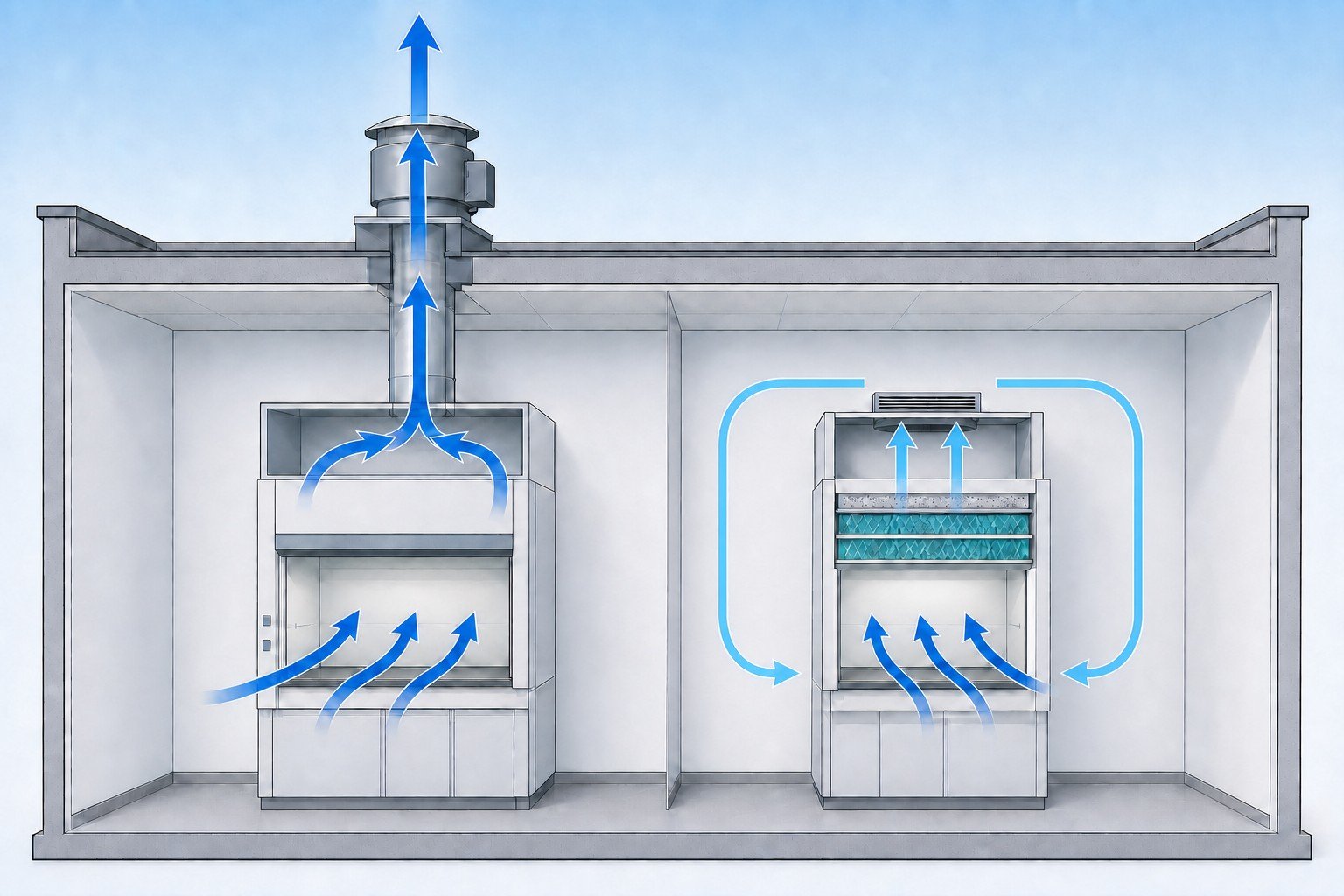
A ducted fume hood is one component of a building exhaust system: room air enters through the sash, travels across the work surface, up the riser duct, and out through a roof-mounted exhaust fan. The room’s HVAC must then replace the exhausted air, and the supply system must do it without undermining the hood’s face velocity — which is why distributor engineering guidance puts makeup-air coordination on the HVAC engineer’s scope, not the cabinet buyer’s. Plans, not hoods, are what make a ducted installation work.
The performance number a facility can hold onto is the face velocity acceptance target. Berkeley EHS cites a satisfactory face velocity range of 100–150 fpm for its hood installations — about 0.51–0.76 m/s on the unit-conversion scale — and XICHENG’s ductless family lists a reference face velocity of 0.4–0.6 m/s (80–120 fpm) to be verified on site at the stated sash opening and fan setting. The two references overlap in the 100 fpm neighborhood and differ at the edges, which is exactly why both are screening/acceptance references for the specific installation, not universal constants. The ducted system also carries building consequences: duct routing, roof penetration, fan sizing, controls, and commissioning, all of which turn “a hood” into “a building project.”
Ductless: The Cabinet, the Filters and the Room
A ductless fume hood is a self-contained unit: the fan draws room air through the sash, the filter bank treats it, and the clean air returns through the top of the cabinet — the room itself becomes the operating boundary. That boundary is what makes the unit portable: no ductwork, no roof fan, no wall penetration, and a footprint that can move between labs as a project, not a construction job (XICHENG’s ductless family offers reference widths of 800 / 1000 / 1275 / 1600 mm — about 31.5 / 39.4 / 50.2 / 63 in — verified against the approved drawing for each configuration).
The trade is that “the room is the boundary” really means the room inherits the risk. Return air re-enters the occupied space, so the unit’s filter state, the room’s background ventilation, and the placement of the return outlet all become safety-relevant. A ductless hood does not remove the need for room ventilation thinking — it shifts where that thinking has to be applied.
That list feeds directly into the decision matrix that follows.
Side-by-Side Decision Matrix: Ducted vs Ductless Fume Hood
| Dimension | Ducted fume hood | Ductless fume hood |
|---|---|---|
| Chemical breadth | Full (including exclusion-register chemistry, with specialty ductwork where needed) | Limited to chemicals matched to documented filter media; exclusion register excluded; screening scale ≈500 mL/chemical, 2–3 hr/day |
| Filter load on the user | None on the hood; building exhaust handles removal | Carbon/HEPA media matched per chemical, replaced on evidence |
| Installation & building dependency | Ductwork, roof fan, makeup air, controls, commissioning | Power and space; no ductwork; room ventilation still relevant |
| Cost structure | Higher first cost (building work), lower recurring filter cost | Lower first cost on the cabinet, recurring filter + monitoring + management cost |
| Moving or relocation | Building project; re-commissioning | Cabinet-sized move, but re-approval and re-review required |
| Energy | Conditioned air exhausted; makeup air load on HVAC | Conditioned air largely returned, minus filter pressure drop |
| Face-velocity acceptance | 100–150 fpm institutional reference, verified on site | 80–120 fpm reference range (0.4–0.6 m/s), verified at stated sash setting |
The matrix rows collapse into one question per row: can the building and the chemistry carry this row’s burden? A single “no” on chemical breadth or institution policy decides the row, and once two rows fall the comparison is over — the remaining sections then size the winner.
Cost Structure: First Cost vs Lifecycle
The honest comparison is not “which is cheaper” but “what do we buy with each option, and what recurs.” Vendor literature is inconsistent about which of these it quotes, so split them yourself.
First Cost: What You Buy With Each Option
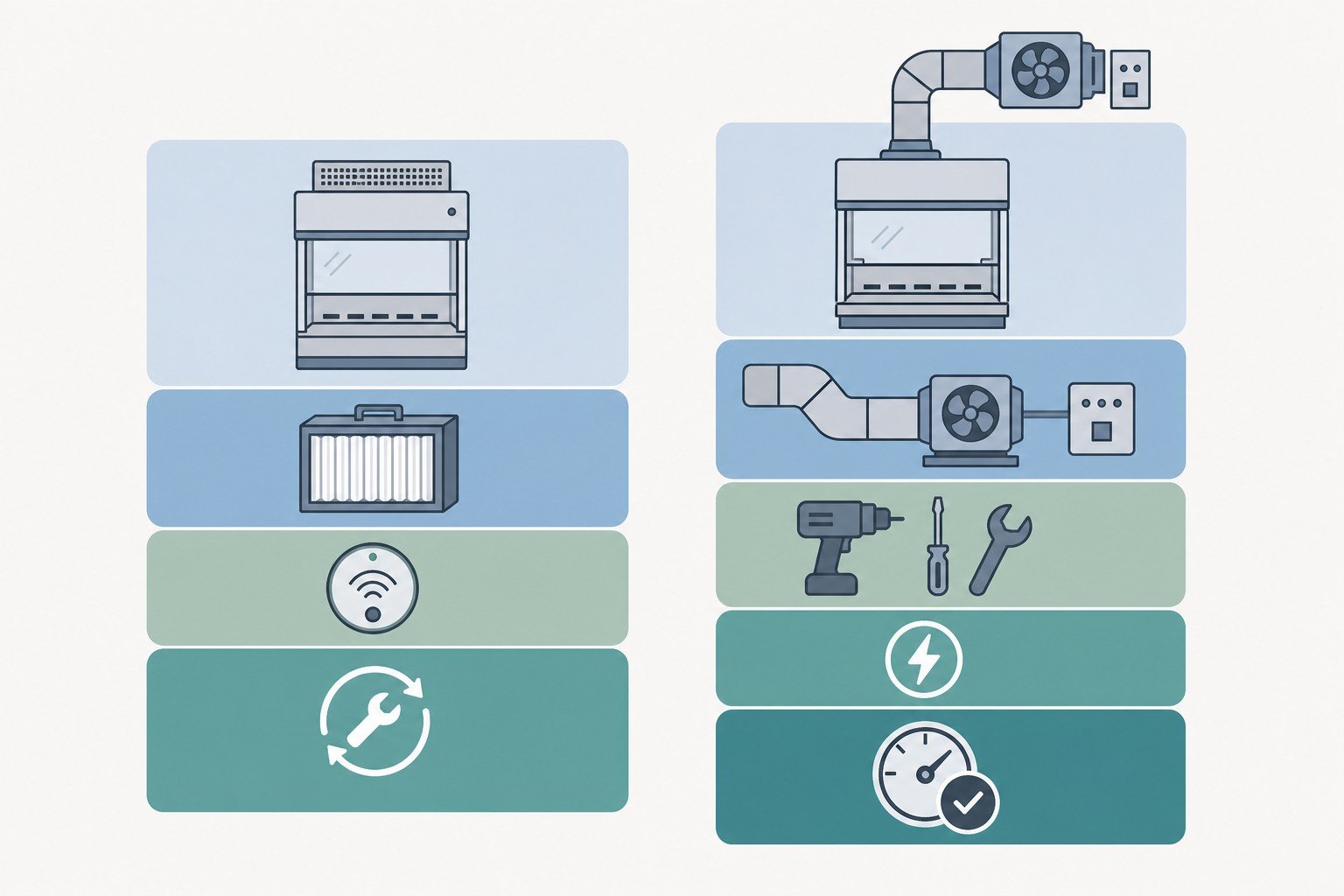
The ducted option buys equipment plus a building project: the cabinet, the duct riser, the roof fan, the controls, the installation labor, and commissioning. Distributor guidance describes ductless units as typically around 50% of the price of a comparable ducted installation and notes the ductless cabinet itself avoids ductwork, roof penetrations, and structural work (Workstation Industries’ guidance). That “around 50%” figure is a coarse industry comparison, not a quote — real prices vary with building conditions, and
The ductless option buys equipment plus a discipline: the cabinet itself, the matched filter media, the monitoring signal, and the management overhead of keeping the approval documentation current. A low first cost on the cabinet is real, but it is the entry ticket to a recurring program, not the end of the cost story.
Recurring Costs: Filters, Monitoring, Energy and HVAC
Recurring costs are where the two options’ shapes diverge. Ducted systems carry building-energy and maintenance loads: conditioned air is exhausted outdoors, makeup air must be supplied, and the exhaust fan and controls sit on the preventive-maintenance schedule. Ductless systems carry filter and verification loads: media is replaced on an evidence-based schedule — manufacturer experience puts carbon life at months to about two years, distributor guidance cites changes as frequent as every two months in heavy use, and another compares monthly-to-yearly intervals — and the monitoring program that justifies each change is itself a recurring activity (Labconco; Triumvirate; LOC). The load that stays inside the screening envelope (roughly 500 mL per chemical, 2–3 hr per day) is the load that keeps that recurring cost predictable; the load that grows past it is the load that converts a low first cost into a standing filter bill.
Neither option escapes recurring cost. The question is which recurring cost your facility is built to carry: an HVAC maintenance program, or a filter-verification program with a named responsible person.
Change and Relocation Costs
The third layer is what happens when the lab changes. A ducted installation moves only as a building project: ductwork, fans, and controls are re-engineered, and the room’s makeup-air balance is re-commissioned. A ductless installation travels as a cabinet — but it must be re-approved for the new room and re-evaluated against the same chemical gate, because the receiving room’s ventilation, occupancy, and policy context are new inputs, not the same inputs. Change cost, in both directions, is a decision variable you should price before you buy, not discover after.
Monitoring and Filter Lifecycle Discipline
A ductless installation is only as defensible as its evidence that the return air is still acceptable.
What an Airflow or Pressure Signal Tells You
An airflow or pressure signal proves the fan is moving air and the duct or filter path is not blocked. It does not prove the carbon still adsorbs: a bed can be saturated and still pass the pressure check, because the pressure drop across an exhausted adsorbent bed is not a reliable proxy for residual capacity. The same logic applies to face velocity on a ductless unit — it confirms flow, and flow is necessary but not sufficient for containment when the media is spent.
Design accordingly: treat the airflow/pressure signal as the fan’s health indicator and treat media condition as a separate question answered by chemical-aware methods — breakthrough monitoring where the vendor or EHS provides it, or a documented change schedule tied to loading data rather than to a calendar alone. Containment performance itself is a separate verification: fume hoods are performance-tested with tracer-gas protocols such as ASHRAE 110, which measures what a gauge cannot.
| Signal | What it proves | What it does not prove |
|---|---|---|
| Face velocity / airflow (e.g. 80–120 fpm or 100–150 fpm reference ranges) | The fan is moving air; the path is not blocked | The carbon still adsorbs |
| Pressure drop across the filter bank | The media path is not clogged | Residual capacity or breakthrough time |
| Filter-change log with load data (500 mL/chemical, 2–3 hr/day scale) | The plan is being executed | That no re-review is ever needed |
Building a Filter-Change and Breakthrough Plan
A defensible plan names the responsible person, the trigger, and the record. The trigger is loading evidence: quantity and frequency of use (the same fields as the screening scales — roughly 500 mL per chemical and 2–3 hr of use per day define the light end of the load envelope), the chemicals actually run, temperature effects, and the manufacturer’s capacity guidance for the specific media — recollected as months to about two years of service life in manufacturer experience, with heavier use pushing toward the monthly end of the range. The record is what makes the plan auditable: each change logged against the media type, the load history, and the monitoring readings at the time of change.
The same documentation supports the EHS approval and the procurement record, so the filter-change log is not an additional chore — it is the operating half of the approval you already obtained in the policy gate.
Two Worked Selections: The Ducted vs Ductless Fume Hood Decision on Real Projects
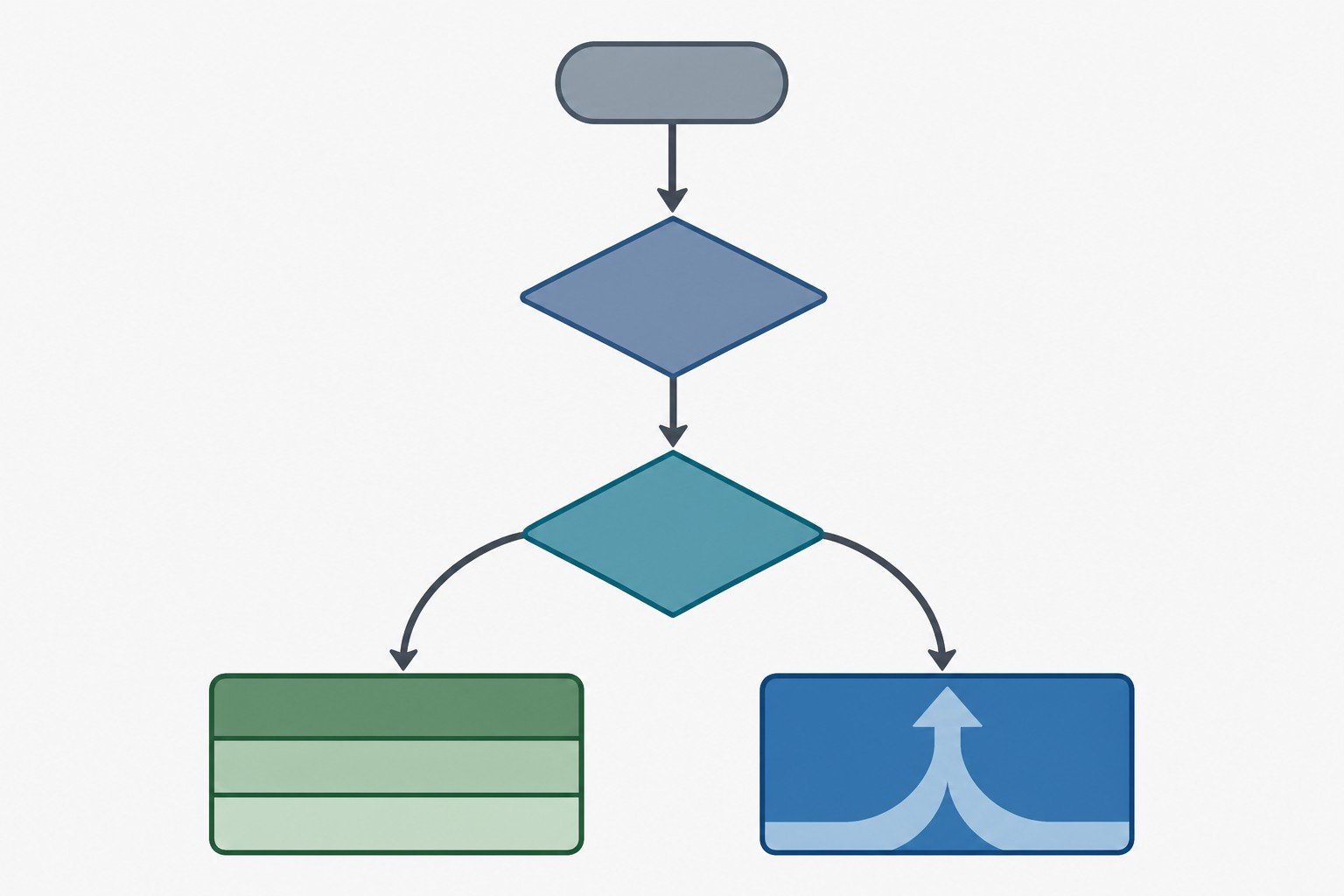
Two examples show the gates producing opposite answers for opposite reasons. Both walk the same chain: chemical list → filter feasibility → institutional policy → decision.
Example A: Small-Scale QC Lab With a Short Chemical List
A three-person QC lab runs buffer salts, a single low-volume solvent, and no heated or high-toxicity chemistry. The chemical list is inside screening range: about 500 mL per chemical, under 10 chemicals total, and 2–3 hr of use per day. Every compound can be matched to documented filter media, nothing sits on the exclusion register, and the institutional policy allows recirculating hoods with approval. The gates output: ductless is defensible, with three open fields to close before purchase — the filter classes for each solvent, the breakthrough or change schedule with the named responsible person, and the room’s background ventilation and return-air placement.
The point of Example A is not that QC work is always ductless; it is that the output followed from the inputs. Change the inputs — a heated concentration step, a second solvent that carbon retains poorly, or a policy that bans recirculation — and the same gates output ducted.
| Gate | Example A: QC lab with short list | Example B: synthesis lab with unknowns |
|---|---|---|
| Chemical list | Buffer salts + one low-volume solvent; ≈500 mL per chemical, 2–3 hr/day | A dozen solvents, strong oxidizers, heated reflux, uninventoried products |
| Filter feasibility | Every compound matched to documented media | Fails twice: oxidizers on the exclusion register; unknowns cannot be matched before they exist |
| Institutional policy | Allows ductless with documented approval | Restrictive where tested (e.g. Berkeley, UW–Madison ban recirculating hoods) |
| Output | Ductless defensible, three open fields | Ducted, decided before cost comparison |
Example B: Multi-Chemistry Synthesis Lab With Heating and Unknowns
A synthesis lab runs a dozen solvents, strong oxidizers for some transformations, heated reflux, and reaction products that are not all inventoried in advance. This list fails the chemical gate twice: the oxidizer category sits on the exclusion register, and unknown products cannot be matched to filter media before they exist. The policy gate would likely add a second “no” where institutions restrict recirculation. The gates output: ducted, and the decision is already decided before any cost comparison — which is the article’s core point.
What Changes When Conditions Change
Both examples flip when conditions change, which is why each decision has a re-review trigger: volumes rise, a new chemical enters the list, a process adds heat, or the room’s ventilation changes. The rule is simple — rerun the two gates, then the matrix — and the artifact is a dated re-review record, not a memory.
Common Selection Mistakes
| Mistake | Why it fails | Typical consequence |
|---|---|---|
| Choosing by first price | The cabinet price is the smallest decision input; recurring and building work dominate | A low first cost becomes a standing filter bill |
| Treating “carbon + HEPA” as universal chemistry | The label is a mechanism description, not a compatibility certificate | Methanol-type solvents and exclusion-register chemistry defeat it |
| Buying before the policy check | Institutional policy precedes vendor capability | A campus ban converts a purchased hood into a doorstop |
| Changing filters on a calendar alone | Load varies; the same media lasts months to about two years depending on actual use | Premature breakthrough or wasted media, both undocumented |
| Trusting the airflow alarm for carbon health | The pressure signal proves flow, not adsorption (e.g. a 100–150 fpm face-velocity reading says nothing about the bed) | Saturation goes unnoticed until the room smells |
| Moving a ductless hood and treating it as the same installation | A new room is a new set of ventilation and policy inputs | Re-approval failure and an un-reviewed return-air boundary |
The six patterns share one root: comparing the options on a single number — usually the first price — instead of on the load envelope (screening scale ≈500 mL per chemical, 2–3 hr per day) and the building commitment behind each option.
The One-Page Checklist and Questions for EHS and Any Supplier
Process Data to Gather Before You Contact Anyone
Have these on one page before the first conversation:
| Data item | Why it matters |
|---|---|
| Chemical inventory (each compound) | Filter match is chemical-by-chemical |
| Volume and frequency per operation | Load vs screening scale (roughly 500 mL per chemical, 2–3 hr per day) |
| Heating or reflux steps | Raises release rate and can push chemistry out of filter range |
| Room background ventilation | The return-air boundary the room must accept |
| Institution’s ductless policy (quote from the CHP) | Gate 2 outcome, in writing |
Five inputs, one page — the same five fields a filter assessment needs, which means the data you gather for the internal decision is exactly the data a supplier needs for a real quotation. Add the face-velocity acceptance target your institution cites (100–150 fpm where one is specified) so the installed check is part of the same request.
Questions to Ask EHS and Any Supplier
- Which filter classes does the vendor document for each chemical on my list, and which compounds does that documentation exclude?
- What is the expected service life for my actual volumes and frequencies — and what loading data supports that estimate?
- What monitoring or breakthrough method does the vendor support, and who is responsible for acting on it?
- What does the approval process require at my institution, and which records must I keep to maintain it?
- If I later add chemicals, raise volumes, or add heat, what re-review does the vendor and my EHS require?
The same questions work with any supplier, which keeps the procurement educational rather than price-driven; the ducted vs ductless fume hood decision is complete when these questions are answered in writing, not when a quote arrives.
FAQ
- Is a ductless fume hood safe? — Safety is a property of the match, not of the cabinet: a ductless fume hood is as safe as its filter match, its monitoring plan, and its institutional approval — no carbon bed adsorbs 100% of every vapor, which is why the chemical gate exists. The filter-feasibility and policy gates above are the definition of that match. (The dedicated safety-topic article covers the boundary cases in depth once it is published.)
- Can you use acids in a ductless fume hood? — Some acids can be handled with the right impregnated carbon for that specific acid and concentration; heated perchloric acid and acid digestion sit on the exclusion register and require ducted or specialty exhaust. Confirm the filter class against your exact chemical before relying on any general answer.
- How often do ductless fume hood filters need replacing? — In manufacturer and distributor experience, from months to about two years depending on load; the answer for your installation comes from loading data and a monitoring plan, not from a generic interval.
- Does a ducted fume hood cost more than ductless? — First cost and lifecycle cost answer differently: ductless typically carries a lower first cost (distributor comparisons put it around 50% of a comparable ducted build) while ducted carries building work; recurring filter, monitoring, and management costs are the ductless offset. No fixed prices exist that survive a real building.
- Can a ductless fume hood be moved between labs? — The cabinet can move as equipment; the approval cannot. A new room means a new ventilation review and a re-run of the chemical scan.
Next Steps: Run the Gates, Then Talk to EHS and Suppliers
The decision is now three actions long:
| Step | What you do | What you produce |
|---|---|---|
| 1 | Run the chemical list through the filter gate (screening scale: roughly 500 mL (≈0.5 L) per chemical, 2–3 hr per day) and the policy gate | A dated outcome: ductless defensible, or ducted |
| 2 | Ask EHS which policy shape applies on your campus | A policy citation from the chemical hygiene plan |
| 3 | Put the five data items and five questions in front of any vendor | Written answers, including the face-velocity reference (100–150 fpm where specified) and the filter-life basis |
For a deeper look at the full family and the ducted alternatives, the types of fume hoods guide covers the wider selection from here, and the ductless fume hood page documents the five decision inputs and the reference face velocity to verify on site, with the laboratory fume hoods category as the catalog view. Your next step is the policy call: name the outcome, list the data you still need, and take the one-page file to EHS.
Leave a Reply