





Key Takeaways
- Pick by decision order, not by type lists. A fume hood is a ventilated enclosure; the types of fume hoods that fit your lab come down to five decisions: hazard, exhaust, structure, material, and controls.
- Special hazards force special cabinets. Heated perchloric acid, radioisotopes, and hot-acid digestion work require dedicated hoods that a general-purpose unit cannot replace.
- Ducted exhaust is the default. A ductless hood is safe only after a chemical-by-chemical filter review, because carbon media does not capture every compound.
- Face velocity is a design target, not a law. Values commonly range 60–100 fpm by institution; verify the installed hood with an ASHRAE 110 containment test.
- Size makeup air with the exhaust. A 6-ft hood at 80 fpm draws about 440 CFM; a room that cannot supply it will depressurize and fail to contain.
A laboratory fume hood is a ventilated enclosure that captures, contains, and exhausts airborne contaminants from lab operations. The hard part of choosing one is that “fume hood” covers several distinct systems — ducted and ductless, benchtop and floor-mounted, general-purpose and special-purpose — and those differences change which chemicals you can run, which building services you need, and what the installation will cost. The most common mistake is to pick a hood from a picture of types. The reliable path is a fixed decision order: hazard, exhaust, structure, material, and controls. Work that order once, and the types of fume hoods that fit your lab shrink to one or two candidates before you call a supplier.
This guide walks those five decisions in sequence, then applies them to a worked example, and closes with the data to gather before you buy. It covers the type families you will compare: ducted and ductless, benchtop and walk-in, and the special-purpose cabinets for perchloric acid, radioisotopes, acid digestion, and explosive atmospheres.
Direct Selection Framework: Five Decisions in Order
A fume hood selection is five linked decisions, not one. Run them in this order, because each decision constrains the next and a later decision can overturn an earlier guess.
- Hazard and chemical inventory. List the chemicals, quantities, and operations. This step decides whether a standard hood works or a special type is mandatory, and it feeds every later choice.
- Exhaust arrangement. Can the building run ducted exhaust, or is a ductless unit the only option? Ducted is the default for general chemical work; ductless is conditional.
- Structure and size. Does the equipment sit on a work surface, or does it demand a floor-mounted or walk-in cabinet?
- Interior material. Match the liner to the chemicals and temperatures.
- Airflow control and sizing. Set the design face velocity, estimate the exhaust airflow, and choose the controls and monitoring.
| Decision | What it settles | Data you need |
|---|---|---|
| 1. Hazard and chemical inventory | Standard hood vs special type | Chemical list, quantities, temperatures |
| 2. Exhaust arrangement | Ducted vs ductless, building services | Duct path, makeup air, institutional policy |
| 3. Structure and size | Benchtop vs floor-mounted, width | Equipment envelope, number of users |
| 4. Interior material | Liner: PP, stainless steel, or FRP | Chemicals, operating temperature |
| 5. Control and sizing | Face velocity, CFM, monitoring | Target fpm, sash area, controls budget |
The order matters. Choosing a ductless hood before checking for a perchloric operation would be reversed twice over: perchloric work forces a ducted, wash-down cabinet with dedicated exhaust. Starting with the chemical inventory prevents that class of error.
Three numbers frame the whole exercise. Stanford University EH&S guidance for intensive chemical use plans at least 2.5 linear feet of hood space per student, so the number of users usually sets how many feet of hood, not which type. The face-velocity design targets you will see — roughly 60 to 100 fpm depending on the institution — are screening values, not a single legal number. And the airflow that results is the same scale whether the hood is ducted or ductless: a 6-ft unit at 100 fpm draws roughly 550 to 600 CFM, which is why makeup air often decides whether a project is feasible.
After this module, you can list the five inputs for your project and flag the hazards that might force a special cabinet.
The Main Types of Fume Hoods
The main types of fume hoods divide along two axes that every manufacturer and EHS program uses: exhaust arrangement (ducted vs ductless) and physical form (benchtop vs floor-mounted). Special-purpose cabinets add a third axis for specific hazards. The table below maps the families you will compare; the sections that follow explain the operating difference each column represents.
| Type | Exhaust | Structure | Typical use | When to consider |
|---|---|---|---|---|
| Ducted benchtop hood | Ducted | Work surface, ~36 in high | General chemistry, most lab work | Default for mixed chemical use |
| Ducted floor-mounted / walk-in hood | Ducted | Floor to ceiling, tall interior | Large equipment, drums, tall apparatus | Equipment too tall for benchtop |
| Ductless (filtered) hood | Filtered, recirculated | Benchtop, often portable | Limited chemical set, no duct access | Only after chemical review |
| Distillation hood | Ducted | Tall interior, low workbench | Distillation columns, reflux | Tall glassware needs headroom |
| Perchloric acid hood | Ducted, dedicated | Benchtop or floor | Hot perchloric acid | Wash-down required |
| Radioisotope hood | Ducted (often HEPA/charcoal) | Benchtop | Radioactive materials | Surface and decon requirements |
| Acid digestion hood | Ducted | Benchtop | Hot acid digestion of metals | Acid-resistant liner, polycarbonate sash |
| Explosion-proof hood | Ducted | Benchtop | Flammable atmospheres | Electrical classification applies |
| Canopy hood | Ducted (typical) | Overhead, no enclosure | Heat, steam, non-toxic odors | Not for hazardous chemical work |
| Demonstration hood | Ducted | Benchtop, clear panels | Teaching, audience viewing | Two-sided access |
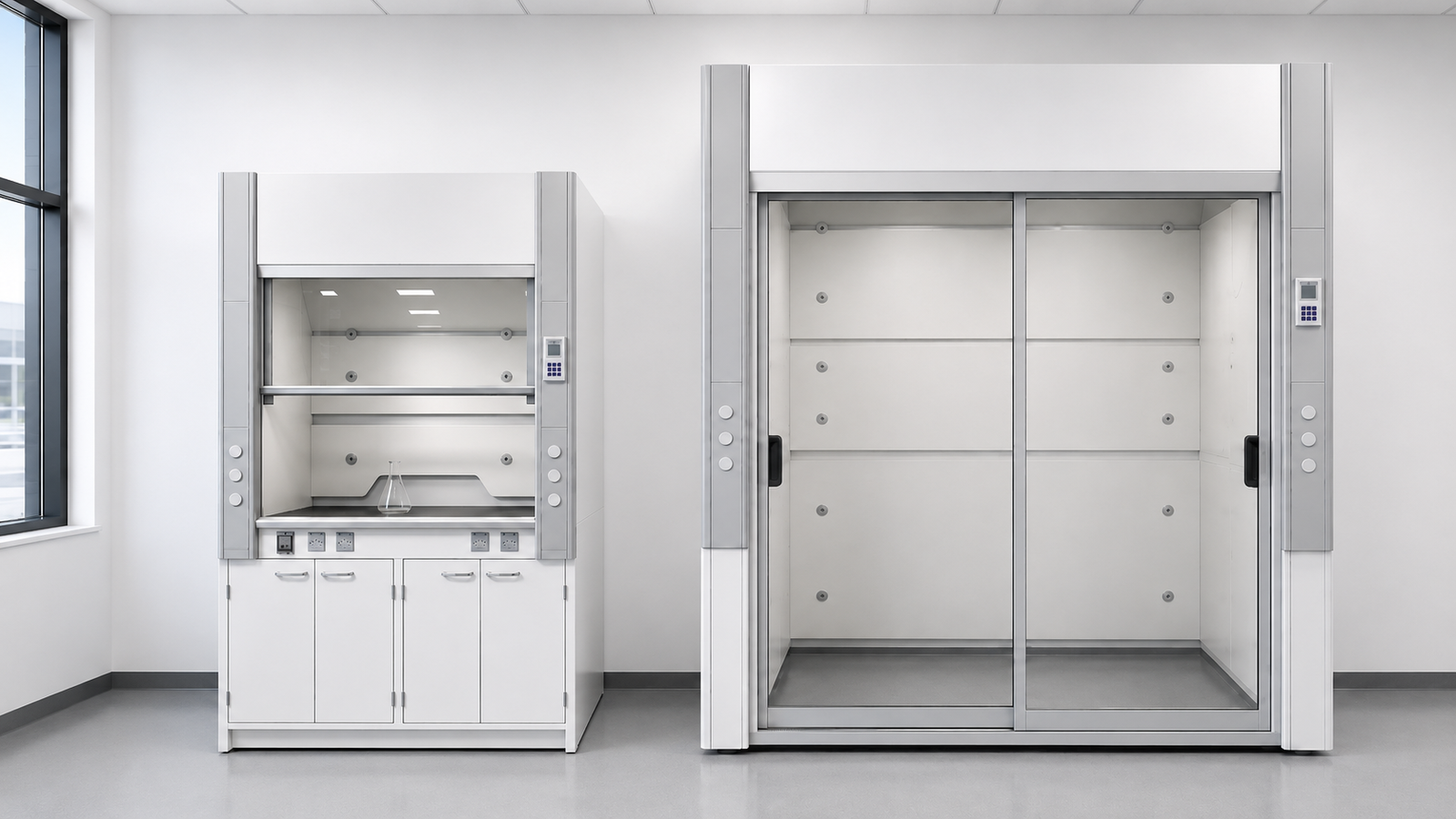
Ducted hoods: the standard path
A ducted hood is a ventilated enclosure connected to a blower and ductwork that discharges air to the outside of the building. It is the default choice for general chemical laboratories because it removes vapors continuously instead of storing them in a filter. University EHS guidance treats ducted exhaust as the baseline for chemical use, with ductless treated as the exception that needs review.
The ducted family covers the most common geometries: a benchtop hood for work at a standard ~36-inch work surface, and a floor-mounted or walk-in hood for equipment that needs interior height. If your building can support ducted exhaust, the remaining decisions are structure, material, and control — not exhaust method.
Ductless (filtered) hoods
A ductless hood filters air through activated carbon or HEPA media and returns it to the room instead of exhausting it outside. That makes it movable and cheap to install, because there is no ductwork or wall penetration. The trade-off is that filtration is chemical-specific: a carbon bed that captures organic solvent vapor may pass chlorine gas, and the filter saturates with use.
Stanford EH&S restricts portable, non-ducted hoods to limited applications reviewed case by case, citing ANSI/AIHA Z9.5. Ductless units are a conditional choice, not a general substitute for ducted exhaust. If you are weighing them, run a chemical inventory first and check whether the filters match every compound you will use.
Walk-in and floor-mounted hoods
A walk-in hood is a floor-mounted cabinet tall enough to hold equipment that would not fit in a benchtop unit. Despite the name, it is not a space for people: the interior is for drums, process units, and tall apparatus, and technicians work at the opening. Standard walk-in hoods commonly range from 6 to 24 ft wide and 7 to 16 ft high, so they also change how much makeup air and exhaust the room must supply.
Canopy and demonstration hoods
Two boundary types round out the picture. A canopy hood is an overhead exhaust without side or front barriers, used to remove heat, steam, and non-toxic odors from equipment like ovens and autoclaves; it is not suitable for hazardous chemical work because it does not enclose the source. A demonstration hood adds clear panels and two-sided access so a class can watch a procedure; it is a teaching tool, not a higher-capability chemical hood.
After this module, you can name the two or three type families that apply to your chemicals and equipment, and you can select which dimensions still need a decision.
Special Types of Fume Hoods
Some hazards make a standard cabinet unsafe, and the chemical inventory decides which of the following special types is mandatory. None of them can be replaced by a general-purpose hood, and several cannot be shared with unrelated chemistry. Each entry below states the trigger, the key requirement, and the boundary.
Perchloric acid (wash-down and dedicated exhaust)
Heated perchloric acid forms vapors that can condense into explosive perchlorate salts. A perchloric acid fume hood must therefore have a water wash-down system, a watertight work surface with a minimum depression of 13 mm (1/2 in) at the front and sides, and dedicated ductwork that takes the shortest path to the outside and never mixes with other exhaust. Stanford EH&S cites NFPA 45 for these requirements, and ANSI Z9.5 requires each perchloric hood to have an individually designated duct and exhaust system. This is the clearest case where a special type is not optional: hot perchloric acid work without a wash-down hood is not safe.
Radioisotope (surfaces and decontamination)
A radioisotope hood is built for contamination control, not for stopping radiation itself. Stainless steel surfaces with coved, welded corners prevent material buildup and make decontamination possible, and the work surface is usually watertight. The exhaust may need HEPA or charcoal HEPA filtration in a bag-out plenum, and the sash often uses horizontal sliding panels. For low-energy emitters, lead shielding in the 1/16 to 1/8 in (1.5 to 3 mm) range is a common screening figure, but the isotope, activity, and institutional license set the actual requirement.
Acid digestion
Acid digestion breaks metal samples down with hot concentrated acid, so the cabinet needs an acid-resistant liner and a sash that will not etch. Polycarbonate sashes are common in these units because glass resists mechanical impact better but polycarbonate tolerates the acid environment. Acid digestion hoods are a special type because the corrosive duty is continuous, not incidental.
Explosion-proof: what the term does and does not mean
An explosion-proof fume hood is a misread name. The term applies to the electrical equipment classification — per the National Electrical Code, Class I Division 1 or 2 for flammable atmospheres — not to the cabinet’s ability to contain an explosion. Selecting a hood with explosion-rated electrical components prevents the hood’s own switches and wiring from igniting a flammable atmosphere inside the cabinet. It does not mean the enclosure will contain a detonation. If you need containment for an energetic reaction, that is a different design question and usually a barricade or blast-rated enclosure, not a fume hood.
Distillation (tall interior)
A distillation hood provides more internal height than a standard benchtop unit so that columns, condensers, and reflux apparatus fit below the baffle. Interior clear heights commonly run 90 to 100 in for a floor-mounted distillation unit, against roughly 60 in for a standard benchtop interior. The taller cavity also changes the exhaust sizing and the amount of room air the unit consumes.
After this module, you can determine whether any of your operations forces a special cabinet, and you can flag that perchloric, radioisotope, and hot-acid work cannot be routed to a standard ducted or ductless hood.
Ducted vs Ductless: The Next Decision
Once the chemical inventory clears the special-type check, the first facility decision is ducted or ductless exhaust. The two approaches remove contaminants by different mechanisms, and the difference drives installation cost, filter maintenance, and institutional approval.
| Decision point | Ducted hood | Ductless (filtered) hood |
|---|---|---|
| Contaminant path | Exhausted outside the building | Filtered and returned to the room |
| Facility needs | Ductwork, roof blower, makeup air | None beyond power and bench space |
| Chemical range | General, including mixed and unknown | Limited to what the filter media captures |
| Approval | Standard for chemical labs | Case-by-case review at many institutions |
| Operating cost | Higher HVAC energy | Filter replacement and disposal |
| Verification | Field testing per ASHRAE 110 | Filter monitoring; possibly quarterly exhaust checks |
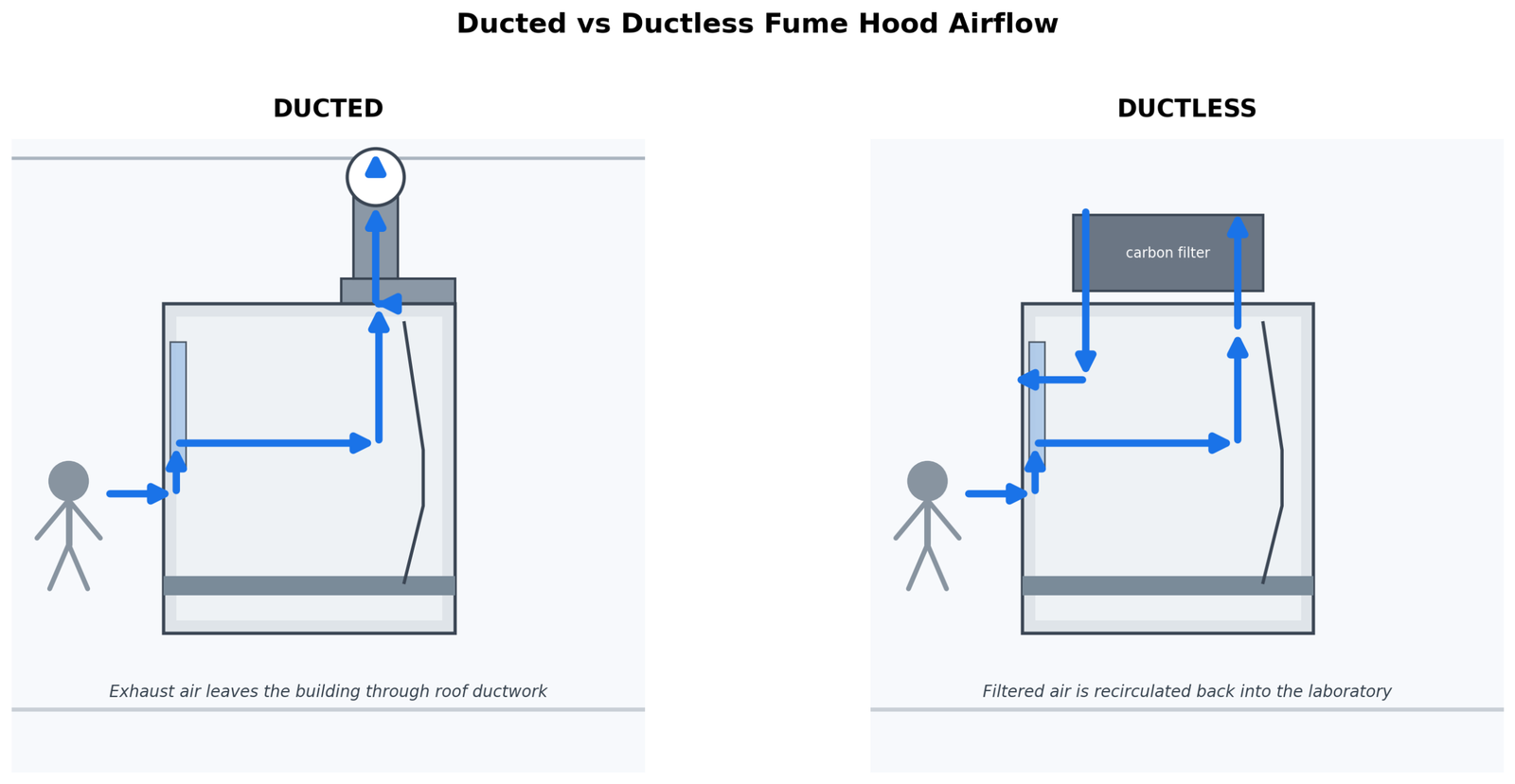
Ducted is the default for a reason. A ducted hood does not depend on filter media matching the current reaction, so a chemist can change procedures without re-validating the filter train. The costs move to the building side: the blower, the duct route, and the makeup air that must replace what the hood exhausts.
Both approaches are designed to the same face-velocity target — roughly 60 to 100 fpm by institutional policy — so the difference is where the air goes, not how fast it enters. The flow scale is identical: a 6-ft benchtop hood designed at 80 fpm draws roughly 440 CFM through its face, whether that air is discharged to the roof or pushed through a filter bank.
Ductless is viable when three conditions hold together. The chemical list must be small enough and stable enough for filter selection to cover it. The operation must not generate chemicals that poison or saturate the media quickly. And the institution must accept the unit for that application — Stanford EH&S restricts portable ductless units to limited, approved uses, and notes that an OSHA compliance officer may require quarterly exhaust monitoring to demonstrate filter effectiveness. A ductless hood that is bought because it is cheap, then used for whatever chemistry arrives, is the setup that produces failures.
After this module, you can decide whether your building supports ducted exhaust, and whether a ductless unit survives a chemical-by-chemical filter review. If both paths are open, the ducted route is the safer baseline.
Structure and Size: Benchtop vs Floor-Mounted
The structure decision is set by the equipment envelope: what must fit inside the hood, at what height, and how it is moved in and out. The physical form of the cabinet follows from those inputs, not from a preference list.
A benchtop hood sits on a support base or work surface that typically puts the interior work surface about 36 in above the floor. It suits operations where reagents sit on the work surface and the chemist works at a seated or standing bench height. Benchtop hoods are sold in standard widths of 4, 5, and 6 ft (about 1.2, 1.5, and 1.8 m), and the width you need depends on how many people work at the hood and how large the apparatus is.
A floor-mounted or walk-in hood runs from floor level to a tall interior, so it is for equipment that will not fit in the ~60 in of interior height a benchtop hood typically offers. Drums, reaction kettles, rolling process units, and tall distillation columns are the candidates. When equipment is taller than roughly 30 to 36 in, or must be rolled in on a cart, a floor-mounted unit becomes worth the extra exhaust and floor space. The term “walk-in” describes the interior volume, not a walkway: technicians do not enter these hoods.
Three inputs settle the size question: the height of the tallest item plus headroom for loading, the depth and width of the equipment footprint, and the number of operators who need simultaneous access. Write those down before you compare width options, and the 4/5/6-ft grid stops being guesswork.
| Equipment envelope | Recommended structure |
|---|---|
| Fits within a ~36 in working height | Benchtop hood |
| Taller than ~30-36 in, or rolled in on a cart | Floor-mounted hood |
| Very large items moved as a unit | Walk-in hood with wide sash or door |
After this module, you can decide whether your project needs a benchtop or floor-mounted unit, and you can select the standard width the equipment and operators justify.
Choosing the Interior Material
The interior liner is the surface that faces your chemicals every day, and the material choice controls chemical resistance, cleanability, and how long the cabinet lasts. Match the liner to the chemistry and the operating temperature, not to the list price of the cabinet.
| Liner material | Chemical resistance | Continuous temperature limit | Typical fit |
|---|---|---|---|
| Polypropylene (PP) | Strong acids and bases; organic solvents vary | ~180°F (80°C) | Corrosive acid work, general wet chemistry |
| Stainless steel (SS) | Broad chemical resistance; halides may pit | Above ~200°F practical duty | Radioisotope, cleanable, hot processes |
| FRP (fiberglass-reinforced plastic) | Corrosive acids and mixed aggressive service | ~200°F (93°C) | Long-life corrosive service |
Polypropylene is the workhorse for acid-heavy laboratories. Its resistance to corrosion makes it a common choice where strong acids dominate, and its nonporous surface resists odor pickup. The practical limit is temperature: PP continuous service is roughly 180°F (80°C), so hot processes need another material.
Stainless steel is specified where the liner must be cleanable and where the process involves radioactive material or hot duty beyond PP’s range. Radioisotope hoods, for example, are required to be stainless steel or a material not corroded by the chemicals in use. Its weakness is halide ions: long exposure to chloride can pit the surface.
FRP covers the corrosive-mixed-service middle, with a continuous limit around 200°F (93°C) and resistance suited to aggressive acid environments. The three materials overlap at the edges; a chemical compatibility review for each process is the correct final step.
After this module, you can select the liner material from your chemical list and temperature ceiling, and you can decide where a hot process forces you off PP.
Face Velocity, Airflow and Monitoring
Face velocity is the speed of air entering the open face of the hood, measured in feet per minute (fpm). It is the single most discussed number in hood selection, and the most misread. Common design targets sit in the 60 to 100 fpm range depending on the institution, with 100 fpm often treated as a default and lower values used where the institution allows them. These are design targets set by institutional policy, not a single legal value, and they are not the same thing as a field reading or an acceptance test result.
Design target vs operating reading vs acceptance test
The three values are easily confused, and the difference matters at commissioning. The design target is the face velocity you specify (for example, 80 fpm for a general chemistry bench). The operating reading is what the airflow monitor shows on a given day, which varies with sash position and filter loading. The acceptance test is the formal verification of the whole containment system, typically done to ASHRAE 110, which measures tracer-gas containment in three states — AM, AI, and AU — instead of a single velocity number. A hood can hit 100 fpm at the face and still fail containment if the room air distribution is wrong.
Estimating the exhaust airflow is a two-step calculation. Exhaust flow in CFM is roughly the face velocity in fpm multiplied by the open sash area in square feet. A 6-ft benchtop hood with a fully open area near 5.5 sq ft at 100 fpm needs roughly 550 to 600 CFM; the same hood at 80 fpm needs about 440 to 450 CFM. These are screening estimates for equipment and makeup-air planning, not field data — the installed system still needs verification.
CAV vs VAV and sash management
The airflow control strategy decides whether the hood moves constant volume or varies it with sash position. A constant air volume (CAV) hood exhausts a fixed airflow, so lowering the sash raises the face velocity — at full close the velocity can climb far above the target. Oregon State EH&S describes this inverse relationship directly: the lower the sash, the higher the face velocity. A variable air volume (VAV) hood modulates exhaust to hold a target face velocity as the sash moves, which cuts the exhaust and the energy load when the sash is closed.
VAV saves energy only if the sash is managed. The savings come from pulling less room air when the hood is not in use, so a lab that leaves sashes up gets the higher upfront cost of VAV without the operating return. Whatever strategy you choose, the face-velocity loop needs field verification, and a monitoring instrument — an airflow monitor or face velocity controller tied to an alarm — is what tells an operator the hood has stopped performing.
After this module, you can set a design face velocity for your institution’s policy, estimate the CFM your hoods will demand, and choose between CAV and VAV knowing the sash-management condition that makes VAV pay.
Worked Selection Example
This example runs the five-decision chain on a concrete scenario so you can repeat it with your own numbers. The figures are screening estimates for planning; the installed system still needs professional design and field testing.
The scenario and chemical inventory
A teaching laboratory for 30 students plans general organic and analytical work: dilute hydrochloric and sulfuric acid, common organic solvents, and one heated perchloric acid digestion station for a metal-analysis course. Equipment includes two benchtop distillation rigs and a floor-standing glass column roughly 5 ft tall. The building can support ducted exhaust, and the available makeup air is about 1,000 CFM.
Walking the five decisions
The chemical inventory triggers one special requirement immediately: the heated perchloric digestion forces a dedicated perchloric hood with wash-down and its own exhaust. Every other operation falls into the general-purpose family.
Exhaust is ducted for the whole lab, because the mixed solvent and acid load is not a stable ductless profile and the building supports ducting. Structure is benchtop for the two distillation rigs, which fit in standard cabinets; the 5-ft glass column is short enough for a benchtop interior and does not force a walk-in. Material is polypropylene for the general benches, given dilute acids and solvents within its ~180°F limit; the perchloric hood uses the acid-resistant wash-down construction the special type requires.
Control and sizing close the loop. Two 5-ft benchtop PP hoods at 80 fpm with roughly 4.5 sq ft of open area each draw about 360 CFM each, or 720 CFM together. The perchloric hood, sized for its ventilation and wash-down duty, is planned near 500 CFM. The total is about 1,220 CFM against 1,000 CFM of makeup air — a shortfall of roughly 220 CFM.
The recommendation and makeup air gap
The shortlist is two 5-ft ducted benchtop PP hoods for the general benches and one dedicated perchloric hood with wash-down. The 220 CFM gap is the real project finding: the room cannot supply the required makeup air until the supply system is upgraded, so the hoods will depressurize the space and degrade containment if installed as-is. That single number changes the project from a cabinet purchase into a ventilation upgrade.
After this module, you can run your own chemical list, equipment dimensions, and makeup-air figure through the same five steps and read the result as a shortlist plus a facilities gap.
What to Gather Before You Buy
A complete RFQ package prevents the most common sourcing loop, where a supplier asks for the chemical list after you have already chosen a cabinet. Gather these items before you contact anyone:
- Chemical inventory: list of process chemicals with quantities, concentrations, and how often each is used.
- Operation type: whether the work is general chemistry, heated acid, radioactive material, or flammable-atmosphere handling.
- Equipment envelope: the tallest and widest item that must fit inside the hood, plus how it is loaded.
- Number of users and hood feet: users per hood and working time, to size width and count.
- Exhaust arrangement: whether ducted exhaust is possible, and the duct route if it exists.
- Target face velocity: the institutional policy value, if one exists.
- Makeup air and room pressure: available supply airflow and whether the lab is negative or positive pressure.
- Location constraints: cross-drafts, doors, and supply diffusers near the proposed location.
- Utilities: power, water, and drainage at the installation point.
- Budget structure: cabinet, installation, ductwork, controls, and commissioning treated as separate lines.
Bringing this list to a supplier converts a catalog comparison into a project review. The single most skipped item is makeup air, which is also the item most likely to turn a working hood into a failed containment test.
Three figures show why the list matters before you contact anyone. A 6-ft benchtop hood designed at 80 fpm draws roughly 440 CFM that must be replaced by makeup air, so item 7 is a building decision, not a product detail. The 60 to 100 fpm target on item 6 sets that CFM number, and item 3 decides whether a ~36-inch benchtop or a floor-mounted unit applies.
| Data item | How it changes the recommendation |
|---|---|
| Chemical inventory | Material, exhaust decision, special type |
| Equipment envelope | Benchtop vs floor-mounted (~36 in threshold) |
| Face velocity target | CFM estimate (60-100 fpm by policy) |
| Makeup air | Feasibility: ~440 CFM per 6-ft hood at 80 fpm |
After this module, you can assemble a data package that lets a supplier or engineer recommend a specific cabinet instead of a generic type.
Common Fume Hood Selection Mistakes
The failures in this list show up repeatedly in laboratories that bought a cabinet before they worked the decision order. Each entry pairs the mistake with the consequence and the avoidance.
| Mistake | Consequence | Avoidance |
|---|---|---|
| Buying ductless for general chemistry | Filters miss or saturate on some compounds | Run a chemical-by-chemical filter review first |
| Standing inside a “walk-in” hood | Operator exposure to contaminants | Treat the interior as equipment space |
| Using a hood as chemical storage | Obstructed airflow, clutter, fire load | Store in vented cabinets, not hoods |
| Ignoring makeup air | Room depressurization, failed containment | Size supply air with the hood exhaust |
| Comparing cabinets on price alone | Under-budgeted ductwork, controls, commissioning | Price the whole system |
| Skipping face-velocity verification | Hood appears to work but does not contain | Field-test per ASHRAE 110 |
| Sharing a perchloric hood with other chemistry | Cross-contamination of a dedicated system | Reserve special hoods for their purpose |
| Expecting an explosion-proof hood to contain a blast | False sense of protection | Read the term as electrical classification |
Each of these has the same root: a decision made in the wrong order, or a special boundary ignored because a general-purpose cabinet looked similar. Run the five decisions before you compare products, and most of this list never happens.
Two of these failures carry specific numbers. A 5-ft hood at 80 fpm with a 4.5 sq ft open area pulls about 360 CFM from the room, so ignoring makeup air on a two-hood lab removes roughly 720 CFM of supply before the HVAC designer is involved. And a ductless unit run without filter verification is the case where an OSHA inspector may require quarterly exhaust monitoring. Each figure is a planning number, not a product spec, but it shows the size of the mistake.
After this module, you can determine whether your own plan contains any of the eight most common failure modes, and decide what to correct before spending money.
Product Families and Next Step
By this point you know which family of types of fume hoods fits your chemistry, your equipment, and your building. The remaining step is to turn that into a cabinet review with real data, not a guess.
Start from your gathered package: chemicals, equipment envelope, exhaust arrangement, face velocity target, makeup air, and project location. With those inputs, a supplier can recommend the hood type, width, and material, and identify the fan, ductwork, and control items that still need confirmation by a ventilation engineer.
For the families this guide covered, the relevant products are the Laboratory Fume Hoods category, the benchtop and walk-in cabinets for the standard path, the ductless unit for reviewed low-chemical use, and the perchloric acid, radioisotope, acid digestion, distillation, and explosion-proof cabinets for the special types.
The polypropylene, stainless steel, and FRP families serve the material decision, and the face velocity controller, airflow monitor, controller, and VAV control damper cover the monitoring and control side. Two numbers anchor that review: a 6-ft benchtop hood at 80 fpm needs about 440 CFM of makeup air, and the 60 to 100 fpm target you set earlier is what drives the CFM estimate.
The deeper questions this pillar deliberately leaves to dedicated guides: the ducted-versus-ductless trade in full, face velocity requirements, benchtop-versus-floor-mounted geometry benchtop-versus-floor-mounted geometry, and material comparisons each get their own treatment when those articles publish. If your work is biological or mixed rather than clearly chemical, the fume hood vs biosafety cabinet comparison tells you whether a fume hood is the right device at all. The five-step order here is the part that applies to every one of them.
When you are ready to move forward, provide the chemical inventory, expected quantities, hood size, exhaust arrangement, target face velocity, available utilities, and project location. XICHENG can use those inputs to recommend the appropriate hood type and to flag the fan, ductwork, and control information that still needs confirmation. That conversation — not the product catalog — is where the right types of fume hoods for your lab get chosen.
After this module, you can decide which product families to review next and select the inputs that turn your five-step shortlist into a cabinet-specific recommendation.
FAQ
What are the main types of fume hoods?
The main types divide by exhaust and structure: ducted and ductless, and benchtop and floor-mounted. Special-purpose cabinets add perchloric, radioisotope, acid digestion, distillation, and explosion-proof categories. Start with the five-decision order in this guide instead of the type list.
Is a ductless fume hood safe?
A ductless hood is safe only when the filter media matches every chemical used and the institution approves the application. Stanford EH&S restricts portable ductless units to limited, reviewed uses. Run a chemical-by-chemical filter review before relying on one.
What face velocity should a fume hood have?
Common design targets range from about 60 to 100 fpm, depending on institutional policy. Treat the value as a design target, not a legal number, and verify the installed system with a field test such as ASHRAE 110.
Do I need a special hood for perchloric acid?
Heated perchloric acid requires a wash-down hood with a watertight surface and dedicated exhaust, because perchlorate salts can form explosive deposits. This is not optional for hot perchloric work.
Can an explosion-proof fume hood contain an explosion?
No. The term refers to electrical equipment classification for flammable atmospheres, not to the cabinet’s ability to contain a detonation.
Leave a Reply