





Key Takeaways
- Protect the person first. In the fume hood vs biosafety cabinet decision, a fume hood is a ventilated enclosure protecting the operator from chemical vapors, not the sample.
- Decide the category, not the cabinet model. Chemical work → fume hood;biological work → biosafety cabinet;clean non-hazardous work → laminar flow hood.
- HEPA removes particles, not vapors. A biosafety cabinet cannot safely replace a fume hood for volatile chemicals.
- BSC class is a biosafety officer’s call. Your job is to know you need a BSC, not to pick A2 vs B1.
- Bring a spec request, not a question. If it’s a fume hood you need, walk in with the chemicals, the 100 fpm target, and the exhaust arrangement.
Laboratory equipment catalogs use “hood” for three machines that share nothing but a glass front and a fan. A chemical fume hood, a biosafety cabinet, and a laminar flow hood protect different things, move air in opposite directions, and are governed by different standards. Choosing by looks or by price, instead of by the hazard, is how a solvent vapor reaches the person, a bioaerosol reaches the room, or a culture gets contaminated. This guide gives you a two-question way to place your own work in one of the three categories, then tells you exactly what to specify and what to send when the answer is a fume hood. The fume hood vs biosafety cabinet decision, done right, ends with a spec request, not a vocabulary lesson.
Direct Answer: What You Protect Decides the Device
Name the device by what you protect and what you protect it against. Chemical vapors, fumes, and toxic gases belong in a chemical fume hood, which draws them away from the operator and exhausts them. Infectious agents and cell culture belong in a biosafety cabinet, which contains them with HEPA-filtered airflow while it protects the work. If you handle no hazardous materials and only need a clean environment, a laminar flow hood (clean bench) protects the product and nothing else.
| Device | Personnel protection | Product protection | Environmental protection | Primary hazard |
|---|---|---|---|---|
| Chemical fume hood | Yes | No | Yes, via exhaust | Chemical vapors, fumes, particulates |
| Biosafety cabinet (Class II) | Yes | Yes | Yes | Biological aerosols, particulates |
| Laminar flow hood (clean bench) | No | Yes | No | Particulates, clean work only |
The mechanism behind the table is why the table holds. A fume hood is accepted at a face velocity near 100 fpm at the working sash height, and its airflow monitor should read at least that during use (UCSC EHS); that inward air carries contaminants out and away from the operator. A biosafety cabinet’s HEPA filter removes 99.97% of particles at 0.3 µm, trapping most bacteria and viruses (UCSC EHS), and a Class II A2 cabinet holds a 100 fpm inward airflow at the front opening on top of that filtration.
A clean bench has neither the exhaust nor the inward barrier. University EHS comparison tables reach the same conclusion: a fume hood protects personnel and the room, a biosafety cabinet protects all three, and a clean bench protects only the product (Yale EHS).
After this section you can state your protection target and your primary hazard, which is the pair that places your work in a category.
Which Category Is Your Work?
Ask two questions, in order, and the answer routes you. Question one: does the work involve hazardous materials — chemicals, biological agents, or both? If the honest answer is no, and you only need the work kept clean, the category is a laminar flow hood. If the answer is yes, ask question two: is the hazard chemical, biological, or mixed? Chemical work routes to a fume hood; biological work routes to a biosafety cabinet; mixed work routes to a plan that sequences the two. The routing runs on three fixed numbers: a fume hood works to a 100 fpm face velocity target, a Class II A2 biosafety cabinet holds a 100 fpm inward airflow behind 99.97% HEPA filtration, and a clean bench has neither barrier. That is the whole routing; the rest of this guide gives the mechanism behind each branch.
| Question | Answer | Route to |
|---|---|---|
| Q1. Hazardous materials involved? | No — clean work only | Laminar flow hood |
| Yes — chemical, biological, or both | Q2 | |
| Q2. What is the hazard? | Chemical vapors, solvents, acids | Chemical fume hood |
| Biological agents, cell culture | Biosafety cabinet | |
| Both in the same workflow | Plan that sequences the steps |
Two terms cause most of the confusion at this point. A “cell culture hood” is a Class II biosafety cabinet, not a fume hood and not a clean bench — it protects the operator while it protects the culture. A “clean bench” is a laminar flow hood, which protects the product only and must never be used for hazardous work. When someone says “laminar flow hood,” confirm which machine they mean, because the same words are used for a clean bench and for a ventilation detail on some fume hoods. The airflow diagram below shows why the three machines are not interchangeable: each moves air in a different direction, and that direction is the protection.
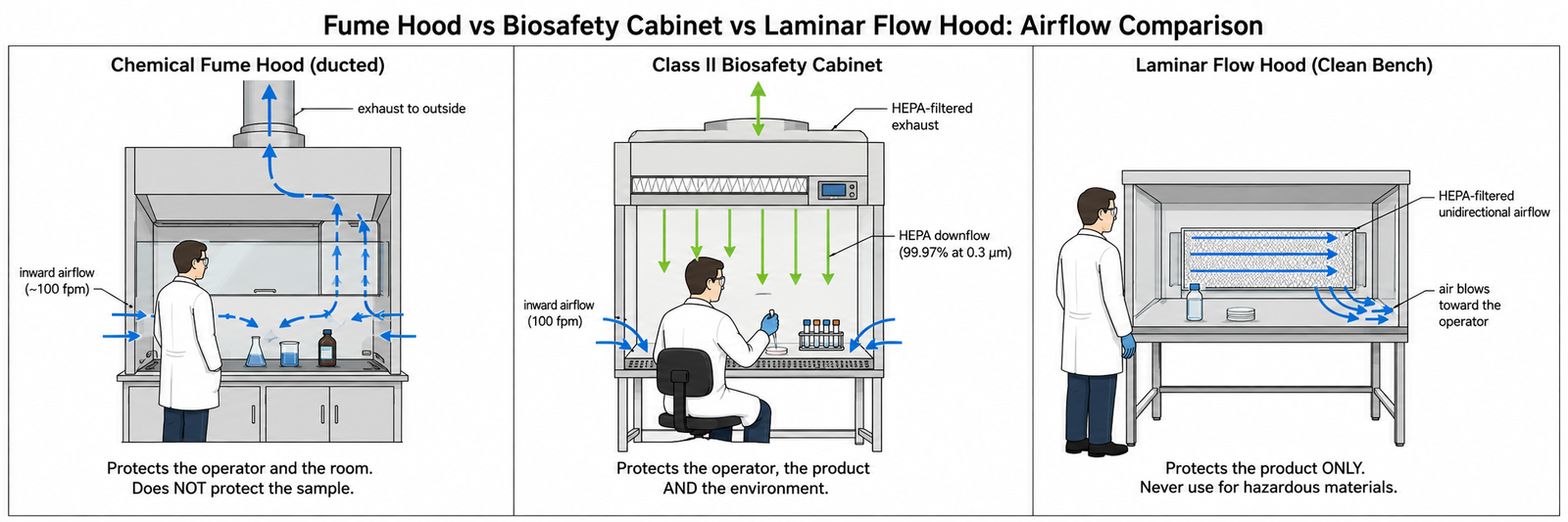
After this section you can choose the category your work belongs to and read the matching section for the next step.
Chemical Fume Hood: What to Specify
What a fume hood is designed to do
A chemical fume hood is a ventilated enclosure that draws room air in through the sash opening, across the work surface, and out through an exhaust path. Its job is to capture chemical vapors, fumes, dusts, and mists before they reach the breathing zone. The common acceptance target is a face velocity near 100 fpm at the working sash height, and a continuous monitor such as a Magnehelic gauge or digital flow meter should read 100 fpm or higher during use (UCSC EHS). That number is a screening check, not proof of containment on its own; performance is verified by testing such as ASHRAE 110.
What a fume hood does not do matters as much as what it does. It provides no product protection and no sterility, so it cannot double as a clean bench for cell culture. Without HEPA on the exhaust it does not reliably contain bioaerosols, which is why infectious work belongs in a biosafety cabinet, not a hood. The fume hood’s boundary is chemical exposure control: it protects the operator and the room, and that is where its duty ends.
Ducted or ductless
The first specification decision is how the air leaves. A ducted hood sends contaminated air to the building exhaust and out of the building; a ductless hood filters it through matched media — carbon for organic vapors, HEPA for particulates — and returns it to the room.
| Ducted fume hood | Ductless fume hood | |
|---|---|---|
| Exhaust path | Building exhaust, outside | Filtered, returned to room |
| Best fit | Strong, toxic, or reactive chemicals | Lighter duty, matched to filter |
| Facility need | Ductwork, exhaust fan, makeup air | Power and space only |
| Filter load | None on the hood | Matched carbon/HEPA, replaced on schedule |
Ducted is the default whenever the chemistry is strong, toxic, or high-volume, because it removes the contaminants instead of holding them. Ductless works where the chemicals are a known, limited set that the selected filter can handle and where the facility cannot support ductwork. Ductless is not a universal replacement; if the filter does not match the chemistry, the hood becomes a recirculating source of the exact vapor it should contain. The ductless fume hood page covers the filter-matching decision in detail.
Face velocity and certification
The second specification decision is the acceptance number and the test record. Most facilities accept a fume hood at 100 fpm face velocity measured at the certified sash position, and work is done at least 6 inches back from the sash plane with the sash as low as the procedure allows (UCSC EHS). The OSHA laboratory standard requires containment for work with particularly hazardous substances, so the hood’s certification record is a compliance input, not an optional extra. Ask for the hood’s last test date and the standard used — ASHRAE 110 for performance, with the facility’s own annual schedule on top. If the article lands on a fume hood, the types of fume hoods guide walks the full type selection from here.
What to bring to a supplier
The third specification step is assembling the inputs a supplier needs to quote a real hood. Bring a hazard inventory: the chemicals, their typical volumes, and whether any are perchloric acid or other chemistry that forces a special construction. Bring the process: which operations generate the exposure and how often. Bring the facility facts: available exhaust or the need for ductless, the room’s makeup-air situation, and the bench footprint. Bring the target: 100 fpm face velocity, and the sash height you expect to work at. Size expectations help the supplier, too: a 4-ft hood at a 12-inch sash draws about 400 cfm, and a 6-ft hood at the same velocity draws about 600 cfm. The arithmetic behind those figures is worked through in the fume hood airflow calculation guide. A supplier can size the hood, the duct, the fan, and the controls only when these are on the table; a request that opens with “a fume hood, please” gets a generic answer.
After this section you can decide whether ducted or ductless fits your chemistry and facility, and you can assemble the hazard inventory, process, and facility facts a supplier needs for a defensible quote.
Biosafety Cabinet and Laminar Flow Hood: When They’re the Right Call
Biological work routes to a biosafety cabinet, and the reason is the filter. A BSC’s HEPA filter removes 99.97% of particles at 0.3 µm (UCSC EHS), which is how it contains aerosols from infected cultures and from procedures that aerosolize biological material. Air enters at the front opening, HEPA-filtered downflow covers the work surface, and the exhaust passes through another HEPA filter before it returns to the room or leaves through a thimble. A Class II A2 cabinet holds a 100 fpm inward airflow at the front opening, and a Class I cabinet — used where product sterility is not required — holds a minimum of 75 fpm inward. The CDC and NIH biosafety guidelines classify these cabinets and define how they are selected.
The boundary you must not cross is the chemistry. HEPA filters capture particles, not molecules: ethanol, formaldehyde, and methanol pass straight through and can accumulate inside the cabinet. A BSC cannot be used as a fume hood for volatile chemicals, and the “fume hood vs biosafety cabinet” answer for solvents is always the fume hood. If a biological protocol adds volatile chemicals, the chemical step moves to a fume hood or to a BSC specifically built and certified for trace amounts, and that decision belongs to the biosafety officer.
Which BSC you need — the class, the type, the airflow split — is not a reader decision. The biosafety officer and the institutional biosafety committee assign the class through a risk assessment of the agents and procedures. Your job is to establish that the work is biological and that a BSC is required, then take the hazard inventory to the biosafety office. The standard that governs BSC certification is NSF/ANSI 49, with annual certification and certification after any move (UCSC EHS).
Clean work routes to a laminar flow hood only when there is no hazard. The clean bench pushes HEPA-filtered air across the work surface toward the operator; there is no inward barrier and no exhaust, so it protects the product alone. For solvents, toxins, or biological agents, that airflow delivers the hazard to the operator’s face, which is why a clean bench must never be used for hazardous work. For genuinely non-hazardous work that needs a clean environment — media preparation, plant tissue culture, electronics assembly — a laminar flow hood is the right and only call (Thermo Fisher). Mammalian cell culture does not belong here: the accepted practice is a Class II BSC that protects the culture and the operator together.
| Combined work | Right setup | Wrong setup |
|---|---|---|
| Cell culture + small-volume fixative | BSC for culture; chemical step under a fume hood or a BSC certified for trace amounts | Clean bench, or recirculating solvent through a standard BSC |
| Chemistry + a sterile product need | Fume hood for the chemistry; BSC or clean bench for the sterile step | One device trying to do both |
Mixed chemical and biological workflows need a sequence, not a compromise. Fix tissue with methanol under the fume hood, then culture under the BSC. The order matters because each step goes to the machine built for its hazard, and no single cabinet replaces the pair.
After this section you can determine whether your work is biological or clean, and you can name the next person to involve — the biosafety officer for biological work, or a supplier for a clean bench.
Fume Hood vs Biosafety Cabinet Decision: One Worked Example and What to Send
Work one lab through the two questions so the routing is concrete. A research group moving into a shared facility will run three workflows: mammalian cell culture, immunostaining with methanol and formalin, and sterile media preparation. Q1 asks whether hazardous materials are involved — yes, cell lines are biological and methanol and formalin are volatile chemicals. Q2 asks which hazard — mixed, so the answer is a plan. Cell culture routes to a Class II biosafety cabinet, the accepted device for BSL-2 culture work. Immunostaining routes its chemical steps to a fume hood or to a BSC certified for trace amounts, because HEPA does not capture methanol vapor. Media preparation is non-hazardous, so it routes to a laminar flow clean bench.
| Workflow | Device | Key numbers | Why |
|---|---|---|---|
| Cell culture (BSL-2) | Class II biosafety cabinet | 100 fpm inflow; HEPA 99.97% at 0.3 µm | Protects operator, product, environment |
| Immunostaining (methanol / formalin) | Fume hood for the chemical steps (or BSC certified for trace amounts) | 100 fpm face velocity; a 4-ft hood at a 12-inch sash ≈ 4 sq ft × 100 fpm ≈ 400 cfm | HEPA traps particles, not solvent vapor |
| Media prep (non-hazardous) | Laminar flow clean bench | ISO Class 5 / Class 100 | Product protection only |
The one lab needed three different machines because each workflow had a different hazard and a different protection target. Confirm the 400 cfm figure with the hood manufacturer and a field test, because sash height and geometry change it.
When the answer is a fume hood, this is the sentence to send to your EHS office or supplier:
“We run [list the chemicals and approximate volumes], need a [ducted or ductless] fume hood, target 100 fpm face velocity, work up to [sash height], in a lab with [exhaust available / no ductwork]. Please confirm certification to ASHRAE 110 and the full quoted scope, not just the cabinet.”
Fill in the bracketed fields and the request is specific enough for a supplier to size the hood, the duct, and the fan. If the answer is a biosafety cabinet or a clean bench, the sentence shortens to a handoff: “We work with [agents], please assign the BSC class” to the biosafety officer, or “we need a clean bench for non-hazardous [process]” to a supplier.
After this section you can run your own workflow list through the same two questions and produce the equipment list and the one-sentence spec request that go with it.
Common Selection Mistakes
| Mistake | What happens | The rule |
|---|---|---|
| Clean bench for hazardous chemicals | HEPA air pushes vapors or aerosols toward the operator | Hazards go in exhaust-type or HEPA-containment devices |
| BSC used as a fume hood | Methanol vapor passes the HEPA filter (99.97% at 0.3 µm traps particles, not molecules) and accumulates | Volatile chemicals need exhaust or adsorption, not HEPA alone |
| Fume hood used as a sterile bench | The 100 fpm inward airflow protects the operator, not the product | Sterile work needs product protection from a BSC or clean bench |
| Working inside a hood beyond the certified sash mark | Containment is only verified up to the certified sash height; face velocity drops as the opening grows | Keep the sash at or below the mark and work at least 6 inches back |
| Buying on cabinet price without scope | Installation, certification, and filters often exceed the cabinet cost | Budget the total, not the cabinet |
| Skipping certification | A failed airflow monitor or worn HEPA removes the protection | Recertify fume hoods and BSCs on the institution’s schedule, typically annual |
The pattern behind every row is the same: each mistake assumed a machine could do a job its airflow was never designed for. Check your own plan against the rows before you commit budget. After this section you can rule out the common failure modes in your own setup.
Cost and Project Inputs for the Fume Hood vs Biosafety Cabinet Decision
Price is a frequent companion to this search, and it is a real decision variable, but no reliable range belongs here. What belongs is the cost structure, because each device spends money in a different place and the cheapest cabinet can be the most expensive project.
| Line item | Ducted fume hood | Ductless fume hood | Biosafety cabinet |
|---|---|---|---|
| Cabinet | Base | Base | Higher (internal blower + HEPA) |
| Ductwork and exhaust fan | Significant | None | Thimble/duct optional |
| Makeup air | Required | Minimal | Minimal |
| Certification | ASHRAE 110, typically annual | Filter monitor; periodic service | NSF/ANSI 49, annual |
| Consumable filters | None on the hood | Carbon/HEPA, replaced on schedule | HEPA, replaced on schedule |
Two numbers put the facility cost in perspective. A 4-ft hood at a 12-inch sash draws about 400 cfm, and a 6-ft hood at the same velocity draws about 600 cfm; the building must supply that as makeup air and move it out through the exhaust. Those figures follow from the face velocity target of 100 fpm, the same number a BSC’s HEPA filter efficiency of 99.97% answers against in its own certification. A ductless hood removes the ductwork line but adds a permanent filter line, and a BSC adds certification to its purchase price. Budget the total — cabinet, installation, certification, and filters — not the cabinet.
Gather the inputs before you talk to vendors: a hazard inventory with chemicals, volumes, and biological agents at their risk level; the procedures that generate exposure; the facility’s exhaust and makeup-air capacity; and a budget that includes installation and certification. If your decision lands on a fume hood, the Laboratory Fume Hoods range covers ducted, ductless, and special-purpose models, and the types of fume hoods guide walks the full selection. If it lands on a biosafety cabinet or a clean bench, take the inventory to your biosafety officer and a certified equipment provider; XICHENG manufactures fume hoods, not biosafety cabinets or clean benches, so we will not pretend otherwise.
The fume hood vs biosafety cabinet decision is a protection decision: name the hazard, match the airflow, verify with a standard, and confirm with the officer responsible for the lab. After this section you can decide which device your hazard inventory supports, who approves it, and what total to budget.
FAQ
Can a biosafety cabinet be used as a fume hood?
No. A BSC’s HEPA filters trap particles, but vapors and gases pass through and can accumulate. Volatile chemicals belong in a fume hood or in a BSC built and certified for trace amounts.
Can a laminar flow hood protect you from chemical vapors?
No. A clean bench has no exhaust and blows filtered air toward the operator. It must never be used with hazardous chemicals or biological agents.
What does a fume hood not protect?
The sample. A fume hood provides no product protection or sterility, which is why clean, sterile work needs a biosafety cabinet or a clean bench, not a hood.
What are the two types of fume hoods?
Ducted hoods exhaust to the outside, and ductless hoods filter the air and return it to the room. Ductless requires matched filters and is not suitable for every chemical.
Can a biosafety cabinet replace a laminar flow hood for clean work?
A Class II BSC also protects the product, but it is engineered for biological containment. For genuinely non-hazardous clean work, a clean bench is the simpler device; your biosafety officer’s risk assessment determines the classification.
Leave a Reply