




Key Takeaways
- A fume hood airflow calculation is a planning estimate of the exhaust volume: CFM equals face velocity times open sash area, and the result only holds for the exact sash height and face velocity you entered.
- Use the net clear opening width, not the nominal hood width — sash tracks, side posts and airfoils shrink the real area, and the ÷144 inch-to-square-foot step only works on the net figure.
- The target face velocity is your input, not the article’s: cite your institution’s band (for example 80–120 fpm hazardous-chemistry certification) or the hood specification, since 100 fpm is common but not universal.
- Units must stay consistent: 1 fpm = 0.00508 m/s and 1 CFM ≈ 1.699 m3/h, and mixing ft² with m² is one of the most common causes of wrong results.
- A calculated CFM is a design estimate, not an acceptance test: field balancing, velocity measurement and ASHRAE 110 containment testing verify the installed hood.
A fume hood airflow calculation answers one practical question: how many cubic feet per minute (CFM) — or cubic meters per hour (m3/h) — must the exhaust system deliver for this hood, at this sash opening, at this face velocity? The math is simple: multiply face velocity by the open sash area. The traps are everywhere else — using the nominal width instead of the clear opening, using the wrong sash height, mixing imperial and metric units, or believing the calculated number is what the hood will actually draw once it is installed. The calculation runs in both unit systems, with a complete forward example, a reverse example (what sash height a given CFM allows), and the result placed into the makeup-air and control discussion, and draws the line between an estimate and a field-verified measurement. You will leave with a calculation card you can put directly into a project file.
Direct Answer: The Fume Hood Airflow Calculation Formula
A fume hood airflow calculation estimates the exhaust volume by multiplying face velocity by the open sash area: CFM = face velocity (fpm) × open area (ft²), with inch measurements converted by width × height ÷ 144. Face velocity is the average speed of air entering through the sash opening, the same number your institution’s requirements band and your hood specification define; open area is the net opening you actually work through. The estimate holds only for the exact sash height and face velocity you entered, and it is a planning estimate rather than an acceptance test — the installed hood must still be balanced and verified on site.
| Variable | Meaning | Example value |
|---|---|---|
| Face velocity | Average inward air speed at the sash plane | 100 fpm (institutional band input, e.g. 80–120 fpm) |
| Open sash area | Net opening width × operating sash height | 6 ft × 1.5 ft = 9 ft² |
| Volume flow | The exhaust volume the system must deliver | 9 ft² × 100 fpm = 900 CFM |
The reverse form is equally useful: face velocity = exhaust airflow ÷ open area, and open area = airflow ÷ face velocity. Those two rearrangements let you check an existing system (is 900 CFM producing 100 fpm across a 9 ft² opening?) and size an operating condition (what sash height does 600 CFM allow at 100 fpm?). All three forms use the same two inputs, which is why getting the inputs right is the real calculation.
Inputs You Need Before Calculating
Clear Opening Width: Net Width, Not Nominal
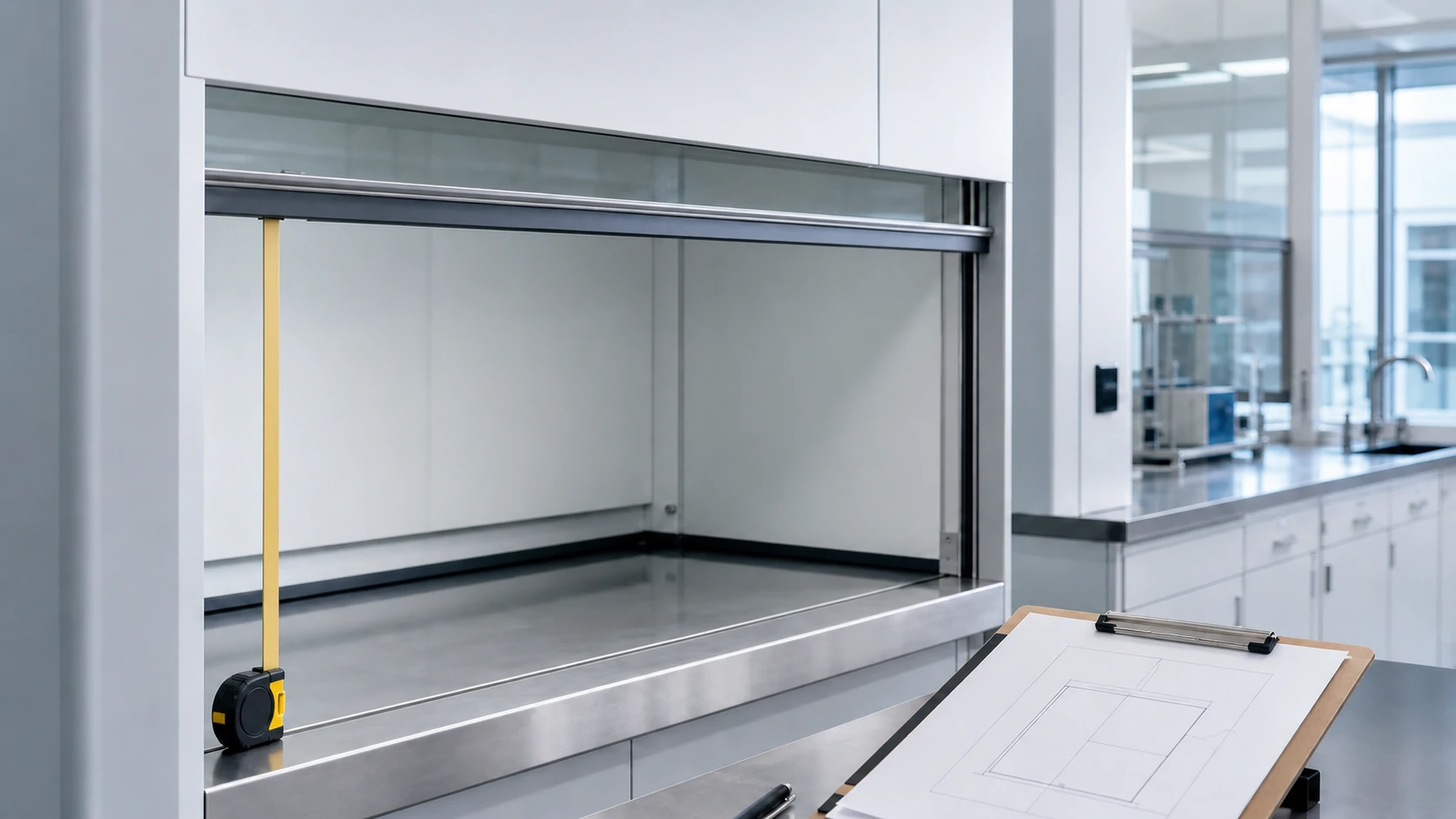
The first input is the width of the opening the air actually moves through. Hoods are cataloged by nominal width (4-foot, 6-foot, 8-foot), but the usable opening is smaller: sash tracks, side posts, framing, and the bottom airfoil reduce the clear width, so the nominal dimension overstates the area (LOC Scientific’s CFM calculation guide makes this the first correction). Measure the clear opening width inside the sash frame — the value you write beside the calculation, not the brochure width. For a 6-ft hood with a 2-inch side-post allowance on each side, the clear width is about 5.7 ft; a 6-ft area input would overstate airflow by roughly 10% at the same face velocity.
Operating Sash Height: The Height That Matters
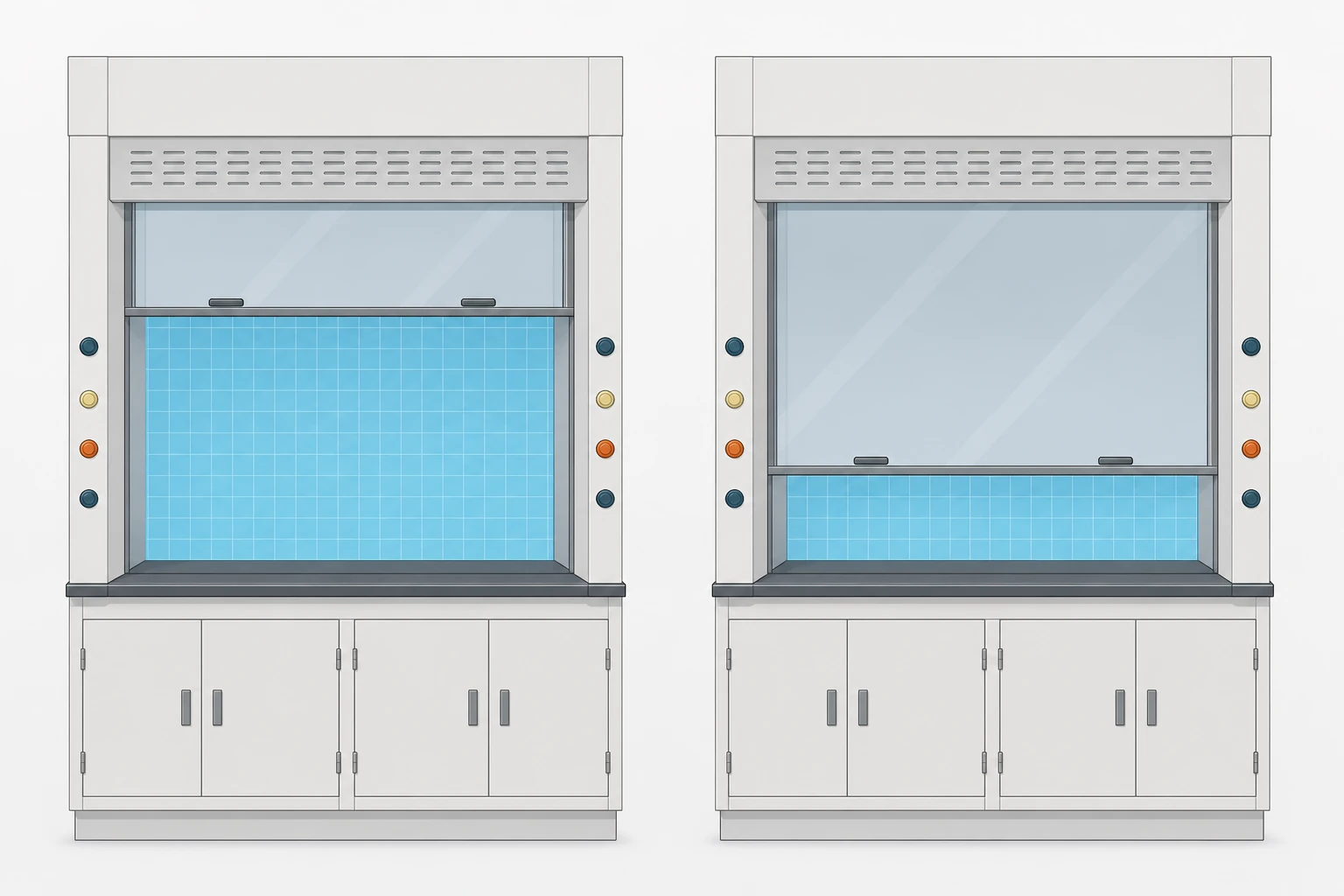
The second input is the sash height that the hood will actually operate at, not the fully open position. Institutions typically set a working sash range — commonly 12 to 18 inches in operating guidance — and the calculation must use the approved operating height for your procedure. A 6-ft hood at 18 inches of sash gives a 9 ft² opening and needs 900 CFM at 100 fpm; the same hood at 12 inches gives 6 ft² and needs 600 CFM. If your process is certified at a specific sash stop, that height is the input; if no operating height is defined, the question belongs in the specification before the calculation has any meaning.
Target Face Velocity: Your Input from Institution or Hood Spec
The third input is the face velocity the hood must maintain, and it comes from your institution’s requirements or the hood specification — not from a universal rule. The same structure carries over from the fume hood face velocity requirements guide: 60–100 fpm for general laboratory work, 80–120 fpm for hazardous-chemistry certification, acceptance bands such as 80–150 fpm in university policy, and 0.4–0.6 m/s as the metric reference on ductless-family specifications.
| Input | What you write down | Where the value comes from |
|---|---|---|
| Net clear opening width | Measured inside the sash frame (e.g. ~5.7 ft for a 6-ft hood) | Field measurement; not the nominal width |
| Operating sash height | e.g. 12–18 inches as approved | Institution working range / procedure |
| Target face velocity | e.g. 100 fpm (band 80–120 fpm) | Institution EHS band or hood spec |
Fume Hood Airflow Calculation in Imperial and Metric
Imperial Worked Conversion
The imperial sequence converts inches to square feet first, then multiplies by face velocity. A hood with a clear opening width of 60 inches and an operating sash height of 18 inches: open area = 60 × 18 ÷ 144 = 7.5 ft²; at a 100 fpm target, CFM = 7.5 × 100 = 750 CFM (the same figures LOC Scientific uses in its example). Record both inputs beside the result, because the 750 CFM is meaningless without its 18-inch, 100-fpm condition.
Metric Worked Conversion
The metric sequence converts airflow to cubic meters per hour directly. A hood with a clear opening of 1.8 m width and 0.45 m operating sash height has an open area of 1.8 × 0.45 = 0.81 m²; at 0.5 m/s face velocity, the volume flow is 0.81 m² × 0.5 m/s × 3600 = 1458 m3/h. The result is the metric twin of the imperial estimate, and it carries the same condition caveats: change the sash height or the face velocity and the number changes.
CFM to m3/h and fpm to m/s Reference Table
| Convert | Multiply by | Example |
|---|---|---|
| fpm → m/s | 0.00508 | 100 fpm = 0.508 m/s |
| m/s → fpm | 196.85 (1 ÷ 0.00508) | 0.5 m/s ≈ 98.4 fpm |
| CFM → m3/h | 1.699 | 900 CFM ≈ 1529 m3/h |
| m3/h → CFM | 0.5886 (1 ÷ 1.699) | 1458 m3/h ≈ 858 CFM |
| in² → ft² | ÷ 144 | 1080 in² = 7.5 ft² |
| ft² → m² | 0.0929 | 9 ft² ≈ 0.836 m² |
The conversion factors in this table are unit-system definitions, not performance claims, and they are exact to the precision shown. Mixing systems is the error to avoid: a 900 CFM result and a 0.81 m² area input cannot be combined with the same formula — pick one system, convert all inputs, then calculate once.
Step-by-Step Calculation and Worked Examples
Worked Example: 6-Foot Hood at 18-Inch Sash
A 6-ft benchtop hood operates with an 18-inch sash height; the institutional band for the chemistry is 80–120 fpm, so the project target is 100 fpm. Step 1: clear opening area = 6 ft × 1.5 ft = 9 ft². Step 2: required airflow = 9 ft² × 100 fpm = 900 CFM — the same arithmetic industry design references use for a 6-ft hood at an 18-inch working sash. Step 3: the makeup air question — the room supply must be able to deliver roughly 900 CFM of replacement air, because the hood exhausts what the room supplies. The published sanity checks agree: a 4-ft hood at a 12-inch sash draws about 400 CFM (4 ft² × 100 fpm) and a 6-ft hood at 12 inches about 600 CFM (6 ft² × 100 fpm), the numbers used in the fume hood comparison guide.
| Condition | Clear opening | At 100 fpm |
|---|---|---|
| 4-ft hood, 12-inch sash | 4 ft² | 400 CFM |
| 6-ft hood, 12-inch sash | 6 ft² | 600 CFM |
| 6-ft hood, 18-inch sash | 9 ft² | 900 CFM |
| 60-inch width, 18-inch sash | 7.5 ft² | 750 CFM |
Reverse Calculation: Sash Height a Given CFM Allows
The reverse direction answers “my exhaust can deliver X CFM — how high can the sash be?” Rearrange the formula: open area = airflow ÷ face velocity, then sash height = open area ÷ width. With 600 CFM available and a 100 fpm target, the allowed area is 600 ÷ 100 = 6 ft²; on a 6-ft hood, the allowed sash height is 6 ft² ÷ 6 ft = 1 ft = 12 inches. If the institution requires an 18-inch working sash, 600 CFM is not enough — the requirement forces 900 CFM or a lower-certification face velocity. That comparison is the point of the reverse form: it converts a system capacity into an operating limit you can enforce.
Sash Height Changes the Number: 12-inch vs 18-inch Rows
Sash height is the lever with the largest effect on the result, because area scales linearly with it. The same 6-ft hood jumps from 600 CFM at 12 inches to 900 CFM at 18 inches at the same 100 fpm — a 50% airflow increase from six inches of sash. VAV systems use this relationship to cut airflow as the sash closes; CAV systems hold the volume constant, which means the face velocity rises as the sash lowers (Northwestern’s handbook describes the inverse relationship). The calculation itself is identical for both system types: it states the volume for a stated opening and velocity, and the system type decides what happens when the sash moves.
What the Result Feeds: Makeup Air, Fans, Controls and Setpoints
One CFM Feeds the Whole Chain
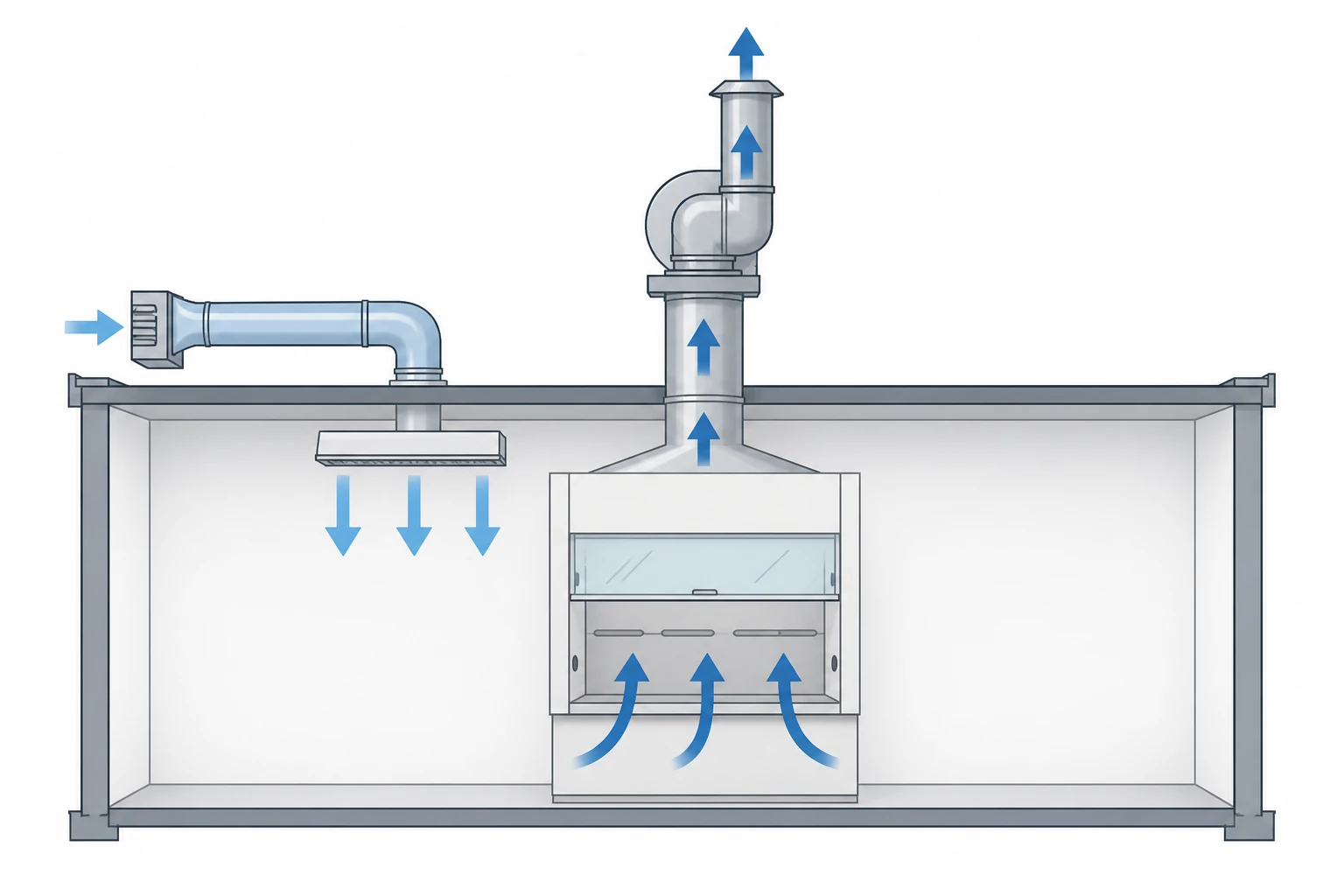
The calculated figure is not only the hood’s number — it is the room’s number. Every CFM exhausted through the hood must be replaced by makeup air, and replacing conditioned air is the dominant operating cost of a hood (manufacturer energy guidance frames the exhaust volume, not the face velocity, as the energy driver). A 900 CFM exhaust needs roughly 900 CFM of replacement supply; a room that cannot provide it starves the hood, and the face velocity falls below the 100 fpm target. The chain runs hood → duct → exhaust valve → fan → stack outdoors, with the supply side bringing replacement air back into the room.
CAV vs VAV: What the Calculation Means per System
The calculation result behaves differently under the two airflow architectures. On a constant-volume (CAV) system, the exhaust volume is fixed — 900 CFM stays 900 CFM — so lowering the sash from 18 inches to 12 inches raises the face velocity from 100 fpm toward 150 fpm; the calculated volume is the fixed design point. On a variable-air-volume (VAV) system, the exhaust tracks the sash to hold a constant face velocity, so the calculation defines the required capacity at the maximum operating opening and, where purge or emergency modes exist, the additional capacity those modes demand. The system-type decision itself belongs to the airflow-control selection guide; the calculation feeds it the numbers.
| System | What the calculated CFM means | Effect of lowering the sash |
|---|---|---|
| CAV | Fixed design exhaust volume | Face velocity rises; volume unchanged |
| VAV | Capacity at max operating opening (+ purge allowance) | Exhaust volume drops; face velocity held constant |
From Calculation to Setpoint: Monitoring and Control
Once the calculation sets the expected volume and face velocity, the control chain turns that number into an operating setpoint. A face-velocity controller such as XICHENG’s FHC11 closes the loop on the measured value: the sensor measures face velocity, the controller compares it with the configured setpoint, and the integrated actuator repositions the damper until the measured signal returns to range. The FHM-5T airflow monitor then displays the resulting face velocity, sash position, and exhaust temperature at the hood. The product boundary matters: the controller regulates the damper and the monitor presents the system’s values — neither creates the measurement, and the alarm identifies an abnormal condition rather than proving containment.
What the Calculation Leaves to Field Work
Why Calculated CFM Differs from Measured Airflow
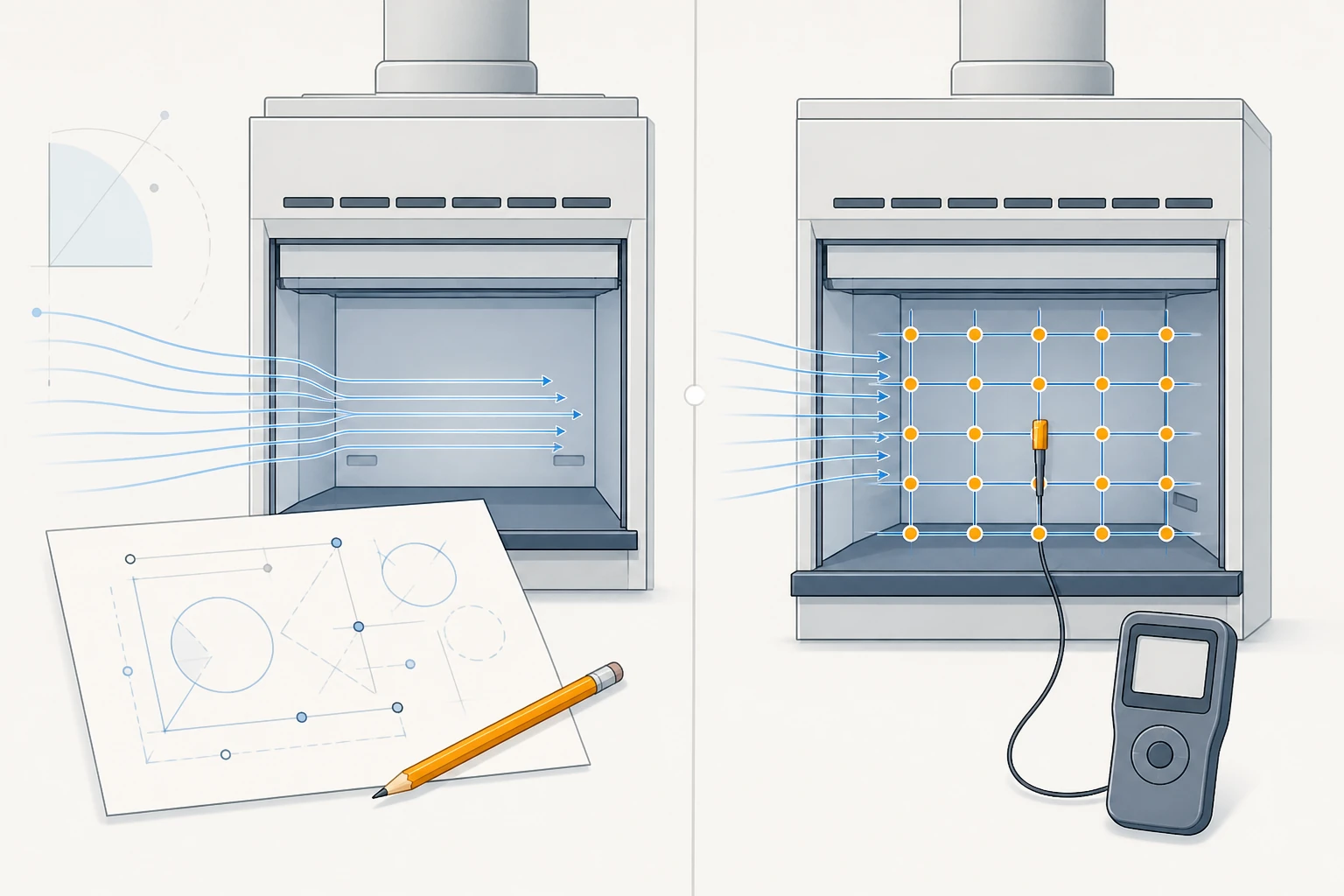
The installed hood almost never matches the calculation exactly, for reasons the formula does not contain. Duct leakage — design guidance allows leakage on the order of 15 CFM per connection in low-pressure exhaust ductwork — directly reduces what reaches the hood; unaccounted openings such as electrical pass-throughs add unintended inlets that lower the achieved face velocity; and balancing instruments disagree, with industry testers reporting VelGrid-style devices reading 5–10% higher than hot-wire anemometers.
| Deviation source | Typical magnitude | What it does to the estimate |
|---|---|---|
| Duct leakage at connections | ~15 CFM per connection | Reduces the delivered face velocity (e.g. 900 CFM sized → ~98 fpm achieved) |
| Unaccounted openings | Pass-throughs, casing gaps | Adds bypass inlets; achieved velocity below target |
| Balancing instrument method | 5–10% difference (velgrid vs hot wire) | Reported velocity higher than hot-wire reference |
Field balancing and velocity measurement exist precisely because the estimate cannot see these effects.
Containment Is a Separate Test
The calculation also cannot answer the safety question. Face velocity is a flow check, and containment — whether the hood holds tracer gas and keeps the operator protected — is verified by ASHRAE 110 tracer-gas testing and by the field measurement methods covered in the face velocity requirements guide. A hood can meet its calculated and measured airflow and still fail containment under room conditions; conversely, a well-designed hood can contain at lower velocities than a generic band suggests. When the question is safety rather than flow, the tracer-gas test carries the verdict, not the arithmetic.
Common Calculation Mistakes
| Mistake | Why it fails | Consequence |
|---|---|---|
| Using nominal hood width | Tracks, side posts and airfoils shrink the real opening (a 6-ft hood can measure ~5.7 ft clear) | Overstated area → oversized fan and vent |
| Using the fully open sash height | Operating height is usually lower (12–18 inches typical) | Overstated CFM or a wrong reverse result |
| Confusing CFM with face velocity | Units of volume vs speed are not interchangeable | Wrong conversation with engineers |
| Applying 100 fpm universally | The input belongs to your institution/hazard (60–100 or 80–120 fpm bands) | A band mismatch that mis-sizes the system |
| Mixing imperial and metric | Formula constants differ per system | Unit-combination errors (ft² with m/s) |
| Sizing a fan from CFM alone | Static pressure and duct geometry also decide fan choice | Blower that cannot deliver the volume in the system |
| Believing the estimate is the test | Field effects (leakage ~15 CFM, balance, turbulence) change the installed result | A certified-looking number with no measurement behind it |
Next Steps: Calculate, Verify, and Connect to the System
Your sequence is now three steps long:
| Step | What you do | What you produce |
|---|---|---|
| 1 | Write the three inputs with sources (net width, operating sash height, institutional face velocity band) and compute forward and reverse values | A calculation card (e.g. 9 ft² × 100 fpm = 900 CFM; reverse: 600 CFM ÷ 100 fpm ÷ 6 ft = 12-inch sash) |
| 2 | Verify the installed hood with field balancing and velocity measurement | Measured values compared with the estimate (± the real deviation) |
| 3 | Hand the numbers to the system conversation | Makeup-air volume, CAV/VAV behavior, purge allowance, control setpoint |
The estimate becomes a design input, never a certificate. Your next step is the calculation card: fill it in, check it against your institution’s band, and take it to the engineer with the makeup-air question.
For the control and monitoring layer, the fume hood face velocity controller page documents closed-loop setpoint control and low-velocity alarms, and the fume hood airflow monitor covers the operator display; the fume hood face velocity requirements guide attributes the input bands you need, and the ductless vs ducted fume hood comparison covers recirculating units with their own metric reference. Fume hood airflow calculation is the planning math the whole system conversation starts from — and the installed measurement is where it ends. Before you size anything, your next step is the policy call: confirm the band from the CHP, fill the calculation card, and let the field measurement carry the verification.
FAQ
- How do I calculate fume hood CFM? — Multiply the face velocity (fpm) by the open sash area (ft²); with inch dimensions, convert first using clear width × sash height ÷ 144. Example: 9 ft² × 100 fpm = 900 CFM.
- How much CFM does a fume hood need? — It depends on the opening and the face velocity: a 6-ft hood at an 18-inch sash needs about 900 CFM at 100 fpm, and about 600 CFM at 12 inches; your institution’s face velocity band is the input that decides the number.
- Does sash height change the CFM? — Yes, in direct proportion: at the same face velocity, halving the sash height halves the open area and therefore the required airflow.
- How do I convert CFM to m3/h? — Multiply by 1.699; conversely divide by 1.699 for m3/h to CFM. Face velocity converts with 1 fpm = 0.00508 m/s.
- Can I use the calculated CFM instead of testing? — No. The calculation is a design estimate; field balancing, velocity measurement, and ASHRAE 110 containment testing verify the installed hood.
Leave a Reply