


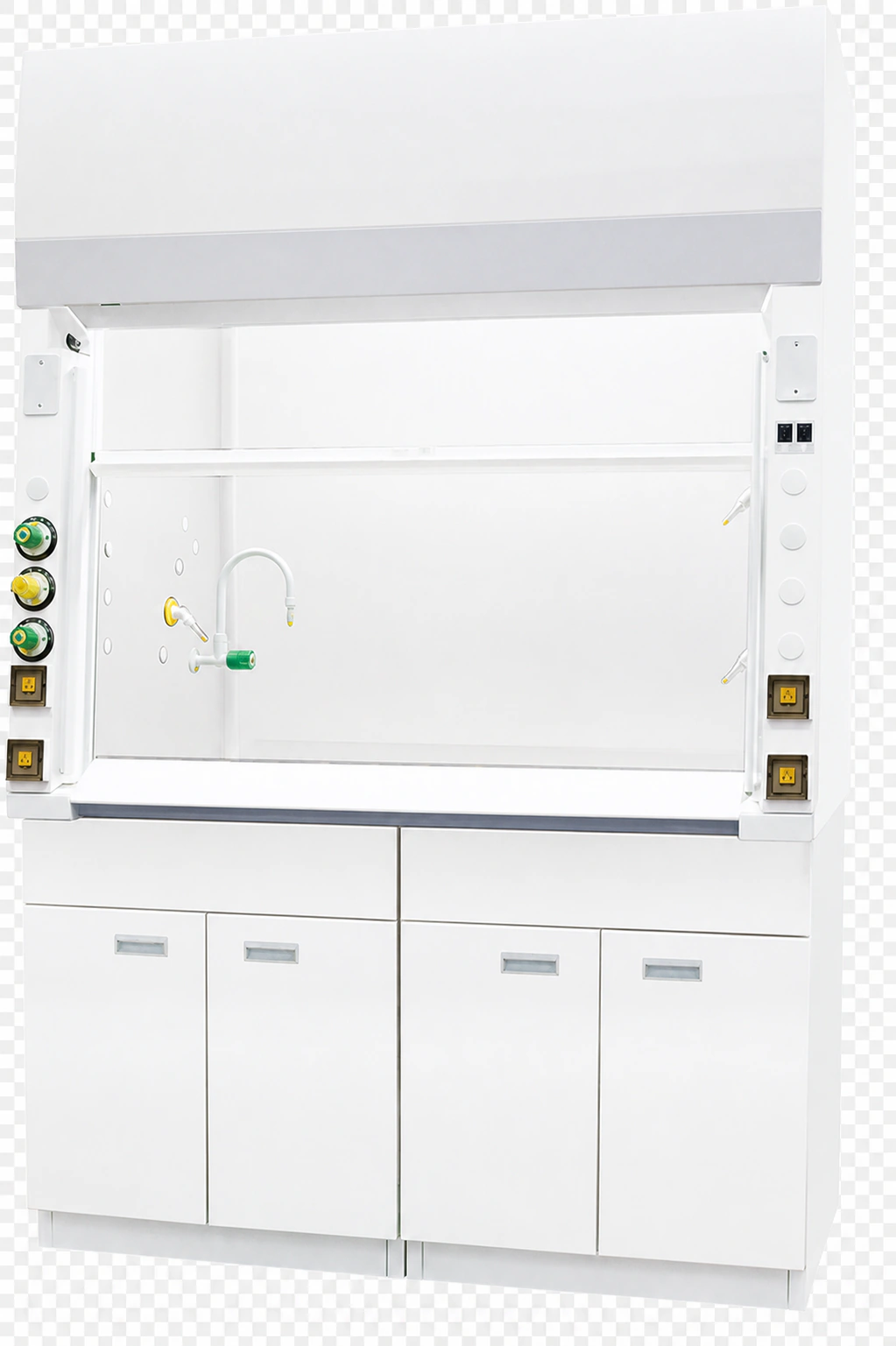
Description
Acid Digestion Fume Hood for Heated Corrosive Processes
An acid digestion fume hood is a ducted laboratory enclosure configured for heated, concentrated or frequently repeated non-perchloric mineral-acid procedures. It provides a defined work zone around digestion vessels, heater blocks and associated services while connecting that zone to a corrosion-aware exhaust system. The final configuration is selected from the actual acids, concentrations, temperatures, batch quantities, apparatus and operating schedule because those conditions determine which components face splash, vapor, condensate, local heat and cleaning exposure.
XICHENG supplies the hot-acid digestion hood as a made-to-order hood family rather than a fixed retail cabinet. The project specification can define the work-zone material, work surface, sash, baffle, service fixtures, opening, external dimensions, exhaust connection, airflow monitor and optional washing or drainage interfaces. Ductwork, a remote fan and exhaust treatment can also be coordinated, but they are not assumed to be included unless the quotation lists them. The approved drawing and component schedule establish the manufactured arrangement for each order.
What Is
The enclosure is intended for acid-digestion work where process heat and corrosive exposure require more deliberate construction than an ordinary general-purpose chemical hood. Its work chamber may use PVC/uPVC, polypropylene or a reviewed combination of materials; the work surface may use an epoxy or phenolic-resin direction with a retaining edge; and a polycarbonate sash may be selected when the process includes hydrofluoric-acid exposure that could attack or cloud glass. These are configuration directions, not a statement that one arrangement is suitable for every acid mixture or temperature.
The hood also creates a controlled interface for the apparatus. Vessel height, heater footprint, service hoses, electrical leads, exhaust manifolds and maintenance access must fit without obstructing the working opening or the intended airflow path. Local radiant and conducted heat can affect the worktop, liner, sash and seals differently, so an apparatus temperature cannot be treated as the temperature rating of the complete hood. The engineering review therefore considers both the chemistry and the physical layout before material and dimensional choices are finalized.
Reference width directions of 1200, 1500 and 1800 mm are available for early room planning. They provide a starting point for comparing apparatus envelope, operator access and exhaust demand, but the final opening, chamber depth, collar and service locations follow the actual equipment layout. A wider cabinet is not automatically the safer or more effective choice if the installed apparatus blocks the rear baffle, pushes work toward the sash plane or leaves inadequate service clearance.
Why Acid Digestion Requires More Than a Standard Chemical Hood
Acid digestion combines several loads that must be reviewed together. A concentrated mineral acid may produce corrosive vapor, the heated vessel may release a stronger plume than an ambient-temperature procedure, and repeated batches can increase condensate or residue on exposed components. Hydrofluoric acid adds a separate glass-compatibility concern, while mixed-acid procedures may expose the worktop, sash, fixtures and exhaust path to different conditions at different stages. Selecting a hood only from the generic phrase “acid resistant” leaves these component-level differences unresolved.
The work-zone material is therefore one decision within a complete exposure path. The liner and baffle face the chamber atmosphere; the work surface faces spills and hot apparatus; the sash and frame face vapor and cleaning; fasteners, seals and fixtures may experience local splash; and the collar, duct, remote fan and any treatment equipment face the extracted stream. Each component must be checked against the listed chemicals, concentration, temperature and contact mode. A suitable polymer liner does not by itself establish the compatibility of the rest of the system.
Exhaust selection also depends on the operating geometry. The required volume is tied to the selected working opening and containment criterion, while the remote fan must overcome losses through the hood, duct, fittings and any scrubber or treatment stage. Room make-up air and pressure can affect the installed result. For this reason, a reference exhaust range supports preliminary planning but cannot replace the project airflow calculation, fan duty selection and site commissioning.
Product Selection Summary
An acid digestion fume hood is appropriate when a documented mineral-acid process creates a combination of corrosive vapor, heat, apparatus load or repeated exposure that requires a purpose-configured work zone and exhaust interface. The first decision is not cabinet width or color. It is whether the project can define the process well enough to select exposed-component materials, fit the apparatus, calculate exhaust duty and assign any washing, drainage or treatment scope.
When to Choose an Acid Digestion Fume Hood
- The procedure heats, concentrates, evaporates or repeatedly uses non-perchloric mineral acids inside a ducted enclosure.
- The acid list, concentration, temperature, quantity, heating method and operating frequency can be documented before material selection.
- Digestion blocks, vessels, condensers, manifolds and service connections can be located without blocking the baffle or pushing routine work outside the selected sash plane.
- The liner, work surface, sash, baffle, fixtures, fasteners, seals and exhaust components can be reviewed separately against their expected exposure.
- The laboratory can provide a corrosion-aware duct, remote fan and discharge arrangement sized for the selected working opening and pressure loss.
- Optional washing, drainage or exhaust treatment can be specified as defined project interfaces rather than assumed from the acid digestion fume hood name.
Key Product-Family Data
The table below brings the first purchase decisions into one place. It identifies the common product-family direction and the project information that changes the final configuration. Values and options remain preliminary until the approved component schedule, drawing and airflow calculation are issued for the order.
The reference width series helps reserve room and compare apparatus capacity, but it does not fix the working opening, chamber arrangement or exhaust requirement. A 1800 mm hood with a large heater array may need a different opening and baffle arrangement from a smaller hood used for a compact digestion block. The process layout and approved drawing therefore remain more important than the nominal width alone.
Do Not Select an Acid Digestion Fume Hood by Name or Liner Material Alone
The phrase “acid resistant” is not a complete specification. A PVC/uPVC liner can address selected chamber exposure while the worktop, sash, fasteners, gaskets, taps, drain, exhaust collar and downstream components remain different materials. Hot vapor can also condense outside the area that receives direct splash. For a defensible selection, the material review must follow the complete exposure path and identify what each component contacts during operation, cleaning and maintenance.
Do not assume that a polycarbonate sash makes the complete hood suitable for hydrofluoric acid. It addresses the viewing-panel concern associated with glass attack, but HF compatibility still depends on the liner, work surface, baffle, seals, fixtures, duct, fan and any treatment equipment. The same component-by-component review applies to nitric, hydrochloric, sulfuric and mixed-acid procedures.
The acid digestion fume hood is also not a substitute for a dedicated perchloric acid fume hood. If perchloric acid can enter the process or exhaust stream, the project must evaluate perchlorate deposits, complete wash coverage, drainage and a dedicated exhaust route under the specialist product scope. Adding an optional rinse connection to an acid digestion hood does not create that system.
A remote fan, scrubber, wash circuit and drain may be required for a project, but none should be assumed to be standard merely because another installation uses them. The quotation must identify each included item, each site-provided interface and the information needed to size or coordinate it. This prevents a cabinet-only order from being mistaken for a complete installed exhaust and treatment system.
Key Specifications and Reference Configurations
The specifications below provide a practical starting point for room layout, apparatus fit and exhaust planning. They describe preliminary configurations within the acid digestion fume hood family, not stocked models or fixed manufacturing limits. Final dimensions, work-zone materials, sash, work surface, exhaust connection and supplied options are defined from the process information and shown on the approved project drawing.
Reference Planning Configurations
Three width directions allow a buyer to compare usable chamber space with the digestion equipment and available laboratory footprint. The chamber width changes with the nominal hood width, while the reference depth and height remain common in this initial planning set. Exhaust-volume directions are included to establish the scale of the mechanical review; they must be recalculated for the selected working opening, containment criterion, duct route, treatment equipment and site pressure conditions.
| Reference Width | Overall Size (W x D x H) | Chamber Size (W x D x H) | Work-Surface Direction | Reference Exhaust Volume |
|---|---|---|---|---|
| 1200 mm | 1200 x 800 x 2350 mm | 950 x 700 x 1100 mm | 25 mm epoxy resin or 30 mm phenolic resin with marine edge | 800-1000 cfm |
| 1500 mm | 1500 x 800 x 2350 mm | 1250 x 700 x 1100 mm | 25 mm epoxy resin or 30 mm phenolic resin with marine edge | 1000-1200 cfm |
| 1800 mm | 1800 x 800 x 2350 mm | 1550 x 700 x 1100 mm | 25 mm epoxy resin or 30 mm phenolic resin with marine edge | 1200-1500 cfm |
These reference exhaust volumes do not establish a guaranteed face velocity or installed airflow. A smaller operating opening may require a different volume than a fully open sash, and a scrubber or long duct route can change the external static pressure required from the fan. XICHENG confirms the final hood connection and equipment schedule after the design team supplies the airflow basis and mechanical-system information.
Compare External Size, Work Zone and Apparatus Envelope Separately
Overall width determines the floor and service-wall allowance, but it does not equal usable chamber width. Side posts, sash guides, service channels and the baffle occupy part of the enclosure. The equipment plan should therefore use the internal chamber dimensions and selected working opening when checking heater blocks, digestion vessels, condensers and manifolds. A tall vessel that fits inside the chamber may still conflict with sash movement, lighting, service fittings or maintenance access.
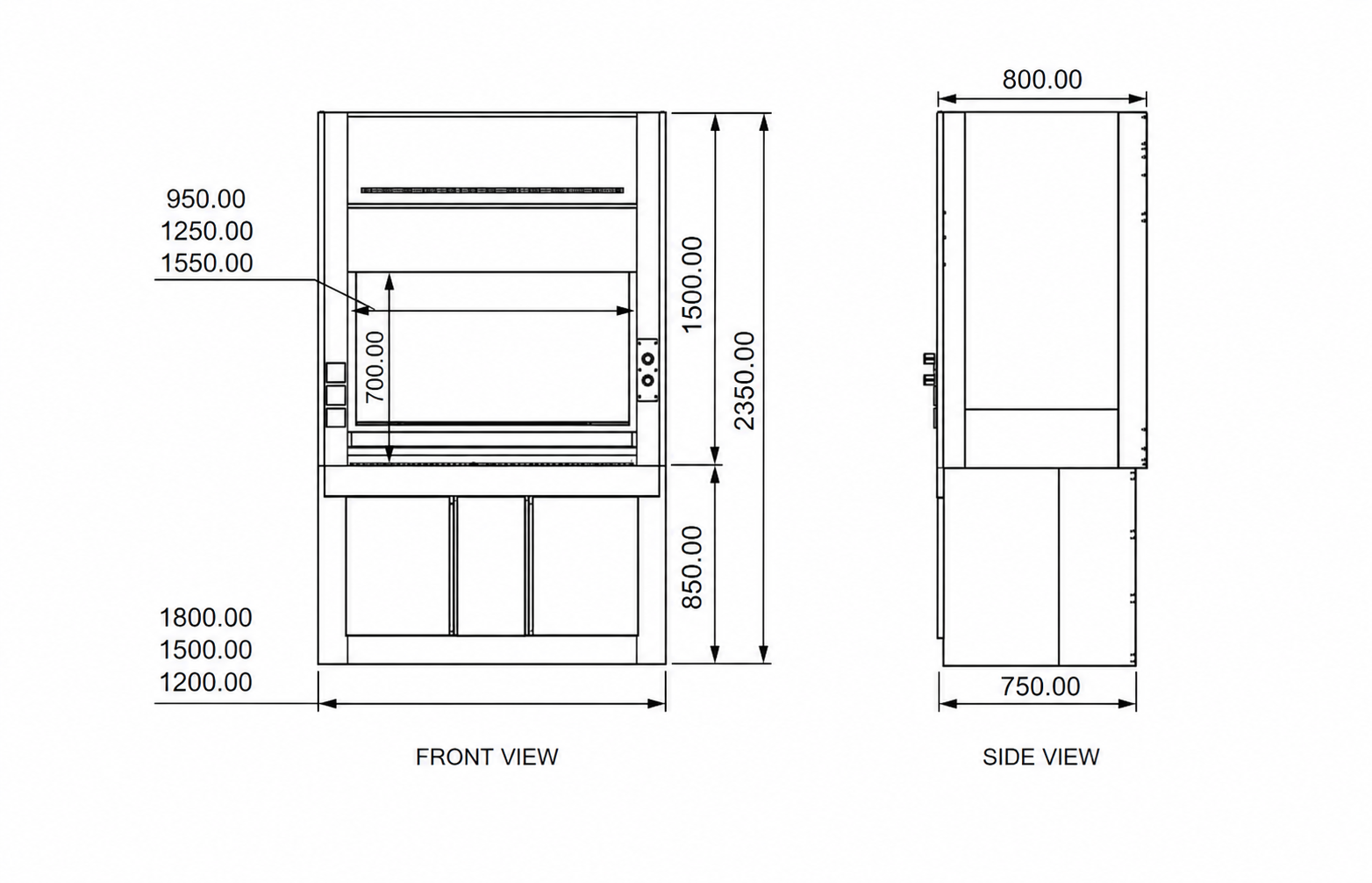
The drawing shows the initial 1200/1500/1800 mm width set, 950/1250/1550 mm chamber-width set and a nominal 2350 mm overall height. It is not the acid digestion fume hoodion drawing for every order. The final drawing must show the selected sash opening, chamber depth, worktop, collar, utilities, base arrangement and apparatus clearances, especially where a heater or vessel projects above the normal work zone.
Installation access needs a separate check. Door widths, corridor turns, lifts, ceiling services and the route to the final position can limit whether a complete cabinet can be moved into the room. Where site access is restricted, the approved manufacturing and installation plan should identify which assemblies are delivered separately and how seals, services and exhaust connections are completed on site.
Reference Material and Interface Options
The work chamber can be configured in PVC/uPVC, polypropylene or a reviewed combination of materials. Selection starts with the actual chemical and thermal exposure, then moves component by component. The work surface faces direct spills and apparatus load, the liner and baffle face vapor and condensate, and the sash, hardware and fixtures may face intermittent splash or cleaning chemicals. The chosen materials must also be practical for fabrication, sealing, inspection and maintenance at the specified temperature.
A 25 mm epoxy-resin or 30 mm phenolic-resin work-surface direction provides a useful early comparison, but the final worktop is selected with the acid list, heat source, vessel load, spill-retention detail and cleaning method. Polycarbonate is a common sash direction for applicable HF work because glass can be attacked or clouded, yet it does not establish compatibility of the remaining hood and exhaust components. Service fixtures, drains and monitor/control options are likewise selected individually.
Work-Zone Materials and Heat Management
Material selection for acid digestion follows the exposure of each component, not a single cabinet label. The design must account for direct spills, corrosive vapor, condensation, cleaning agents, hot apparatus and repeated thermal cycling. A component that performs well under ambient vapor may be unsuitable where a heater transfers concentrated heat or where condensate remains against a joint, fastener or seal.
Review Every Exposed Component
The liner and baffle define most of the visible chamber, but they are only part of the exposure path. The work surface receives vessel load, heat and spills. The sash, sash frame and guides face vapor and cleaning. Service fixtures, fasteners and seals may receive intermittent splash. The collar, duct and remote fan encounter the extracted stream after it leaves the work zone, where cooling can change vapor into condensate. Optional drains and scrubbers introduce additional liquid-contact conditions.
For each component, the project should identify the chemical, concentration, maximum temperature, contact form and expected duration. Direct immersion, splash, vapor, condensate and occasional wipe-down are different conditions even when the acid name is the same. Material thickness, fabrication method, welded or sealed joints and access for inspection also affect the practical design. XICHENG records the selected components in the quotation and approved material schedule so the buyer can review the complete path rather than one headline material.
| Component | Typical Exposure | Selection Question | Project Confirmation |
|---|---|---|---|
| Liner and baffle | Vapor, aerosol, condensate and cleaning contact | Which polymer or reviewed construction fits the chemistry and temperature? | Material, thickness, joints, baffle access and cleanability |
| Work surface | Hot apparatus, direct spill, vessel load and cleaning | Does the surface tolerate the process and retain manageable spills? | Material, thickness, edge/trough detail, load and service penetrations |
| Sash and frame | Vapor, splash, glass-attack risk and repeated movement | Is glass acceptable, or is a polycarbonate viewing panel required? | Panel, frame, guide, opening arrangement and cleaning method |
| Fixtures and hardware | Local splash, vapor and hand contact | Are exposed metals, coatings, seals and fittings suitable? | Tap bodies, fasteners, hinges, handles, gaskets and service connections |
| Collar, duct and fan | Extracted vapor, aerosol and possible condensate | How does the stream change as it cools downstream? | Materials, joints, drainage, access, fan construction and discharge |
| Optional liquid system | Rinse water, collected spill or scrubber liquor | Where is liquid collected and how is it handled? | Piping, valves, trough, drain, receiving system and waste responsibility |
PVC, uPVC and Polypropylene Material Directions
PVC/uPVC and polypropylene are common work-zone directions because they can provide useful corrosion resistance for selected mineral-acid environments and can be fabricated into cleanable panels or welded assemblies. Their suitability still depends on the actual acid, concentration and temperature. Local heat near a digestion block can create a different condition from the average chamber air, and a mixed-acid procedure can expose seals or fixtures to a combination that was not considered when only the primary acid was named.
The final construction can use one principal chamber material or a reviewed combination. For example, the liner and baffle direction may differ from the selected work surface, viewing panel, service hardware or exhaust collar. A mixed-material design is not automatically better or worse; it is useful only when each transition and joint is accessible, sealable and compatible with the real exposure. The material schedule should state the component and material explicitly rather than using a broad phrase such as “acid-resistant interior.”
Sash and Viewing Material for HF-Containing Work
Hydrofluoric-acid procedures require a separate review of glass-containing components because HF can attack and cloud glass. A polycarbonate sash is a common direction for applicable acid-digestion work, allowing visibility without relying on exposed glass in the working opening. The choice must still account for the other chemicals, process temperature, cleaning agents, scratch resistance, panel support and replacement access.
Changing the sash does not make the complete hood suitable for HF. The work surface, liner, baffle, service fittings, fasteners, seals, drain, duct and fan remain part of the compatibility review. If the process uses several acids in sequence, the selected configuration must address the combined exposure rather than optimizing one panel for HF while leaving another component unreviewed.
Apparatus Heat Load, Clearance and Worktop Design
Digesters, hot plates, heater blocks and heated vessels can impose concentrated thermal loads on the work surface and nearby liner. The equipment data should include footprint, total weight, support points, surface temperature, heat rejection and the height of vessels or condensers. Required clearances must be checked around the apparatus for air movement, utility routing, loading, cleaning and maintenance. A unit that fits geometrically can still be unsuitable if it transfers heat into a polymer joint or blocks the intended rear exhaust path.
The work surface must be selected for both chemical and physical duty. Epoxy-resin and phenolic-resin directions offer different construction possibilities, while the project may require a marine edge, raised perimeter, rear trough, service cutout or reinforced support. The surface should allow operators to place and remove vessels without working outside the selected opening, and it should provide a controlled route for small spills without implying that it can contain every possible release.
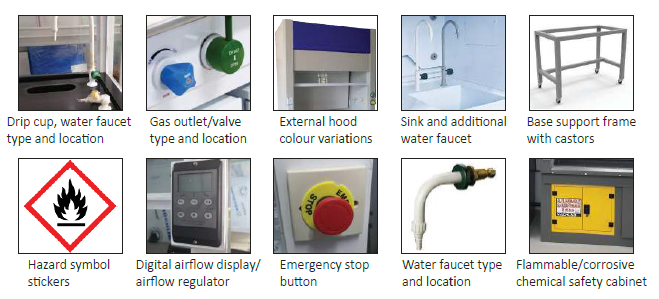
The examples illustrate decisions that may accompany the core enclosure, including taps, gas outlets, airflow display, emergency-stop control, base support and storage. They do not represent a universal package. Each utility and accessory must be checked for its location, material, electrical or plumbing interface and suitability for the selected process; flammable or corrosive storage is specified separately and is not inferred from a cabinet image.
Exhaust, Washing, Drainage and Treatment Interfaces
The hood, duct and remote fan form one airflow path. The cabinet provides the working opening, baffle and exhaust connection, but the installed airflow depends on the selected sash condition, duct resistance, fan duty, room air and final discharge arrangement. Washing, drainage and gas treatment are separate interfaces that can be added when the process requires them. Their presence and supplied scope must be stated explicitly.
Size the Hood, Duct and Fan as One Airflow System
Airflow selection starts with the operating opening and the containment criterion adopted for the project. The mechanical calculation then accounts for hood resistance, collar and transition, duct length, fittings, vertical rise, control devices and any scrubber or treatment stage. The remote fan must deliver the required volume at the resulting external static pressure, not merely match a free-air volume printed on a fan label.
Room conditions influence the result. Insufficient make-up air, strong cross-drafts, doors, diffusers or other exhaust equipment can disturb the inward flow at the sash. A selected fan operating point therefore requires coordination with the laboratory ventilation design and confirmation after installation. An airflow monitor or alarm can indicate a defined operating condition, but its setpoint and sensing method must correspond to the approved hood and exhaust arrangement.
Optional Wash-Down and Drainage Arrangements
A project may include a rinse connection or wash arrangement when the selected cleaning procedure benefits from controlled water delivery. The specification must identify the surfaces to be washed, available water conditions, activation method, required isolation and method for checking the flow path. An unspecified spray fitting does not demonstrate that the complete chamber, baffle and downstream exhaust path can be washed.
Liquid collection requires equal attention. A raised work-surface edge, rear trough or drain connection can help route manageable liquid to a defined point, but the receiving system must be selected for the actual acid and cleaning solution. Facility requirements determine whether the liquid needs collection, neutralization, treatment or another controlled disposal route. The quotation should state where XICHENG’s supplied piping ends and where the site system begins.
These optional features do not convert the acid digestion fume hood into a perchloric-acid hood. Perchlorate-deposit control requires a dedicated specialist design with complete wash coverage and an independent exhaust path. Washing and drainage are included with an acid digestion fume hood only when they suit the documented non-perchloric process and the facility cleaning procedure.
When an Exhaust Scrubber May Be Required
An exhaust scrubber is considered when the contaminant identity, expected loading, discharge requirement or facility policy calls for gas treatment before final release. Selection cannot be made from the hood width alone. The design needs the acid species, concentration, operating rate, gas temperature, moisture condition, target removal requirement, available utilities and liquid-waste route.
A scrubber adds resistance to the exhaust system and may require pumps, controls, chemical dosing, mist elimination, drainage and maintenance access. Its pressure loss must be included in fan selection, and its construction must be reviewed against both the process stream and scrubbing liquid. The scrubber is listed as an included component only when the quotation and equipment schedule define it; otherwise the hood provides an interface to a separately engineered treatment system.
Applications, Suitability and Product Selection
An acid digestion fume hood fits a project when the process is known well enough to configure the work zone and exhaust path around its actual chemistry, heat and apparatus. Product selection should begin with the procedure rather than an assumed material. The same acid name can create different requirements when concentration, temperature, batch size, heating method or operating frequency changes.
Good-Fit Acid Digestion Work
The acid digestion fume hood family is intended for non-perchloric mineral-acid digestion performed with heater blocks, hot plates, digestion vessels or related laboratory apparatus. It is especially relevant when repeated hot-acid operation, concentrated vapor, condensate, splash or a large equipment envelope makes a general-purpose hood difficult to specify. The purpose-built configuration allows the liner, work surface, sash, baffle, fixtures and exhaust connection to be selected around those conditions.
Typical process reviews may involve hydrochloric, nitric, sulfuric, hydrofluoric or mixed mineral-acid procedures, but naming an acid here does not establish compatibility. Each procedure requires its own concentration, temperature, contact-mode and component review. HF-containing work also requires explicit attention to glass-containing components, while mixed-acid processes require the full sequence and all cleaning agents to be disclosed.
The hood can support laboratories that need repeatable equipment placement and a documented system boundary. A project is a stronger fit when the digestion apparatus can remain inside the selected working zone, utility connections can be routed without obstructing the baffle, and the laboratory can coordinate the remote exhaust fan, duct, room air and optional treatment system. These conditions allow the final drawing and airflow basis to reflect the actual operation rather than a generic cabinet arrangement.
When an Acid Digestion Fume Hood Is Not a Good Fit
Do not use the hot-acid digestion hood as the default for perchloric acid. A process that can create perchlorate deposits must be evaluated as a perchloric acid fume hood with a dedicated wash-down and exhaust system. An optional rinse fitting or corrosion-resistant liner on an acid digestion hood does not provide the same deposit-control mechanism.
For ordinary non-special chemical procedures with limited heat and no unusual corrosion requirement, a general-purpose steel fume hood may provide a more direct configuration. Where the main decision is polymer construction rather than hot digestion equipment, evaluate a polypropylene laboratory fume hood. A stainless steel laboratory fume hood may suit reviewed processes where metal construction and thermal durability are appropriate, but it is not universally compatible with hot acids.
The acid digestion fume hood is also not a substitute for a biosafety cabinet, glove box, radioisotope hood or other specialist enclosure. Unknown chemistry, unverified explosive or flammable conditions, radioactive materials, biological containment needs or a process that cannot be connected to a suitable exhaust system require a separate hazard and equipment review before a hood type is selected.
Select the Complete Configuration in This Order
- Define the process. Record every chemical, concentration, temperature, quantity, operating step, heating method, frequency and cleaning agent.
- Map component exposure. Identify splash, vapor, condensate, heat and cleaning contact at the liner, worktop, sash, baffle, hardware, fixtures and exhaust path.
- Fit the apparatus. Establish chamber, opening, service, load and maintenance clearances from a dimensioned equipment layout.
- Select work-zone construction. Confirm component materials, fabrication/joints, work-surface detail, sash and accessible cleaning provisions.
- Calculate the exhaust system. Set the operating opening and airflow criterion, then calculate duct loss, treatment loss, fan duty, room air and discharge.
- Define optional liquid and gas treatment. Specify washing, collection, drainage or scrubber functions only where the process and facility require them.
- Close utilities and controls. Confirm fixtures, power, lighting, monitoring, alarms, interlocks and BMS interfaces.
- Assign scope and acceptance. List supplied equipment, site-provided work, approved documents and commissioning responsibilities.
This order prevents a late material or airflow change from invalidating earlier dimensional choices. For example, adding a scrubber after fan selection changes system resistance, while substituting taller apparatus after drawing approval can change the working opening and airflow path. Closing the process and apparatus first reduces those avoidable redesigns.
Information Needed to Configure the Acid Digestion Fume Hood
Send a process schedule covering acids, mixtures, concentration, temperature, quantity, heating method, cycle duration, batches per day and cleaning procedure. Attach available safety or compatibility requirements and clearly state whether HF or perchloric acid is present. Provide apparatus drawings or photographs with dimensions, weight, heater information, vessel count, service points and the clear access needed for operation and maintenance.
For the laboratory interface, provide the room layout, available installation envelope, access route, preferred working opening, utilities, duct concept, available static-pressure information, remote fan scope, discharge condition and make-up-air arrangement. Add any required washing, drainage, scrubber, wastewater, airflow monitor, alarm, BMS, documentation, quantity and delivery details.
XICHENG can then prepare a configuration with proposed dimensions, work-zone materials, work surface, sash, baffle, service fixtures, exhaust connection and selected options. The quotation identifies the supplied components and site interfaces; the approved drawing establishes geometry and connections; and the component schedule records the selected materials. Final airflow and system acceptance remain tied to the completed installation and agreed commissioning method.
Installation, Commissioning and Maintenance
Installation closes the interfaces established during product selection. The hood must be positioned with the approved apparatus and service clearances, connected to the specified duct and utilities, and checked under the intended sash and room-air conditions. Commissioning confirms the installed configuration and operating sequence; it does not expand the chemical or performance boundary established by the approved project documents.
Coordinate the Hood and Building Interfaces
Before delivery, verify the route from unloading to the final laboratory position, including doors, turns, lifts and ceiling or corridor restrictions. Confirm the finished floor and service-wall condition, available footprint, bench/base arrangement, anchoring direction and clearance for sash movement, access panels and maintenance. If the hood is delivered in sections, the installation plan must identify field joints, seals and reassembly checks.
The mechanical layout should show the hood collar, transition, duct support, remote fan, treatment equipment where used and final discharge. Duct weight and vibration should not be transferred unintentionally to the cabinet. Electrical and utility schedules should identify power, lighting, taps, monitoring, alarms, interlocks and BMS points. Optional wash or drain connections require accessible isolation, compatible piping and a defined receiving system.
Commission the Installed Airflow Condition
Begin by confirming that the delivered hood, sash, baffle, collar and controls match the approved drawing and component schedule. Check that the apparatus is placed in the reviewed position and that temporary packaging, service hoses or storage do not obstruct the baffle or working opening. The exhaust fan and any control device should then be operated through the intended sequence before airflow measurements are interpreted.
Airflow acceptance must use the agreed operating sash condition and project test method. Record the exhaust setting, fan condition, room state and monitor/alarm response so the result can be repeated. A fan-running contact or actuator position alone does not demonstrate that the required air is moving through the hood. Where room pressure or make-up air affects the opening, those systems should be tested in their normal operating modes.
Verify Optional Washing, Drainage and Treatment Functions
Only included functions should be commissioned, but every included function needs a visible check. For a rinse or wash arrangement, verify supply isolation, control action, the intended flow path, leaks and the ability to collect liquid without uncontrolled pooling. For a drain, confirm the connection, slope, receiving route and facility procedure before introducing process-contaminated liquid.
If an exhaust scrubber is part of the project, commission it as a separate system with its pump, liquor, mist control, alarms, pressure loss and waste handling. Confirm the relationship between scrubber operation and exhaust fan control. A hood airflow check cannot demonstrate treatment performance, and a running scrubber cannot demonstrate adequate airflow at the sash; both functions require their own acceptance records.
Inspect Materials and Accessible Exhaust Components
Inspection frequency should reflect the actual acids, temperature, batch frequency, condensate and observed condition. Check the work surface, liner, baffle, sash, hardware, seals and fixtures for discoloration, swelling, cracking, distortion, corrosion, looseness or residue. Accessible collar, duct, fan and treatment components should be included according to the facility maintenance plan because downstream condensate can create conditions different from the visible chamber.
Cleaning methods must match the selected materials and process residue. Do not introduce a cleaning chemical merely because it is common elsewhere; it becomes another exposure that may affect the liner, seals, drain or treatment system. Keep records of observed condition, cleaning, repairs, alarms and changes in process so emerging patterns can be identified before damage affects operation.
Related Laboratory Fume Hood Options
Choose the adjacent product by the process mechanism that drives the enclosure, not by appearance alone. The following alternatives share some dimensions, materials or exhaust components with an acid digestion hood, but each owns a different primary selection condition.
Perchloric Acid Fume Hood
Select a perchloric acid fume hood when the procedure can create perchlorate deposits and requires a dedicated wash-down and independent exhaust path. That product coordinates cleanable surfaces, wash coverage, controlled collection, drainage and the hood-to-discharge route. It is not interchangeable with an acid digestion enclosure that has an optional rinse or drain.
Polypropylene or Stainless Steel Fume Hood
A polypropylene laboratory fume hood is a material-led option for reviewed corrosive chemical work where heated digestion equipment and a dedicated high-temperature configuration are not the primary drivers. A stainless steel laboratory fume hood may suit processes that benefit from metal construction and reviewed thermal durability. Neither material name proves compatibility with every acid, concentration or temperature.
General-Purpose Steel Fume Hood
The general-purpose steel fume hood supports ordinary ducted laboratory chemical ventilation where the process does not require the specialized material, heat or apparatus configuration of acid digestion. It can reduce unnecessary complexity for well-defined non-special procedures, but it should not be selected merely because the room already uses similar steel cabinetry.
Browse the complete Laboratory Fume Hoods category when the process may require a different enclosure geometry, material system or control strategy.
Frequently Asked Questions
What makes an acid digestion fume hood different from a standard chemical fume hood?
An acid digestion fume hood is configured around heated or concentrated mineral-acid work. The selection reviews exposed-component materials, apparatus heat and clearances, sash/viewing material, spill and cleaning conditions, and the corrosion-aware exhaust path. A standard hood may share the same general enclosure form but does not automatically address those combined process loads.
Can an acid digestion fume hood be used for hydrofluoric acid?
It can be configured for an HF-containing procedure only after the complete process and component exposure are reviewed. A polycarbonate sash can address the glass-viewing-panel concern, but the liner, work surface, baffle, seals, fixtures, drain, duct, fan and any treatment equipment still require separate material confirmation. Provide the HF concentration, temperature, quantity and all co-used chemicals before selection.
Does every acid digestion hood need a wash-down system or drain?
No. Washing and drainage depend on the acids, residue, cleaning procedure and facility liquid-handling plan. A project may use controlled manual cleaning, an optional rinse arrangement, a retaining edge, a trough or a connected drain. Any connected liquid route must identify compatible materials, collection and the receiving waste system.
When should an exhaust scrubber be added?
Add a scrubber when the contaminant loading, discharge target, facility policy or environmental requirement calls for gas treatment. Selection needs the acid species, operating rate, gas temperature, moisture, target and waste-handling information. A scrubber changes system resistance and must be coordinated with the remote fan; it is not a default component of the hood.
Can the acid digestion fume hood be used for perchloric acid?
Do not use the acid digestion product as the default for perchloric-acid work. Perchlorate deposits require a separately designed perchloric acid hood with complete wash coverage, controlled drainage and a dedicated exhaust path. State any possible perchloric-acid use at the start of the technical review so the correct product family is selected.
Contact the Xicheng Engineering Team Today
Send the acid list, concentration range, maximum process temperature, batch quantity, heating method, operating frequency and cleaning procedure. Include apparatus dimensions and heater information, the required working opening, utilities, room layout, duct route, available pressure information, fan or scrubber scope, and any washing, drainage, monitoring or BMS requirement. XICHENG will use these inputs to prepare a product configuration, material and component schedule, preliminary drawing, supplied-scope list and quotation for the reviewed acid-digestion process.
Shenzhen Office: No. 34 Zhenxing Road (Shengtaian Heavy Industrial Park B), Loucun, Guangming New Dist, Shenzhen, Guangdong, China
WhatsApp: +86 18126478161
Engineering Mailbox: fanalax34@gmail.com
Send your acid-digestion process and laboratory layout to the Xicheng engineering team.