





Key Takeaways
- Requirements come from your license, not from the catalog. A radioisotope fume hood is a chemical fume hood built to a set of dedicated requirements — a surface that can be decontaminated completely, exhaust that is not shared with other systems, and airflow that is monitored continuously with an alarm — and radioisotope fume hood requirements are set by your license, your radiation safety program and the authority that issues the license. Shielding, filtration and permitted nuclides are not buyer choices.
- Ask whether independent exhaust is required; do not assume it. Several jurisdictions forbid connecting this class of hood to a common exhaust duct, while at least one institutional program states that ventilation needs range from no special requirements up to a separate system with an emergency shut-off switch — decided facility by facility.
- Face velocity is not one number. A minimum value, an average with a per-point floor, and a fixed range all appear in different jurisdictions, and each figure belongs to the authority that published it.
- Shielding follows the radiation type. Gamma emitters are shielded with dense material such as lead; beta emitters are not, because lead generates bremsstrahlung X-rays, so low-atomic-number material such as acrylic is the correct choice. Unsealed alpha emitters are an internal-exposure problem and generally belong in a glove box.
- Filtration is an approval item, not a feature. One position is that these hoods contain no filters unless filtration is declared and approved; at least one state regulation requires filters rated at 99.97 percent by the DOP test method with safe filter changeout; a third position requires a risk assessment and radiation safety officer approval before any filtration is installed.
Procurement teams write “radioisotope fume hood” on a requisition and expect a chemical hood with a shielding upgrade. Design teams inherit that line and start hunting for a specification. Neither document yet says what the work is, how much activity is involved, or who has to sign the finished requirement. That gap is where projects lose months, because the equipment that gets quoted is chosen before the requirements that decide it exist.
A radioisotope fume hood is a fume hood configured for radionuclide work, and the radioactive materials it will hold decide its exhaust path, its interior surface, its shielding and its monitoring. Those four axes are what this article covers. Radioisotope fume hood requirements are assembled from three different sources — your license and the regulation that governs it, your institution’s radiation safety policy, and the design objective of a surface and system you can decontaminate — and the work is knowing which source each line came from.
What you carry away from this article is an eight-item requirement list you can hand to a reviewer and to a supplier, plus a clear split between what you may write yourself and what your radiation safety officer or committee and your licensing body must decide.
Definition: What Makes a Radioisotope Fume Hood Different
Three things separate this hood from a general chemical hood: the dedicated construction its work demands, the approval path attached to that construction, and the operational obligations that follow the cabinet for as long as nuclides are inside it. Buyers usually price the first and discover the other two in the same week the license application goes out. Getting the order right at the definition stage prevents every later axis from being argued twice.
This article covers the requirement side of that equipment. Selection between materials in the abstract, exhaust fan sizing, duct selection, make-up air, sash-height criteria and the suitability of ductless equipment are separate subjects, and we point to them where the boundary is useful rather than repeating them here.
What “Radioisotope Fume Hood” Names — and What It Does Not
The term names a use, not a product family. A “radioisotope fume hood” is a chemical fume hood whose specified features come from the radionuclides it will hold, which is why the same cabinet shell can be quoted against two different requirement sets. Categories that carry a similar name often answer a different question, so a buyer looking for a radiochemical fume hood requirements list usually means exactly this article, while a buyer who asked for a shielded hood wants a shielding change to an otherwise chemical unit.
“Dedicated” carries both a construction meaning and an administrative meaning, and the two do not always arrive together. The construction meaning is physical: an interior you can clean completely, exhaust that is not shared, a surface that resists the chemicals in use. The administrative meaning is what most requisitions omit — the enclosure, its exhaust and its location have to sit inside an approved license and an institutional radiation safety program. The second meaning decides whether the first may be used at all.
That split is why a purchase order and an approval are not interchangeable documents. The requisition describes a cabinet, while the institution approves a set of work conditions — nuclides, activity, form, procedure and location — and the cabinet is only one of the things those conditions attach to. A quotation that lists radiation warning labels tells you the vendor read the market convention, not that your facility has been cleared for the work.
The Pattern Repeated Across Special-Purpose Hoods
One institution’s laboratory policy states the pattern in a single line. Temple University’s EHRS policy allows hood exhaust to be manifolded together, then names the exceptions: “Dedicated radioisotope, carcinogen, or hot acid (perchloric) fume hoods shall be single ducted,” and hoods requiring HEPA filtration or other special exhaust cleaning shall have a dedicated exhaust system. The same policy permits manifolded exhaust in general and removes this class from it.
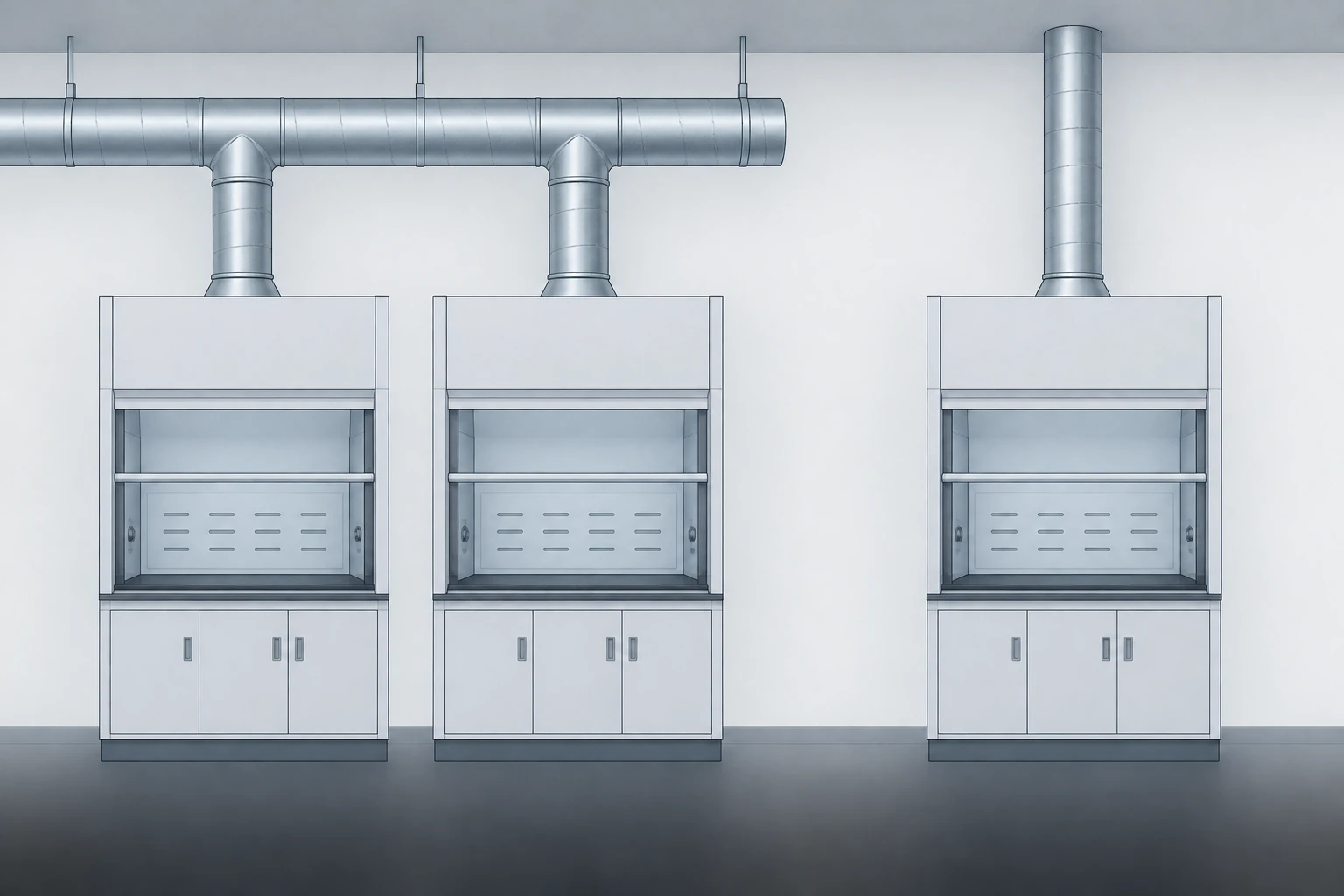
A national nuclear regulator’s design guidance says something similar in fewer words: “The fume hood exhaust will not connect to other exhaust systems.” Read together, these two documents show that dedicated exhaust is not a premium option. It is how several independent authorities treat the class, and the wording arrives with the application rather than with the budget.
Recognizing the pattern changes what your requirement list looks like. Once the application triggers dedicated construction, the unit is no longer a cabinet alone; the exhaust route, its identification, and its service access become part of what a reviewer examines. The same pattern appears in perchloric acid work, so the perchloric acid fume hood requirements cover the wash-down and duct design that this article deliberately leaves alone.
Where a Fume Hood Is the Wrong Enclosure
Some nuclide work does not belong in a fume hood, and the earliest place to catch that is the definition stage. Stanford University’s laboratory standard says that “glove boxes with HEPA filtered exhausts shall be provided for operations involving unsealed radioactive material that emit alpha particles,” with a direction to consult the institution’s radiation safety program. The University of Illinois Division of Research Safety applies the same logic to physical form: powdered radioactive material belongs in a closed system, and a nuclide that stays radioactive for many hours should be handled in a containment enclosure.
Both statements are institutional policy rather than universal law, and that is the point worth keeping. If an operation belongs in a glove box, no amount of stainless steel or lead turns a fume hood into the right answer, and the requirement list should stop rather than grow. Glove boxes carry their own design and construction standards, and the type is a decision for the radiation safety program.
A fume hood has one job: it keeps airborne material out of the room air while the operator works at the sash. Enclosures built around biological hazards answer a different question and carry their own standards, so a comparison between the two is a distraction. Biological safety cabinets are specified by the biosafety officer and the institutional committee that governs biological work, and a radioisotope program that borrows those criteria for nuclide work ends up documenting the wrong control.
You can decide the shape of your own project once you know which operations are excluded from a fume hood and which enclosure class applies. That check takes one conversation with the radiation safety program, and it happens before a single requirement is written. Once your operations are cleared for a hood, the requirement list begins with the nuclide rather than the cabinet, which is where the next section starts.
Start With the Nuclide and the Process, Not the Cabinet
Four pieces of information about the work decide almost every line of the requirement list: the radiation the nuclides emit, their physical form and the operations performed on them, the activity handled at one time, and whether the material can become airborne as powder or aerosol. A fume hood for radioactive materials is sized and specified against those four facts, so a requisition that omits them cannot be quoted accurately.
Buyers reach for the cabinet first because a cabinet is easy to describe. Nuclides, activity and procedure are harder to write down and slower to agree internally, so they get deferred until after the quote. That order guarantees rework, because the ventilation, the shielding and the monitoring requirements all trace back to the same four facts.
This is also where the requirement list stops being a list and becomes a form of risk management. Two laboratories can hold the same nuclide, look similar on paper, and still need different exhaust treatment because one boils its samples and the other counts them.
The Four Process Facts That Change Every Other Requirement
The first fact is the radiation itself. Gamma emitters drive shielding choices and therefore cabinet loading, beta emitters need a shielding material that does not generate a secondary X-ray problem, and alpha emitters raise an internal exposure question before they raise a shielding question. Write the nuclide list with the emission type next to each entry, because the two axes diverge from the first requirement you write.
The second fact is physical form and the operation applied to it. Illinois DRS requires that operations with materials susceptible to atmospheric distribution — boiling, evaporating, distilling or burning — be done in a fume hood with adequate airflow, which tells you that the procedure, not the isotope, decides whether airborne release is credible. The third fact is the activity handled at one time, and the fourth is whether the material is handled as a powder or can be aerosolized.
| Process fact | What it changes in the requirement set | Authority behind the link |
|---|---|---|
| Emission type (gamma / beta / alpha) | Shielding material and cabinet loading; alpha becomes an internal-exposure question | Illinois DRS (beta and gamma materials, bremsstrahlung warning); the institutional standard cited in the previous section (unsealed alpha emitters) |
| Physical form and operation (boiling, evaporating, distilling, burning) | Whether airborne release is credible, and therefore whether exhaust treatment is considered at all | Illinois DRS (operations susceptible to atmospheric distribution) |
| Activity handled at one time | Weight and thickness of shielding, and the level of monitoring attention | Institutional radiation safety program (shielding determined from proposed type and quantities) |
| Powder or aerosol potential | Containment class rather than cabinet options | Illinois DRS (powdered material in a closed system; half-life longer than a few hours in containment) |
Gathering those four facts takes one meeting, and it produces the only input the rest of this list needs. A quotation request that carries them gets comparable answers, because the supplier can see which exhaust and shielding class is being asked about.
How Activity and Half-Life Shift the Answer
Activity and half-life move the emphasis between two different risks rather than simply raising the requirement level. Higher activity concentrates the external dose question and pushes the shielding discussion toward thickness, weight and material; longer half-life and a form that can be inhaled concentrate the contamination question, where the obligation is to remove material from surfaces completely and to keep it out of the room air. Those two risks do not point at the same equipment decisions.
Institutional policy attaches concrete thresholds to the physical form. Illinois DRS asks that a nuclide with a half-life of more than a few hours be handled inside a containment enclosure, and that powdered radioactive material be handled inside a closed system, which means part of your routing decision can be made before the shielding question is settled. The design guidance treats a hood, a dry box or another closed system as the preferred place for radioactive material work wherever the operation allows it.
Shielding weight lands on structure, not on the liner. Canadian design guidance for nuclear substance laboratories requires the work surface to carry the weight of whatever shielding is needed, and an institutional standard requires the cabinet below the hood to be adequate to support it. When you write the structural requirement, name the support level and the work surface rather than the interior finish.
Activity and half-life do not tell you how much shielding you need. They tell the radiation safety program what to assess, because the need for shielding is a judgment your radiation safety program makes against the inventory you intend to hold. Put the assessment on the critical path early, since it changes the bench, the cabinet and the floor loading at the same time.
When the Work Belongs in a Glove Box Instead
A fume hood removes a small volume of air from the room continuously and pulls replacement air across the operator’s working position. A glove box separates the operator from the material with a physical barrier and keeps the material in a controlled atmosphere. The first control is appropriate when the release is small, occasional and captured by airflow; the second is appropriate when the material must not reach the operator’s breathing zone at all.
The institutional direction to provide glove boxes with HEPA filtered exhausts for operations involving unsealed alpha-emitting material follows from that difference, and it arrives with an instruction to put the specifics to that program. That institution’s research safety office concentrates the same conclusion into physical form, asking for a closed system when the material is a powder. Neither statement leaves room for substituting a fume hood with better surfaces.
Treat this as a routing test you can perform before specifying anything. List the operations that will be performed inside the enclosure, mark the ones that involve unsealed alpha emitters or powders, and confirm with the radiation safety program whether those belong in a glove box. You can carry the remaining operations forward knowing that the enclosure class has been settled by the right authority rather than by preference.
The output of this section is four facts and one routing decision: the emission types involved, the operations and physical forms, the activity handled at one time, and the aerosol potential, plus confirmation of which operations stay in a hood. Those are the inputs the ventilation requirement consumes next, because whether the exhaust may be shared with anything else is decided by what the hood will contain.
Radioisotope Fume Hood Requirements for Exhaust: When Independently Ducted Is Not an Opinion
Radioisotope fume hood requirements for exhaust start with one question that has a rule attached in several jurisdictions: may this hood share an exhaust duct with anything else? British Columbia’s laboratory regulation answers it with a prohibition rather than a preference. So does the Temple University policy quoted earlier, which permits manifolded exhaust in general and then removes this class from the permission. So does the Texas radiation control regulation, which requires that each hood used to process radioactive materials be connected to an independent exhaust system.
The Canadian nuclear regulator’s design guide for nuclear substance laboratories states the same outcome in a single sentence: “The fume hood exhaust will not connect to other exhaust systems.” The clause that follows it keeps the door open for a facility to argue a variation, requiring detailed information on the provisions made to ensure that exhaust from one area cannot flow into another.
That structure is why this requirement is a condition rather than an opinion. Where the rule is written as an outright prohibition, an independently ducted installation is the only compliant option. Where the rule provides a variation route, you may propose an alternative, and you will have to document how contamination cannot travel between the two areas.
What Independent Exhaust Actually Prohibits
The prohibition applies to the exhaust, not only to the cabinet. “Not connected to a common exhaust duct” means the hood does not discharge into a riser that also serves other hoods, and it means the exhaust from one hood cannot reach the laboratory through another hood’s ductwork. The British Columbia regulation adds that last case to the prohibited list explicitly, describing a danger of backdrafts that could result in contaminants from one fume hood being discharged into the laboratory from another fume hood.
Hoods that need exhaust cleaning are covered by the same rule through a different route. The same institutional policy states that hoods requiring HEPA filtration or other special exhaust cleaning shall have a dedicated exhaust system, which means a filtration decision made later in the project can create an exhaust requirement you did not plan for. This is the link between two axes, and it is worth flagging to the mechanical engineer before the shaft space is fixed.
| Authority | Exact instrument | What it says about shared exhaust |
|---|---|---|
| British Columbia | BC Laboratory Regulation, Part 30, §30.10(1)(b) | A fume hood must not be connected to a common exhaust duct if carcinogenic substances or radioactive materials are used in the hood |
| Texas | 26 TAC §511.163 | Each hood used to process radioactive materials shall be connected to an independent exhaust system |
| Canada (design guidance) | CNSC GD-52, clause E21 | The fume hood exhaust will not connect to other exhaust systems, with a variation path if provisions are documented so exhaust cannot flow between areas |
| Temple University (institutional policy) | EHRS miscellaneous policies | Dedicated radioisotope, carcinogen or hot acid hoods shall be single ducted; other hoods may be manifolded |
| The institutional standard introduced earlier | Laboratory standard, radioactive materials | Ventilation requirements depend on the materials used and range from no special requirements up to a separate exhaust system with an emergency shut-off switch, reviewed per facility |
Read the fifth row carefully, because it limits the first four. The institution that publishes one of those separate-exhaust provisions also describes laboratories with no special ventilation requirements, and it places the judgment with its radiation safety program on a facility-by-facility basis. If you write “all radioactive material hoods require independent exhaust” into a design narrative without qualification, the reviewer who holds that program can show you the other end of the range.
You can decide which sentence belongs in your project by naming the instrument that governs you. If your hood falls under a rule written like British Columbia’s or Texas’s, the requirement is mandatory and the design should assume an independent duct. If it falls under institutional review, you present the nuclide and process facts from the previous section and let the radiation safety program determine the ventilation class.
For nuclear substance work in Canada, the guidance also attaches a marking requirement to the cabinet itself. The hood has to carry a label naming the exhaust system that serves it, and there is a companion requirement for the working chamber to show a radiation warning sign. Both labels only make sense when the answer is specific, which is another reason to settle the exhaust question before the cabinet is ordered.
Face Velocity: Four Authoritative Values and the Jurisdiction Behind Each
Face velocity figures circulate as if one number governed every project, and the sources do not support that reading. The published values come from different instruments, apply to different jurisdictions and are written as different kinds of limits: a floor value, an average with a per-point minimum, and a fixed range.
| Value | Instrument and jurisdiction | How the limit is written |
|---|---|---|
| Minimum 0.5 m/s | CNSC GD-52, clause E14 (Canada, design guidance) | A floor: the face velocity will be at a minimum of 0.5 m/s |
| 0.50 m/s (100 fpm) average | University of Toronto fume hood standard, §5.6.4 (institutional), which traces the figure to CNSC GD-52 | An average, stated for radioisotope hoods regardless of the general guidance |
| 90–110 fpm | 26 TAC §511.163 (Texas, regulation) | A range applied to each hood used to process radioactive materials |
| Average 0.75 m/s (150 fpm), not less than 0.65 m/s (125 fpm) at any point across the face | BC Laboratory Regulation §30.8(2)(b) (British Columbia, regulation) | An average plus a per-point floor, applied where radioactive materials are used |
The two numerical conventions do not translate into each other. A minimum value and an average with a per-point floor are different tests, and a hood can pass one while failing the other, so a specification that quotes a number without the convention leaves the commissioning test undefined. Say which instrument you are following, then quote the figure with the way that instrument writes it.
Other figures circulate outside the regulatory sources, and they are worth seeing for what they are. The same research safety office specifies approximately 60-120 linear feet per minute for operations with materials susceptible to atmospheric distribution, adding that some newer fume hoods are designed to be in compliance at lower rates of approximately 60-65 lfpm. Vendor material quoted online offers face velocity paired with exhaust volume and static pressure, such as 100 FPM or 120 FPM alongside 790 CFM or 950 CFM, though the pages state nothing about the sash position or test method behind those pairings.
Those circulating figures describe institutional policy and product claims rather than a common baseline, which is why the requirement has to say which instrument it came from. Use the institutional number where your institution publishes one, because the reviewer checking your submittal will be reading the same document you are.
Face velocity itself, the 60/80/100 fpm families and the exhaust volume arithmetic belong to a separate treatment of face velocity requirements. The point on this page is narrower and more useful: the number you write down is a jurisdictional choice, and your license or institutional policy is what makes it yours.
Duct Routing, Identification and Emergency Power
Exhaust ductwork for nuclear substance work carries obligations beyond pressure loss. The Canadian guidance requires ducts constructed of corrosion-resistant material appropriate to the substances used, with all joints smoothly finished and sealed, and it requires the route to be vertical except where horizontal sections are submitted with provisions to limit condensate collection and are sloped at least 2.5 cm per 3 meters downward in the direction of airflow. Duct sizing and material selection are a separate duct-sizing subject; what matters here is that horizontal runs become a submission item rather than a convenience.
Identification is where the nuclear substance requirements diverge most from a chemical installation. Two independent sources land on the same spacing. The design guidance calls for the radiation warning symbol on exhaust ducts at 3-meter intervals to flag the possibility of contamination, and the institutional fume hood standard sets the same ceiling on the spacing of those symbols along any reachable section of duct. Both are hardware obligations, and they belong in the submittal rather than in the commissioning punch list.
The discharge end carries its own numbers. In the design guidance, exhaust fans will be placed close to the discharge point and located outside the building. Exhausts will be located on the roof as far as possible from any air intakes, never less than a recommended 15.24 m from an intake. The stack velocity will be at least 1.4 times the average wind velocity, and the stack height will be at least 3.05 m above the highest point on any adjacent roofline or air intake, with discharge directed vertically upward. Every one of those figures belongs to a Canadian design guide, so a project under a different authority confirms the local value before it writes them into a specification.
Availability of the fan is a requirement, not a maintenance preference. The design guidance states that the hood will remain on at all times when nuclear substances are present, that provisions will be in place to ensure the hood remains functional where a routine automatic after-hours shutdown system exists, and that exhaust fans will be connected to an emergency power system to maintain functionality if a power failure occurs. The University of Toronto standard adds that where a hood is used for radioactive material storage, the fan servicing it must remain operational at all times and the hood must remain under negative pressure below the fan.
Those clauses tell the electrical engineer and the building controls contractor something the chemical hood next door does not require. A night setback that shuts the exhaust down with the lights is incompatible with a hood holding nuclear substances, so the requirement set has to name the operating condition and the power source together. Installation sequencing for a hood of this class is covered in the general installation requirements, and exhaust fan selection and static pressure are handled in a separate fan-sizing article; this section adds only what the nuclide work changes.
What leaves this section is a ventilation decision you can put in writing: whether the hood is independently ducted or reviewed under a variation or institutional route, which instrument’s face velocity convention you are following, and which identification, discharge, availability and power clauses your specification has to carry. The next requirement depends on that outcome, because filtration cannot be discussed until it is clear whether the exhaust is a dedicated path or a shared one.
Filtration: an Approval Decision, Not a Feature
Filtration is the axis where vendors and regulators disagree most openly, and the disagreement is not a misunderstanding that better data would settle. Three positions exist, each held by a different kind of authority, and each produces a different requirement line. Your jurisdiction and your institution decide which one you are working under, and that choice has to be made before the exhaust design is drawn.
One position treats filters as an exception that must be justified. The design guidance opens with a default rather than a rule: hoods of this kind are not fitted with filters. It then sets out the circumstances in which filtration will be required — where nuclear substances will be released regularly through the fume hood exhaust, or where biohazards are present — and requires detailed information on the filtration, including filter monitoring and exchanges, to be supplied. A second position makes filtration mandatory in effect: the Texas radiation control regulation requires each hood to have filters rated at 99.97 percent efficiency by the DOP test method in the exhaust stream, designed and equipped for the safe removal, disposal and replacement of contaminated filters, positioned as close to the hood as practical to limit duct contamination.
A third position routes the question through a risk assessment and an institutional approval rather than a rule. The National Academies guidance states that before any filtration system is installed, a risk assessment should be performed to determine the need and the appropriate level of filtration required, and that special treatment of exhaust from radioisotope hoods may be required by government regulations, usually involving HEPA filters. The institutional standard puts the approval step plainly: the fume hood exhaust treatment system must be approved by the institution’s Radiation Safety Officer prior to installation and use.
These are not three opinions about one question. They are three jurisdiction types answering the same question, and the practical consequence is that a specification written from one position can be wrong under another. Vendor material and institutional pages treat filtration as a capability to be added at purchase, which is precisely the framing the first and third positions contradict.
Three Positions on Filters in Nuclear-Substance Hoods
The first position is written as a prohibition with a declared exception, and the exception is not informal. The design guidance asks for detailed information about the filtration, including filter monitoring and exchanges, which means the submission covers how the filter’s performance will be watched and how it will be replaced while it holds contamination. The institutional fume hood standard states the same prohibition in its own words — “The fume hood will not contain any kind of air filtration” — and attaches the condition that radiation monitoring and change out schedules must be confirmed with the institution’s Radiation Safety Officer.
The second position imposes the filter and the changeout provisions together. The Texas regulation pairs a 99.97 percent DOP efficiency requirement with a design obligation: the hood must be designed and equipped to permit the safe removal, disposal and replacement of contaminated filters, and the filters must sit as close to the hood as practical to minimize duct contamination. Read as a set, those clauses treat the filter and its replacement procedure as one deliverable rather than two.
The third position makes the assessment the trigger. The National Academies guidance asks whether operations might cause materials to aerosolize or become airborne and whether inhalation poses a risk, and then asks whether filtration or trapping is required or recommended. That ordering — hazard first, filter second — is what allows an institution to end up with no filter on a hood that handles nuclides, and it is also what allows the same institution to require treatment on a hood that looks identical on the drawings.
| Position | Source | What it means for your specification |
|---|---|---|
| No filters unless filtration is declared and approved; submission must cover monitoring and exchanges | CNSC GD-52, clause E20 (Canada, design guidance) | Default is no filtration; if filtration is needed, it is an application with technical content, not a line item |
| No air filtration; if required, monitoring and changeout confirmed with the Radiation Safety Officer | the institutional fume hood standard cited above, §5.6.4 | Default is no filtration; the exception runs through an institutional officer as an approval item |
| Filters required: 99.97 percent efficiency by the DOP test method, designed for safe removal, disposal and replacement, placed close to the hood | 26 TAC §511.163 (Texas, regulation) | Filtration is mandatory in this jurisdiction, and the changeout provision is part of the requirement |
| Risk assessment first; special treatment may be required; treatment system approved by the Radiation Safety Officer before installation and use | National Academies laboratory facilities guidance; Stanford laboratory standard (consensus guidance and institutional policy) | Whether a filter exists at all is an assessment outcome followed by an approval, not a purchasing preference |
No row is the correct answer for every project, and the table is meant to be read as a map of where your project sits. If your hood falls under a regulation written like Texas’s, the filter is mandatory and the design obligation to change it safely is the harder half of the requirement. If your hood falls under an institution that holds the first or third position, adding filtration because a supplier suggested it creates an approval problem rather than a safety improvement.
The Approval Path That Applies Either Way
Filtration cannot be decided separately from the exhaust requirement because the two decisions constrain each other. A hood that is filtered is a hood whose ductwork becomes a contaminated asset, and institutional policies generally require hoods needing HEPA filtration or other special exhaust cleaning to have a dedicated exhaust system. Filtration therefore strengthens the case for the dedicated duct you may already be required to install, and it adds maintenance obligations on the duct side that a plain exhaust run does not carry.
The assessment has to happen before the equipment order, not after it. Where an institution follows the risk-assessment position, the sequence is a hazard review of the operations, a determination of whether filtration or trapping is required or recommended, and an approval of the exhaust treatment system before installation and use. Reversing that order produces the common project failure in this axis, which is a hood ordered with a filter package that the radiation safety officer then declines, or a plain hood that the reviewer requires to be retrofitted with a treatment system after the shaft is built.
Every position shares the same second element once filtration is required: a plan for watching the filter and replacing it. The design guidance asks for filter monitoring and exchanges as part of the submission, and the institutional fume hood standard requires the monitoring and changeout schedules to be confirmed with the Radiation Safety Officer. The Texas regulation approaches the same obligation from the equipment side by requiring that the hood be designed and equipped to permit safe removal, disposal and replacement of contaminated filters.
| Item to submit | Who requires it | Why it changes the design |
|---|---|---|
| Statement of whether filtration is required, and the level | Institution applying the risk-assessment position | Decides whether the exhaust is a plain run or a treatment system |
| Filter monitoring method and changeout schedule | the design guidance; the institutional fume hood standard | Creates a service access requirement and an operating procedure |
| Safe removal, disposal and replacement provisions for contaminated filters | Texas regulation | Sets the filter location relative to the hood and the handling space around it |
| Approval of the exhaust treatment system before installation and use | the institutional standard; institutional policy | Makes the treatment system an approval milestone on the schedule |
Filtration media selection, filter life and the split between carbon and particulate stages are a separate filtration subject, and predicted filter life is treated in the article on filter service life. This section covers only what the nuclide context changes, which is who approves the decision and what has to accompany it.
What you can decide at the end of this section is which position governs your project, and therefore whether you are preparing an exception submission, designing to a mandatory filter requirement, or waiting on an assessment outcome. Decide that before the exhaust layout is frozen, because a filter added later changes the duct, the access space and the maintenance plan at the same time.
Surfaces and Construction: the Requirements Behind “Fully Decontaminable”
Requirements written around decontamination are often reduced to a material name, as if stainless steel were the answer and the surface geometry were decoration. The documents say something more specific. The National Academies guidance asks that chemical hoods used for work with radioactive sources or materials be designed so that they can be decontaminated completely on a regular basis, which makes complete removal of contamination a repeating obligation rather than a commissioning test.
That is the standard your interior has to meet, and it is a joint test rather than a surface test. A surface that cannot be cleaned completely fails it, and so does a surface that can be cleaned completely only while the contamination stays where you can reach it.
The consequence is that geometry and material carry the same weight. A welded liner with rounded internal corners is not chosen for appearance; it is chosen because it removes the places where material collects and resists removal.
Once the goal is stated that way, the requirement switches from assessment to verification. You are specifying a surface that a wipe test can clear and a geometry that leaves no residue beyond reach, and both can be checked at handover.
Why Cracks and Crevices Fail the Decontamination Test
The reason is stated plainly in institutional requirements: “Cracks and crevices are difficult to decontaminate.” A crack holds liquid that a wipe cannot reach, and after the liquid dries the residue stays in the crack until the surface is mechanically removed or treated with chemicals aggressive enough to attack the material around it. Neither outcome belongs in a routine decontamination cycle.
Contamination that survives a cleaning cycle becomes an ongoing source term. It keeps a fixed reading on an instrument, it can re-suspend during later work, and it puts the final release survey in doubt, because that survey is testing the very surfaces you were sure had come clean.
The same logic explains why the requirement is written against the interior as a whole rather than against the bench top alone. The under-shelf, the back of the working chamber, and the corners where the walls meet the bench are the places where liquid runs and collects, so a joint or seam in any of those locations reintroduces the problem the geometry is meant to eliminate.
What the Requirements Actually Specify
The requirements are written as properties rather than products combined with one identifier requirement. A hood in this class is built from material that is smooth, impervious, washable and resistant to the chemicals in use, with interior corners turned to a radius so that decontamination and clean-up can reach them, a way to hold a small spill, and a work surface reinforced for the load that shielding adds. The additional item is a label naming the fan or ventilation system that serves the hood, which is a construction deliverable rather than a plumbing detail.
The construction pattern is described in consensus guidance as a usual feature rather than a universal rule: “A usual feature is a one-piece stainless steel welded liner with smooth curved corners that can be cleaned easily and completely.” Institutional policy converges on the same two properties, requiring radioisotope hood internals to have coved corners to facilitate decontamination and requiring the hood to be built from stainless steel or another material that the chemicals in use will not corrode.
| Requirement | Where it comes from | How it is verified |
|---|---|---|
| Smooth, impervious, washable, chemical-resistant construction | CNSC GD-52, clause E9 | Visual and material verification at handover |
| Coved corners on the interior | CNSC GD-52 clause E11; the institutional radioisotope hood policies quoted earlier | Inspection of internal geometry and the wall-to-bench junction |
| A means of containing a minor spill | CNSC GD-52, clause E10 | Spill-containment feature present at the working surface |
| Work surface reinforced for the weight of required shielding | CNSC GD-52, clause E12 | Structural confirmation against the shielding assessment |
| Hood labeled with the fan or ventilation system it connects to | CNSC GD-52, clause E13 | Label present and matched to the as-built exhaust diagram |
| Interior built from a material the process chemicals will not corrode | the same two institutional policies | Chemical compatibility review against the substance list |
| Horizontal sliding glass sash panels mounted in a vertical sash | Temple institutional policy for hoods used for radioactivity | Sash configuration confirmed at inspection |
Two consequences follow from reading the table as a set. The first is that the verification column is mostly inspection and review rather than testing, so these clauses need to be written into the submittal and handover scope. The second is that the table does not name a material grade, because the sources describe properties and leave the grade to the project and its chemical list.
Material grades and the choice between stainless steel and other constructions are a material comparison subject in their own right, and the construction specification for your hood has to come from the manufacturer’s product documentation for the model you buy rather than from this article. What the requirement set contributes is the property list and the geometry, both of which can be held against any product.
Handling Spills and Change of Use
Spill containment is a requirement in its own right, and it points to a sequence. Canadian guidance requires the hood to have a means of containing a minor spill, and the design guidance requires that work surfaces be either joint-free in design or have all their joints sealed. A spill plan that assumes the liquid will be caught somewhere needs a surface designed to hold it long enough for the operator to act.
Change of use is where this requirement gets tested after handover. Institutional policy is explicit that fume hoods and sinks must be decontaminated before maintenance work, which means the surface has to survive decontamination as an operation and not only as a cleaning routine. A hood, a duct or a sink that cannot be decontaminated before a contractor arrives becomes a work stoppage and a radiation protection problem at the same time.
The end of the life of the enclosure follows the same logic. Release of a space is a survey question rather than a cleaning question, answered with portable instruments and wipe sampling to find surface material that has not bonded, and the release test itself is set out later in the section on records. What belongs here is the consequence for surfaces: the finish you specified years earlier determines how hard that final survey is to satisfy.
What you can carry into the specification from this section is a short list: surfaces that are built smooth and washable and resist the chemicals in use, internal corners turned to a radius, a way to hold a small spill, and a load rating set by the shielding that may sit on the bench. Confirm how the surface will be verified as part of the submittal, and record the finish and geometry in the handover file, because the next requirement deals with the loads those surfaces have to carry.
Shielding by Radiation Type: Gamma, Beta and Alpha Take Different Materials
Shielding is the axis where widely circulated product descriptions go wrong in a way that matters. Vendor material and distributor pages present a lead lining as the defining feature of a radioisotope hood, and a general-purpose hood as one that lacks it. One distributor page states that these cabinets must be built with lead lining or other radiation-shielding materials, without qualifying which nuclides it is describing.
The radiation type decides the material before any thickness is considered. Gamma emitters call for dense material; beta emitters call for the opposite; unsealed alpha emitters raise an internal exposure question that shielding does not answer. Specifying one material for the whole class produces a hood that is heavier than needed on some work and, in the beta case, less protective than a cheaper alternative.
Getting this axis right therefore starts with the nuclide list from the second section and its emission types. The requirement you write is a material requirement qualified by radiation type, not a material requirement applied to the enclosure as a whole.
Gamma, Beta and Alpha Demand Different Materials
One institutional source states the rule in three short sentences. Illinois DRS recommends adequate shielding for high-energy beta and gamma emitters whenever possible, notes that beta particles are stopped by 1 cm of Plexiglass, and states that stopping gamma rays requires dense material such as lead. Those sentences summarize how the three radiation types interact with matter, and they lead to different specifications.
| Radiation type | Correct shielding approach | Reason | What to write in the requirement |
|---|---|---|---|
| Gamma | Dense, high-atomic-number material such as lead | Gamma rays are penetrating radiation, so attenuation requires mass and density | Shielding material specified as dense material; the amount to be determined by the radiation safety assessment |
| Beta | Low-atomic-number material such as acrylic; lead is not used | Higher-energy beta emitters also produce bremsstrahlung when stopped, so a dense material creates a new X-ray field | Explicitly exclude lead for beta-emitting nuclides; name a low-atomic-number material |
| Alpha (unsealed) | Not a shielding problem; a containment problem | Alpha particles are stopped by the outer layer of skin, so the credible exposure route is inhalation or ingestion | Route the operation to a glove box or closed system and let the radiation safety program confirm the enclosure class |
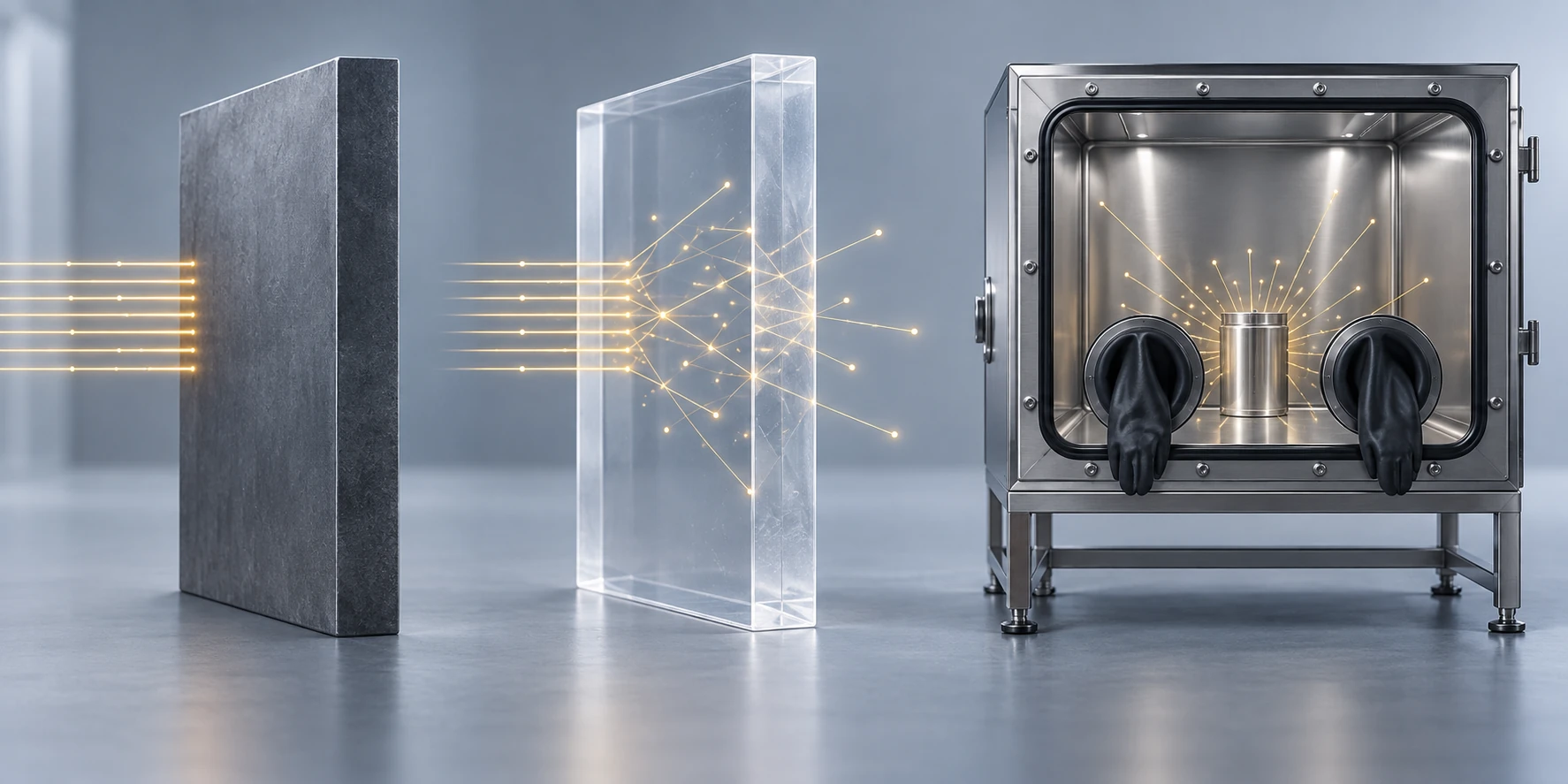
Row three is the one that most often changes a project’s equipment list rather than its shielding order, because it moves an operation out of the hood instead of adding material to it. Institutional policy describes glove boxes with filtered exhausts for unsealed alpha-emitting material, and treats powder handling inside a closed system as the norm.
Shielding also interacts with the cabinet beyond the liner, in the way the load clause set out earlier already implies. Consensus guidance notes that this class of hood is usually built stronger than a conventional one so that it can take lead bricks and similar material where they are needed. The weight is the constraint that shows up in the structural drawings, not the surface finish.
Why Lead Is the Wrong Answer for Beta Emitters
The mechanism is secondary radiation. When beta particles pass into a dense, high-atomic-number material, they are slowed abruptly and part of their energy is converted into X-rays, a process described as bremsstrahlung. The result is that a lead shield chosen to absorb beta radiation can produce a photon field that reaches the operator, which is why authoritative institutional guidance contains a direct prohibition rather than a preference.
Illinois DRS states it in exactly those terms: “Do not use lead shielding for beta-emitting nuclides because it will produce hazardous Bremsstrahlung (x-rays).” That source gives the replacement material immediately, noting that beta particles are stopped by 1 cm of Plexiglass while gamma rays require dense material such as lead. A requirement set that copies the vendor convention of a lead lining for the whole hood therefore specifies the wrong material for part of the work it is describing.
The practical consequence is a two-material requirement in a mixed program. Where your nuclide list contains both gamma and beta emitters, any shielding provision has to set out which material applies to which nuclide instead of naming one material for the whole enclosure, and the shielding assessment has to consider whether beta and gamma work share the same hood or occupy different benches.
The exact thickness and configuration still come from the assessment. What you can decide without it is the material rule and the prohibition, and both belong in the specification because they are what keeps an unqualified lead lining from being installed as a default.
Shelf Loading and Cabinet Structure
Shielding weight turns a surface requirement into a structural requirement, and the authorities treat it that way rather than as a bench detail. The load decides how the support is built, and it is the reason a heavy bench in this class of room is not interchangeable with a standard laboratory bench. Consensus guidance adds the comparison that matters to a buyer: radioisotope hood superstructures are usually made stronger than conventional hoods.
Distributed load, not point load, is what most often gets missed. A bench designed for glassware and instruments carries its load in a few places, whereas shielding arrives as slabs and bricks spread across the work surface, and stacked lead brick absorbs working space. The requirement to reinforce the work surface exists because the surface is what the load lands on, and the cabinet below it is what has to transfer that load to the floor.
The enclosure also has to remain usable once the shielding is in place. Shielding consumes working volume, it can obstruct the sash path, and it changes how the operator reaches into the chamber. Any requirement you add for shielding should be checked against the practical access to the controls, which institutional policy requires to be located outside the hood and immediately accessible to the worker.
The decision that stays with you here is the material rule and the loading provision. The thickness of the shielding, and whether a particular operation needs shielding at all, is determined by the radiation safety program against the inventory you propose, as an institutional standard states. Ask for that determination early, because it lands on the bench, the cabinet and the floor at the same time.
With the material rule and the structural provision written, the next requirement concerns how the installation tells you when containment has failed, which is the monitoring and alarm axis.
Airflow Monitoring and Alarm Response
Monitoring is the requirement that turns airflow from a design value into an operating condition. A hood only protects the operator while air is moving, so the requirement set has to include something that reports when movement stops. Institutional and regulatory sources agree on the instrument, and the disagreement among vendors is mostly about what to call it: authoritative documents describe a continuous monitoring device with an alarm rather than a named product.
The design guidance states that each fume hood will have a continuous monitoring device for the proper functioning of the hood, with an alarm, either visual or audible, present to indicate reduced air flow. British Columbia’s regulation requires airflow in a hood used for very toxic or radioactive materials to be monitored continuously where there is a risk to workers if airflow is lost. The two clauses are doing the same work from different directions, one prescribing the equipment and the other tying the obligation to the consequence of failure.
The Texas regulation adds a placement requirement that changes the specification. Each laboratory hood must have a pressure-independent air modulating device and an alarm to alert staff of fan shutdown or loss of airflow, and the alarm must be audible within the laboratory and at a 24-hour manned location. That clause answers a question buyers often leave open, which is who is supposed to hear the alarm when nobody is in the room.
Continuous Monitoring, Alarms and Sash Marking
Monitoring requirements describe three layers, and each one belongs in a different part of the specification. The first layer is the device, which has to be continuous rather than periodic, because an intermittent check cannot report a failure that occurs between checks. The second layer is the notification, which has to reach both the person at the bench and the place where people are present around the clock, where the governing instrument requires it. The third layer is the response, which depends on knowing the maximum sash position that still maintains the required airflow.
| Layer | Requirement | Source |
|---|---|---|
| Device | A continuous monitoring device for the proper functioning of the hood | CNSC GD-52, clause E15 (design guidance, Canada) |
| Device | Airflow must be monitored continuously in a hood used for very toxic or radioactive materials where loss of airflow puts workers at risk | BC Laboratory Regulation, §30.9(2) |
| Notification | An alarm, either visual or audible, to indicate reduced air flow | CNSC GD-52, clause E15 |
| Notification | A pressure-independent air modulating device and an alarm audible within the laboratory and at a 24-hour manned location | 26 TAC §511.163 (Texas, regulation) |
| Operation | A hood with an adjustable sash must be marked to identify the maximum height the sash may be set at while still maintaining the required air flows | BC Laboratory Regulation, §30.9(3) |
| Operation | Controls for the hood and its services must be located outside the fume hood and immediately accessible to the worker | BC Laboratory Regulation, §30.8(1) |
The sash marking clause is the one that most often gets lost between disciplines. The mark defines the working opening the airflow figure was calculated for, so a hood certified at a given velocity with the sash at a marked height is not certified at a wider opening. If the marking is missing, the operating instruction cannot be written, and the certification record cannot be matched to a physical position.
The control location clause is a second operating consequence. Controls outside the hood mean the operator can shut down or adjust the installation without reaching into a contaminated chamber, which matters precisely when the airflow alarm has just sounded. The sash-height criteria themselves are covered in a dedicated sash height article; what this requirement contributes is that the mark and the control position are part of the monitoring scope.
What to Do When the Alarm Sounds
An alarm with no procedure attached produces exactly the wrong behavior, which is to silence it and continue. Institutional policy addresses that directly, and it is worth writing the sequence into the requirement set because it belongs in the operating procedure for the enclosure. The University of Texas at Austin states that if the alarm sounds or the monitor lights indicate low flow, work should be stopped, equipment turned off, and the sash closed, and that laboratory fume hood alarms or monitors should never be turned off.
The sequence is ordered for good reasons. Stopping work removes the source of airborne material, turning off equipment removes heat and aerosol generation, and closing the sash contains whatever is already inside the chamber while the airflow problem is investigated. Disabling the alarm has no place in the sequence, because the alarm is the only signal that containment has stopped working.
One boundary is worth stating inside the same operating procedure. An airflow alarm reports that air is no longer moving as designed; it says nothing about contamination on surfaces or in the work area. Questions about what was released, and whether anything has to be cleaned, are answered by measurement, which brings this requirement into contact with the contamination monitoring axis rather than the airflow axis.
That distinction is also where the specification should stay humble. Consensus guidance describes the assessment of radiological hazards as relatively straightforward using handheld survey meters and wipe tests for removable contamination, and institutional manuals publish their own check frequencies, such as one university’s recommendation of daily checks with a portable survey instrument and weekly checks with swipe tests analyzed in scintillation counters. Frequencies differ between institutions, so quote one with its institution attached rather than as a general rule.
What you can specify from this section is an alarm coverage statement, a sash marking requirement, a control location clause, and a written response sequence for the operating procedure. The next requirement is about proving all of it, because you can determine nothing about the installation’s performance from a file that is incomplete.
What the Record Must Show
Documentation is the axis that most often decides whether an installation can be used on the day the license review happens. The requirements described so far are physical and operational, and each one generates a piece of evidence: a drawing annotation, a test result, a marking, an approved plan. Buyers who treat documentation as paperwork for the contractor discover at the review stage that some of it does not exist.
The regulatory sources attach records to specific physical conditions rather than to the project as a whole. Some evidence is fixed at commissioning, such as verification that the hood achieves its flow rate and has no counter-currents before use. Other evidence is periodic, such as air velocity measurements recorded at least annually. A third kind is triggered by events, such as re-measurement after repairs or maintenance that could affect air flows.
Naming those three categories in the specification is what makes the obligation enforceable. A clause that asks for documentation without saying when it is produced leaves the schedule undefined, and the schedule is usually what the reviewer tests first.
Documentation the Reviewer Will Ask For
The documents follow the equipment rather than the process, which makes them straightforward to list. What the reviewer wants is evidence that the physical marking and drawing work required under the exhaust and surface sections was actually delivered, and that it still matches the installation as built. The two tables this article carries list those items in full, so this section only has to record them as evidence rather than restate them.
| Evidence | Requirement source | When it is produced |
|---|---|---|
| Hood label identifying the connected fan or ventilation system | CNSC GD-52, clause E13 | At installation |
| Duct marking with the radiation warning symbol, at the interval set under exhaust requirements | CNSC GD-52, clause E24; University of Toronto standard §5.6.4 | At installation |
| Radiation warning sign on the working chamber | University of Toronto standard §5.6.4; Stanford and Temple institutional policies | At installation |
| Duct identification on plans supplied to maintenance personnel | CNSC GD-52, clause E23 | At drawing issue |
| Limits on use clearly labeled on the hood | BC Laboratory Regulation, §30.8(5) | At installation; updated when use changes |
| Exhaust treatment approval before installation and use, where filtration applies | Stanford laboratory standard; institutional policy | Before installation |
The submittal requirement for verification sits on top of that list. The institutional standard requires proper operation of fume hoods to be demonstrated by the contractor installing the fume hood prior to project closeout, and recommends the containment performance test described in ANSI/ASHRAE 110. The standard is named as a recommended test method rather than reproduced here, because the standard text itself is outside what this article covers.
Annual Measurement, Re-certification and Change Control
Air velocity measurement is the requirement with the clearest clock attached. British Columbia’s regulation requires air velocities over the operational face area of a fume hood to be measured and recorded at least annually and after any repair or maintenance which could affect the air flows. The annual interval is a floor rather than a target, and the second trigger is the one that catches projects out, because a fan replacement or a duct modification invalidates the previous record.
Verification before first use comes before any of that. The design guidance requires the fume hood to be tested prior to use to verify the flow rate and the absence of counter-currents, which places a functional test between installation and first operation. Institutional practice adds a recurring certification habit, with one university stating that all fume hoods must be re-certified annually by EHS.
Change control is where the record and the approval meet. Institutional policy requires fume hoods and sinks to be decontaminated before maintenance work, and a change of use moves the installation into a new approval state rather than a new maintenance ticket. If the substances, the quantities or the procedures change, the ventilation, shielding and filtration conclusions from the earlier sections have to be revisited, and the file that documents the original installation is the input to that review.
Decommissioning and Final Release
Surfaces, records and approvals all converge when a hood or a room leaves nuclide service. Consensus guidance sets the test for release in one sentence: a radiological survey should be done unless it can be assured that no radioactive material had been used in the space. That wording puts the burden on the record, because the assurance it refers to is exactly what a documentation file is for.
The method is the same one used for routine surveys: a handheld instrument for fixed reading, and wiping for contamination that can still be picked up. A wipe test is looking for contamination that can be picked up and moved, which is the fraction that matters for both release and for the next occupant of the room. Fixed contamination still registers on a survey meter, so both instruments appear in a competent release survey.
The decision on release does not belong to the installer or the buyer. Institutional policy places the approval with the radiation safety program, which is where the survey result goes before the space is returned to general use. Treat the decommissioning plan as a deliverable that accompanies the other records from the day the hood is installed, and the final release stops being an end-of-project emergency.
What the record requirement gives you is a schedule rather than a pile of paper: evidence created at installation, evidence recreated at defined intervals, and evidence triggered by maintenance or by a change of use. Determine who holds each item and when it is regenerated, and the file will still be complete when a review or a decommissioning asks for it.
What You Cannot Decide, and Who Signs Off on Radioisotope Fume Hood Requirements
Every requirement set has a boundary, and this one has three items outside it. How much shielding is needed, whether filtration is permitted and what falls inside the license are determined by your radiation safety officer or committee and by the authority that issues your license. A specification that asserts an answer in any of those three places will be corrected at review, and a specification that leaves them open invites the reviewer to answer them later under worse conditions.
The reason those items sit outside the buying decision is that each one depends on facts only the institution can assemble: the nuclides and their quantities, the procedures and their frequency, the staffing, the location of the room relative to occupied space, and the terms of the license itself. A supplier receives the finished requirement, not the license.
The practical work is therefore to write everything you can decide, then hand the remainder over as a list of questions with the facts attached. That list is short if the earlier sections have been done properly, because most of the requirement set has already reduced to properties, materials and records.
Decisions That Belong to the RSO, the Committee and the Licensing Body
Shielding is the first. The institutional standard ties the determination to the program rather than the project: based on the proposed type and quantities of radioactive materials, the Radiation Safety Program will determine the need for the shielding. That sentence covers both halves of the question, because it decides whether shielding is needed at all and how much, which the buyer cannot conclude from a nuclide name.
Filtration is the second, and it is an approval item whichever of the three positions set out above governs your project. Where the risk assessment route applies, the assessment itself answers whether filtration applies at all and at what level; where an institutional prohibition applies, the exception must be submitted with the monitoring and changeout arrangements; and where a regulation requires filters, the requirement is fixed but the changeout provisions still have to be designed and accepted.
The third item is the scope of the license itself, together with the conditions that come with it. Institutional policy is explicit that radioactive materials use is governed by the terms and conditions of the institution’s radioactive materials license, and the associated program controls which operations are permitted in which rooms. A hood can be correctly specified and still unusable in a given room, because the approval attaches to the location and the work rather than to the cabinet.
| Decision | Who decides | What to bring to them |
|---|---|---|
| Whether shielding is needed and how much | Radiation safety officer or committee, from the proposed type and quantities of material | Full nuclide list with emission types, activity handled at one time, and the operations performed |
| Whether filtration is permitted, and at what level | Radiation safety officer, committee or the license, depending on which position applies | The hazard assessment for the operations, and a proposed monitoring and changeout arrangement |
| Whether an operation is permitted in a hood at all | Radiation safety program, against institutional policy | The procedure, the physical form of the material, and whether it can become airborne |
| Whether a hood insert or any addition may be used | Radiation safety officer, on a per-procedure basis | The procedure requiring it, and the containment effect of the addition |
| Whether a room’s ventilation arrangement satisfies license conditions | License holder with the licensing body | Room pressure and airflow direction details for the review of the license conditions |
One entry in that table catches buyers out more often than the others, and it is the fourth. The institutional standard states that hood inserts are only permitted for radioactive iodination procedures specifically approved by the Radiation Safety Officer, which means an addition to a hood is a per-procedure approval rather than an accessory decision. If your procedure needs an insert, the approval and the specification travel together.
Why an Approval Does Not Travel Between Institutions
Approvals attach to an institution, and the mechanism is worth knowing before you assume that a neighboring laboratory’s arrangement will be accepted. The institutional standard states that all radioactive materials used on site are governed by the terms and conditions of the institution’s own radioactive materials license, issued by a state department of public health. The same physical hood, installed in the same way under a different license, is a different approval question.
The institutional program is the second half of the same point. The radiation safety program reviews proposed uses and makes specific recommendations appropriate for each facility, which is the sentence that explains why the ventilation answer ranges so widely. Two facilities with identical benches can hold different ventilation requirements because the approvals were written for different material inventories and different procedures.
This article deliberately stops short of quoting federal requirements as a shorthand for good practice. The primary document collection published by the United States nuclear regulatory body was not reachable during the research for this article, so no claim is made here about the content of its guidance, and any statement of the form “the regulator requires” would be unsupported by the sources used. Where a federal-level reference point is needed, this article uses the state regulation quoted earlier and the National Academies consensus guidance instead.
The same restraint applies to standards that were not obtained in full. Where this article names ANSI/ASHRAE 110, it records only that the institutional standard recommends that test; it does not restate the published standard’s content. Where the Texas regulation points to NFPA 801, the article records that reference rather than summarizing a document it has not read.
What you can take from this section is a short list of questions rather than a set of answers, which is the correct output for this axis. Ask the radiation safety program what shielding the proposed inventory requires, ask what the filtration position for your operations is, ask whether the operations are permitted in the proposed room, and ask what the license conditions require of the room’s ventilation. Bring the nuclide list and the procedures with you, because those four answers depend on them.
From Requirement List to Quotation
The requirement set is now complete enough to price, and it is worth seeing it in one place before it goes out. Every axis in this article produced either a property to specify, a material rule, or a document to produce, and the list below collects those outputs with the authority behind each one. Work through it as a purchaser would, and the items that remain open are exactly the ones that belong in the covering note rather than in the specification.
| Axis | Requirement to carry into the specification |
|---|---|
| Nuclide and process | Nuclide list with emission types, physical form, activity handled at one time, and operations; routing decision for operations that do not belong in a hood |
| Exhaust | Independent exhaust or a documented variation route; the face velocity convention and figure from the governing instrument; identification, discharge, availability and emergency power clauses |
| Filtration | Whether filtration applies, at what level, and what the submission has to contain |
| Surface and construction | The decontamination properties and internal geometry; containment for a small spill; structural support sized for the shielding itself |
| Shielding | Material rule qualified by radiation type, with lead excluded for beta emitters; structural provision for shielding weight |
| Monitoring | Continuous airflow monitoring, alarm coverage including the manned location where required, sash marking, controls outside the hood |
| Movement and operations | Sash handling, waste routing and bench discipline for the enclosure class in use |
| Records and approval | Installation evidence, periodic re-measurement, event-triggered re-measurement, release survey, and the approvals listed above |
A worked example shows how the list behaves when it is applied to a real inventory. Consider a university research laboratory that holds an institutional radioactive materials license, with three streams of work: a gamma-emitting nuclide handled at low to moderate activity in limited weekly quantities, a low-energy beta-emitting nuclide used daily in small volumes, and a single unsealed alpha-emitting source used for tracer work. The operations include boiling, evaporating and dispensing, which are the operations that institutional policy treats as susceptible to atmospheric distribution, plus routine pipetting and one iodination procedure that requires a hood insert.
Applying the list produces a convergent result rather than a list of options. Exhaust is independently ducted, because the institutional policy for this class of hood does not permit manifolded exhaust, and the face velocity is written with the institution’s convention and figure. Shielding is specified by radiation type: a dense material for the gamma stream, with no lead on the beta stream because lead generates bremsstrahlung, and a low-atomic-number material for that bench instead. The alpha source is routed out of the hood into a glove box, and the iodination insert is submitted as a per-procedure approval. Monitoring is a continuous airflow device with an alarm, a marked sash position and a written response sequence. Three items go to the radiation safety program rather than into the specification: the shielding amount for the gamma stream, confirmation of the filtration position for the boiling operations, and confirmation that the room is permitted for the alpha tracer work.
Change one input and the output moves in a way you can predict. Replace the gamma stream with beta work only, and the shielding requirement inverts from a dense material to a low-atomic-number one; the structural provision for shielding weight may still be needed for handling, but the material rule changes. Place the same project under a regulation that requires filtration at a stated efficiency, and the exhaust treatment arrives as a mandatory element with a safe changeout design, instead of a submission that argues for an exception. Keep the alpha source in the hood instead of routing it to a glove box, and the conclusion changes from a specification to a refusal, because the enclosure class for that operation is not a hood at all.
The inputs a supplier needs to quote against this list are worth stating, because they are what makes quotations comparable: the nuclide list with emission types and forms, the operations and their frequency, the activity handled at one time, the governing instrument for face velocity and its convention, whether filtration is required or excluded, the shielding material rule, the monitoring coverage expected, and the document set you intend to require. A hood configured to this class of requirement is what the supplier is being asked to price, and the radioisotope fume hood range shows the configuration to start from. Send those inputs with the reference, and the quotations you receive will differ on price and delivery rather than on what is being offered.
The eight-axis list is the durable output of this article. Take it to your radiation safety officer or committee first, because the three open items change the specification, and take the completed list to suppliers second, because the blank items are what send a project back to the beginning. If the enclosure class is still open, the laboratory fume hood range is the place to confirm what the rest of the installation can offer.
The purpose of stating radioisotope fume hood requirements this way is to keep the equipment decision where it belongs: inside a set of approvals that your institution and your licensing authority own, and inside a specification that you can defend line by line. Decide which items you can write yourself, confirm the rest with the people who hold the authority to answer them, and the hood you order will be the hood your license permits.
FAQ: Exhaust, Filter and Shielding Questions Buyers Still Ask
Three questions keep arriving after the requirement list is otherwise settled, and each of them is really a question about which authority you are following. They are answered here rather than in the body of the article because the reasoning behind them is already set out above.
Is a Radioisotope Fume Hood Just a Stainless Steel Chemical Hood?
No, and the difference is administrative as much as physical. Stainless steel construction and coved corners are properties a chemical hood can have as well, so a hood built that way is not yet an approved enclosure for nuclide work. What makes it a radioisotope hood is that its exhaust arrangement, its monitoring, its shielding and its permitted operations were specified against a radionuclide inventory and accepted by a radiation safety program.
That distinction matters most during procurement, because it explains why two visually identical hoods can be offered at different prices against the same enquiry. One is a chemical hood with a stainless interior, and the other carries the requirements that the nuclide work adds: a non-shared exhaust path, a monitored and alarmed airflow, an identified duct run, and a surface geometry chosen so that decontamination cycles can clear it completely.
If you need to justify the purchase, the argument is not the material. It is the requirement set behind the material, and the record that shows each requirement was verified.
Can a Ductless or Filtered Hood Be Used for This Work?
Not as a substitute for dedicated exhaust. The rule that governs nuclear substance hoods is written against sharing: the design guidance states that hoods will not contain filters unless filtration is declared and approved, that the hood exhaust will not connect to other exhaust systems, and that air vented through the hood will be vented without recirculation. A recirculating enclosure contradicts all three provisions at once, because the air it discharges returns to the room it is protecting.
Institutional policy reaches the same place by a second route, with the University of Toronto standard restricting ductless hoods to situations approved by its environmental health and safety office and stating that a radioisotope hood will not contain any kind of air filtration. A filtered enclosure therefore does not remove the exhaust requirement for nuclide work; at most, filtration becomes an additional treatment stage on a dedicated duct that is already required.
The suitability of ductless equipment in general is a separate question about ductless boundaries and this article does not restate the policy framework that applies to it. For nuclide work the conclusion is narrower: plan on ducted exhaust, and treat any filtration as part of that ducted system rather than as a replacement for it.
Which Face Velocity Should You Specify?
Specify the figure published by the instrument that governs you, and state the convention it uses along with the number. Where a regulation applies, use its value and its convention: a minimum value, an average with a per-point floor, or a fixed range are three different tests, and a hood can satisfy one while failing another. Where a regulation does not apply, use your institution’s figure, because the person reviewing the submittal will be reading the same document.
If more than one instrument appears to apply, write both into the requirement and ask the radiation safety program which one governs the installation. Quoting the higher figure without authority is not a safe default, because it changes the exhaust volume the system has to move and can push the installation into a design that does not match the certification the consultant is testing against.
The substantive part of that answer stays with the authority that published the number. Decide which instrument governs your hood, write its figure and its convention into the specification, and leave the rest of the face velocity discussion to the article on face velocity requirements linked earlier rather than reproducing it here.
Leave a Reply