


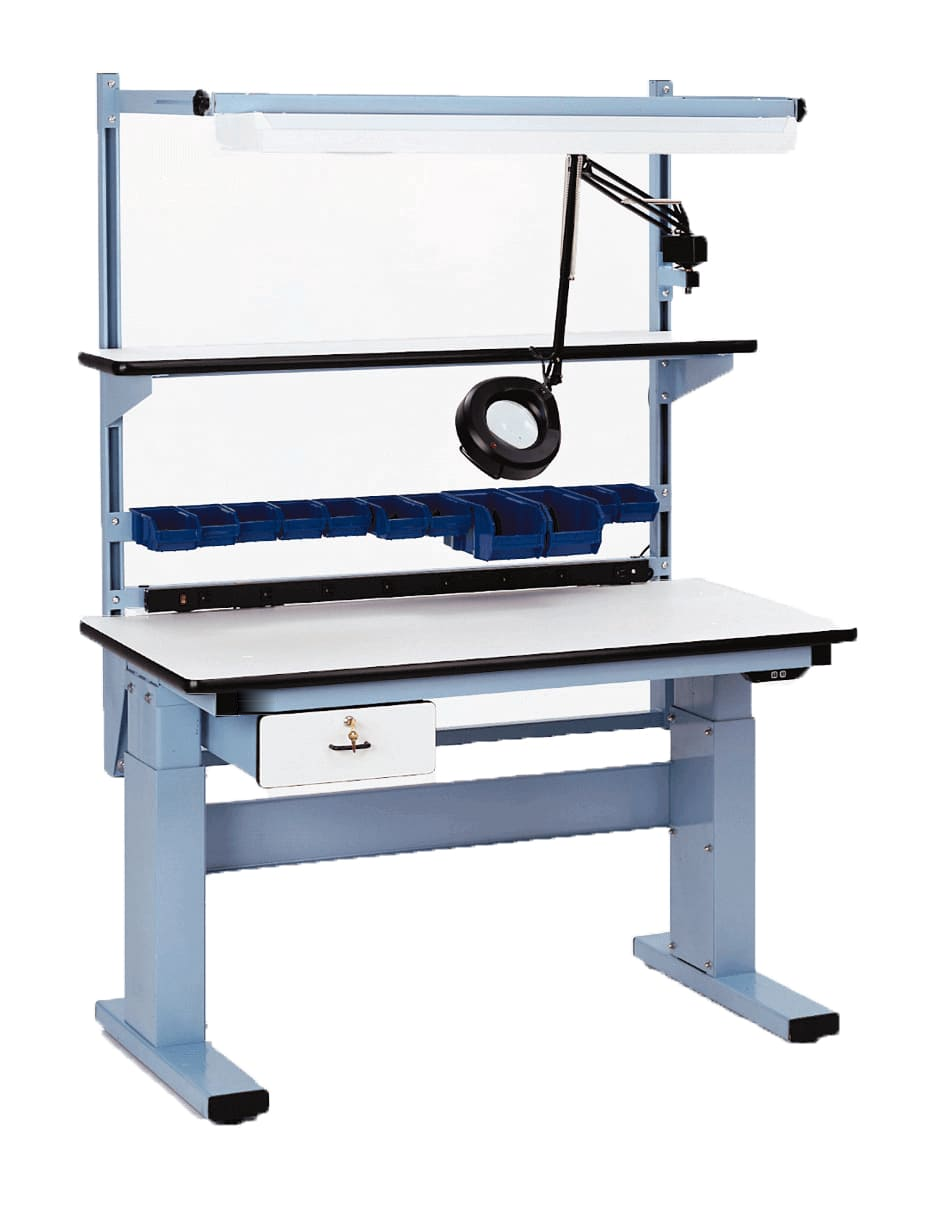
Description
Key Specifications and First Selection
An adjustable height lab bench should be selected from the laboratory task and the height-change mechanism, not from a generic sit-stand image. Buyers need to know whether height is set occasionally for one instrument, changed by a crank between users, adjusted regularly by powered controls, or balanced by a spring-assisted system. The answer determines the frame, lift architecture, load condition, control package, service routing and the checks required before the worktop moves.
The primary electric reference on this page is a 28-44 in (711-1118 mm) base-height range before worktop thickness, with 36/48/60/72 in widths, 30/36 in depths, dual synchronized linear actuators, integrated limits, 12 VDC low-voltage control and 1200 lb (544 kg) published evenly distributed capacity. These fields belong together. The final working height must add the selected worktop thickness, and the published capacity must not be copied to a hand-crank bench, a spring-assisted unit, a bench with heavy uprights or a configuration carrying concentrated equipment.
| First selection field | Electric base reference | Buyer must define | Why it changes the selection |
|---|---|---|---|
| Height range | 28-44 in base height before worktop | Seated, standing and equipment working heights | Base height and finished work height are different dimensions |
| Lift mechanism | Dual synchronized linear actuators with limits | Change frequency, power availability and required controls | Electric, crank, indexed and spring mechanisms have different use conditions |
| Static condition | 1200 lb / 544 kg evenly distributed reference | Worktop, equipment footprint, local loads and attachments | Distributed static capacity is not a universal lift rating |
| Surface and frame | Selected laboratory worktop on a lift base | Chemical, heat, cleaning, openings and support points | Top material and accessories affect load, clearance and finished height |
Start with finished working height
Record the required height at the actual work surface, not only the frame. A 28-44 in base range becomes a different finished range when a 25 mm resin worktop, a stainless-steel skin and reinforcement, a ceramic slab or a layered work surface is installed. Include the operator posture, stool or chair range, instrument eye level, sample-handling height, under-bench clearance and the height of adjacent fixed furniture. A bench that reaches a desirable number on paper can still be unsuitable if the worktop thickness or local equipment base was omitted.
Pick the mechanism from frequency and load
Electric dual-column systems are useful where several operators need regular controlled height changes and the selected electrical, control and cable arrangement is available. Hand-crank systems are useful where adjustment is deliberate and power is not required. Indexed legs or locking-screw mechanisms are generally for periodic setup rather than repeated daily movement. Spring-assisted systems can provide rapid adjustment only within their defined balancing load. These four mechanisms should remain distinct in the quotation and in any requested performance data.
Information needed for a usable quotation
Send the finished working-height target, desired lower and upper positions, worktop material and thickness, equipment schedule, local support points, selected accessories, adjustment frequency, preferred mechanism, power availability, service cables or hoses, room layout and any accessibility requirement. This lets the proposal define a matched lift base, worktop and control scope rather than placing a laboratory top on an unspecified office-style frame.
Height Adjustment Mechanisms and Use Conditions
Height-adjustable laboratory benches can use powered linear actuators, hand cranks, mechanical pins or screws, and spring-assisted columns. They perform the same broad function but do not provide the same user experience, motion control or load boundary. The selected page configuration must identify one mechanism and the information required to use it, rather than listing all mechanisms as if their travel, speed and capacity were interchangeable.
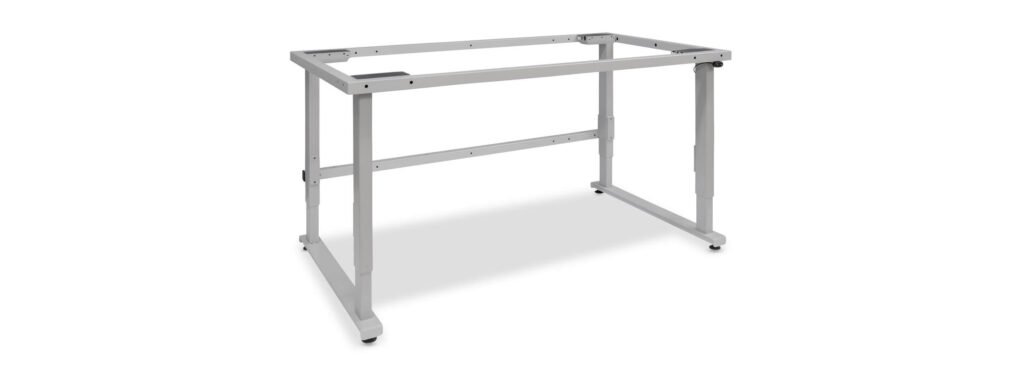
Electric dual-column lifting
The electric reference base uses two synchronized linear actuators with integrated limit functions and low-voltage control. This architecture is appropriate where the working height changes regularly and the operator needs a repeatable command method. The final configuration should state the number of lift columns, controller version, incoming power, control voltage, actual height range with worktop, permitted load during movement, static load condition, duty cycle, speed, memory functions, error behaviour and overload response. A digital display or preset button is not proof that the installed system has every option available in another electric frame family.
Hand-crank and manual mechanisms
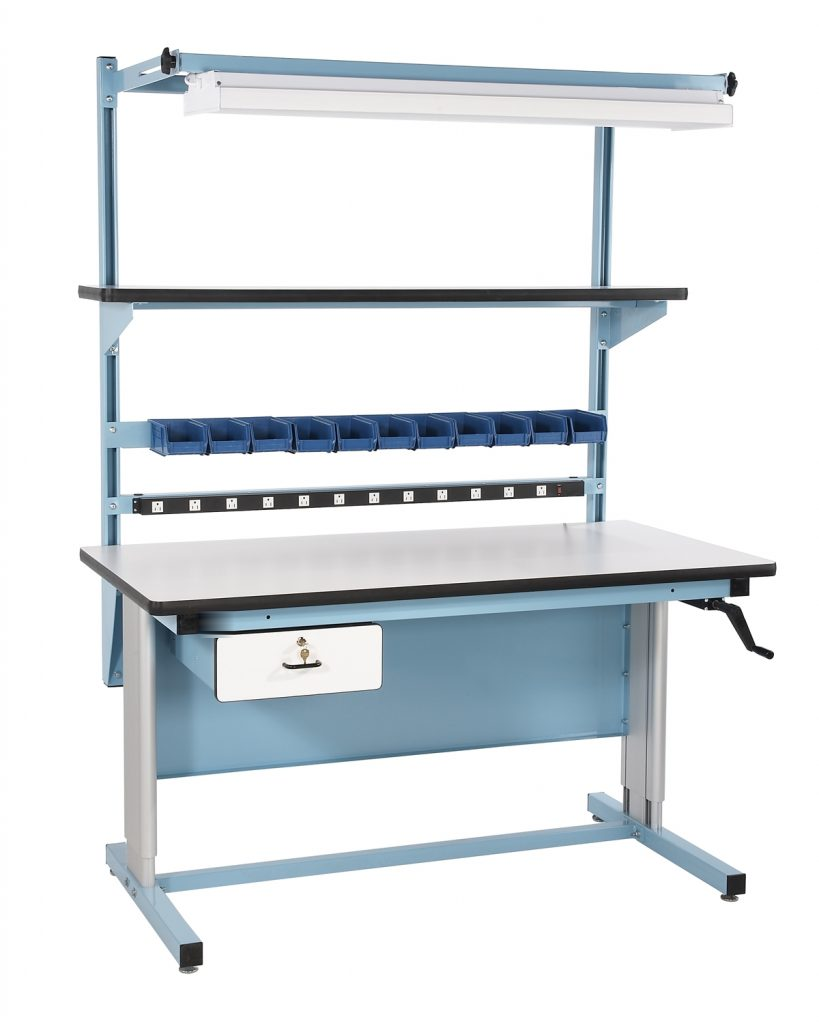
A hand-crank bench is not simply the unpowered version of an electric bench. The crank location, required clearance, travel per turn, operator force, mechanical stops, locking method and load condition all need to be considered. A manual laboratory reference can use a 670-1120 mm height range with a 1530 x 750 x 25 mm worktop and a 38 x 38 x 1.5 mm stainless frame, but the load, crank travel and exact operating mechanism remain separate confirmation items. Do not use the electric base capacity or control features for that manual arrangement.
Indexed and spring-assisted systems
Indexed legs, locking screws or Allen-key height settings suit planned reconfiguration where the bench is unloaded or supported during adjustment. A spring-assisted mechanism can provide a broader quick-adjustment range, but the balance point depends on the installed top and equipment mass. It needs a defined operating load range and a check for stable stopping at every selected position. Neither mechanism should be marketed as continuous powered sit-stand adjustment unless that specific function is supplied.
Movement, limits and pinch zones
Any moving bench needs a clear area above, below and beside the worktop. Confirm cable paths, hose loops, drawers, chairs, shelves, wall-mounted equipment and the operator’s hands before motion begins. Mechanical limits prevent travel past the selected range; they do not replace pinch-zone planning, synchronisation checks or a safe stop procedure. Attachments such as a shelf upright, monitor arm, reagent rack or under-bench cabinet change the moving envelope and must be reviewed with the lift system.
Finished Height, Load and Worktop Configuration
The base-height range is only one part of the laboratory workstation. Finished height includes the selected worktop and any mounting plate, equipment feet or surface insert. The usable range also needs to be checked against the lowest and highest task position, knee and stool clearance, operator reach, overhead fittings and the path of any attached shelves or cables. Height values from an unrelated frame must not be combined with the reference electric base.
Reference configuration families
Published configurations demonstrate several distinct height-adjustment approaches: an electric laboratory base at 28-44 in before the worktop with a 1200 lb distributed static reference; a manual bench at 670-1120 mm with a 1530 x 750 x 25 mm top; an electric workstation at 620-920 mm with 300 mm travel; and a different electric workstation at 30.5-46.5 in with 16 in travel. These are planning references, not a single fixed family. The final range and load must be chosen from one compatible frame and top assembly.
| Configuration family | Published height or travel fields | Mechanism direction | Boundary for use |
|---|---|---|---|
| Electric laboratory base | 28-44 in base height; 36-72 in width; 30/36 in depth | Dual synchronized linear actuators and digital control direction | 1200 lb distributed static reference; final height excludes worktop |
| Manual laboratory bench | 670-1120 mm height; 1530 x 750 x 25 mm top | Manual adjustment on stainless-frame reference | Exact load, operating force and mechanism need confirmation |
| Electric equipment station | 620-920 mm height; 300 mm travel | Electric height adjustment | Load, speed and controller fields not established on the reference |
| Electric workstation family | 30.5-46.5 in height; 16 in travel | Electric base with optional accessories | Load and worktop data are selected for the actual configuration |
Lift load, static load and local load
Three load questions must stay separate. First, the lift load is the mass permitted while the worktop moves. Second, static evenly distributed capacity applies after the bench is parked at a selected height. Third, a local load describes a concentrated instrument base, sink cut-out, clamp or edge-mounted accessory. Uprights, drawers, shelves, power modules and the worktop itself all count in the actual mass and may shift the centre of gravity. A large distributed number should never be used to approve a tall, off-centre or moving instrument.
Worktop selection and support points
Epoxy, phenolic, compact laminate, ceramic and stainless-steel worktops have different thickness, weight, cutting and support requirements. The selected top should be checked for chemicals, temperature, cleaning, impact, conductivity requirements, edges, openings and the equipment base. The lift frame must support the top across the required span and at any local cut-out. A worktop can be suitable as a fixed bench surface and still need different support details when attached to a moving lift base.
Height changes with equipment installed
Before changing height, decide whether equipment remains on the bench, whether it is restrained, whether containers are emptied, and whether cables, tubing and accessories can move through the whole range. Heavy instruments, high centres of gravity, sensitive optics and liquid processes may require a parked setup height rather than routine repeated motion. The final operating procedure should state what can stay on the worktop, what must be isolated or removed, and who verifies clearance.
Selecting the usable height range
The widest available travel range is not automatically the most useful selection. A laboratory bench used mainly for seated preparation may need a lower working position and unobstructed knee space, while a standing inspection task may need a higher surface with enough clearance below the worktop for drawers, service rails or column covers. Where several operators share one station, the selection should begin with the task envelope and the equipment rather than a nominal desk-height convention. The selected lower and upper positions should remain usable after the worktop, monitor arms, reagent shelves, splash guards and service connections are fitted.
Concentrated loads and asymmetric layouts
An instrument installed near one end of the worktop creates a different condition from the same mass distributed across the full surface. A sink bowl, balance enclosure, microscope, compressed-gas restraint, side-mounted rail or cantilevered shelf can also transfer load away from the centre of the lift base. The final frame and worktop layout should identify concentrated equipment footprints, edge offsets and any under-bench module that changes the balance of the moving assembly. This review is especially important when the bench is adjusted at working height, where a raised centre of gravity can make an otherwise acceptable static layout less stable during movement.
Reference dimensions versus released dimensions
Published widths, depths and height ranges are useful for early room layouts, but they are not a release drawing for a particular laboratory. Finished dimensions depend on the selected base, worktop overhang, back service zone, edge treatment, accessory uprights and any sink or equipment opening. The project drawing should therefore record the finished worktop height at both travel limits, overall footprint, support-point locations, required movement envelope and the location of every fixed service that could restrict adjustment.
Controls, Services and Stability at Every Height
The control, worktop, accessories and service path form one moving system. An electric bench may use a digital display and stored positions, while a hand-crank bench uses a mechanical operating point and an indexed bench uses a setup procedure. Each approach needs enough clearance to operate without hitting adjacent furniture, drawers, uprights or the operator. The selection must also define how the bench responds after a power interruption, stop command, overload, out-of-sync condition or control fault.
Controls and user positions
For an electric system, specify whether the controller has simple up/down movement, a display, programmable memory, key lock, shared-user settings, a local emergency stop or a project-specific interface. A stored position is only useful if the installed top, attachments and work area have been checked for it. For manual systems, place the crank or adjustment point where it can be reached without a collision and where the operator can observe both sides of the bench. Mechanical adjustment should be made in accordance with the selected load condition rather than forcing a loaded frame through an unknown range.
Service routing through the full travel
Electrical leads, data cables, vacuum hose, gas hose, water lines and drain connections need a separate full-travel review. Identify the connection point, cable carrier or loop, minimum bend radius, retained slack, strain relief, isolation method and points where a line could snag or be trapped. The shortest route at one work height is not always safe at another. A permanently hard-piped service can prevent ordinary height adjustment unless the installation is designed for that movement.
Stability and optional mobility
Height adjustment and mobility are different product decisions. Levelling feet are generally preferred for a bench that changes height under laboratory equipment. Casters or retractable wheels can be selected where relocation is needed, but they require a separate moving and parked-stability review. A high bench with heavy shelves, an off-centre instrument or a tall service upright may need a wider base, lower operating height, anchoring or another equipment-support solution. Do not use a mobile-lab-bench statement as proof of stability for a height-adjustable installation.
Accessories and lift-system mass
Treat every accessory as part of the lift calculation: shelves, task lighting, power strips, monitor arms, reagent racks, drawers, keyboard trays, under-bench cabinets, service rails and the worktop itself. Their individual weight, position and cable path change the actual lifted mass and moving envelope. The final schedule should list included accessories and separate any item supplied by others.
Applications, Ergonomic Fit and Product Boundary
A height-adjustable laboratory bench can support shared laboratories, variable operator stature, standing sample preparation, seated documentation, instrument setup and task changes that need a controlled work-surface position. It is most useful where changing the height improves the working relationship between the operator, sample and equipment without turning the bench into a different class of product.
Shared and sit-stand laboratory work
In teaching, quality-control and preparation rooms, one bench may be used by several operators across a shift. A selected height range can reduce the need to compromise around a single fixed work level. The finished surface height, stool range, foot clearance, reach to shelves and task location should be checked for the actual users and equipment. A general sit-stand phrase is not an ergonomic approval for every installed height or person.
Equipment setup and instrument support
Height adjustment can position an ordinary laboratory instrument at a usable operating level, provided the worktop, lift frame and equipment base are selected for that load. The bench does not become an anti-vibration table because it carries a microscope or balance. For a measurement task requiring isolation from floor or frame vibration, use an Anti-Vibration Balance Table or a dedicated instrument-support approach rather than relying on a lifting mechanism.
When another bench is more suitable
Select a Mobile Laboratory Bench when controlled relocation is the primary requirement and the moving/parking conditions drive the base design. Use a Laboratory Wall Bench for a permanent perimeter arrangement with fixed services, or a Laboratory Island Bench for a central double-sided work zone. Use a Laboratory Instrument Table where the support, heat, cable routing and maintenance needs of one instrument define the whole workstation.
Accessibility and special applications
Accessibility, cleanroom, ESD or chemical-process requirements must be evaluated from the final bench height, knee space, worktop material, frame, grounding and local requirement. They are not automatic outcomes of an electric lift. State the application requirement separately and confirm the selected configuration, site rule and required supporting information before using those descriptions in a project schedule.
Selection summary
Choose a height-adjustable laboratory bench when changing the work-surface level is a regular part of the laboratory task and the selected mechanism can carry the defined assembly safely. Choose a fixed bench when the height does not need to change. Choose a mobile bench when relocation is the primary need. Choose an anti-vibration or specialist support table when measurement stability, rather than height adjustment, is decisive.
Planning, Installation and Commissioning
The final release should identify the selected mechanism, base range, finished worktop height, frame, worktop, equipment arrangement, accessories, electrical connection and service routing. Before the bench is installed, check the room height, overhead shelves, wall services, nearby fixed furniture, door swing, floor level and maintenance access. A lift base needs enough free volume to move through its full selected range after the top and every attachment are installed.
Installation and first-use checks
Install the bench on the specified support points and verify the base is level and stable before equipment is placed on it. Check frame fasteners, column alignment, worktop attachment, control location, limit operation, cable support, accessory attachment and the full up/down clearance. For an electric system, verify the incoming power, controller, direction, stop function and any documented error indication. For manual or mechanical systems, verify the adjustment point, locking condition and safe procedure under the selected load.
Commissioning sequence
Begin with the bare bench, then add the worktop, then accessories and finally equipment in the documented order. Test a slow complete travel without a process load, observing cables, hoses, shelves, drawers and nearby items. Repeat the check with the approved equipment condition only after the static and movement boundaries have been confirmed. Record the usable lower and upper positions, any restricted positions, the selected parking height, and the action required after power loss or a change in load.
| Planning item | Project input | Decision produced | Confirmation before release |
|---|---|---|---|
| Task and height | Operator posture, equipment and target finished height | Mechanism, base range and worktop thickness | Lower/upper work positions and room clearance |
| Load and accessories | Worktop, equipment, shelves, drawers and local supports | Lift/static load assessment and frame layout | Components included in the selected load condition |
| Controls and services | Power, controller, memory, cables, hoses and isolation | Control package and full-travel routing | Stop, error, pinch-zone and routing checks |
| Installation | Floor, walls, overhead items and adjacent furniture | Position, stabilisation and service access | Full-height motion and maintenance space available |
Maintenance and change control
Inspect the worktop fasteners, frame, columns, mechanical joints, crank or control unit, cables, limits, power lead, accessories and floor supports at the required interval. Any new heavy instrument, changed worktop, upright, service connection or routing change requires a review of the moving mass, height envelope and stability. Do not reuse the original adjustment setting after the configuration has materially changed.
Frequently Asked Questions
Is the listed height measured to the work surface?
Not necessarily. Some published values describe the lift base before the worktop is installed. The final working height must include the selected top, mounting details and any equipment interface.
Can an electric lift base use the same load value as a manual bench?
No. Electric, hand-crank, indexed and spring-assisted arrangements use different mechanisms and stated conditions. Keep lift capacity, static capacity, range, speed and operating requirements tied to the selected structure.
Can equipment remain on the bench during height adjustment?
Only when the selected lift condition, equipment mass, local supports, centre of gravity, restraint, service routing and operating procedure permit it. A static distributed capacity does not automatically approve repeated movement with a concentrated instrument.
Is a sit-stand laboratory bench suitable for precision balances?
Not by default. Height adjustment improves working position but does not establish vibration isolation. Select a dedicated Anti-Vibration Balance Table where the measurement duty requires it.
Can power, data or gas be installed on the bench?
They can be selected with an approved connection and full-travel routing plan. Define isolation, slack, bend radius, strain relief and checks at the lower and upper positions before normal operation.
Contact the Xicheng Engineering Team Today
Send the required finished working-height range, worktop selection, equipment and accessory schedule, adjustment frequency, preferred mechanism, electrical and service requirements, room layout and any accessibility criteria. The engineering team will return a height-adjustable laboratory bench configuration discussion and pricing proposal within 24 hours.
Shenzhen Office: No. 34 Zhenxing Road (Shengtaian Heavy Industrial Park B), Loucun, Guangming New Dist, Shenzhen, Guangdong, China
WhatsApp: +86 18126478161
Engineering Mailbox: fanalax34@gmail.com