


Description
Key Specifications and First Selection
A laboratory chair is more than a standard office chair placed beside a bench. It needs to support the operator at the actual work height while accommodating cleaning, equipment access, floor movement and the repeated posture of laboratory work. The main choices are seat-height range, backrest and seat adjustment, surface construction, base and mobility, and whether a higher chair with a footring is required. These decisions should be made before colour or minor accessories.
| Selection field | Decision required | Why it changes the chair | Confirmation before release |
|---|---|---|---|
| Workstation height | Low, standard or elevated laboratory bench | Determines usable seat range and foot support | Finished bench height, lower clearance and operator posture |
| Surface construction | Integrated PU, sealed vinyl or upholstered seat | Affects cleaning approach, comfort and surface geometry | Cleaning materials, spills and shift duration |
| Backrest and controls | Fixed, adjustable, contact or tilting backrest arrangement | Changes sustained-posture support and reach | Task motion, operator position and adjustment need |
| Base and movement | Casters, braked casters or glides; optional footring | Changes stability, rolling behaviour and access | Floor finish, movement frequency and high-seat use |
Reference dimensions and configuration limits
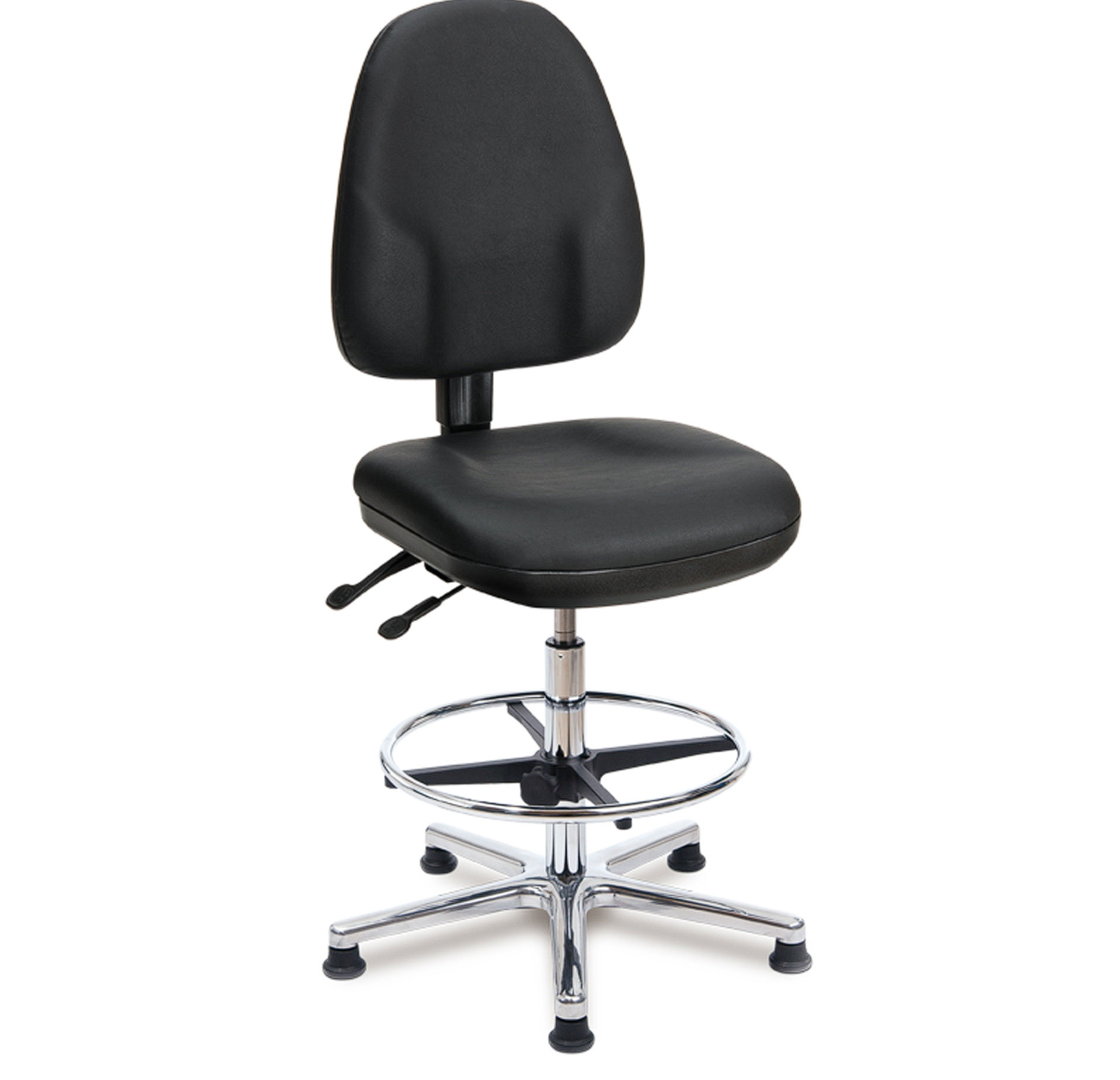
Published laboratory-chair examples include a 440-575 mm standard seat-height range in one integrated polyurethane configuration, a 430-560 mm compact PU arrangement, and a 610-845 mm high-chair range in one PU family with a footring and glides. Seat sizes around 450 x 420 mm and five-star bases around 600 mm diameter also occur in individual configurations. These values belong to separate chair designs. They are planning references, not a combined fixed specification for every laboratory chair.
Start with the working position
Record whether the operator works seated at a low bench, alternates between seated and standing work, uses a microscope or instrument, or works at an elevated counter. Check feet, knees, elbows and backrest contact in the actual position. A high laboratory chair without appropriate foot support can be less suitable than a standard-height chair, even when its gas-lift range appears to reach the bench. The selected seat range, footring and base must work together.
Special-environment boundary
An easy-to-clean PU lab chair is not automatically a cleanroom chair or an ESD chair. Cleanroom and electrostatic-control requirements depend on selected materials, construction, components and test conditions. Where these requirements are part of the specification, evaluate the separate cleanroom laboratory chair configuration rather than transferring special-environment claims to an ordinary laboratory chair.
Key selection questions before comparing models
Before comparing chair styles, establish the highest and lowest bench positions that users actually work at, whether the chair must roll during use, whether a footring is needed, and which cleaning products contact the seat. Then decide whether a simple height-adjustable PU laboratory chair is sufficient or whether the task needs a more adjustable backrest, cushioned surface, fixed glides, armrests or a special-environment configuration. This sequence keeps the purchasing discussion focused on the conditions that change usability and delivered scope.
Seat Height, Ergonomics and Backrest
The useful height of a laboratory chair is the relationship between the seat, feet, knees, bench, work item and backrest, not only the printed gas-lift range. Operators may spend long periods pipetting, documenting results, handling samples, viewing a microscope or working at an instrument display. The chair should permit the arms, shoulders and feet to remain supported while the operator can still reach the working area without persistent forward leaning.
Choose low, standard or high seat height
Low and standard chair ranges are commonly used with ordinary laboratory benches and instrument tables. High laboratory chairs are used where the work surface is elevated and should include a suitable footring or foot support. Measure the bench height, the clearance below it and the required approach position. If a chair must serve more than one workstation, identify the full range that users actually need rather than choosing the maximum travel available from a gas lift.
Backrest contact and adjustment
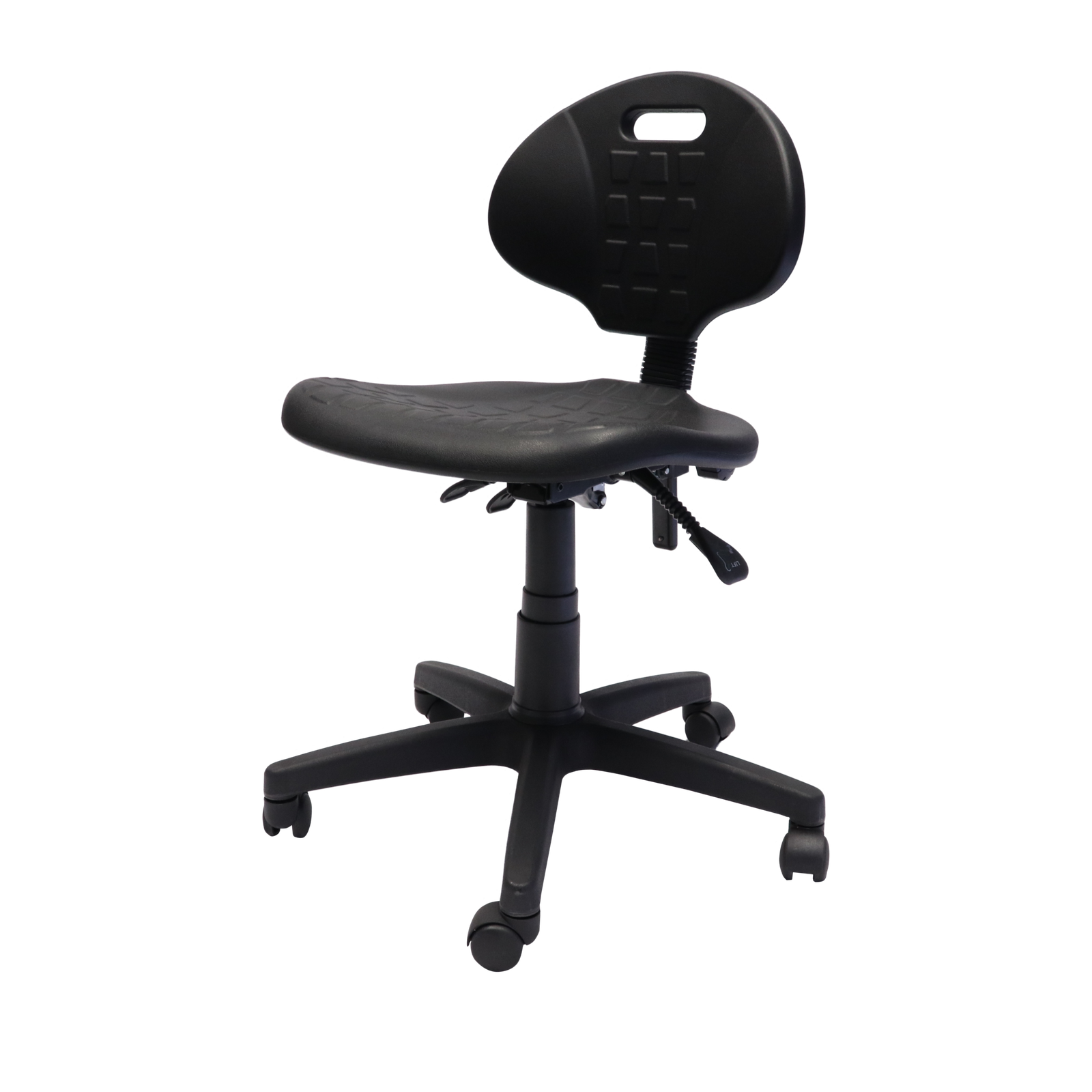
A backrest can be set for continuous contact, intermittent support or a task that needs frequent forward reach. The useful adjustment fields may include backrest height, depth, tilt, seat tilt and the relationship between seat and backrest. Not every chair includes every adjustment. A laboratory task chair should list the controls actually supplied instead of treating a generic ergonomic description as a fixed performance claim.
Seat surface and front-edge support
Seat width and depth need to fit the expected user range while allowing access to close work. A rounded or flexible front edge may reduce pressure at the back of the legs during a forward-working posture. For a shared laboratory, test the selected seat with the intended bench height and typical work movements. A larger seat is not automatically better if it prevents the user from reaching a microscope, sample tray or instrument control in a neutral posture.
Armrests, foot support and shared use
Armrests can support some documentation or display-based tasks, but may obstruct approach to a bench or interfere with under-bench clearance. A footring is normally considered with a high-seat arrangement, not as an ornamental accessory. For shared rooms, select controls that users can identify and adjust quickly, then record the normal seat height and footring position for the task. This helps maintain a repeatable working position without locking the chair to a single operator.
Test the chair with real work, not an empty bench
The final check should include the objects that occupy the workstation: a keyboard, pipette rack, microscope controls, sample containers, monitor or instrument panel. An empty bench can make any chair appear suitable, while the real task may require a different forward reach or foot position. Ask the operator to adjust the chair through the normal range, approach the bench, turn to adjacent equipment and return to the working position. This practical check can identify an unsuitable seat depth, armrest interference or footring position before a larger order is released.
Materials, Cleaning and Base Selection
The chair surface must be matched to the laboratory’s actual cleaning routine, contact materials and expected use. Integrated polyurethane is commonly selected where a smooth wipe-clean seat and backrest are required. Sealed vinyl or artificial-leather upholstery may be used where a cushioned surface is preferred. Textile upholstery can suit selected dry areas, but it is not a substitute for a sealed surface where frequent wiping or spill management is required.
Integrated PU and sealed upholstery
An integrated PU seat and backrest have a different structure from a cushioned chair with a vinyl or artificial-leather cover. Review seams, edges, exposed fasteners, texture and the accessibility of the adjustment mechanism. The required cleaning agent, disinfectant, contact chemical and cleaning frequency should be supplied with the request. A general statement that a surface is easy to clean does not establish compatibility with every chemical or disinfection procedure.
Base construction and stability
Five-star bases are common because they provide a broad support area for a rotating adjustable chair. Base diameter, material, total chair height and user position affect stability. A high chair can require a different base and mobility arrangement from a low chair. Confirm that the selected base fits below the bench and that the chair cannot foul drawers, service pedestals, footrails or other furniture during normal movement.
Casters, braked casters and glides
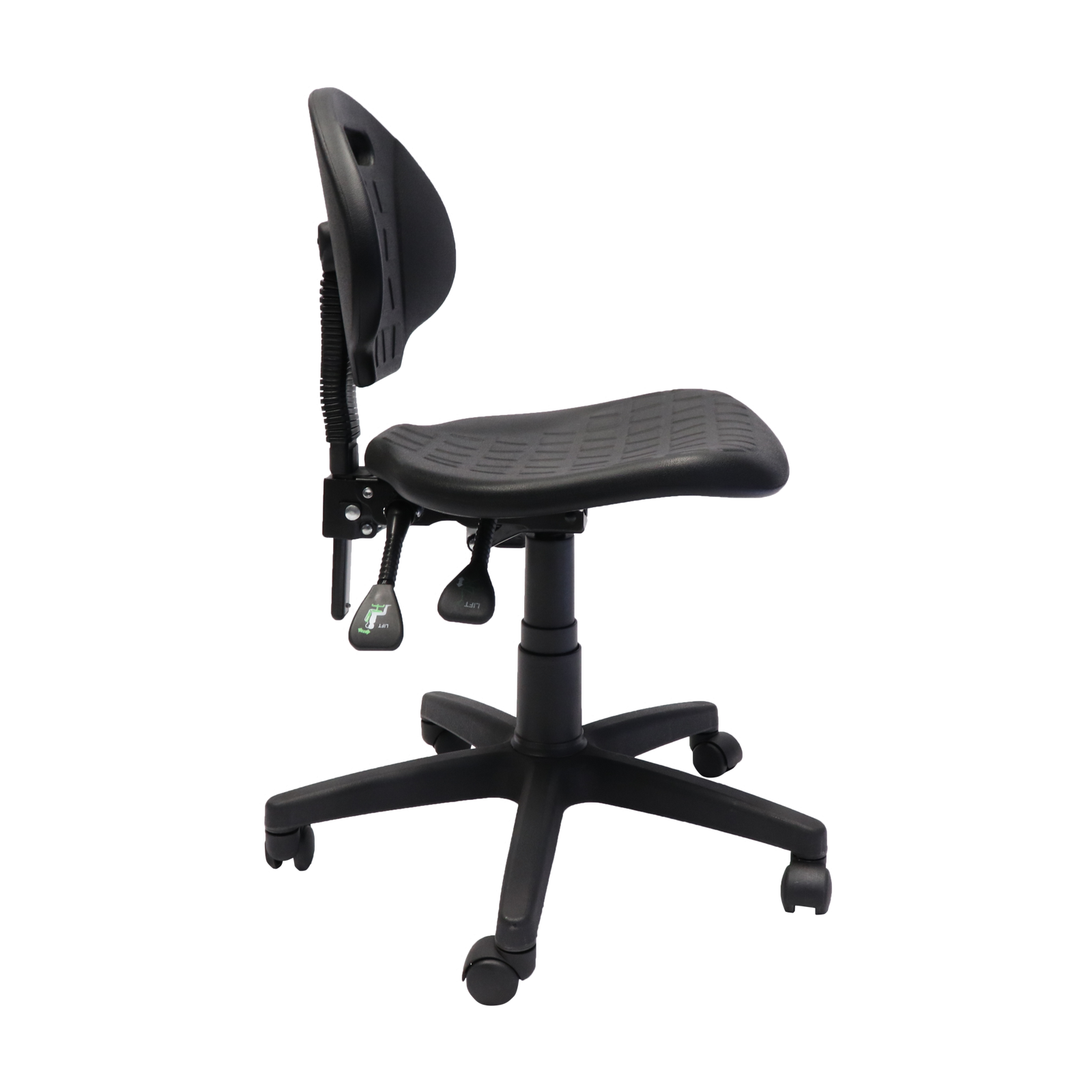
Casters are useful when the chair needs to move frequently between positions or be moved aside for cleaning. Glides can be more appropriate when the chair should remain fixed at a high bench or a specific instrument position. Braked caster arrangements should be assessed by their stated brake logic and the actual floor. Select wheels or glides from floor material, rolling requirement, stability and cleaning procedure; do not choose them only from the visible appearance of the chair.
| Material or component | Common selection purpose | Project input needed | Boundary to retain |
|---|---|---|---|
| Integrated polyurethane | Wipe-clean seat and backrest for general laboratory work | Cleaning procedure, surface texture and user comfort | Does not by itself establish cleanroom or ESD status |
| Sealed vinyl or artificial leather | Cushioned laboratory seating with a wipeable cover | Seam construction, cleaning agent and expected use | Cover material and compatibility depend on the selected configuration |
| Casters or braked casters | Frequent repositioning and access around workstations | Floor type, brake behaviour and movement frequency | Wheel material and brake action are configuration-dependent |
| Glides and footring | Fixed positioning or elevated bench work | Surface condition, chair height and foot support | Footring is selected with a high-seat arrangement |
Cleaning access and replacement parts
Leave access to clean below the seat, around the gas lift, behind the backrest and at the base. Where the laboratory uses repeated disinfection, include replacement parts and surface-maintenance expectations in the purchase request. Casters, glides, gas lifts and upholstery may have different service intervals and replacement methods. A configuration is easier to maintain when those components can be identified before delivery.
Material selection by laboratory zone
One laboratory may need more than one surface arrangement. A general instrument room can prioritise comfort and adjustable support, while a preparation area may favour an integrated PU surface with fewer exposed seams. This does not require a separate chair design for every room, but it does require that the chosen surface, base and cleaning approach are recorded by zone. Keep the configuration specific enough that purchasing, installation and future replacement use the same material and mobility assumptions.
Mobility, Footring and Accessory Options
Mobility and accessories should improve the operating position, not make the laboratory chair harder to use. Choose them after the seat range and surface have been defined. The key questions are whether the user changes position during a task, whether the chair must fit beneath the bench, whether feet can be supported at the selected height, and whether accessories reduce the space required for the operator.
Footring selection for elevated work
At a high laboratory bench, a footring or other foot support helps avoid unsupported legs and provides a stable lower-body position. Its diameter, height, adjustment method and clearance below the bench should be considered with the selected gas lift. A footring may be unnecessary or obstructive on a low chair. Confirm the highest normal work position rather than assuming that every tall chair requires the same footring geometry.
Caster and glide selection by floor use
Hard floors, resilient floors, coatings, grating and uneven transitions each influence how a chair should move. Where a chair is used at one fixed analytical station, glides may provide a more predictable position. Where the operator must move between a bench, microscope and storage area, casters may be appropriate. The supplied option must state whether it is a standard caster, a braked caster, a glide or another selected component.
Armrests and task clearance
Armrests may support a display-based or documentation task, but can prevent close approach to a bench and interfere with drawers or instrument controls. Check armrest height, width and the path below the bench. For microscopy, sample handling or fine manipulation, the ability to move close to the work can be more important than a large armrest. Confirm whether armrests are omitted, fixed or adjustable.
Colours, labels and shared-room control
Colour can help distinguish zones, departments or cleaning status in a shared laboratory, but it should not be used as a proxy for a technical classification. A label, asset tag or room identifier can be specified where chairs are assigned to equipment. Document the selected components so that later replacement of a wheel, footring or gas lift does not change the originally intended operating height or mobility condition.
Preventing interference with the workstation
Check the turning diameter of the chair base against fixed items around the workstation. A five-star base can contact pedestal legs, instrument stands, shelving or another chair before the user reaches the normal working position. Where equipment access is narrow, a compact base, glides or a defined parking position may be more suitable than unrestricted rolling. The decision should reflect the actual floor plan and task route rather than a general preference for maximum mobility.
Applications and Product Boundary
A laboratory chair can be configured for general wet-laboratory work, sample preparation, instrument operation, microscopy, diagnostic rooms, teaching laboratories and technical documentation stations. The suitable arrangement changes with the bench height, cleaning expectation, movement pattern and duration of seated work. The product is intended for a back-supported task chair, not for every form of laboratory seating.
General laboratory benches and sample preparation
General laboratory work usually requires a selected seat height, wipe-clean surface and enough mobility to approach benches, cabinets and shared equipment. Casters can support movement where the floor and task allow it; glides can be selected for a more fixed position. The backrest and seat controls should be accessible without creating protrusions that interfere with bench clearance.
Microscopy, instrument and display work
Microscope and instrument tasks often require closer, more controlled positioning than general bench work. The chair height, backrest position, lower-zone clearance and optional armrest arrangement should be reviewed with the operator’s actual line of sight and controls. Where the principal decision is the instrument support surface rather than seating, see the microscope table or laboratory instrument table as appropriate.
High benches and elevated counters
High benches need a chair arrangement that provides enough seat range and stable foot support. A high laboratory chair with a selected footring and glides or casters may be suitable, but the bench height and lower clearance must be confirmed. Do not use a standard low chair at an elevated work surface merely because it has a large gas-lift range.
Chair, stool and special-environment seating
A laboratory stool is the better choice where a backrest is not required, quick changes of position are common or compact seating is needed. A cleanroom laboratory chair should be evaluated where cleanroom or electrostatic-control performance is part of the order requirement. A normal laboratory chair may have a wipe-clean surface, but it does not inherit those special-environment properties without the relevant configuration and documents.
Related bench layouts
The chair must work with the bench geometry. A laboratory wall bench has a different approach path from a laboratory island bench. Review service pedestals, under-bench storage, footrails, drawer projection and the user’s movement route before choosing base diameter, casters, glides or armrests. This prevents a well-specified laboratory chair from becoming impractical after it reaches the installed workstation.
Training rooms and multi-shift laboratories
In teaching or multi-shift laboratories, users may vary widely in height and familiarity with the equipment. A laboratory chair should therefore have a clear adjustment range, durable controls and a configuration that can be reset quickly. Identify whether seats are shared across benches, assigned to a room or dedicated to a particular instrument. The decision affects the appropriate adjustment range, the need for a footring, the value of a wipe-clean surface and the practical choice between casters and glides.
Installation, Commissioning and RFQ
Laboratory seating should be assessed at the actual workstation, not only in an open area. Place the chair beneath the bench, set the intended working height, check knee and foot clearance, test reach to the normal work area and move the chair through its expected path. The selected base must clear floor transitions, under-bench furniture and nearby equipment without undermining stability.
Installation and adjustment checks
Before handover, set and test the seat height, backrest position, tilt controls, footring where supplied, casters or glides and any armrest adjustment. Confirm that the gas lift can move through the required operating range with the actual user and bench. Where several chairs are delivered, record which components are common and which differ by room, bench height or operator requirement.
Cleaning and maintenance plan
Give the site the surface-care guidance for the selected material and identify which cleaning products should be checked before routine use. Inspect casters, glides, gas lifts, footrings and adjustment controls as part of normal maintenance. When a part is replaced, confirm that the replacement retains the required seat height and mobility condition rather than simply fitting the visible chair base.
| RFQ input | Why it is needed | What the quotation should define | Site confirmation |
|---|---|---|---|
| Bench height and task | Establishes seat range and foot support | Low, standard or high chair configuration | Actual bench and lower-zone dimensions |
| Surface and cleaning method | Determines material and seam requirements | Integrated PU, sealed upholstery or another selected surface | Contact materials and cleaning procedure |
| Base and floor condition | Determines movement and stability option | Casters, braked casters, glides and base arrangement | Floor finish, transitions and required movement |
| Users and accessories | Establishes ergonomic settings and supplied scope | Backrest controls, footring, armrests and quantity | Operator range, room layout and delivery access |
Information required for a project-ready quotation
Provide the laboratory type, task, finished bench height, lower clearance, preferred seat range, user range, expected sitting duration, surface preference, cleaning procedure, floor type, caster or glide preference, footring and armrest requirement, quantity, colour and destination. Identify separately whether cleanroom or ESD performance is required. This prevents a normal lab chair configuration from being quoted where a special-environment chair is actually needed.
Delivered configuration scope
The quotation should identify the seat and backrest material, selected height range, base, mobility component, footring, armrests, adjustment controls, quantity and any room-specific differences. It should also state items that remain dependent on final confirmation, such as material compatibility, special-environment conditions and installation access. The delivered chair is defined by that selected configuration, not by a combined list of unrelated published features.
For a multi-room order, provide a small configuration schedule that identifies each chair group by room, bench height, surface, seat range, mobility option and accessory package. This avoids a common purchasing problem in which a high chair, a standard chair and a special-environment chair are all described under one generic line item. The schedule also gives the installation team a clear basis for placing each group at the correct work area.
Frequently Asked Questions
How is a laboratory chair different from an office chair?
A laboratory chair is selected around bench height, cleaning method, task posture, surface construction, base and movement at a laboratory workstation. An office chair may not provide the required wipe-clean surface, foot support, clearance or configuration range.
When is a high laboratory chair needed?
Use a high chair when the actual bench or counter height requires it and when the selected footring or foot support gives the operator a stable position. Confirm the bench height and lower clearance before selecting the gas-lift range.
Should a laboratory chair use casters or glides?
Choose casters where controlled repositioning is needed and the floor supports it. Choose glides where a more fixed, stable position is required. The final option depends on the task, floor and chair height.
Is an integrated PU chair suitable for every cleaning procedure?
No. Integrated PU can provide a smooth wipe-clean surface, but the cleaning agent, disinfection method, contact chemicals and frequency must be reviewed for the selected material and configuration.
When should a cleanroom or ESD chair be selected instead?
Use a dedicated cleanroom laboratory chair when cleanroom construction, particulate control, electrostatic-control properties or specified testing is required. These conditions are not automatically created by a normal PU surface or a conductive-looking base.
Contact the Xicheng Engineering Team Today
Send the workstation height, task, preferred seat surface, cleaning procedure, floor condition, required mobility, footring or armrest requirement and quantity. A configuration proposal can define the laboratory chair arrangement and quotation scope for the intended work area.
Shenzhen Office: No. 34 Zhenxing Road (Shengtaian Heavy Industrial Park B), Loucun, Guangming New Dist, Shenzhen, Guangdong, China
WhatsApp: +86 18126478161
Engineering Mailbox: fanalax34@gmail.com