


Description
Key Specifications and First Selection
An acid storage cabinet should be selected from the chemical inventory and spill scenario before its cabinet size or colour is considered. A PP acid and corrosive chemical storage cabinet combines a welded polypropylene case, selected shelf arrangement and lower secondary-containment area for compatible corrosive chemical containers. The important question is not whether the cabinet is called PP. It is whether the specific chemical, concentration, temperature, bottle material, volume, possible leak, segregation need and every exposed cabinet component have been reviewed together.
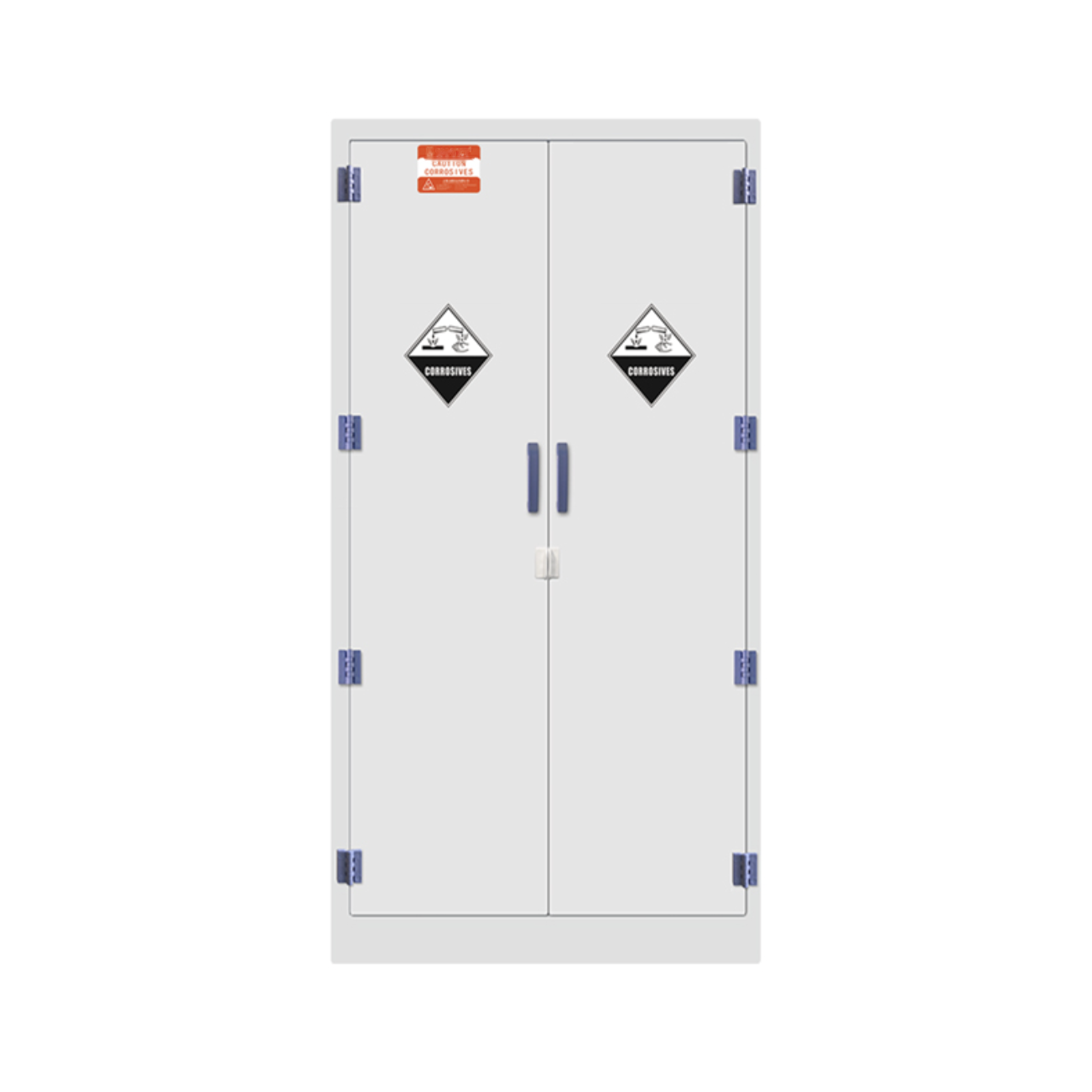
The reference configuration used on this page is a 30 gallon / 114 L two-door cabinet with 1120 x 1090 x 460 mm external dimensions and 1010 x 1000 x 375 mm internal reference dimensions. It has one adjustable shelf, a 19 L lower sump and 8/10 mm PP construction by component. These values belong to one configuration. The 114 L nominal cabinet capacity is not the 19 L containment capacity, and neither value alone proves that the cabinet can safely store a particular container group.
| First selection field | 114 L reference configuration | Buyer must provide | Why it changes the selection |
|---|---|---|---|
| Nominal cabinet capacity | 30 gal / 114 L | Bottle count, largest bottle and total stock | Nominal capacity does not define the leak-containment requirement |
| Lower containment | 19 L lower sump | Largest credible spill and applicable site rule | Sump volume is independent from cabinet storage volume |
| Cabinet arrangement | Two manual doors and one adjustable shelf | Access pattern, container height and shelf loading | Door count does not prove independent chemical segregation |
| PP assembly | 8/10 mm PP by component | Chemical, concentration, temperature and contacting parts | PP alone is not a universal compatibility decision |
Start with a chemical inventory
Provide the name or CAS number of each chemical, concentration, mixture details, storage temperature, container material, largest container volume, total quantity, oxidising and flammable properties, and known incompatibilities. This allows the cabinet configuration to be evaluated against the real contents rather than a broad corrosive label. Nitric acid, perchloric acid, hydrofluoric acid, strong oxidisers and mixtures with flammable characteristics require individual assessment and should not be included in a general statement that a PP chemical cabinet is suitable for acids or bases.
Keep storage functions distinct
This product is not a general PP Glassware Storage Cabinet for clean non-hazardous vessels, a wet-work PP Laboratory Sink unit, a fire-rated cabinet or an automatically ventilated fume enclosure. The chemical-storage cabinet’s lower containment and selected material system serve a defined chemical-storage duty. Any need for fire resistance, hazardous-vapour extraction, active monitoring or regulated flammable-liquid storage must be evaluated as a separate product and compliance requirement.
Early data for a usable quotation
Send the chemical inventory, safety data sheets where available, bottle dimensions, maximum single-container volume, quantities, required acid/base separation, preferred cabinet location, wall/floor conditions, whether a vent opening is requested, lock requirement and destination regulations. The proposal can then distinguish cabinet capacity, shelf layout, sump capacity, partitioning, hardware and installation scope instead of treating one generic PP cabinet as a completed safety solution.
Chemical Inventory and Compatibility Boundary
Chemical compatibility is a property of the complete storage arrangement. It depends on the chemical and concentration, operating and storage temperature, contact duration, bottle condition, potential vapour exposure, liquid-leak path, PP case, shelf material, welded joints, hinges, lock, seals, labels and any selected vent or drain part. A statement that the cabinet uses polypropylene should therefore be read as a construction direction, not as a substitute for a chemical-specific compatibility review.
Acids, bases and incompatible groups
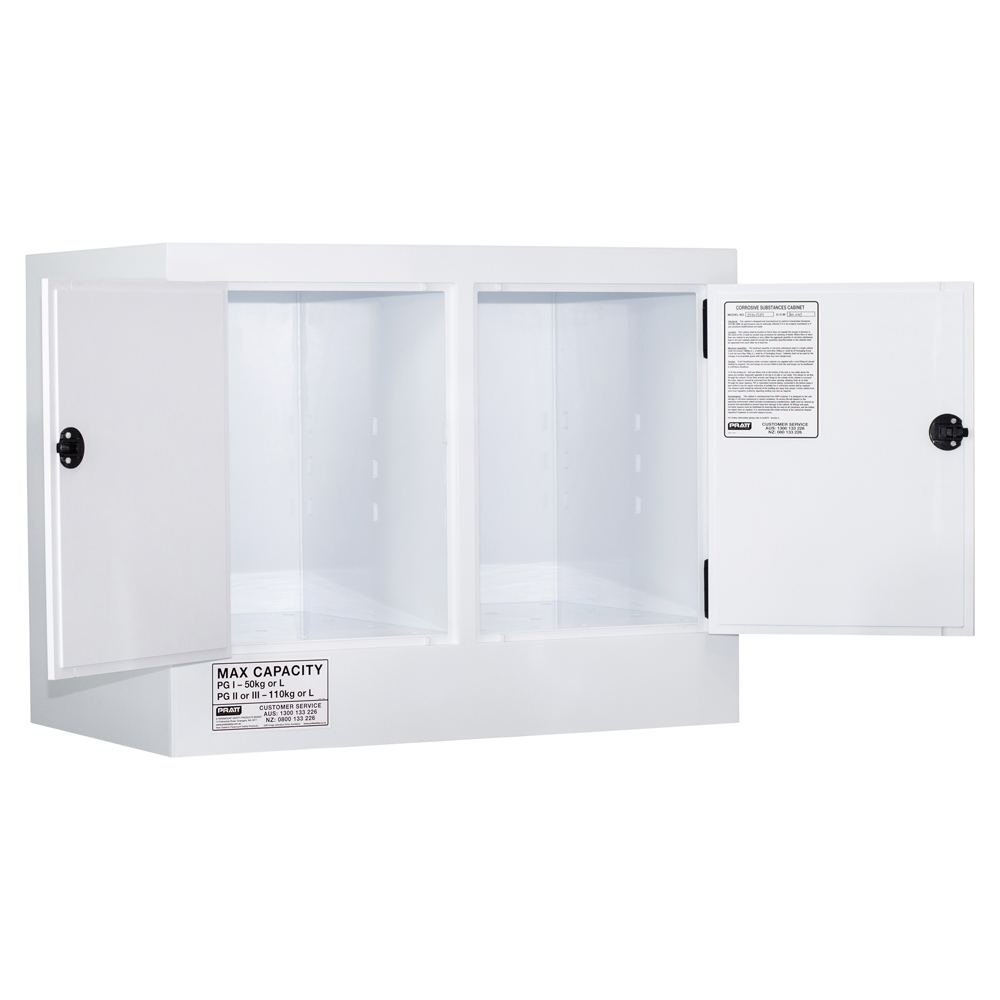
Acids and bases are both corrosive, but they should not automatically share a single chamber. A two-door front may still open into one continuous internal space and one common lower sump. True acid/base segregation requires a configuration with a physical internal barrier or separate cabinet spaces, independent paths for a spill, and a chemical-inventory review that confirms the planned groups can be stored that way. Where those conditions are absent, use separate cabinets rather than calling a standard double-door unit an acid-and-base storage cabinet.
Certain chemicals need an additional review even within a corrosive storage plan. Strong oxidisers, nitric acid, perchloric acid, hydrofluoric acid, compounds with unstable decomposition products and materials with flammable characteristics should be assessed against the complete storage requirement. Do not rely on a general acid-resistant description, a corrosive warning label or a general cabinet material name to make that decision.
Containers and maximum spill scenario
The chemical cabinet must be planned around the actual containers, not simply around a nominal litre label. Document each bottle’s material, cap condition, external dimensions, maximum fill volume and the likely consequence if its contents escape. A lower sump can provide secondary containment, but its required capacity must be determined separately from the cabinet’s 114 L nominal storage capacity. The selected shelf, any tray, lower containment region and access method should all be checked against that scenario.
Compatibility review fields
The review should identify four connected items before the cabinet layout is fixed:
- Chemical group: Record names, CAS numbers, concentrations and mixture details. A corrosive label does not define compatibility with PP or with another stored chemical.
- Container set: Record bottle material, external size, condition and maximum fill volume. These details determine shelf spacing, handling clearance and the credible spill scenario.
- Incompatibility: Separate acid/base, oxidiser, flammable and special groups before deciding whether one containment area is acceptable.
- Site rule: Confirm the destination procedure, required labels, lock approach and documentation. These requirements can change the vent, partition and access-control arrangement.
Why a cabinet cannot replace chemical management
The cabinet is one part of a chemical-management system. It does not establish an approved inventory, replace container inspection, determine emergency response, identify every incompatible combination or automatically satisfy a local regulation. Maintain the laboratory’s own labelling, quantity control, safety data and inspection procedure. If the chemical list changes, repeat the storage review instead of assuming the original cabinet selection remains suitable.
Capacity, Sump and Physical Segregation
The 30 gallon / 114 L figure describes the reference cabinet’s nominal storage capacity. It is useful when comparing the volume of containers that can be organised inside the cabinet, but it does not describe the lower spill-containment volume. In the locked reference configuration, the lower sump is 19 L. These two figures answer different questions: the cabinet volume helps plan inventory, while the sump volume is part of the secondary-containment response to a defined leak scenario.
Do not substitute one for the other. A 114 L cabinet is not a 114 L spill tray, and a 19 L sump should not be treated as adequate until the largest credible spill, container location, shelf design and applicable site requirement have been reviewed. The lower containment area must also remain accessible for inspection and cleaning. It should not become a hidden storage zone filled with small bottles or disposable materials.
Shelf layout and container placement
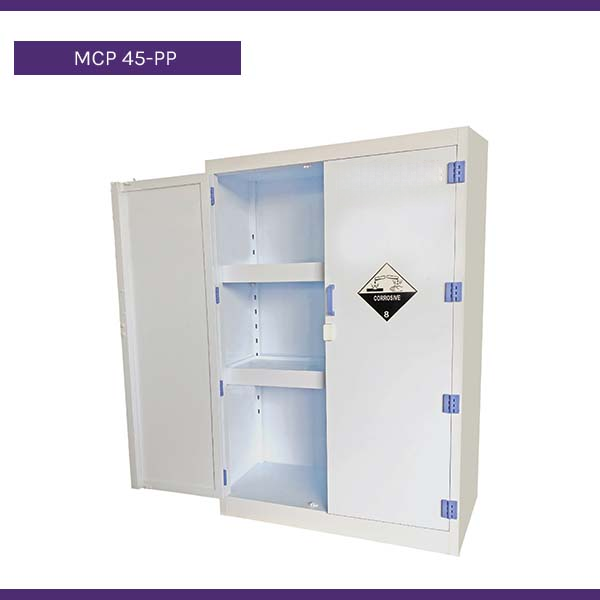
The reference arrangement provides one adjustable shelf. Its final elevation should be set from the actual container heights, safe lifting method and lower sump clear space. A higher shelf position can accommodate a larger lower container, while a lower shelf position may create an efficient layout for smaller bottles. Neither option should reduce the ability to inspect the lower containment area or obstruct door operation. The shelf’s permitted load is confirmed for the selected construction and loading condition; a numerical value from a different cabinet capacity or shelf design must not be transferred to this configuration.
Single chamber, divided cabinet and separate cabinets
A single chamber is appropriate only where the reviewed chemical group can share one containment area. A double-door cabinet can still be a single chamber, because the doors may merely improve access to the same internal space. A divided cabinet uses a physical barrier and separate spill-management arrangement to support defined groups. When the inventory requires complete separation, two independent cabinets may provide the clearest control. The appropriate option comes from chemical compatibility and the spill scenario, not from the number of external doors.
Reference configuration fields
| Physical field | 114 L reference configuration | Confirmation required | Selection boundary |
|---|---|---|---|
| Nominal storage capacity | 30 gal / 114 L | Planned container inventory and arrangement | Not a spill-containment value |
| Secondary containment | 19 L lower sump | Largest credible spill and required containment duty | Must remain available and inspectable |
| Cabinet dimensions | 1120 x 1090 x 460 mm external | Room fit, delivery path and door clearance | Internal layout and installation access reviewed separately |
| Shelf arrangement | One adjustable shelf | Container height, load distribution and support needs | No cross-model load rating is claimed |
Access and spill response planning
Put the cabinet where a leak can be identified and managed without obstructing exits or exposing unrelated equipment. Staff need room to open the doors, remove containers safely and inspect the lower region. Maintain the laboratory’s spill response materials and procedure outside the cabinet unless the selected configuration explicitly includes them. A sump is a containment feature, not an instruction to delay cleanup or a replacement for site spill procedures.
PP Construction, Shelves and Hardware
The locked reference configuration uses 8/10 mm PP construction by component. That notation means different parts of the cabinet can use different stated PP thicknesses; it must not be rewritten as one universal 8 mm or 10 mm construction claim. The welded case, adjustable shelf, lower containment, door panels, PP hinges, lock provision and labels make up the selected assembly. Every exposed part should be reviewed where it can contact liquid, vapour, cleaning materials or a spill.
Welds and cabinet case
Welded PP construction is intended to create a continuous cabinet shell appropriate to the selected chemical storage duty. The relevant review includes panel thickness by location, weld method, finished joints, lower-sump transitions, shelf supports, door alignment and the inspection method for the completed assembly. A material description without those interfaces is not enough to establish how a leak would travel or where it would be retained.
Doors, hinges, lock and labels
The reference cabinet has two manual doors, PP hinges, warning labels and a padlock provision. It does not claim self-closing, self-latching, a specific opening angle, a key-management system or an access-control standard. If any of those functions are needed, describe them explicitly in the project request. Similarly, warning labels should be determined by the actual stored materials, destination rules and the agreed cabinet layout rather than copied from an unrelated product image.
Component-level material review
Review the cabinet as an assembly rather than treating the body material as the only decision. The welded case and lower containment use the 8/10 mm PP direction by component; the exact thickness allocation and weld details define the shell and spill path. One adjustable shelf requires confirmation of its material, support method, load condition and spacing. Two manual doors with PP hinges require confirmation of alignment, handles and closure requirements, while the padlock provision and warning labels must follow the selected lock method and destination rule. Each item affects either containment, handling or access, so it belongs in the final configuration record.
Avoid a generic all-PP claim
Some chemical cabinets are specified with no internal metal components, while others use different external hardware, locks or accessories. The PP cabinet body does not prove every part of the supplied assembly has the same material. Confirm hinges, fasteners, lock, handles, seals, labels, vent pieces and support feet separately. This is particularly important where the cabinet is cleaned frequently or where vapour exposure can reach a component that is not normally wetted.
The same restraint applies to material compatibility. The cabinet can be configured around a reviewed chemical inventory, but the page does not claim compatibility with every acid, base or chemical mixture. Submit the specific chemical details before treating a general PP material description as an approval for the actual storage duty.
Ventilation, Installation and Access Control
Ventilation should be selected from the chemical inventory, the site risk assessment and the applicable local requirement. A vent opening, knockout or optional vent connection is not a direction to connect every PP corrosive chemical cabinet to an extract system. Connecting a cabinet can alter pressure, vapour movement, leak behaviour, corrosion exposure and the required fan or discharge design. Leaving a cabinet unvented can also be the intended arrangement for some duties. The final decision belongs in the project’s chemical-storage and ventilation design.
If ventilation is requested, define the opening size, exposed materials, duct route, airflow requirement, pressure condition, fan responsibility, discharge location, any required alarm/interlock and maintenance access. Do not use a generic vent feature to claim a quantified airflow, fume extraction performance or regulatory compliance. A chemical storage cabinet is not a fume hood.
Cabinet location and access
The 1120 x 1090 x 460 mm external reference envelope must be checked against the actual room, doorway, aisle, wall condition, floor level, nearby wet-work equipment and open-door clearance. The cabinet should be placed where labels can be read, doors can be opened safely, the lower sump can be inspected and emergency egress is not restricted. Avoid locations subject to direct impact, uncontrolled heat, unsuitable water exposure or inaccessible service areas.
Where the cabinet is installed under or beside a Laboratory Wall Bench, confirm the available height, depth, worktop overhang, access to doors and compatibility of nearby activities. A PP Laboratory Sink can form part of the same room, but a chemical cabinet should not be placed in a splash zone or used as a substitute for wet-work equipment. Chemical-storage location should be coordinated with the laboratory’s handling route and emergency procedures.
Locking and authorised access
The reference configuration provides a padlock provision. Select the lock method around the laboratory’s access policy, not around an assumption that any cabinet lock meets every security or regulatory requirement. State whether a padlock, keyed lock, two-person access, access log or other control is needed. A lock controls access; it does not establish chemical compatibility, fire protection, containment capacity or ventilation performance.
| Installation decision | Reference direction | Project data required | Final confirmation |
|---|---|---|---|
| Ventilation | Optional configuration feature | Chemical inventory, site rule, duct and fan responsibility | Enabled, omitted or connected ventilation scope |
| Location | Floor-standing 114 L reference cabinet | Room layout, floor, aisle and open-door clearance | Stable accessible position and service space |
| Access control | Padlock provision | Required lock type and authorised-user process | Supplied lock/hardware and management boundary |
| Documentation | Selected configuration only | Destination rule, labels, SDS and inspection needs | Drawing, labels and required supporting documents |
Inspection and maintenance
Inspect doors, shelf supports, lower containment, hinges, lock, labels and any selected vent connection on the laboratory’s required schedule. Remove leaks or residue according to the chemical-specific procedure; do not use an incompatible cleaner simply because the cabinet shell is PP. If the stored inventory, container type, ventilation condition or installation arrangement changes, the cabinet selection must be reviewed again.
Applications and Selection Boundary
This PP corrosive chemical storage cabinet can be considered for laboratory areas that need enclosed storage for a reviewed group of compatible corrosive chemicals, with selected shelves, lower secondary containment, access control and installation provisions. Typical use contexts include analytical laboratories, quality-control rooms, preparation areas, educational laboratories and process support spaces where the chemical inventory and local procedures are known. The use decision remains dependent on the actual inventory rather than the broad term corrosive.
When to select a single chamber
A single-chamber arrangement can be considered when the reviewed chemical group may share the same containment area and access pattern. The cabinet size, shelf layout and sump are then selected around the containers and spill scenario. A pair of external doors can improve access but does not turn one chamber into an independently segregated acid/base system. Keep the chemical group and potential leak path clear in the cabinet schedule.
When to select divided or separate storage
An acid and base storage cabinet should only be considered where a specific configuration provides physical segregation and separate spill-control paths, and the chemical inventory supports that arrangement. For groups that require full separation, two distinct cabinets are often the clearer solution. Strong oxidisers, special acids, flammable mixtures, gases, waste liquids and materials needing fire protection should be assessed as their own storage categories rather than added to a general PP corrosive cabinet.
What this cabinet does not replace
The cabinet does not replace a flammable-liquid safety cabinet, a fire-rated enclosure, a gas-cylinder cabinet, a biological-material cabinet, a waste-liquid collection system or a fume hood. It does not establish a building’s emergency response plan, chemical labelling procedure or regulatory compliance. Those functions must be addressed by the appropriate equipment and site program.
Selection path
Follow the selection in order. First complete the chemical list and container schedule; no cabinet choice is reliable while the inventory is incomplete. Then decide whether all planned contents can share one leak zone. If not, specify divided containment or independent cabinets before comparing exterior dimensions. Next, test the 19 L reference sump against the defined credible spill and required containment duty. Finally, separate any requirement for fire protection, flammable-liquid storage or vapour extraction from the corrosive-storage decision and select purpose-specific equipment where that duty applies.
Related equipment roles
Use the PP Laboratory Sink for compatible wet-work station selection and the PP Glassware Storage Cabinet for clean non-hazardous vessel organization. A chemical storage cabinet keeps a reviewed chemical inventory contained and separated; it is neither the point of use nor the place for general glassware storage. Maintaining that functional boundary improves the room layout and reduces the chance that incompatible duties are combined in one enclosure.
Frequently Asked Questions
Is a PP acid storage cabinet suitable for every acid or base?
No. Polypropylene is a cabinet-material choice, not a universal compatibility approval. Suitability depends on each chemical, concentration, temperature, contact duration, container and every exposed cabinet component. Submit the chemical inventory before a configuration is approved.
Is 114 L the spill-containment capacity?
No. The 114 L value is the nominal storage capacity of the locked reference configuration. Its lower sump is 19 L. The required containment capacity must be determined from the largest credible spill and the applicable site requirement.
Can acids and bases share the cabinet?
Only when the selected configuration provides physical separation and independent leak paths, and the specific chemical inventory has been reviewed. A standard two-door cabinet can still have one continuous chamber and one common sump. When full separation is needed, select a divided configuration or two independent cabinets.
Should the cabinet always be connected to ventilation?
No. A vent opening or optional connection does not create a universal extraction instruction. Ventilation must be selected from the chemical inventory, site risk assessment, local rule, duct arrangement and fan/discharge design.
Is this a fire-rated or flammable-liquid cabinet?
No. The page does not claim fire resistance, fire rating or flammable-liquid storage performance. Those duties need a purpose-specific cabinet with the required documentation and test records.
Contact the Xicheng Engineering Team Today
Send the chemical inventory, concentrations, container sizes, maximum spill scenario, required segregation, preferred cabinet location, ventilation decision and destination requirements. The engineering team will return a suitable PP corrosive chemical storage configuration discussion and pricing proposal within 24 hours.
Shenzhen Office: No. 34 Zhenxing Road (Shengtaian Heavy Industrial Park B), Loucun, Guangming New Dist, Shenzhen, Guangdong, China
WhatsApp: +86 18126478161
Engineering Mailbox: fanalax34@gmail.com