




Key Takeaways
- A fume hood face velocity reading that is too high or too low is a diagnostic snapshot, not a containment verdict — NEBB reports that more than 80% of hoods failing tracer-gas containment tests were running at their prescribed face velocity (as transcribed by NEBB; verify current editions).
- An alarm that stays on after reset is a signal to check, not to silence — restore the sash, look at the reading path, compare the hoods on your system; never disable the alarm, and never treat a nuisance as a reason to ignore it.
- Work the checks in order: sash, blockage, cross-drafts, system balance and makeup air, fan, VAV controls, then sensor and field calibration — each layer tells you whether the fault sits in the hood or in the exhaust system around it.
- Repair, adjustment and calibration belong to facilities or your service vendor — the reader’s part is to observe, compare, clear the hood interior, close the sash, stop use when the boundary is reached, and report with a complete information packet.
- Stop-work boundaries are not negotiable — unexplained alarm = stop hazardous work and lower the sash; an Unsatisfactory rating = do not use the hood until it is returned to service by qualified staff.
A fume hood face velocity reading that is too high or too low is a diagnostic snapshot of the air moving through your sash opening — it tells you to start a check, and on its own it does not prove whether the hood is containing fumes. That distinction is the first thing to hold onto, because it determines what you do next: a reading is evidence for a check, not a verdict on the hood.
The causes behind an out-of-range reading usually live outside the box — in the sash position, the room air, the exhaust system or the sensing path — which is why this guide walks a fixed order of checks rather than a grab bag of fixes. Work the layers in sequence, keep every repair action with facilities or your service vendor, and use the stop-work boundary at the end to decide when the hood comes out of service. None of the checks that follow requires special tools, and none of them asks you to adjust equipment you are not qualified to touch.
Fume Hood Face Velocity Too High or Too Low: What the Reading Does and Doesn’t Tell You
Before touching anything, settle what the number on the panel can and cannot tell you. Face velocity is a measurement of how fast air is moving through the open sash at a given moment, and the confusion starts when a snapshot gets treated as a certificate.
A Reading Is a Diagnostic Snapshot, Not a Containment Verdict
The National Environmental Balancing Bureau (NEBB) states the position directly in its article on the role of face velocity: velocity is a useful diagnostic indicator, and it should not be used as the method for determining how well a hood contains (as transcribed; verify against the current edition). Its supporting statistic is the one to remember — more than 80% of hoods that failed tracer-gas containment testing were operating at their prescribed face velocity at the time of the test (as transcribed by NEBB; verify current editions). A hood can read “normal” and still fail to contain.
The same article describes a 24-hour logging study of a single hood in which the average reading looked healthy while instantaneous readings wandered well away from it — a reminder that any single number is a moment, not a picture of the week. Fisher American makes the same point in plainer terms: face velocity alone should not be treated as a guarantee of safety (as transcribed).
If the question is whether the hood actually contains fumes, the answer comes from a containment test — the ASHRAE 110 procedure covered in our guide to ASHRAE 110 fume hood testing. What counts as an acceptable range for your hood has its own numbers, handled in our fume hood face velocity requirements article; your institution’s specification governs in your lab.
What the Alarm and the Out-of-Range Signal Are Telling You
The alarm is the monitor’s way of saying that a monitored condition has crossed its configured threshold. XICHENG’s FHM-5T airflow-monitor documentation lists the conditions its panel can annunciate — low face velocity, excessive sash opening, high exhaust temperature, communication interruption, and sash obstruction or anti-pinch indications (product documentation, as read). What triggers a low-flow alarm in service is usually a small set of situations: the sash raised beyond what the exhaust can serve, a building exhaust fault, or a power outage (Northwestern University’s chemical fume hood handbook, as transcribed).
Why do hoods carry monitors and alarms at all? The expectation traces to standards that require continuous airflow indication and alarm on laboratory hoods — ANSI/AIHA Z9.5-2012 §8.10 and NFPA 45-2015 §7.8.7, with OSHA’s 1910.1450 Appendix A pointing to continuous monitoring and SEFA-1 §4.1.10 defining what a monitor must deliver — all as transcribed in Labconco’s article on airflow monitors; verify against the current editions. An alarm is a designed-in safety function, and treating it as background noise is where troubleshooting goes wrong before it starts.
One Reading Path, Four Links: Monitor, Sensor, Controller, Damper
A single displayed value is the output of a chain, not a measurement made at the screen. XICHENG’s monitor documentation is explicit that the panel displays the measurement but does not create it: the monitor does not generate the values shown and does not regulate exhaust airflow on its own; face velocity is supplied through the configured air-velocity sensing path rather than a sensor built into the touchscreen (product documentation, as read). The sensor is doing the actual work, and a sidewall-mounted sensor is itself an approximation — XICHENG’s air velocity sensor documentation describes sidewall face-velocity sensing as an indirect representation of the average velocity through the sash opening, related to the true average during commissioning (product documentation, as read).
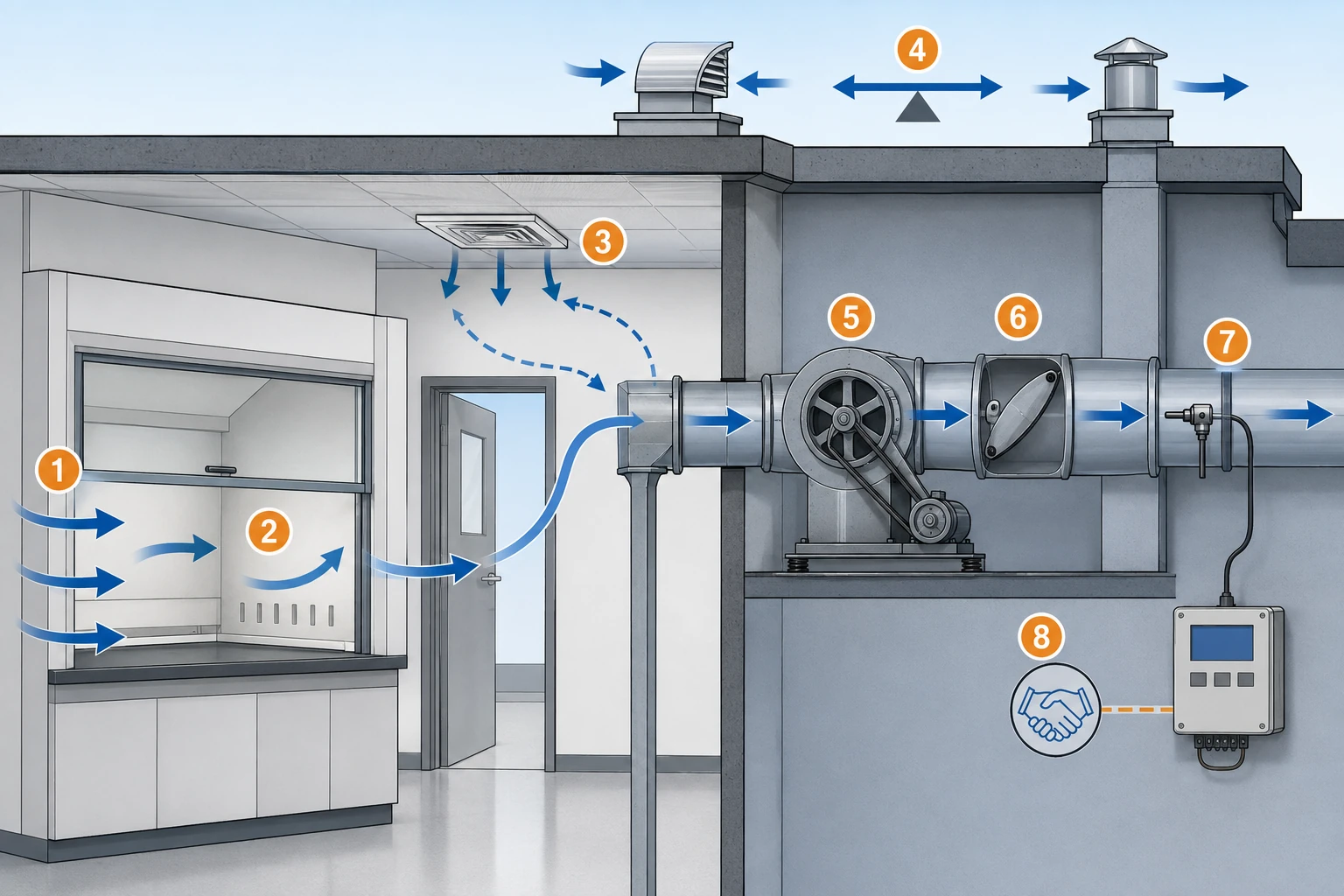
Between the sensor and the exhaust damper sit the controller and, on variable-volume systems, the damper actuator. That chain is the structural reason behind the article’s core idea: when a reading looks wrong, the fault can be in any single link, from a tired sensor to a blocked pickup tube to a misconfigured controller — the reading can be wrong while the hood’s airflow is fine, and the airflow can be wrong while the reading is fine. By the end of this module you can decide whether the question you are chasing is about the reading path or about the airflow itself, which determines whether the next hour belongs to observation or to the ordered checks that follow.
Why Is My Fume Hood Face Velocity Too High or Too Low? Check These First
The first sixty seconds cost nothing and they change the rest of the diagnosis. Before you call anyone, before you touch a controller, and before you treat the reading as a fault, run three checks that need no tools and no permission.
First Check: The Sash Is at Its Normal Working Position
Most out-of-range readings are sash problems wearing a costume. Face velocity is measured through the open sash, so the sash position is part of the measurement itself: close the sash and the reading on a constant-volume hood climbs; raise it and the reading falls. The first check is to return the sash to the height your lab treats as the normal working position — the setting your EHS office or your hood’s operating label defines for your work — and then watch the reading for a minute.
Do not reach for the dampers or the controller while you do this. If the reading returns to its expected behavior once the sash is back at the working position, you have found an operating artifact, and the module after this one explains why that happens and when it still deserves a record. If the reading stays out of range with the sash at the working position, the check chain continues below — from a known sash state instead of a guess.
Reset Acknowledges; It Does Not Repair
If the alarm is sounding, the natural reflex is to press reset and wait. The reset control does not fix the condition that triggered the alarm — XICHENG’s monitor documentation states the limit plainly: the alarm-reset control silences or acknowledges the panel indication as configured, and it does not correct the underlying fault; a low face-velocity alarm calls for the sash and exhaust condition to be checked (product documentation, as read).
That single sentence explains most “the alarm came back” stories: the reset cleared the annunciator, not the cause. Northwestern University’s handbook adds the operating rule that matters — no hazardous chemical work may continue while a low-flow alarm is active, until exhaust volume is restored — and it is explicit that laboratory staff must not disable alarms; adjustment belongs to facilities (as transcribed). If the alarm returns after reset, treat the return as information and move the diagnosis forward instead of silencing it.
Compare Hoods on the Same System Before You Conclude
The fastest discriminator between a hood problem and a system problem is the hood next door. If two or more hoods sharing an exhaust system read low at the same time, the common cause is probably common — a fan, a duct, or a supply condition serving all of them, not simultaneous hood failures. If only one hood on the system is out of range while its neighbors read normally, the fault is far more likely to live at that hood or in its local branch.
Pair that comparison with a short memory check: has anything changed recently in the building, the HVAC schedule, the room, or the power supply? A weekend construction change, a rebalanced supply fan, or a breaker event explains readings that appeared “out of nowhere.” By the end of this module you can decide the opening triage for yourself: continue under interim measures with observation and logging, or move into the layered checks that make up the rest of this guide.
Sash Position Artifacts: When the Reading Follows the Sash
The first layer of the check chain is the sash, and it earns that position because it is the only layer the operator controls directly. When the reading changes as the sash moves, the hood may be reporting its own design behavior rather than a fault.
CAV Physics in One Sentence: Close the Sash and the Reading Climbs
On a constant-volume (CAV) hood the exhaust volume stays roughly fixed, so the face velocity is set by the size of the opening it must pass through: close the sash and the same volume of air moves through a smaller opening, which makes the reading climb; raise the sash and the reading falls (Northwestern University’s handbook, as transcribed). That inverse relationship is why a CAV hood can read high with the sash nearly shut and read low with it wide open — and why the first question for any odd number is always “where was the sash?”
The hood’s design changes the exact behavior. A bypass hood adds an alternate air path so that closing the sash does not push the velocity into a spike, and a variable-volume hood closes its exhaust damper as the sash closes to hold the velocity steadier. The control strategies behind those differences belong to our CAV vs VAV fume hood guide; for troubleshooting, the takeaway is that the same sash movement produces different reading behavior on different hood types.
Bypass and VAV Behavior: Not Every Hood Reacts the Same Way
Knowing which type you are standing in front of changes what a sash-following reading means. On a CAV hood, a reading that tracks the sash is the expected physics; on a variable-volume hood, the whole point of the control loop is to keep the face velocity near steady as the sash moves, so a reading that swings with the sash can point at the control side rather than at normal behavior.
The sensing and control hardware reflects that split. XICHENG’s controller documentation describes inputs that accept either a sash-position signal or a face-velocity signal, and its sensor documentation notes the same sensor can serve a constant-volume hood that needs continuous monitoring or a variable-volume hood whose control strategy uses face-velocity feedback (product documentation, as read). A hood whose controller is wired to the wrong input type, or whose monitor was calibrated for the wrong control scheme, can produce readings that look like failures — which is why a later module covers the monitor-to-system mismatch in detail.
Reading Follows the Sash? Treat It as an Artifact
Put the first two H3 sections together into one judgment. If the reading returns to its normal behavior whenever the sash is at the working position, and moves in the expected direction whenever you move the sash, treat the out-of-range number as an operating artifact: the hood was reporting the sash position, not a fault. Log what you saw — the position, the reading, the time — because an artifact that keeps recurring at the working sash height is not an artifact anymore; it is a symptom for the chain.
One caution keeps this module honest: an artifact explains a reading, it never licenses ignoring an alarm. If the alarm sounded, it still called for a sash and exhaust check, and if it returns at the working position, the next layers apply. By the end of this module you can determine whether the reading follows the sash — an artifact to log, or a signal that points down the chain to blockage, the room, and the system ahead.
Blockage: What Chokes the Airflow Path
With the sash settled at its working position, the next suspect is the path the air has to travel. Blockage is the one layer where the operator can act directly, but only on the part inside the hood — everything downstream of the work surface belongs to a work order.
Clear the Interior: Clutter and the Six-Inch Rule
The fastest blockage to find is the one you put there. Northwestern University’s handbook is direct that a fume hood is not storage, and its six-inch rule keeps work and stored items back from the face so they do not disturb the air entering the opening (as transcribed). Bottles, boxes and apparatus piled on the work surface or leaning against the rear force the air to route around them and create local turbulence, which a sidewall sensor can read as a changed velocity even when the exhaust fan is behaving.
The clearance check is a reader-side action, and it is the only blockage check you should perform yourself. Remove items you do not need for the current work, move tall containers away from the sash plane and from the side where the sensor mounts, and leave the area near the bottom baffle slots open. Re-check the reading after each removal. If clearing the interior brings the reading back to its expected behavior, you have found a blockage-by-clutter and the fix is yours to keep; if not, the blockage — if there is one — sits further down the path.
Baffles and Airfoils: Look, Don’t Adjust
Behind the work surface, the baffle system divides the hood’s height into slots that draw air evenly across the work. Debris, paper, foil or large items pressed against the slots can block them, changing how the airflow is distributed even when total exhaust volume is unchanged. Northwestern’s handbook assigns the baffles to facilities: they are set according to the density of the chemicals in use, and users must not re-adjust them (as transcribed).
That split defines the reader’s whole job on this layer: look at the baffle slots and the lower airfoil, and clear away anything loose resting against them — but do not move the baffles to “balance” the hood, and do not re-angle the airfoil. Baffle position is a chemical-hygiene decision made by people who know what the hood is handling; if the slots are repeatedly blocked or the baffles look damaged, that observation belongs in the report to facilities rather than in an adjustment made at the bench.
The Duct Side: Blockages, Dampers and Access Doors
Past the hood itself, the exhaust path runs through ductwork, fire dampers and access doors above the ceiling or behind walls. The University of Guelph’s cause list for alarm activation names exactly these as things its service teams check: obstructed or severely corroded duct, a closed fire damper, and a duct access door left off (as transcribed). Each behaves like a kink in a hose: it raises the resistance the fan has to push against and cuts the airflow the hood can pull, showing up as a low or unstable reading at the face.
One more blockage lives in the control loop rather than in the duct. XICHENG’s VAV damper documentation states that a blocked pickup tube or a displaced face-velocity sensor can cause a control error even while the actuator still moves normally (product documentation, as read) — a “working” damper does not prove a working signal. None of these duct-side checks is a reader task: they sit behind locked access, and the pickup-tube check belongs to the service vendor, which the controls module returns to shortly. By the end of this module you can now decide what you clear tonight — the interior clutter — and what goes on the work order: baffle evaluation, duct inspection, damper verification and the sensing line. Your next step is the room-air layer.
Cross-Drafts and Placement: When Room Air Fights the Hood
A hood can be mechanically healthy and still read badly because the room around it is pushing air across its face. Cross-drafts are the third layer of the chain, and they are diagnosed by watching the room, not by opening the cabinet.
Doors, Diffusers and Traffic
The hood draws air from the room, so the room has to cooperate. Northwestern’s handbook lists the usual offenders: supply diffusers located over the face of the hood, heavy foot traffic, and doors left open create air movement across the opening (as transcribed). Fisher American’s cause list for abnormal readings runs the same set from the measurement side — influx from doors and windows and diffuser placement disturb the velocity pattern the sensor sees (as transcribed).
A cross-draft works against the air curtain rather than with it. When a gust crosses the face, it can push contaminants toward the operator and momentarily depress or spike the velocity at the sensor — which produces exactly the symptom this guide keeps meeting: an alarm that sounds intermittently for no reason the hood itself can explain. The diagnostic habit is to correlate: if the alarm clusters at certain times of day, check what changes in the room at those times — doors opening for deliveries, the HVAC schedule switching, a crowd moving past at shift change.
Symptom Dictionary: Intermittent Alarms and Odors
Match the symptom to the layer before you open anything. Labconco’s field article pairs symptoms with causes this way: intermittent alarms and chemical odors that appear for no obvious reason point to placement and cross-flow problems rather than to a failing hood (as transcribed). When the reading swings widely between checks, Fisher American’s testing guidance reads single-point deviations from the average beyond about 20% as a sign of turbulence, obstruction or imbalance to investigate (as transcribed). An odor that reaches you while the face velocity reads normal is a different alarm entirely — it points to re-entrainment or to a containment question, covered in the system module and the FAQ that follow.
| Symptom you can notice | Most likely layer | Reader action |
|---|---|---|
| Alarm sounds intermittently, no pattern in the hood itself | Cross-drafts or placement (Labconco, as transcribed) | Note the timing, close doors and windows, check diffusers overhead; report if it persists |
| Reading swings widely between checks | Turbulence, obstruction or imbalance (Fisher ±20%, as transcribed) | Re-check interior clutter and sash first, then look for room-air sources |
| Chemical odor reaches you while the reading is normal | Re-entrainment or a containment question | Stop the work if the odor is chemical and report; a normal velocity is not a clean-air certificate |
Use the table as a triage tool, not as a diagnosis. Each row ends in an action you can take from the floor, and each unresolved row moves to the service report rather than to guesswork at the controls.
Placement Is a Design Question
If the room itself is the problem — the hood sits beside a doorway, faces a corridor, or has a supply diffuser aimed straight at the sash — the cause is placement, and placement is a design question rather than a maintenance one. Hood position and room airflow interact as their own subject, beyond what a troubleshooting guide can settle from the bench: a poorly placed hood can be well maintained and still fight its room, and resolving the layout is a facilities conversation, not a reader fix.
What the reader can do on this layer is temporary and behavioral: keep doors and windows closed during hazardous work, re-route traffic away from the face, and avoid parking carts or equipment in front of the hood. Moving the hood, relocating the diffuser, or changing the room layout is a facilities decision made with the people who own the ventilation design. By the end of this module you can determine whether intermittent alarms and odors trace to the room air, run the temporary mitigations that are yours to run, and send the layout question onward — your next step is the system layer, where the exhaust and supply sides of the building meet.
System Balance, Makeup Air and Fan Hardware
The fourth and fifth layers of the chain sit outside the hood and, in most cases, outside the room. When the fault is here, no amount of sash discipline or interior clearing will change the reading, because the hood is only as good as the exhaust system and the air supply behind it.
Supply–Exhaust Balance and Room Pressure
A fume hood moves air that has to come from somewhere. When the supply side cannot keep up with the exhaust side, the room runs negative and the hood has to fight for every cubic foot it pulls. Fisher American lists room pressure among the causes of abnormal readings (as transcribed), and the effect shows in the building: doors hard to open or sucking shut, whistling under door gaps, and supply diffusers that barely move air.
The numbers behind this layer come from NEBB, which attributes the containment failures it studied across three buckets: about a quarter to hood design and lab layout, half to room conditions — the ventilation system, specifically the balance of exhaust and supply — and a quarter to user practice (as transcribed by NEBB; verify current editions). Half the failures living in room conditions is the strongest argument this guide can make for checking the system before blaming the box. Makeup air and hood performance interact as their own subject; here it stays at the level of a system condition the reader observes and reports to the team that balances the building.
Makeup-Air Re-Entrainment
Flow Sciences’ field paper on containment problems documents a rarer but serious failure mode: makeup air that pulls in the building’s own exhaust. Its case studies include a makeup-air intake positioned to draw in roof exhaust discharged through short stacks, and decorative roof skirts around stacks that trapped the exhaust plume and let it re-enter the supply (case studies from Flow Sciences, as transcribed — specific installations, not a general rule). The symptom is insidious: face velocity can read normally while the air entering the room is not clean, and an odor complaint arrives despite a “good” reading.
Treat re-entrainment as a building-level suspect whenever an odor appears with a normal velocity reading and the room-air checks came up empty. The fix — extending the stacks, reworking the intake, or removing the skirt — belongs to the facilities team and the ventilation engineer, not to the hood. The reader’s action is to stop hazardous work if the odor is chemical, report the symptom with its timing, and hold the line that a normal reading is not a clean-air certificate.
Fan Hardware Symptoms
When many hoods on one system read low together, the fan itself earns a place on the list. The University of Guelph’s activation-cause list catalogs the hardware failures its teams find: a slipping or broken belt, a slipping pulley, a motor that has slowed or failed, and broken fan blades (as transcribed). Flow Sciences documents the matching case from the field: reversed three-phase fans that ran backward and produced uniformly low readings across every hood on the system (case study from Flow Sciences, as transcribed). A fan problem often announces itself in sound as well as in numbers — a change in pitch, a rattle, or a hood that sounds weak compared with last week.
None of the fan-hardware checks is a reader task: belts, pulleys, motors and blade inspection sit behind the fan housing, and every repair belongs to the service vendor. The reader’s contribution is observational — log what you hear, which hoods are affected, and when the change started — because that log lets the vendor walk in with the right tools and spares. A backward-running fan or a gone belt is a stop-and-report condition, not a continue-and-watch one.
The Multi-Hood Tell: Same System, Same Symptom
Bring the early comparison check to its conclusion. The single most useful question in the system layer is whether the problem is shared: if several hoods on the same exhaust system read low at the same time, the cause almost certainly sits in what they share — the fan, the main duct, the makeup-air supply, or the power feeding them — rather than in a coincidence of simultaneous hood failures. If only one hood misbehaves while its neighbors read normally, the fault is far more likely to be in that hood’s branch, its controls, or its sensing path.
That system-versus-hood judgment is the payoff of the layer, and it is exactly what the service team needs to hear first: which hoods are affected, what the readings and alarms do, when it started, and what changed in the building recently. You now have the discriminator this layer exists to produce — shared symptom means shared system — and your next step is the controls and sensing layer, where a hood can misreport a perfectly healthy airflow. If the symptom is severe or the odor is present, the stop-use boundary in the closing module applies before any further checking.
VAV Controls, Sensors and Field Calibration
The sixth and seventh layers are where “reading wrong” and “hood wrong” finally separate. A hood can pull perfectly good air while its control loop, its sensor, or its calibration makes the panel say otherwise — which is why this module ends with the field-calibration rule.
Damper and Actuator Response
On a variable-volume hood the exhaust damper moves to match the sash, and the control loop has to keep up. Flow Sciences documents a case in which contaminants escaped while the sash was moving because the face-velocity sensor or the damper responded too slowly to the change (case study from Flow Sciences, as transcribed). The response expectation it cites is that the system should answer a sash change within a short interval — ANSI/AIHA Z9.5 §6.3.4.2 sets a response time of under 3 seconds, as cited by Flow Sciences; verify against the current edition.
The hardware numbers belong to the product, not to the standard. XICHENG’s VAV damper documentation describes a control arrangement that begins repositioning as soon as the sash signal changes and lists its package response: a control response of less than one second, an FHC10 5 N·m actuator travel time of 2.0 seconds for 0–90 degrees, and a 2–3 second face-velocity stabilization reference (product documentation, as read). Those figures describe one product family; do not transplant them onto other vendors’ dampers. What matters for troubleshooting is the failure signature: a worn actuator, a sticking damper, or a slow sensor turns a normal sash movement into a brief escape path and a confused reading.
Monitor–System Mismatch: A CAV Monitor on a VAV Hood
The monitor has to match the control scheme it reports for. Labconco’s airflow-monitor guidance is explicit that a constant-volume monitor is calibrated at two points — sash fully open and sash fully closed — and that this two-point calibration cannot be applied correctly to a variable-volume hood, so a CAV monitor installed on a VAV system is a standing source of false alarms (as transcribed by Labconco; verify current editions). The fix is not recalibration of the wrong monitor; it is a monitor matched to the system type.
The XICHENG line draws the same boundary across its components. Its sensor documentation notes the same air-velocity sensor can support a constant-volume hood that needs continuous monitoring or a variable-volume hood that uses face-velocity feedback; its controller documentation describes inputs that accept either a sash-position or a face-velocity signal, and states the controller is not intended for room differential-pressure control, general supply-air terminal control or stand-alone fan control (product documentation, as read). If the monitor, the sensor strategy and the control scheme were never matched at commissioning, treat “the readings look wrong” as a configuration question before it becomes a hardware question.
Sensing-Path Faults: Blocked Pickup, Reversed Tubing, Travel Range
The sensing path between the airflow and the display is the most fragile part of the chain, and it fails in ways that look exactly like hood failures. XICHENG’s controller documentation warns that reversed sensor tubing or an unchecked mechanical travel range can produce an incorrect airflow indication or drive the connected mechanism in the wrong direction (product documentation, as read); its damper documentation adds the matching case — a blocked pickup tube or a displaced face-velocity sensor can cause a control error even when the actuator still moves normally (product documentation, as read).
A reading is only as honest as the sensor, the tubing, the travel limits and the signal wiring that produced it — and XICHENG’s sensor documentation concedes the measurement is itself indirect, a sidewall representation of average velocity related to the true value only during commissioning (product documentation, as read). When the panel says too high or too low and the airflow checks come up clean, the error is living in the sensing path, and none of its repairs is a reader task: tubing, pickup, travel and wiring all belong to the service vendor.
The Field-Calibration Rule
The calibration rule settles the layer. Labconco’s guidance is unambiguous: airflow monitors cannot be calibrated at the factory — the room, the fan, the cross-drafts and the duct design where the monitor will actually be used determine its accuracy, so it must be calibrated where it will be used (as transcribed by Labconco; verify current editions). A “factory-calibrated” claim on a monitor is not a substitute for field calibration.
XICHENG’s four product pages converge on the same position without stating a factory-calibration number: the monitor, sensor, controller and damper documentation all describe field calibration, commissioning relation or on-site verification (product documentation, as read), and the monitor page is explicit that during commissioning each screen value should be compared with the related field condition (product documentation, as read). The decision that closes this module is yours to make: you can now determine whether the reading is trustworthy enough to continue on — and if it is not, your next step is to request a field calibration, which the facilities team or the service vendor performs, never the bench operator.
Stop-Work Boundaries and What to Tell Your Service Team
Every layer so far has been about diagnosis. This module is about the two moments that outrank diagnosis: when the hood must stop being used, and what you hand the people who fix it. The boundary is not negotiable, and the report is the most useful thing the reader produces all day.
The Graded Response Table
The response to an out-of-range reading or alarm depends on whether the cause is explainable and whether the hood has a current satisfactory performance rating. Run the graded table in order, and stop at the first row that fits:
| Situation | What to do | Who acts |
|---|---|---|
| Alarm with an explainable cause (sash too high, clutter, an open door) that clears after the interim measure | Continue with observation; log the reading, the cause and the time | Reader continues; reader logs |
| Alarm with no explainable cause after the ordered checks | Stop hazardous work and lower or close the sash until the exhaust condition is restored | Reader stops and lowers sash; facilities diagnoses |
| Hood rated Unsatisfactory (high or low) on a performance label | Do not use the hood until it is returned to service by qualified personnel | Reader stops use; facilities/EHS returns to service |
The rows rest on institutional practice. DigeLab’s service guidance tells users to stop work immediately and lower the sash to the maximum safe operating position or close it completely when the alarm sounds, and Northwestern University’s handbook bars hazardous chemical work while a low-flow alarm is active until exhaust volume is restored (as transcribed). The University of Guelph’s label scheme goes further: a hood rated Unsatisfactory for high or low velocity carries a “do not use” condition until it is restored to service (as transcribed). Your institution’s EHS office and its SOP are the governing documents — treat the table as the floor, not the ceiling.
The Service-Call Information Packet
Before you call facilities or the service vendor, the information to gather before you call is what turns a service visit from a guessing trip into a fix: the values and the alarm state, in writing, from the hood itself. A digital display earns its place here — a panel that shows the reading and the alarm state lets you report the number and the condition instead of describing them from memory, which is the practical value of an airflow monitor during a fault (product documentation, as read). Build the packet in this order:
- The reading values and which way they are off, plus the alarm state and how often it repeats;
- The sash position when the reading was taken and when the alarm sounds;
- When the problem started, and whether it is constant or tied to a time of day;
- Any recent changes: HVAC work, construction, power events or schedule changes in the building;
- How the other hoods on the same system behave, and your system-versus-hood judgment from the earlier module.
Hand that packet to the service team along with your observation log. The reader who walks in with the pattern, the values and the timing has already done half the diagnosis — with every repair action left in the hands of the people qualified to perform it.
Your Decision Line and the Monitor Conversation
Step back and hold the whole chain in one place. Start from the reading: whatever makes a fume hood face velocity too high or too low, the number is a diagnostic snapshot, not a containment verdict. Check the sash first, then clear the interior, then watch the room, then test the system with the multi-hood tell, then suspect the controls and the sensing path — at every layer keeping the six reader actions in reach: observe, compare, clear interior clutter, close the sash, stop use, report. Repair, adjustment and calibration stay with facilities and the service vendor from the first module to this one.
If the symptom is severe, the odor is present, or the alarm will not explain itself, apply the graded table before anything else: stop hazardous work, lower the sash, and do not use an Unsatisfactory hood until qualified staff return it to service.
When the diagnosis is done and the hood needs a monitoring panel that shows the values and alarm states you will be reporting, that is the point of the product conversation — the first question to a supplier is whether the monitor matches your control scheme and is calibrated in the field, not on the factory bench. If you are evaluating a fume hood airflow monitor for exactly that reporting role, XICHENG’s engineering team can review your setup and quote against it. By the end of this module you can run the entire decision line from a fume hood face velocity too high or too low reading to stop-work to service call — and you now have the one judgment that matters most: whether your next step is a calibration request, a service call, or simply a better monitoring panel on the bench.
FAQ
Why Does My Fume Hood Alarm Keep Beeping Even After I Reset It?
Because the reset silences the panel; it does not fix the condition that triggered the alarm. XICHENG’s monitor documentation states the limit plainly: the alarm-reset control silences or acknowledges the panel indication as configured, and it does not correct the underlying fault (product documentation, as read). If the beeping returns, work the check chain in order — sash position first, then blockage, then the room, then the system — and if nothing explains it, move to the sensing path and field-calibration layer. A recurring alarm that survives the checks is a reason to stop hazardous work and call the service team.
Can I Silence or Disable a Fume Hood Low-Flow Alarm?
No — and the reason is safety, not policy. The low-flow alarm is the monitor telling you the exhaust condition needs attention, and disabling it removes the only continuous warning the hood has. Northwestern University’s handbook is explicit that staff must not disable the alarm and that adjustment belongs to facilities (as transcribed). If the alarm is a nuisance because it sounds when the hood is fine, find why the reading is wrong — a sash position, a monitoring mismatch or a calibration issue — and let facilities or the vendor correct that cause. Silencing the symptom does not restore the protection.
Why Is Face Velocity High When the Sash Is Almost Closed?
Because on a constant-volume hood the exhaust volume stays roughly fixed, so closing the sash makes the same airflow pass through a smaller opening — and the reading climbs (Northwestern University’s handbook, as transcribed). A bypass hood tempers that rise with an alternate air path, and a variable-volume hood closes its damper to hold the velocity steadier. With the sash at its normal working position the reading should return to its expected behavior — a sash artifact rather than a fault. The control differences are covered in the CAV versus VAV guide.
My Hood Passed Its Annual Test — Why Is It Alarming Now?
Because a test is a snapshot and the alarm is a continuous monitor. An annual or scheduled performance test records how the hood behaved on the day it was measured; the alarm watches every day after that, and conditions change — a sash left higher than the test position, clutter added, a damper drifting, a sensor aging, or a building system shifting since the test. Treat the passing test as the baseline, then run the check chain from the sash outward when the alarm sounds. The items an annual inspection covers are listed in this site’s fume hood inspection checklist, and your institution’s schedule governs how often the test repeats.
Face Velocity Is Normal but I Still Smell Chemicals — What Does That Mean?
It means the reading is not a clean-air certificate. An odor that reaches you while the face velocity reads normally points to room air pushing across the face despite a good local reading, or makeup air re-entering the building’s own exhaust — the re-entrainment failure Flow Sciences documents (as transcribed). If the odor is chemical, stop the hazardous work first and report it: a normal number does not override a real smell. Whether the hood actually contains is answered by a containment test, not by the velocity reading.
Do I Need a Digital Airflow Monitor on Every Hood?
Continuous airflow monitoring on laboratory hoods is an established expectation — ANSI/AIHA Z9.5-2012 §8.10 and NFPA 45-2015 §7.8.7 require airflow indication and alarm, with OSHA’s 1910.1450 Appendix A and SEFA-1 §4.1.10 pointing the same direction, all as transcribed by Labconco; verify current editions. Whether the monitor is digital or analog is a separate choice: a digital panel adds a displayed value and alarm state that speed up diagnosis and reporting — the role the service-packet section describes — while a simpler indicator only tells you that airflow exists. Your EHS office’s requirements decide what each hood must carry; when you compare monitors, the questions that matter are whether the unit matches your control scheme and whether it is calibrated in the field.
Leave a Reply