





Three replacement intervals get quoted for the same filter, and they disagree with each other. Replacement intervals quoted for these filters run from about six months to two years, and none of them states the chemical it assumed, the mass of solvent the hood sees per week, or the concentration that marked the endpoint. That gap is the whole problem.
Short answer. Ductless fume hood filter life is the relationship between the retention capacity a manufacturer states in grams, the load your work generates in grams per day, and the detection limit that tells you the filter has stopped removing what you put into it. Two of those three belong to your operation, and the third comes back on a supplier’s data sheet. Strip the month counts out and the decision becomes concrete: a filter is not a consumable with a service date, and its usable life follows from quantities you can assemble.
Key Takeaways
- Filter life is a calculation, not a calendar item. No quoted month count can stand in for the relationship between a stated retention capacity in grams, the mass of chemical your work actually puts into the filter each day, and the detection limit that defines the endpoint.
- The intervals you find online disagree with each other and carry no measurement basis. Six months to 24 months, 6 to 12 months, a flat 12 months, a few months to two years: each source gives a different number, and none of them states the test conditions behind it.
- The arithmetic is short and it shows why the answer stalls. Life in days equals capacity in grams divided by load in grams per day. Until a supplier states that capacity figure for your chemical and filter type, the calculation has no numerator.
- The endpoint is a detected breakthrough, not empty carbon. Monitoring exists to catch breakthrough, and the thresholds in standards describe how well a detection device must perform rather than how long a filter lasts.
- Four events void a plan you already have. Any spill, even a minor one, heating or boiling work, flammable saturation, and alarms that stop behaving normally each require evaluation before the hood goes back into service.
Those quoted intervals cannot settle this. Each arrives without the test conditions that produced it, and the sources contradict one another.
You can act before you can calculate anything. Request the retention capacity in grams, start recording the load your work generates, and ask which breakthrough criterion your monitoring is set to.
Why ductless fume hood filter life is a permitted condition, not a consumable schedule
What a ductless fume hood is under SEFA 9-2026, and why the room air is the final receiver
A ductless fume hood is a laboratory fume hood with a DH III filtration system that returns filtered exhaust air back into the laboratory work area. That wording carries a consequence readers usually miss. The air leaves the hood and enters the room, so the people at the bench become the downstream side of every filter. Nothing here is a claim about how well any particular hood filters; it is the definition that decides which device you are maintaining.
Treat the room as a receiver and maintenance changes character. A ducted hood sends its exhaust outside, where a breakthrough is a compliance problem. A ductless hood sends it to the bench, where a breakthrough is an exposure problem for the people standing there. That difference is why the standards treat recirculation as something to be justified rather than assumed, and why the filter’s condition supplies the justification. Where an application falls outside what recirculation can support is a separate question, covered in the limits of ductless containment.
Who regulates what: standards, institutional policy and federal law are three different layers
| Layer | Who it is | What it does and does not do for filter life |
|---|---|---|
| Industry standard | SEFA 9-2026, and the NFPA 45 text reproduced in the SEFA Desk Reference | Defines the device categories, requires saturation detection, requires manufacturers to state retention capacity per compatible filter type, and leaves the replacement date as a field the manufacturer fills in |
| Institutional policy | University EHS programs at research universities | Adds site requirements: approval of each application, written procedures, hazardous waste handling, annual review of the hazard evaluation |
| Federal regulation | OSHA 1910.1450 and 1910.94 | Sets exposure limits and the chemical hygiene plan requirement; neither text carries a replacement requirement or a filter lifespan figure, and 1910.94 uses the word filter only for particulate-filter respirators |
The three layers get quoted interchangeably, and that mistake costs readers the one thing they came for. Federal OSHA rules require employers to keep exposures below the permissible exposure limits and to maintain a written chemical hygiene plan. What those rules do not contain is a replacement interval: the text of 1910.1450 names no filter and sets no interval, and 1910.94 sets no interval either. SEFA 9-2026 is an industry standard that buyers, institutions and designers adopt, and its own text contains no time figure either. Quoting an interval at either layer is a category error, and it is common enough that a single search will surface it.
Separate the layers before you read any number, and you learn something more useful from the division of labor. A standard that stays silent on intervals can still be explicit about paperwork, because the paperwork is what carries the missing number. Your institutional policy is the layer that decides who signs, which applications are approved and how a used filter leaves the building. The federal layer then sets the outcome you have to hit and leaves the means to you, which is why no amount of regulatory searching will produce a month count.
Why the standard publishes no interval at all
What the standard does instead is instructive, because it treats life as a value a manufacturer must supply for one specific application. SEFA Form 9-A asks the manufacturer to state the filtration system’s date of first use, the estimated date of replacement and the estimated filter life. The form is issued per application, after the user submits chemical identities, quantities, concentrations, operating duration and material temperature.
A field that a manufacturer fills in for one application cannot be turned into a general schedule, because the inputs behind it change with the application. That is why a standard can be silent on intervals while remaining explicit about the paperwork that carries them forward, and why the interval tables found online are not competing answers. They are answers to a question the standard declines to ask.
What this page does not cover, and where those questions go
This page owns the maintenance decision: how long a filter remains valid and how you establish that. Selecting a filter medium for a chemical family belongs to choosing the filter type, comparing recirculating and ducted systems belongs to the ducted alternative and its trade-offs, and special-handling cases such as perchloric acid handling have their own boundary pages.
The recirculation question decides the shape of this page, so resolve it first. NFPA 45 states through the SEFA Desk Reference that air exhausted from laboratory fume hoods and other special local exhaust systems is not to be recirculated, and a ductless hood recirculates by design. Read alongside the DH III filtration system the standard requires, recirculation is a permitted exception whose validity rests on demonstrated filtration performance. Decide the question in that form and the month counts stop competing for your attention: you are not deciding when a cartridge wears out, you are maintaining the evidence that keeps the exception valid.
What Determines Ductless Fume Hood Filter Life: Capacity, Load and the Detection Limit
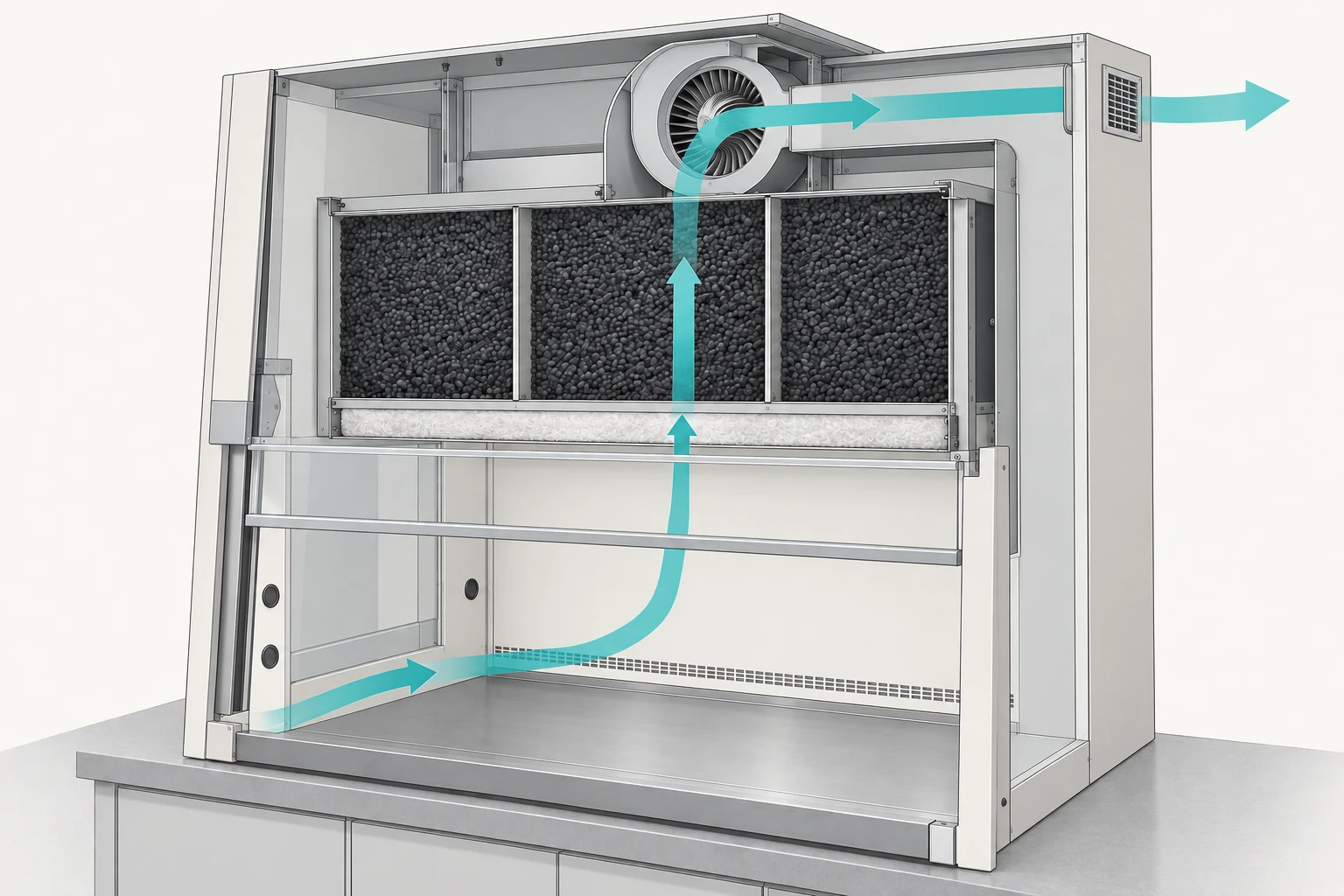
Adsorption capacity is a mass, and it is stated in grams or ounces
Adsorption capacity is the amount of a specific chemical a filter can retain before reaching saturation or breakthrough. SEFA 9-2026 defines it that way, and the same standard makes the definition operational by requiring manufacturers to publish retention capacities in grams or ounces for each compatible filter type, backed by third-party verified test results. Read the phrase “a specific chemical” as the operative part of that sentence, because it decides how you can use the number. Our working rule follows from it: buy the filter for a named chemical or not at all.
Capacity therefore arrives per chemical, which means a filter does not fail gradually in some general sense. It fails for one chemical at one point, and a second solvent in the same enclosure follows its own curve while competing for the same sites. That is why a mixed-solvent bench cannot be represented by one capacity figure, and why a supplier who quotes a single capacity for your process has not yet quoted you an answer.
Saturation and carbon filter breakthrough are the same event, defined once
Filter breakthrough, also called saturation, is the point at which a filter can no longer effectively remove contaminants from the airflow, allowing chemicals to escape into the exhaust stream. The standard lists the two words as one definition, so treat them as one event described twice: breakthrough is the event, saturation is the state it produces. Neither term means the carbon is exhausted.
That distinction changes what you are waiting for. You are not waiting for the medium to be used up; you are waiting for the first measurable passage of chemical beyond the filter, which a downstream measurement detects rather than a glance at the bed. Because the trigger is a measurement, the sensitivity of the measuring apparatus sits upstream of your replacement decision. A hood whose detection cannot resolve low concentrations will reach a different replacement decision than an identically loaded hood whose detection can, which makes this a purchasing question rather than a maintenance preference.
Retention capacity versus adsorption capacity: which one is the numerator
The terms retention capacity and adsorption capacity both appear in supplier documents and in standards, and the units differ between the descriptions. One common form describes retention capacity as the total weight of chemicals the filter can retain, usually expressed as a percentage of the filter’s own weight. The standard asks for the figure in grams or ounces. Those two forms are not interchangeable until you know the filter’s mass.
A percentage of filter mass tells you how well a medium performs relative to itself, which is useful for comparing carbon grades. A gram figure tells you what the bed holds for one named chemical, which is the only form the arithmetic can consume. Ask your supplier for the conversion and you will usually find that only one of the two forms is documented for your filter type, and that documented figure is the one to design around.
The arithmetic you can check: life equals capacity divided by load
The relationship is short enough to write in one line: life (days) = capacity (g) ÷ load (g/day). The standard does not publish this line and does not need to, because it publishes both ends separately: retention capacity in grams per compatible filter type in its manufacturer-performance clause, and evaporation measured as a container’s mass loss over time in its test protocol. Joining two published quantities is an inference, which is why the calculation labels the line an engineering relationship rather than a standard citation.
Load is the mass entering the bed per unit of time, not the volume of liquid you keep on the shelf, so bottles in storage do not load a filter while a repeatedly opened vessel does. The equation also has an endpoint you choose: it runs until a measurement says otherwise, not until the carbon is gone. Determine both inputs and the criterion, and a schedule has been replaced by a calculation.
Why the effective capacity is far below the intuitive number
Effective capacity sits below theoretical capacity because the bed does not load evenly, a behavior the mass transfer zone explains. ASTM D5160’s published summary states that the shorter the length of this mass transfer zone, the more effectively the carbon in the bed is utilized, and that a bed whose depth is less than the length of this zone will show immediate appearance of adsorbate in the effluent, or breakpoint. The parameters describing it are dynamic adsorption capacity and critical bed depth.
Picture the consequence in your hood. Carbon near the inlet works until it sits in equilibrium with the incoming vapor, while the rest of the bed still holds capacity, and the shallow bed used in a cabinet filter compresses that arrangement. Breakthrough therefore arrives while a meaningful fraction of the medium is still unused, and a bed thinner than the zone passes chemical almost from the start. That is the reason advertised capacity does not translate into a proportional service period, and the reason airflow distribution across the filter face matters as much as carbon grade.
Where temperature and humidity fit, and where they do not
Temperature and humidity belong to the test conditions rather than to a ready-made lifetime adjustment. The standard prescribes 18 to 22 degrees Celsius and 40 to 60 percent relative humidity for its testing, and a capacity figure is comparable only when it was produced under such conditions. Treat those two as measurement conditions rather than as multipliers on a service period.
The honest position on humidity leaves a gap. Humidity reduces the working capacity of activated carbon, and no source states a quantified relationship, so treat the effect as real in direction and unusable as a multiplier. The sources for this page do not establish that relationship, which is a different statement from asserting that no relationship exists. Determine where your own process sits relative to the test conditions before comparing any two capacity figures, and choose your breakthrough criterion deliberately, because the criterion and the replacement plan are one decision rather than two.
When to replace ductless fume hood filter: measuring the load you actually generate
Load is a measured quantity, not an estimate
Evaporation rate is determined by weighing the container before and after evaporation with an appropriate balance, so the load side of the equation already has a defined method. The standard states that requirement in its test protocol, and the reason is that the quantity you need is a mass, not an impression of how strong the smell was or how often the bottle came off the shelf. Weighing answers the question the calculation actually asks.
The same protocol shows what the measurement feeds. Its test output is a table or graph plotting the mass of test chemical evaporated against the concentration found in the exhaust, sampled at 15-minute intervals with instrumentation whose minimum detection capability meets a defined floor. Load and endpoint therefore live on one curve, and a load figure quoted without the breakthrough criterion it was measured against has lost half its meaning.
The six factors competitors list collapse into two numbers
Filter life responds to temperature, humidity, residence time, filter age, evaporation rate and the chemical concentration the work produces. Those six are not separate variables; they are inputs to one quantity. Temperature, container state and material temperature govern how fast a volatile leaves its vessel, while volume and handling duration govern how much is there to leave, so both groups converge on the mass entering the filter bed per unit of time.
Institutional policy works from the same control point. Oregon State restricts ductless hood use to activities that could safely be performed on an open bench, and the same conventions describe small-quantity work rather than a capacity limit: a small number of chemicals, no extreme heating, and modest volumes per chemical. Those limits describe what the hood is approved to see, not how long a filter lasts. Your load figure either comes from a measurement or from documented usage parameters, and the calculation treats a figure traced to neither as unusable.
How the challenge test defines the same quantity
The standard’s challenge test treats load as evaporated mass, which is the cleanest way to keep the units honest. Evaporated mass is what the filter receives, so a load value expressed in grams per day can be compared directly against a retention capacity expressed in grams, without conversions that hide assumptions about density or concentration.
The sampling detail does something else useful. Exhaust concentration is sampled at 15-minute intervals, and the instrumentation must resolve down to a small fraction of the relevant exposure limit, because a detector that cannot see a low concentration turns a real breakthrough into an absent reading. That is the same sensitivity problem a monitoring device faces on your hood. Load and detection capability are therefore two halves of one measurement rather than separate topics, which is why the calculation treats them together.
What you must log, and who reads it
The fields worth logging on the load side are the ones a manufacturer needs in order to answer you: chemical identities, quantities and concentrations, frequency and duration of use, material temperature, container state, and the largest volume that could be released at once. SEFA Form 9-A collects exactly those items from the user, which makes each logging field a boundary condition for the test that produces your capacity figure.
Operations records carry a second purpose. The institutional requirement is that the operations log record chemical types and quantities along with maintenance activity and the performance of alarm and detection systems, and that the hazard evaluation include manufacturer statements on adsorption capacity and expected filter life. Reviewed annually by a qualified person, that file is how a stale load estimate gets caught by a person instead of by an exposure.
Why more than one chemical breaks the single-division model
Adding a second chemical does not add a second term to the same equation; it ends the equation’s validity. Retention capacity is defined per chemical, two solvents compete for the same adsorption sites, and their breakthrough curves do not add arithmetically, so a hood running five solvents per week cannot be described by one capacity figure divided by one aggregate load. Guidance documentation and institutional policy both push toward identified, limited, approved applications for this reason.
The practical consequence is that your load figure is valid for one approved chemical set, and any change to that set invalidates the estimate as a technical matter, before any paperwork is considered. Scope the spreadsheet to a recipe rather than to a hood, because the approved list is the thing that has to stay current.
The gap you cannot close yourself
No source for this page publishes a retention capacity figure in grams for any specific filter type and chemical, while the standard requires manufacturers to state exactly that figure in their performance information. The requirement exists, and the number is not publicly available, which means half the equation sits behind a supplier request rather than in a document you can look up. That is a structural gap rather than an oversight in your own preparation.
Treat the missing number as a deliverable rather than an obstacle. You can build the load half of the equation today from a weighing or from logged usage, and the moment a retention capacity figure arrives the division has both terms. You can determine the composition of that request now: request the capacity figure for your filter type and chemical, and the load measurement you already hold becomes the thing that turns an unanswerable question into a scheduled procurement action.
Why no published interval for ductless fume hood filter life can replace a measured answer
The eight intervals, side by side, with their stated basis
Search for a replacement interval and you will find several confident numbers, and they do not agree with each other. Quoted replacement intervals run from about six months to two years, several sources recommend a flat 12 months for carbon, and one product-line claim reaches 48 months. Not one of them states the chemical it assumed, the throughput it observed, or the breakthrough criterion that marked the endpoint.
That is not a range you can plan against. A number that arrives without its conditions cannot be compared with another number or transferred to your bench, so our working rule is to treat the whole set as unusable rather than to pick the most credible-looking member of it.
| Input that drives life | What to state for it | Why the number exists at all |
|---|---|---|
| Chemical identity | One approved chemical, or an approved set | Capacity is defined per chemical, so the interval means nothing without it |
| Quantity and concentration | Working volume and strength | Sets how much material is available to evaporate |
| Frequency and duration | Sessions per week, hours per session | Converts a vessel’s contents into a rate |
| Material temperature | Room temperature, or a stated setpoint | Heating moves vapor generation onto a different curve |
| Container state | Covered or open, with cumulative open time | Open time is when the filter is actually working |
| Evaporation rate | A weighing, or a documented value and its method | This is the denominator of the calculation |
| Retention capacity | The manufacturer’s figure in grams or ounces | This is the numerator, and ours is the only column we cannot fill |
| Detection limit | The breakthrough criterion the monitoring uses and how far it resolves | The endpoint is a measured concentration, not a used-up bed |
The absence of a basis is itself evidence
Two sources reporting six months and 24 months are not arguing about the same filter; they are reporting two different unstated experiments in the same units. An interval that arrives without a chemical, without a throughput and without a breakthrough criterion has been produced somewhere other than a test, or it has been lifted from a test whose conditions were dropped in transit. Either way its value to you is the same, which is why our reading of that absence is not suspicion but direction: the figure you need has a documented source and these do not.
Two entries map to the lifespan you can read, not the one you want
Two of those figures describe something other than service life, and separating them prevents an expensive mistake. The roughly six-month cost cadence recorded by one university is a budgeting observation about what that institution spent, so treat it as a planning input for the budget and never as a replacement rule. The three-to-five-year figure circulating as a service life is actually a shelf life for a filter still in its original packaging, and it carries no standardized basis. Our working rule is to keep budget figures in the budget and storage figures in the storeroom, and to plan replacements from neither.
Once a filter is in service, none of those figures describes its remaining life. The distinction sounds obvious until you watch a budget meeting, where a shelf-life figure and a service-life claim routinely get averaged into one planning number. Keep them apart and the number you need is still missing, which is the point of the next section. Decide which of the two objects you are describing before you quote either figure, because a storage specification and a service life are not the same quantity.
An interval cannot be attributed to OSHA or SEFA
Intervals in circulation get tied to ANSI/AIHA Z9.5 and to OSHA 29 CFR 1910.1450, and that attribution does not survive checking. The full text of 1910.1450 contains no occurrence of the word ductless, no reference to a filter and no replacement interval, and 1910.94 contains no occurrence of the word ductless and no replacement interval either; its only uses of the word filter refer to particulate-filter respirators rather than to a hood filter. The Z9.5 text was not obtained, so no claim is made about its content either way.
A standard can regulate ductless equipment and stay silent on intervals at the same time, which is exactly what ours does. Where it needs a lifespan it asks the manufacturer to state an estimated one for a specific application, and a standard that collects the number from a supplier cannot be the origin of a quoted month count. That is what makes the attribution worth stating plainly: those numbers look authoritative because they name standards, and the naming is where the authority came from.
What to ask instead of “how often”
Replace the frequency question with three questions that have documented answers. Which filter type and chemical does the capacity figure cover? Which breakthrough criterion defines the endpoint, one percent or 50 percent of the relevant exposure limit? And what detection method establishes that endpoint on this hood?
Each question has a source: the first comes from the standard’s manufacturer performance requirement, the second from its saturation detection clause, and the third from its test protocol. The pages offering intervals do not answer any of them, which is why their counts cannot be reconciled with each other or with your process. A supplier who answers all three has given you something an interval never could. Choose the question you send carefully, because the answer determines whether you gain a calculation or another number that needs the same scrutiny.
Why this page still refuses to publish its own number
The honest answer is not a friendlier interval, because the evidence does not support one. No source for this page reports a retention capacity in grams for a specific filter type and chemical, which is the figure the division needs. Adding a month count here would mean inventing the very quantity the arithmetic lacks, and a safety-relevant number invented to make a page feel complete is worse than an acknowledged gap.
The institutional position states the same problem without softening it: filters can load unpredictably, which is a claim about the limits of prediction rather than about any particular hood. Together with numbers that carry no stated basis, that is enough to support a negative recommendation. Determine your own load, request the capacity figure, and confirm the breakthrough criterion, because the interval tables are a closed line of inquiry and the arithmetic is not.
Ductless hood filter monitoring: what it detects, and what to do when it cannot
The monitor reports breakthrough and runtime, not percent of filter life remaining
Monitoring on a ductless hood exists to catch breakthrough while work is in progress, rather than to forecast a date. The standard requires that a ductless fume hood or enclosure design carry continuous, automatic, audible and visible saturation detection capable of detecting the manufacturer-approved contaminants. Read such a display as a status light with a formal requirement behind it, not as a fuel gauge.
The requirement carries a design consequence worth knowing before you rely on it. Under the standard’s categories, a DH III system keeps working after primary breakthrough by using a secondary filter layer of the same medium, efficiency and capacity to provide time to finish an experiment. A DH II enclosure protects only up to breakthrough, and its use must be suspended once breakthrough is detected. Both classifications protect you under the same condition: the detection device works and its alarm is understood.
The two percentages are device performance requirements, not lifetime values
Two numbers from the same clause get read as limits on your operating concentration, and they are not. The standard requires that a DH III unit not release more than one percent of the threshold limit value of the approved contaminant after primary breakthrough, while DH II uses 50 percent. These are downstream concentration limits that define what the detection device and the secondary layer must achieve, and they describe a device specification rather than a chemical concentration at which anything becomes a signal to replace.
Treat them as procurement-relevant facts. A hood built to meet a tighter downstream limit implies a detection system built to resolve lower concentrations, which is the same sensitivity that determines how close to the beginning of breakthrough you receive an alarm. Ask for the limit your model is designed around and you learn something about the instrument. Quote these numbers as a replacement trigger, and an alarm function has been described as a schedule. Select your sensor and your replacement plan as one decision, because they are one.
When the sensor cannot detect breakthrough
A chemical sensor does not detect every breakthrough, and the standard concedes the principle. Where the instrument cannot resolve the endpoint, sampling moves downstream of the primary filter and becomes a periodic confirmation rather than a continuous reading. The standard is explicit about one case: colorimetric detection tubes for hydrogen chloride lack the necessary resolution to determine concentration accurately, and are acceptable for that service only when neither FTIR nor an ion chromatograph is available.
The reasoning transfers directly: the problem is not that a tube reads badly, it is that a tube cannot resolve the concentrations that matter for this endpoint. Use it as a qualitative confirmation that something is passing the filter, sampled downstream of the primary filter, on a filter that has been in service, and build that check into the maintenance plan.
How much trust to place in a reading
Readings carry ranges, including for the instrument set the standard’s own test protocol depends on. A plus-or-minus 25 percent error rate circulates for detector tubes as an industry convention; no standardized error limit was obtained for this page, so treat the figure as an indication of magnitude rather than a specification to design against.
The consequence of a wide error range reaches beyond tube selection. You cannot demonstrate compliance by trusting one reading back and forth; repeated sampling at the same port shows a trend, and the trend is where confirmation lives when it exists. Add a sampling port downstream of the primary filter if the instrument set cannot see the endpoint, and define the sampling interval before you need it rather than during an investigation.
What monitoring does not replace
A detection device is verified rather than merely trusted, and the standard assigns that duty explicitly. It requires manufacturers to provide the means to ensure the proper functioning and manual verification of the automatic saturation detection device, so the capability arrives with the equipment. The frequency is the manufacturer’s to recommend, while the EHS officer is responsible for ensuring that verification actually happens.
Face velocity monitoring sits on its own timetable rather than inside the breakthrough alarm. The standard calls for permanent face velocity monitoring for these enclosures, calibrated using an ASHRAE 110 instrument sweep and tested at least annually, which is why airflow verification keeps a separate schedule. The face velocity requirements page covers when a reading falls outside the expected band, and the diagnostic article covers what to do once it does.
The sensor has a service life of its own, and a two-to-five-year replacement interval circulates as an industry convention with no standardized basis. Nothing in it tells you how to detect a dead sensor, which leaves scheduled verification as the check. Log the alarm and detection performance either way, because both the verification and the sensor replacement need a record behind them.
Institutional policy uses the same structure of periodic external review, and the requirement is documented rather than implied. Annual testing and inspection of filters must be recorded with the filter change timeline, the hazards associated with changing one, the required PPE and the hazardous waste procedures. The standard’s performance clause requires manufacturers to publish third-party verified test results for retention capacity rather than to certify a lifetime, which anchors evaluation in periodic verification instead of a running clock. Decide which of the two readings you are relying on before you rely on either, because a breakthrough alarm and an airflow reading answer different questions.
Events that invalidate your estimate: spills, heating and flammable saturation
A spill invalidates the estimate even when it is minor
A spill rewrites the load history rather than resetting a timer, and our working rule is written to catch exactly that case. After any spill, even a minor one, the filters get evaluated for possible saturation or chemical breakthrough, because filters can load unpredictably, and replacement is likely required before the hood is used again. Read that sequence carefully, because the first action is an evaluation and the replacement decision follows it.
The escalation logic matters for how you plan. A spill transfers a mass to the filter bed in one event instead of across months, and it bypasses everything you have measured so far: your weekly mass-flow figure does not cover an event that delivered a month of load in a few minutes. Decide how a spill gets reported, who performs the evaluation, and on what authority the hood is returned to service, before any of it happens.
Heating and boiling change the load by orders of magnitude
Heating does not simply increase the load; it changes the basis of the calculation by accelerating the phase change. Heating and boiling work do not belong in a recirculating enclosure, and acid digestion is the standard example. UC Irvine’s 2011 position statement notes that heating operations may require a fire suppression system and code analysis as part of the approval, and the institutional boundary is the same wherever you work: anything in the hood has to be work you could safely perform on an open bench.
The engineering point sits behind both statements. Above a material’s boiling point, vapor generation stops tracking the modest evaporation you measure at room temperature, so a load figure measured under bench conditions loses its meaning rather than merely growing. If your process boils anything on that bench the arithmetic is not the next question, because heating is the one change that makes a measured load figure inapplicable.
Flammable saturation is a fire condition, not just a spent filter
A filter holding flammable vapor becomes a fuel load inside your laboratory. Filters saturated with flammable chemicals can be a fire hazard, and that is a property of the filter rather than a site-specific rule. That redirects the analysis away from exposure alone: a saturated filter is a fire risk inside its own housing, which is a different failure mode from breakthrough appearing in the room.
The institutional position adds a quantified boundary. Flammable chemicals are prohibited in quantities that could exceed the lower explosive limit, and any change requires a demonstration that flammable vapor in the enclosure stays below 10 percent of that lower explosive limit. That 10 percent figure is a campus requirement rather than a federal one, and it belongs to the institution that wrote it. Attribute the threshold to its source and combine both statements to set your own ceiling, because exposure response and fire prevention are separate duties with the same filter at the center.
Alarms, sensors and logs that stop behaving normally
An alarm that stops behaving normally is an event in its own right, because the detector is the only device standing between you and an unnoticed breakthrough. The operations log records chemical types and quantities alongside maintenance activity and the performance of alarm and detection systems, and the sensor itself belongs on that log: vendors quote a two-to-five-year replacement interval, which is a convention rather than a rule.
This category is easy to lose because nothing has been spilled and nothing is boiling, yet the protection you were relying on has changed. The failure is invisible in the room and obvious in a log, which is one reason the log exists. It also decides what else must stop: an unreliable detector removes the condition the enclosure was approved under. Determine what evidence closes an alarm-reliability event before you accept the hood back into service, and record the closure.
Worked example: a single solvent that still cannot be calculated
Here is the arithmetic carried through one scenario. Every number below is a stated assumption of the example rather than a sourced value, and the scenario describes an approved application in a benchtop ductless enclosure. The solvent is a single alcohol-class chemical, stored in a closed five-liter container between uses, and the operator works with a 500-milliliter aliquot for three hours a week with the container open for 20 minutes in total across those sessions.
| Step | Quantity | Value in this example | Where it comes from |
|---|---|---|---|
| 1 | Weekly evaporation load | 20 grams per week | 5 percent of the 500-milliliter aliquot is 25 milliliters; at the example’s assumed alcohol density of 0.79 grams per milliliter that is about 20 grams |
| 2 | Daily load | 4 grams per day | Step 1 divided across five working days |
| 3 | Retention capacity for this chemical | Not supplied | A manufacturer figure this page does not have |
| 4 | Life in days | Cannot be determined | Step 3 divided by Step 2, with the numerator missing |
Until a supplier states a capacity figure for an alcohol-class solvent in that filter type, the arithmetic has no numerator, and the output is a request rather than a date. One safeguard keeps those grams honest: the real load comes from a weighing or a documented usage parameter, so the figure above stands in for that measurement and is not one. Our point is the shape of the exercise, not the digits in it.
How the answer changes: adding a chemical, or a spill
Two changes move the example onto different paths, and neither is solved by improving the arithmetic. Add a second solvent and the division loses its subject, because capacity is defined per chemical and two solvents compete for the same adsorption sites; a change of application is equivalent to a new usage qualification, so the operator must obtain prior written re-approval before adding it. The single capacity figure loses its basis, the load figure survives, and the approval comes before the calculation.
Spilling part of the aliquot changes the opposite half: the filters get evaluated for possible saturation or breakthrough even after a minor spill, and replacement is likely required before the hood is used again. Neither branch produces a next date. One produces a request, the other a stop-work decision, and deciding which one you are in comes before touching the schedule.
Decision point: what to record when nothing is wrong
The final answer to the question of when to replace a ductless fume hood filter is a procedure rather than a period, and the procedure produces records even when nothing has happened. Keep the load figures from your weighing or your usage log, keep the alarm and detection performance entries, and keep the application approval with its approved chemical list, because that set of records is what makes a later change reviewable instead of arguable.
The question that matters at the bench is not a date. It is determining which of these four events the last change belongs to: a spill, a heating or boiling step, flammable saturation, or an alarm or sensor anomaly. Adding a heating or boiling step needs prior written re-approval, because it varies the approved application, and flammable saturation needs the fire-safety point settled before the hood returns to service. A spill needs an evaluation of possible saturation or breakthrough, and an alarm or sensor anomaly needs the detector’s function verified before the enclosure is trusted again. Your next step after this module is to confirm that your operations log captures all four well enough to answer that question later.
Replacing a ductless fume hood filter is an EHS event, not a supply swap
Shut the airflow down before you open the housing
Replacing a filter in a ductless hood is a hazardous-materials operation with an order of operations, and the first step is not handling the filter. Airflow through the filter housing is shut down during change-out, every time. Read that as the entry condition for everything that follows, because a fan moving air through an open housing distributes exactly what you are trying to contain.
The institutional reasoning is about exposure control rather than convenience. A loaded filter holds the chemical inventory of every application it has seen, and the requirement to shut the airflow down exists to keep that inventory where it is until the procedure catches it. This is also the step where a written procedure earns its place, because it names who shuts the airflow down and what evidence confirms it is off before anyone opens a housing.
Unload under a safe-work procedure, with the PPE it names
Contaminated filters must be unloaded following safe work practices that avoid exposing personnel and that contain the filter for final disposal, which makes the written procedure part of the equipment rather than part of the paperwork. The hazards of changing a filter and the required PPE get an annual review, so the procedure keeps describing the filter that is actually installed.
Notice where the specificity sits: not in a generic instruction to wear protective equipment, but in an inventory of the hazards of this change, which only the people who know the chemistry can write. That is why the annual review matters more than the initial draft. A procedure written for a single approved solvent, then carried unchanged through three years of new applications, describes a different filter from the one being lifted out.
Both new and used filters leave as hazardous waste
Disposal is not a disposal detail; it is a requirement with an unusual scope. The institutional safety instruction states that both new and used filters must be disposed of properly as hazardous waste. An approved application carries the duty to develop and execute the replacement and disposal procedure and to report changes of use to the environmental health and safety office, so the paperwork travels with the hood.
The inclusion of unused filters is what readers find surprising, and the reason is contamination rather than consumption. A filter removed early, a spare stored next to a used unit, and a filter pressed into service once and set aside all sit inside the same waste stream once they have been part of that enclosure. Plan the waste route before the filter is out of the housing, because the route determines the packaging and the holding location.
Records, labels and the annual review that keep it visible
The record fields a reviewer expects are specific and few. Annual testing and inspection of filters must be documented with the filter change timeline, the hazards associated with changing the filter, the required PPE and the hazardous waste procedures, and the posted information on the hood must include its filter replacement plan.
Taken together, the fields turn a maintenance job into a documentary asset rather than a story. The mechanism to watch is the floor rather than the recommendation: replacement follows the manufacturer’s recommendations at minimum, and the institution can require it more frequently rather than less. Keep the four fields current, because the record is what a reviewer checks when the filter is already gone.
Where the cabinet ends and the filter begins
This module owns the filter, not the enclosure. Inspection frequency, responsibility, stop-use conditions and the record fields for the cabinet as a whole belong to a different article, and the inspection checklist covers them; what stays here is the filter-side sequence you have just read.
The split matters because the two sets of records get confused in audits. A hood that passed its annual containment check has demonstrated the enclosure, not the filter’s condition, and a filter that was changed on schedule has not demonstrated anything about airflow. Keep the two files distinct, and let each one answer its own question.
Decision point: what a pre-replacement check must produce
Before anyone opens the housing, three things should already exist: a reason to replace, evidenced by a breakthrough indication or a documented evaluation after an event; a procedure that names the airflow shutdown, the PPE and the unloading steps; and a waste route that accepts used and unused filters alike. Evidence for the first comes from monitoring and the load record, and the second and third come from your own written procedure.
That set is the difference between maintenance and disposal. Decide now which of the three you would have to invent on the day, because the one you cannot answer in advance is the one that will delay you. Your next step after this module is to open the procedure, confirm it names all three, and check that the posted information on the hood matches the filter actually installed.
Who actually approves the change, and which fields only you can supply
Adding one chemical is a new usage qualification
Adding a chemical is not a log entry, and the standard says so in the language of certificated documents rather than of housekeeping. A change of application is equivalent to a new usage qualification, and operators must obtain prior written re-approval from the manufacturer every time an application varies in any way from the initial approved usage. The institutional requirement reaches the same conclusion from the other side: any change in use, chemical compounds or chemical quantities must be approved by the environmental health and safety office.
The word prior carries the operational weight, because it places approval before the first time the chemical is opened. A reader who treats this as notification rather than permission has inverted the sequence, and the sequence is the whole requirement. Rule on the change before the work, not after the exposure.
The fields only you can supply
The user-side fields of SEFA Form 9-A are what the manufacturer needs to answer your question, and each one describes something only your operation knows. Separate what you must supply from what you must obtain: chemical identity including the CAS number, the amount and concentration of each material, the frequency and duration of the application, the material temperature, the container state as open or closed, the evaporation rate, and the maximum potential spill volume.
That list is the denominator of the arithmetic, and it supplies why no manufacturer can complete it for you. The phrase “the amount you actually handle” is different from the amount a catalog lists, and a supplier has no access to your bench practice. Fill all seven fields and the request has a defined subject; leave one out and the response can only be generic.
The fields you can only obtain
The other half of Form 9-A is the manufacturer’s answer, and each item in it is something you cannot derive yourself. You obtain the approved filter type and its approved substance list, the retention capacity in grams or ounces for the compatible filter, the breakthrough criterion your monitoring is set to, the filtration system’s date of first use together with the estimated replacement date and estimated filter life, and the saturation detection system’s information.
This is the column where the arithmetic closes. The gram figure is the numerator the calculation has been missing since the first module, and the detected concentration and detection method decide where the endpoint sits. Without both, you are holding a well-documented request and no capacity figure, which is a legitimate state but not a finished one.
The three approvals that are not the same approval
Three separate gates control a change, and treating them as one slows everybody down. The manufacturer’s written re-approval establishes that the application is within the equipment’s approved use. Your institution’s environmental health and safety approval establishes that the application is acceptable on that site. The annual review of the hazard evaluation keeps both determinations current rather than permanent.
The ordering is practical rather than bureaucratic. A manufacturer can approve an application that your institution declines, because the two gates answer different questions. Know which gate a proposed change is standing at, because the wrong queue is how a two-week change becomes a two-month one.
Why “use less” is not a documented way to extend life
Ordering a smaller aliquot feels like a defensible way to prolong service, and the reasoning is half right. UC Irvine’s 2011 statement restricts these hoods to a fixed set of known, non-synthesized chemicals used in small consistent quantities, and chemical volume is the clearest single lever: larger volumes shorten filter life, which is why small consistent quantities per chemical are the intended operating range. Volume clearly belongs in the denominator.
The conclusion does not follow, and everyone who has ever gone on a diet knows why. You can reduce a quantity, but you cannot show how much life the reduction bought without the capacity figure, and the reduction does not survive the arrival of a second chemical. Treat volume control as a condition of approval rather than as a method of estimation.
What belongs in the hazard evaluation file
One document connects all of the above, and its required contents are stated rather than implied. Oregon State requires the hazard evaluation to include the manufacturer’s statements on adsorption capacity and expected filter life, and requires it to be reviewed at least annually by a qualified person. The capacity figure and the expected life therefore have a designated home before the hood is even used.
That home is what gets opened during an approval, an audit or an incident review, and it is where a gap becomes visible to someone other than the operator. Write the file knowing that a reviewer will reach for capacity first. Confirm that your file states the capacity figure and the expected life for the current approved chemical list, because a file containing everything except those two items is the most common version of an empty one.
Decision point: what to submit, and to whom
Two submissions run in parallel, and both start with your own fields. Assemble the seven user-side items first, because the manufacturer’s answer depends on them, and send them to the manufacturer for written re-approval before the change happens. Send the site-level change to your institution as a separate request, because that gate answers a different question.
Decide which submission you will make first, and confirm that the hazard evaluation file already carries the capacity statement the manufacturer supplied, because that statement is what both gates will look for.
The request that closes the loop: a two-column RFI for ductless fume hood filter life
What the request has to contain, and why
Everything above converges on one document, and its shape follows from the arithmetic. A request for ductless fume hood filter life is two columns, because the calculation needs one input that only you possess and one that only a manufacturer can state. Fill the first with the operating facts and the second becomes a specific question with a numeric answer rather than a request for advice.
Written that way, the request survives forwarding. A colleague, an EHS reviewer or a purchaser can read it and understand what is being asked, which is not true of a question about replacement frequency.
Column one: what you supply
Supply the chemistry and the usage, because these are the inputs the manufacturer cannot reconstruct. The list below follows the user side of SEFA Form 9-A, and each line describes something measurable or scheduleable in your own operation rather than something you can estimate on the supplier’s behalf.
| Field you supply | Detail to include |
|---|---|
| Chemical identity | Name and CAS number for each chemical in the approved set |
| Amount and concentration | Working quantity per session, with full strength or dilution stated |
| Frequency and duration | Sessions per week and hours per session |
| Material temperature | Room temperature or a stated setpoint, and whether any step heats the material |
| Container state | Covered or open during use, with cumulative open time |
| Evaporation rate | Your measured or documented value, and the method used to obtain it |
| Maximum potential spill volume | The largest volume that could be released in one event |
Column two: what you ask for
Ask for the numbers, not for a schedule. Each item below is something the manufacturer can state for the filter type they supply, and each one either closes the arithmetic or defines the endpoint that ends it.
| Item you request | Why the request needs it |
|---|---|
| Approved filter type and approved substance list | Establishes that this chemistry is inside the approved application |
| Retention capacity in grams or ounces | The numerator the calculation has been missing |
| Breakthrough criterion the monitoring is set to | Names the endpoint as a detected concentration rather than an elapsed period |
| Saturation detection method and its stated limit | Determines how close to the onset of breakthrough an alarm arrives |
| Date of first use and estimated replacement date | Ties the estimate to one installation rather than to a generic filter |
| Estimated filter life as stated for this application | The manufacturer’s own estimate, for your hazard evaluation file |
| Replacement procedure, PPE and waste route | Confirms the disposal path required for the used and unused filter alike |
The one line that asks a question the calendar cannot answer
Most requests ask how often a filter needs replacing, and that wording invites the answer you already have too many of. Rewrite it to ask, for the filter type supplied, what the retention capacity is in grams or ounces for your listed chemicals at your stated quantities and material temperature, and which breakthrough criterion the detection system is set to.
That sentence converts a request for a policy into a request for a measurement, and it makes an evasive reply visible, because a response that returns only a month count has answered none of it. Keep it in the email body rather than in an attachment, so a redirected thread cannot arrive without it.
Your next step after this page
Send the two columns, and accept that the reply may take a round trip. Requests phrased around capacity sometimes return with a question about the application, which is the system working rather than stalling, and a hazard evaluation file updated with the manufacturer’s answer ends the exercise.
The judgment to carry away is short. Ductless fume hood filter life is a property of one approved application, and the only durable way to hold it is to keep the load record current and route every change through approval before the change happens. Keep the columns, the log and the approval together in one file, so the next reviewer opens a record instead of starting an investigation.
Frequently asked questions
Are HEPA and carbon filters replaced on the same schedule?
No, and the two categories fail for different reasons. A particulate filter loads with dust while a carbon bed saturates chemically, and the page offering 12 months for carbon alongside one to two years for HEPA states no basis for either number. Selecting and pairing the media types is covered by choosing the filter type.
Do ductless fume hood filters have a shelf life?
They do, and it is a different quantity from service life. The three-to-five-year figure found in the research applies to an unopened filter stored in its original packaging away from humidity, dust and direct sunlight, and it says nothing about a filter in service.
Can I go by smell or by a monthly visual check?
No. Uneven loading leaves part of a filter face oversaturated while the rest still has capacity, an alarm can fire without any odor reaching you, and filters can load unpredictably. A change in odor is a reason to evaluate, never a measurement.
How do I know the monitor is working?
It is verified rather than merely watched. The standard requires manufacturers to provide the means for the proper functioning and manual verification of the automatic saturation detection device, the manufacturer recommends the verification frequency, and the EHS officer is responsible for ensuring the verification happens. Face velocity monitoring keeps its own annual test, and a two-to-five-year sensor replacement interval circulates as an industry convention with no standardized basis for detecting a dead sensor.
Is there a legal replacement interval in the United States?
No federal interval exists in the standards checked for this page. OSHA 1910.1450 and 1910.94 set exposure limits and the chemical hygiene plan requirement without a replacement requirement, an interval or a capacity figure, which leaves the duty with employers and institutional policy.
What documentation should follow a filter change?
Four items: the filter change timeline, the hazards of the change, the required PPE and the hazardous waste procedures. The cabinet-side inspection records that sit alongside them belong to the inspection checklist.
Does the cost of replacement belong in my budget?
Yes, but not as a replacement rule. One institution’s recorded cost cadence of roughly six months describes what those hoods cost to run, so it belongs in the budget rather than in the maintenance plan.
Why does the article not give a number?
Because no source for this page publishes a retention capacity in grams for a specific filter and chemical, which is the numerator the arithmetic requires. A friendly month count would mean inventing the quantity that is missing.
Can I extend life by using smaller volumes?
Only within the approval you already hold. A smaller quantity reduces what enters the bed, but without a capacity figure the saving is not quantifiable, and adding a second chemical changes the application regardless of volume.
Who decides when the filter must be changed?
The detection system and the approved application decide it together. A breakthrough indication, an evaluation after a spill, or a chemical change each trigger a decision, while an institutional requirement can ask for replacement sooner than a manufacturer recommends.
What is the single most useful thing to request?
The retention capacity in grams or ounces for your filter type and chemical, alongside the breakthrough criterion the monitoring uses. Those two answers turn the load record you already hold into a dated decision rather than a standing question.
Leave a Reply