


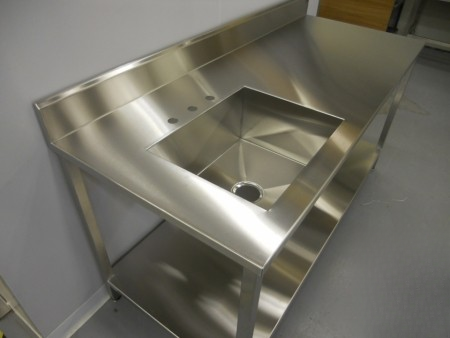
Description
Key Specifications and First Selection
A stainless steel laboratory sink is selected for the wet-work arrangement, not simply for a bowl size. The first choice is whether the project needs an independent basin fitted into an existing top or a complete laboratory wash station with a work surface, frame, storage and service space. The second choice is the working sequence: one large uninterrupted bowl, two bowls for separated washing and rinsing, or a compact basin for a localized task. Material grade, thickness, finish, outlet, faucet holes and support structure then need to be tied to that chosen arrangement.
Choose a Basin or a Complete Workstation
An independent stainless lab sink is appropriate where a countertop, cabinet and plumbing layout already exist and only the basin interface must be defined. A complete workstation is appropriate where the sink, worktop, splash control, open frame, undershelf or cabinet are being planned together. The two arrangements cannot share one dimension schedule: bowl dimensions describe washing space, while workstation dimensions describe the footprint, support and access envelope of the completed wet-work area.
Before choosing either route, identify the largest vessel, tray or glassware basket that must be washed; whether water must be retained, drained or transferred between bowls; and whether an operator needs a dry landing area beside the bowl. Those facts determine bowl depth, bowl number, left/right/central position and working-top length more reliably than selecting a standard overall bench size.
Put Comparable Data in the Same Unit of Scope
When comparing two stainless sink quotations, record the bowl internal length, width and depth separately from the overall worktop length, depth and finished elevation. Record material grade and gauge separately for the bowl, top and frame. Also distinguish an included outlet from a merely prepared drain opening. These fields prevent a small inset basin from appearing comparable with a complete open-frame wash station only because both are called laboratory sinks.
Reference Formats That Must Not Be Combined
| Reference configuration | Separate published geometry | Material example | Selection use |
|---|---|---|---|
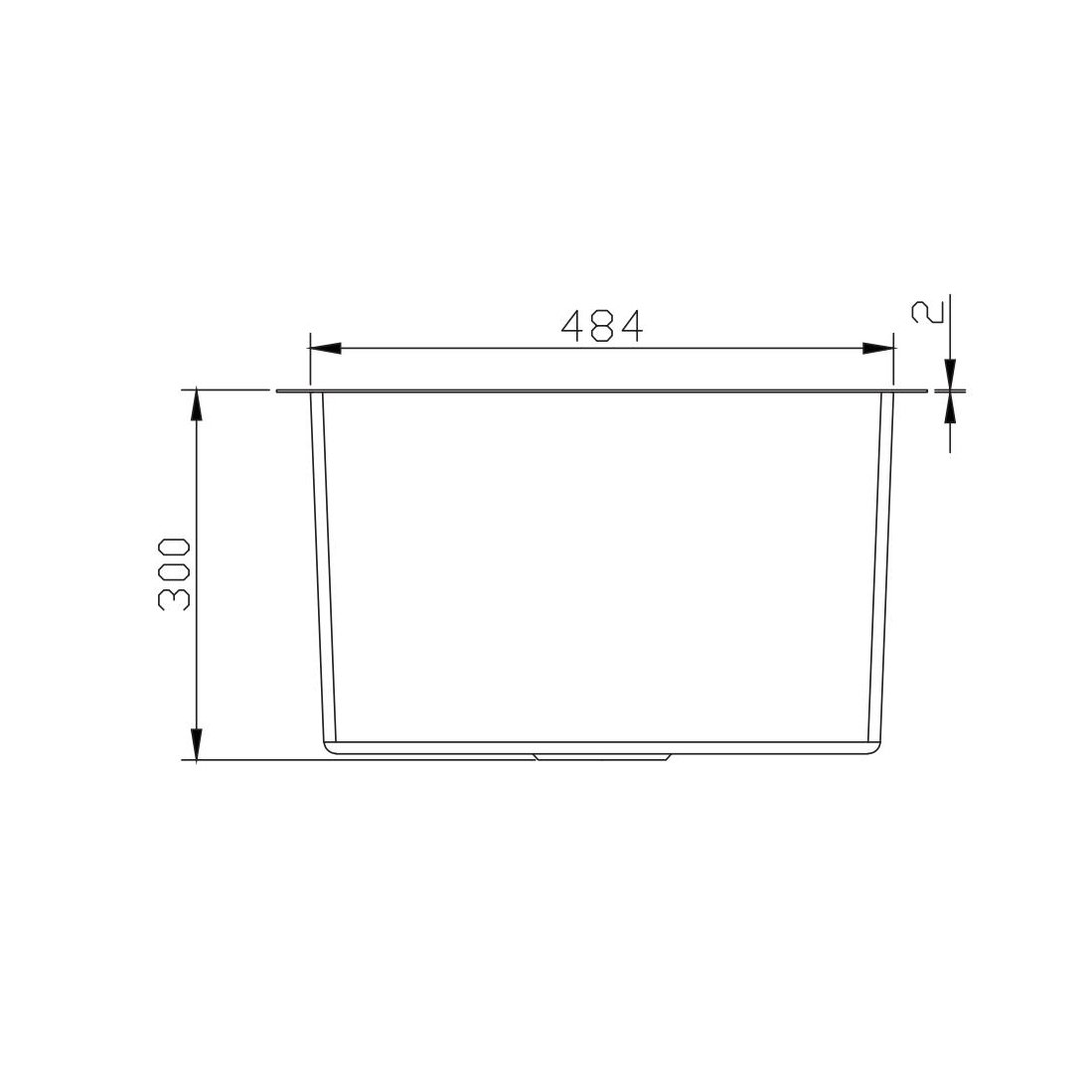
| Deep single bowl | 356 x 406 x 254 mm internal; 478 x 460 mm top-mount envelope | Type 316, 18 gauge example | Countertop basin requiring a defined cut-out and faucet ledge |
| Single-bowl work station | 1829 x 762 mm overall; 457 x 406 x 254 mm bowl | 304, 16 gauge example | Open-frame wet-work table with a selected bowl and drainage route |
| Large open-frame station | 2438 x 864 x 864 mm overall | 304, 16 gauge example | Larger bench-scale washing arrangement with selected support and storage |
| Compact cup basin | 76 x 152 x 94 mm internal | Type 316, 20 gauge example | Localized rinse or small-item use, not a substitute for a full wash station |
These are separate reference configurations rather than one standard size range. A quotation should identify the selected bowl dimensions, complete external dimensions where applicable, steel grade and thickness for each supplied component.
Product Scope and Supply Boundary
This product family covers a configurable stainless steel basin or laboratory washing station. A supplied scope may include a selected bowl, fabricated top, backsplash, open frame, undershelf, cabinet interface, faucet holes or drainage provisions. It does not mean every pictured faucet, pre-rinse spray, drying rack, splash panel, bottle basket, trap, cabinet or service valve is automatically included. Each element must be identified in the selected configuration.
Avoid Treating Visible Accessories as Standard Scope
Workstation imagery often shows multiple bowls, a faucet, spray unit, drying rack and storage shelf because these components explain a possible wet-work layout. They also have different procurement and installation responsibilities. Confirm the faucet type and hole pattern, whether a backsplash is continuous, the selected drain fitting, and whether an undershelf or closed sink cabinet is required. This avoids a finished worktop with missing service connections or an under-sink space that cannot be accessed.
Set the Steel Grade by Component
The bowl, worktop, frame, backsplash, faucet and drain fitting may not be made from the same stainless grade. A project may use a 304 workstation reference with a selected faucet of another grade, or request a 316/316L configuration for defined exposure conditions. The schedule should state the material and finish for the part that matters rather than applying one steel label to the entire assembly.
Separate Fabrication Scope from Site Work
The selected sink may be delivered as a loose basin, a fabricated top with bowl, or a self-supporting washing station. Site work can include placing the unit, making water and drainage connections, sealing a top-mounted rim, anchoring a frame, and testing the completed installation. These are related activities but they are not the same supply scope. The project documents should state who provides the counter, frame, faucet, valves, trap and final service connections before fabrication begins.
Bowl, Worktop and Support Arrangement
The bowl form should follow the washing sequence. A single bowl stainless steel lab sink provides a continuous area for larger vessels, trays or equipment components. A double bowl stainless steel lab sink can separate washing from rinsing, or keep different tasks from competing for one bowl. A compact basin serves a smaller localized task and should not be selected where larger glassware or containers must be handled. Confirm the usable internal dimensions and depth against the largest item entering the bowl.
Open Frame, Undershelf and Cabinet Interfaces
An open frame provides direct access to the drain and leaves space for selected mobile storage, but exposed pipework and cleaning access must be planned. An undershelf adds storage without automatically solving the trap route. A cabinet can conceal services and provide enclosed storage, but rails, shelves, back panels and doors must be coordinated with the bowl and trap. Link the selected station to the Laboratory Sink Base Cabinet only when the below-bowl configuration has been defined.
The support layout also affects day-to-day use. A central bowl may leave usable work areas on both sides, while an end-position bowl can preserve one uninterrupted preparation area. A drainboard or retaining edge may be useful where rinsed items must rest beside the bowl, but it changes the required top length and the cleaning interface at the splash edge. Confirm whether these surfaces are required for the actual task rather than treating them as standard sink features.
Workstation Components Must Be Scheduled Separately
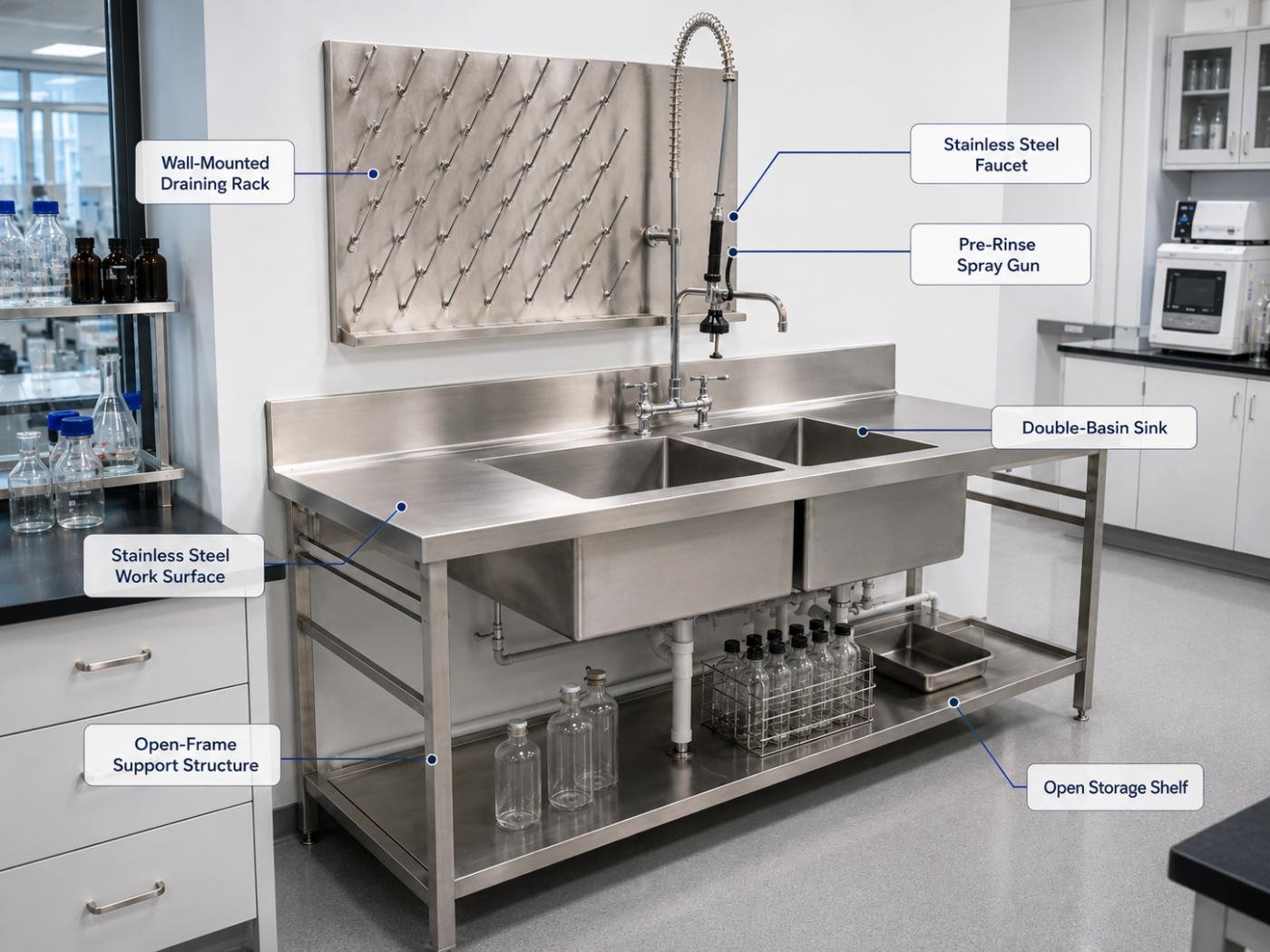
The figure illustrates why a basin should not be ordered as though it includes a complete workstation. The number and position of bowls, top length, side work areas, backsplash, drying rack, faucet, spray unit and lower structure should be listed one by one. A wall-side arrangement can be coordinated with a Laboratory Wall Bench; a central wet-work layout can be coordinated with a Laboratory Island Bench.
For a double-bowl station, decide whether both bowls need identical internal dimensions and drain routes. A wash-and-rinse sequence may use equal bowls, while another process may require one deeper bowl for immersion and one shallower bowl for transfer or final rinsing. The relevant decision is the approved combination of bowl geometry, faucet reach and drainage access, not the label “double bowl” by itself.
Material Grade and Surface Selection
304, 316 and 316L are separate material selections. A 304 stainless steel laboratory sink may be suitable for a defined general wet-work arrangement, while a 316 stainless steel laboratory sink or 316L configuration may be evaluated where the actual liquid exposure, residue, temperature and cleaning regime require a different material review. A steel grade alone does not establish compatibility for all acids, alkalis, salts, chlorides, solvents or disinfectants.
Review the Complete Wet Path
The liquid path includes the bowl, outlet, strainer, tailpiece, trap, seals, faucet and downstream pipework. A suitable bowl does not automatically make every wetted accessory suitable. Provide the process media, concentration, temperature, contact duration, cleaning agent and rinse routine, then identify every wetted item in the selected assembly. This is more useful than a broad corrosion-resistance statement because it identifies which component must be changed or confirmed.
Finish and Fabrication Affect Cleaning Access
Brushed, satin, sand-blast and electropolished finishes appear in real configurations, but the specified finish must be linked to the selected component. Weld seams, inside corners, rim joints and splash interfaces should be considered with the intended cleaning routine. Do not specify a finish only for appearance: it also determines how joints are maintained and whether residues can be reached during routine cleaning.
Do Not Use Thickness as an Isolated Quality Claim
Published references show 16-gauge workstations, 18-gauge deep bowls and 20-gauge compact basins. These examples relate to different product forms and cannot be converted into one universal thickness requirement. Record the gauge or millimetre thickness for the bowl, worktop and support structure that will actually be supplied. Then review the required support, fabrication method and intended use with that defined construction.
Consider Edges, Corners and Splash Returns Together
An elevated back edge or side return can help direct incidental water toward the wet area, but it also adds fabricated corners and joints. A flat top can simplify one type of equipment placement, while a retaining lip may be useful for a different rinsing arrangement. The page therefore treats splash control as a selected geometry field. Confirm its height, length, continuity and the relationship to nearby wall finishes or equipment instead of assuming that every stainless worktop has the same edge detail.
Faucet, Drain and Wet-Service Interfaces
The faucet and drain arrangement must be selected with the basin, not added after the worktop has been fabricated. Confirm whether the faucet is deck-mounted, wall-mounted or provided through a separate service panel; then define the hole count, hole position, supply route and clearance for fixing hardware. A faucet ledge can be part of a particular bowl form, but it is not present on every stainless steel laboratory sink configuration.
Drain Openings and Below-Bowl Access
Real laboratory sink references include both approximately 89 mm basket-strainer openings for larger bowls and approximately 38 mm waste arrangements for compact basin forms. These are examples of different component families, not interchangeable requirements. The selected outlet, strainer, tailpiece, trap and pipe connection must be matched to the actual bowl and the project drainage design.
Drainage must also be considered with the intended use of the station. A bowl used for frequent glassware rinsing may need a strainer and access arrangement that can be cleaned routinely. A bowl handling larger containers may need a different internal clear space and a drain position that does not interfere with how the item sits in the basin. The plumbing designer determines pipe sizing, fall and disposal requirements; the product configuration must leave the necessary physical access to implement that design.
Interface Items to Confirm
| Interface item | Decision required | Why it matters | Drawing or quotation input |
|---|---|---|---|
| Faucet and supply | Mounting type, holes, supply type and reach | Controls top fabrication and usable bowl access | Faucet data, hole pattern and service route |
| Drain assembly | Outlet diameter, strainer, tailpiece, trap and pipe entry | Determines wet-path components and maintenance access | Drain schedule and plumbing connection point |
| Splash control | Backsplash, side splash, rim or retaining lip | Changes containment and cleanable interfaces | Required height, length and continuous edges |
| Under-sink space | Frame, shelf, cabinet, valves and service access | Prevents conflict with the bowl and trap | Cabinet or frame drawing with service elevations |
Keep the Trap Serviceable After Installation
The lowest visible point of the bowl is not the bottom of the service envelope. Add the outlet fitting, tailpiece, trap bend, isolation valves and the room needed to remove or inspect them. If the station uses an undershelf or closed cabinet, locate any opening, removable panel or shelf interruption against the actual drain centreline. This avoids a well-finished work surface that requires major disassembly for a routine drainage inspection.
Installation, Cleaning and Maintenance Planning
Install the selected stainless lab sink from the approved bowl and workstation drawings. A top-mount or flush basin needs its own cut-out and sealing detail. A welded-in basin needs a defined fabrication and finish scope. A freestanding station needs its frame, legs, floor or wall interface, top level and plumbing route coordinated as a complete unit. Do not use a general external basin dimension as a cutting template.
Protect the Worktop and the Service Route
Before fabrication, check the bowl envelope, rim or flange, top thickness, backsplash, faucet holes, drain centerline and any required support. Before installation, check that cabinet rails, shelves, valves and pipework do not occupy the same space as the bowl or trap. The selected Laboratory Countertop should be cut only after the exact basin arrangement and interface detail are approved.
Cleaning Access Is a Selection Criterion
The rim joint, bowl corners, drain strainer, faucet fixing and accessible portions of the trap should be reachable for the proposed cleaning and maintenance practice. A stainless surface does not remove the need to inspect seams, joints and drainage components. Where a rack, backsplash or side splash is selected, its connection to the worktop should be shown clearly enough for the joint to be cleaned and maintained.
After the assembly is installed, inspect the basin support, rim or welded joint, faucet fixing, outlet connection and the accessible waste route before the station enters normal use. Fill and drain the selected bowl under controlled conditions and check that water does not stand unexpectedly, the bowl does not move at its support points and cabinet doors or shelves can still be operated. This is an installation coordination check, not a claim of project-specific commissioning performance.
Installation Inputs for a Project-Ready Configuration
| Installation input | Information to provide | Decision enabled | Typical conflict prevented |
|---|---|---|---|
| Bowl and station drawing | Internal/external dimensions, bowl count, rim and finished height | Correct basin and worktop geometry | Bowl or rim interference with the fabricated top |
| Material and finish | Grade, thickness and finish required for each selected component | Component-level steel scope | Treating bowl, top and faucet as one unspecified grade |
| Water and drainage route | Faucet, valves, outlet, trap, pipe entry and access path | Service interface and maintenance space | Drain or valve obstruction behind a cabinet rail |
| Mounting and support | Top-mount, flush, welded-in or freestanding arrangement | Cut-out, seal, frame or fixing detail | An unsupported bowl or inaccessible service connection |
Applications, Related Products and Selection Boundary
A stainless steel laboratory sink can be configured for glassware washing, container rinsing, preparation-area wet work and selected general laboratory cleaning tasks. Select the bowl count and depth from the objects entering the sink and the desired sequence of washing and rinsing. Select the material grade and all wetted accessories from the actual liquid exposure and cleaning regime. Do not treat this page as a substitute for a chemical-compatibility review, a site plumbing design or an acceptance test for a completed wet-work station.
Match the Wash Station to the Working Area
A wall-side wash station usually needs the backsplash, faucet reach, drain route and clearance to adjacent equipment considered with the wall bench layout. A central station may need working access from more than one side, a defined bowl position and a drainage route that does not compromise the circulation space around the bench. For either layout, the outer footprint alone does not show whether an operator can place items beside the bowl, reach the faucet controls and remove a strainer or trap when needed.
Where the task involves routine washing of bottles or glassware, identify whether a separate rinse area, draining surface or wall-mounted drying rack is needed. Where the task involves larger containers or equipment parts, specify the required internal bowl envelope and the method for handling the item at the worktop. These decisions determine whether the project needs a single deep bowl, two process-separated bowls, a longer station or a selected support arrangement.
Conditions That Need a Separate Engineering Decision
This page should not be used to imply that a standard stainless arrangement is suitable for every chemical process, waste stream, pressure-washing practice or high-temperature cleaning cycle. Strong chemicals, chloride-bearing liquids, aggressive cleaning agents, unusual temperatures and special waste handling may affect the selected bowl, seals, fittings and downstream drainage system differently. Supply the actual conditions so that the selected material and wet-path scope can be reviewed before the configuration is released.
Where the required liquid path is better served by polypropylene rather than stainless steel, compare the selected conditions with the PP Laboratory Sink. Where the principal purchase decision is a bench layout rather than a basin, start with the relevant bench and countertop configuration, then define the sink interface. This keeps the sink page focused on the actual basin or wash-station entity rather than claiming every wet-work component as one product.
Information That Produces a Usable Quotation
For each requested sink or workstation, provide the laboratory task, the items to be washed, the required bowl count and usable internal dimensions, overall station footprint and finished working height. Add the proposed 304, 316 or 316L requirement where known, together with any requested gauge, surface finish, backsplash, drainboard, frame, undershelf or cabinet.
Include the faucet mounting type, number and position of holes, water supply, outlet and strainer arrangement, trap and drainage entry, plus the actual media, concentration, temperature, contact time and cleaning method. A countertop, cabinet, plumbing or room-layout drawing is useful where it identifies clearances. This set of inputs allows the basin, worktop, support and drainage scope to be defined as one coordinated configuration rather than as unrelated components.
Frequently Asked Questions
Is 304 or 316 stainless steel always better for a laboratory sink?
Neither grade is a universal answer. Specify the selected bowl, top, frame and wet-path components separately, then review the actual media, concentration, temperature, contact time and cleaning routine. The final grade must be confirmed for the specified configuration.
Should a project choose a single bowl or double bowl stainless steel lab sink?
Choose a single bowl where continuous internal space is required for larger items. Choose a double bowl where the work sequence benefits from separated washing and rinsing areas. Confirm usable internal dimensions, depth, faucet reach, drain route and the overall worktop footprint before selecting either form.
Does a stainless laboratory sink include the faucet and drain trap?
These are selected interface items, not automatic inclusions. The quotation should list the faucet, holes, outlet, strainer, tailpiece, trap, valves, backsplash, shelf, cabinet and any support structure that are required for the project.
Can an existing countertop be used with the selected sink?
Possibly, if its material, thickness, cut-out, rim support, sealing method and below-top clearance match the selected basin drawing. Confirm the actual basin, faucet and drain arrangement before any new cut-out is made.
Contact the Xicheng Engineering Team Today
Send the required basin or workstation format, expected washing task, selected steel grade where known, bowl dimensions, top or cabinet drawing, faucet and drain requirements, liquid exposure, quantity and destination. The returned proposal can define the selected stainless steel laboratory sink configuration, component scope, unresolved interfaces and commercial pricing.
Shenzhen Office: No. 34 Zhenxing Road (Shengtaian Heavy Industrial Park B), Loucun, Guangming New Dist, Shenzhen, Guangdong, China
WhatsApp: +86 18126478161
Engineering Mailbox: fanalax34@gmail.com