


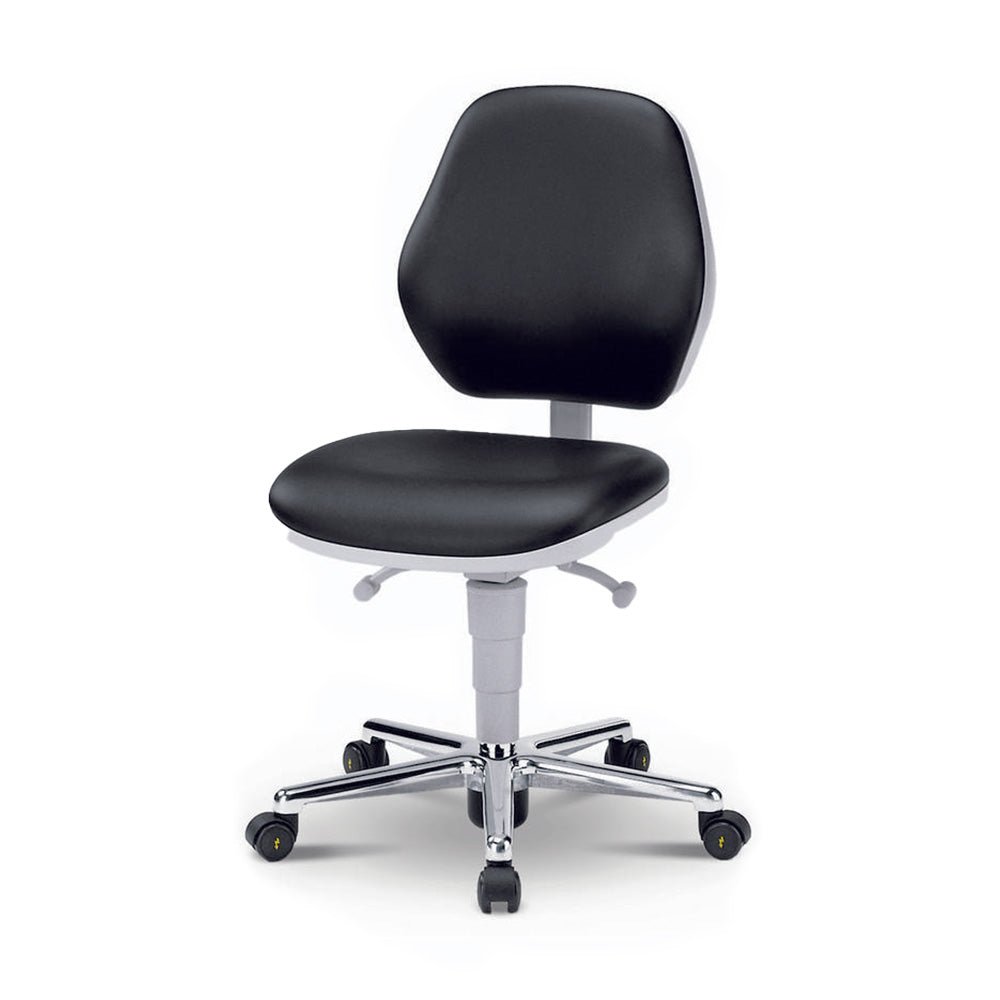
Description
Key Specifications and First Selection
A cleanroom chair must be selected as a controlled configuration, not as a normal laboratory chair with a special label. The first decisions are the required cleanroom condition, whether ESD is also required, the working height and the selected ground-contact components. The order then needs matching materials, seams, mechanism cover, base, footring, casters or glides, cleaning process and documents for the same final configuration.
| Selection field | Decision required | Why it changes the chair | Confirmation before release |
|---|---|---|---|
| Cleanroom condition | Project cleanliness requirement and acceptance method | Defines material, structure and documents needed | Room standard, model scope and acceptance record |
| ESD requirement | None, separate ESD, or combined cleanroom/ESD | Requires a complete tested path rather than one component | Test method, floor system, attachments and conditions |
| Working height | Low or high seat with suitable foot support | Determines gas lift, footring and base selection | Bench height, user posture and cleanroom-garment clearance |
| Construction and mobility | Surface, mechanism cover, glides or casters | Affects cleaning, movement and supplied configuration | Cleaning process, floor and required access |
Reference configuration ranges
One sealed cleanroom-chair configuration publishes a 450-620 mm seat-height range, while a high version of the same product family publishes 570-810 mm with a footring. Another high cleanroom-chair configuration lists 600-870 mm. These are separate configurations. The final cleanroom laboratory chair must identify its exact seat range, base, footring, surface and ground-contact components together with the documents applicable to that order.
First confirm cleanroom and ESD separately
Cleanroom suitability addresses contamination control, surface construction, cleaning and the relevant model documentation. ESD performance addresses a defined electrostatic path and test condition. A configuration can require either one or both. The order must not assume that a chair is ESD capable because it has a metal base, or cleanroom suitable because it has a smooth PU surface.
Decision order for a controlled-environment chair
Start with the room requirement and the required order documentation. Then identify whether an ESD condition is also required, followed by the work height, user movement, floor interface and cleaning process. Select the seat material, mechanism cover, base, footring and ground-contact parts as one configuration. This order prevents the common mistake of choosing a chair by appearance first and attempting to add documentation or conductive components afterwards.
Cleanroom, ESD and Documentation Boundary
The cleanroom and ESD requirements must be read as independent, configuration-specific conditions. A chair can be designed for a controlled environment without a specified electrostatic path, or it can have an ESD configuration without establishing the cleanroom suitability required by a particular room. When both are needed, the final chair, its selected accessories and the test conditions must all be covered together.
Cleanroom construction fields
Review the seat and back material, seams, exposed fasteners, mechanism enclosure, base surface, wheel or glide geometry and cleaning access. Smooth sealed materials and fewer exposed areas can assist controlled-environment cleaning, but a visual inspection does not replace applicable documentation. The project should state the required room condition and the model-specific information needed for approval.
ESD path and site condition
An ESD arrangement may involve the seat, gas lift, base, casters or glides, a chain or another ground interface, and the floor system. The path must be considered as a complete system. Test method, humidity, footwear, ground condition and selected attachments can affect the result. Do not state a resistance range or standard unless it is supplied for the selected complete configuration.
Documents to request before release
Request the final product code, material list, dimensions, selected base and ground-contact components, footring or armrest details, cleanroom documentation where required, ESD documentation where required, test method, report scope and date. This makes it possible to check that the documents describe the delivered configuration rather than another product in the same family.
Cleaning process versus test condition
Cleaning requirements should be supplied separately from cleanroom and ESD requirements. Identify the products used, frequency, application method and any exposure to IPA, disinfectants or other agents. A chair may have a suitable controlled-environment construction but still need material confirmation for a particular cleaning routine. Keep these decisions in the same project record as the requested environmental documentation.
Configuration changes that require a renewed review
The selected seat surface, gas lift, base, caster or glide type, footring, armrest and ground-contact component can each be relevant to the final chair condition. A supplier may offer options within one product family, but those options should not be assumed to share the same cleanroom or ESD scope. When an attachment changes after the original request, compare the revised model code and component list with the documents required for the project. This is particularly important where a low chair is changed to a high chair, or glides are replaced by a mobile caster arrangement.
What the site needs to retain
The room team should retain a simple configuration record for each chair group: final item code, seat and back construction, seat range, base, wheels or glides, footring, cleaning method and any requested environmental documents. This record supports correct placement, repeat ordering and replacement-part selection. It also prevents a component from another seating group being fitted without considering its effect on the controlled work area.
Interpreting test documentation correctly
The report should be read for the actual model, the construction tested, attachments included, test method, laboratory, date and conditions stated. A document can be useful for comparing configurations, but it does not automatically cover a revised chair with another gas lift, caster, glide, footring or surface. Where a project has a defined quality review, submit the final configuration schedule alongside the requested documentation so that the buyer can compare the delivered item line by line.
ESD path after installation
An ESD arrangement should be considered again after the chair reaches the actual site because the floor and the selected ground-contact components form part of the operating condition. Keep the approved wheels, glides or other relevant components together with the chair group. Do not substitute components between ordinary and ESD seating merely because they appear to fit mechanically. Any project test should follow the relevant site method and the condition specified for the installed work area.
Materials, Structure and Cleaning
Cleanroom seating can use sealed vinyl, self-skin polyurethane, non-porous polymer or another selected construction. The material choice is only one part of the chair. The project also needs to examine seams, cushioning, backrest form, mechanism cover, base finish and the geometry around wheels or glides, because these details affect cleaning access and the configuration that is actually delivered.
Sealed and non-porous seating surfaces
Sealed upholstery and self-skin polymer surfaces are common selections where the seat must be wiped repeatedly. A non-porous polymer seat may reduce some seam-related considerations, while an upholstered surface can have a different comfort and cleaning profile. The final selection should list the material and construction, not simply use “PU” or “vinyl” as a broad environmental claim.
Mechanism cover and cleanability
The gas lift, control levers, underside of the seat and base all need a practical cleaning approach. Covered mechanisms and accessible surfaces can reduce difficult areas, but their actual construction varies. Confirm whether any control, spring, joint or fastener remains exposed and how the approved cleaning method reaches that area. A cleanroom chair should be maintainable in the intended room without requiring unplanned disassembly.
Cleaning compatibility and replacement parts
Provide the expected cleaning chemicals, concentration, frequency and contact time. Ask for compatibility guidance for the seat, backrest, base, footring, casters or glides and any conductive component. If a wheel, glide or seat component is replaced, verify that the replacement remains within the approved configuration where cleanroom or ESD documentation is required.
Materials are selected with the whole room procedure
Material selection should account for the way a chair is moved, cleaned and maintained in the room. A resilient seat surface can still be unsuitable if its seams, wheel housings or underside are difficult to reach under the approved cleaning procedure. Conversely, a hard non-porous surface may be easy to wipe but require different comfort or posture decisions for a long task. The order should identify which factors are essential for the particular controlled area instead of relying on one generic material label.
Packaging, entry and initial cleaning
The delivery and entry process may be relevant to a controlled work area. Confirm packaging condition, unpacking location, any required wipe-down procedure and the path from receiving to the room. The chair should be inspected for damage, exposed components or incorrect accessories before entry. These handling steps do not create a cleanroom rating; they ensure that the delivered configuration can be introduced and maintained according to the site’s own procedure.
Service access without compromising the configuration
The chair must remain serviceable without introducing unapproved components. Plan how the seat, base, gas lift, wheel or glide, footring and controls can be inspected or replaced. A maintenance team should be able to identify the approved component group from the item record and order the corresponding replacement. This is preferable to fitting a convenient substitute that changes cleaning access, rolling behaviour or an ESD-related part of the configuration.
| Component group | Selection purpose | Documentation needed | Boundary to retain |
|---|---|---|---|
| Seat and back surface | Wipeable controlled-environment seating | Material and construction details | Smooth material alone is not a cleanroom rating |
| Mechanism and base | Cleaning access and support geometry | Cover, finish and maintenance information | A covered mechanism varies by configuration |
| Casters or glides | Room movement and ground interface | Selected component and floor compatibility | May affect environmental or ESD configuration |
| Cleaning process | Repeated care and contamination control | Chemical compatibility and procedure | Does not prove resistance to every agent |
Seat Height, Base and Footring
Controlled-environment seating still needs to fit the operator and workstation. Low and high cleanroom-chair configurations have different gas lifts, base requirements, foot-support arrangements and working envelopes. The selected height must allow the operator to work comfortably in the required garment while keeping the chair components within the approved configuration.
Low and high chair arrangements
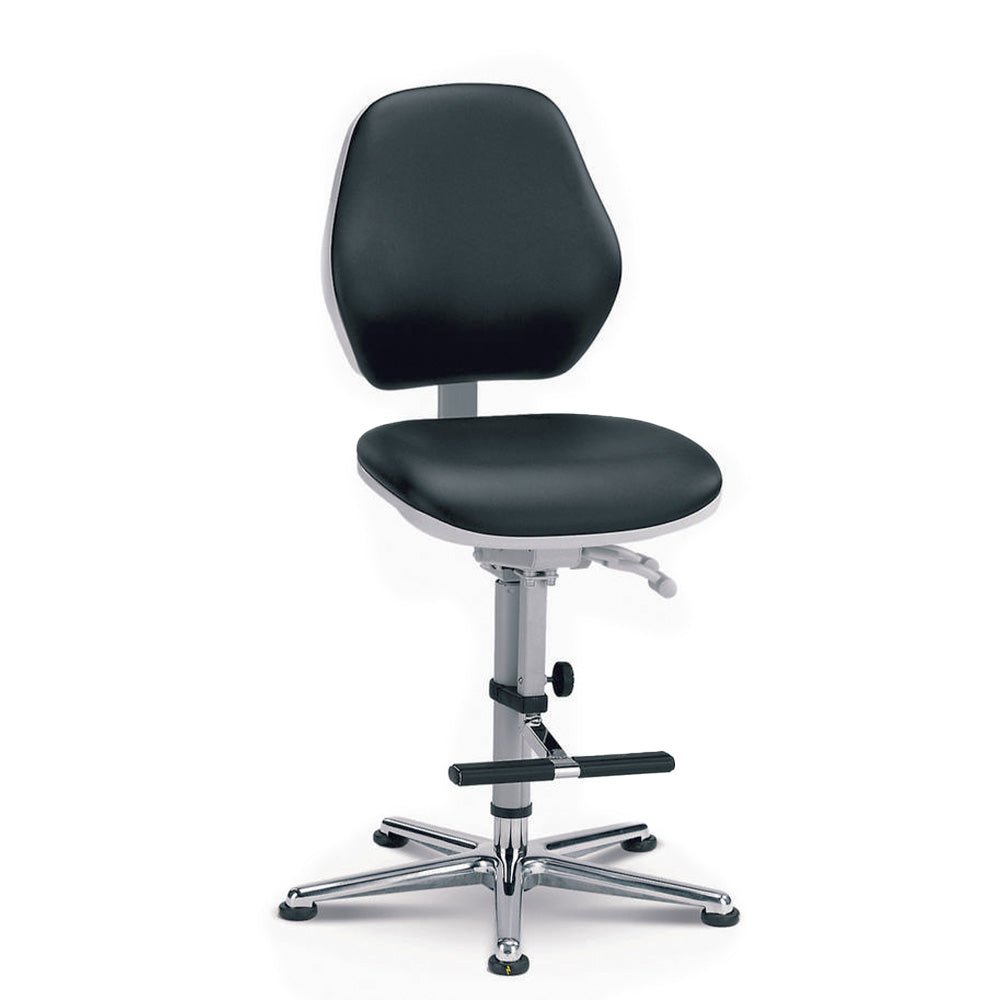
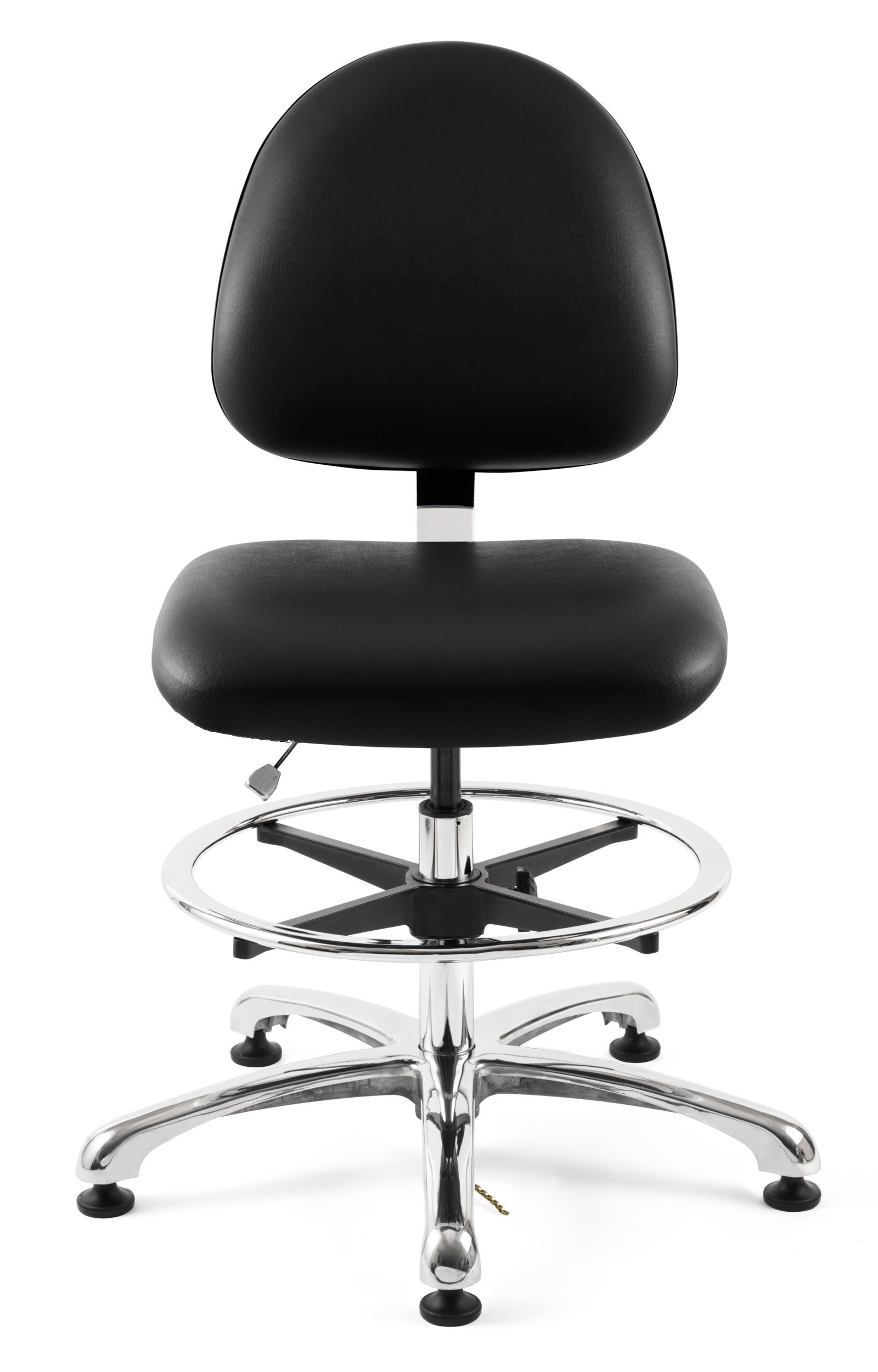
A low chair can suit standard laboratory benches, inspection stations and seated technical work. A high chair can suit elevated counters or work surfaces but needs a compatible footring and suitable approach clearance. Confirm the normal work height rather than choosing the widest published range. The highest seat position, base spread and foot support should be reviewed together at the installed workstation.
Glides, casters and floor interface
Glides can be selected where a fixed station and predictable position are required. Casters can be selected where controlled movement is required and the room floor permits it. The choice may affect cleaning, movement, stability and any specified ESD path. Confirm the final ground-contact parts, brake behaviour where applicable, floor condition and clearance around the chair base.
Footring and accessory impact
A footring is not a decorative addition to a high chair. It affects entry, exit, foot support, lower-body posture and the space around the base. Armrests, back controls and other accessories can also alter the chair envelope and may affect the approved configuration. State every supplied attachment in the final model code and documentation package.
Operator movement and garment clearance
The user must be able to approach the work surface, turn, adjust the chair and leave the station without catching garments, footwear or accessories on the footring, base or controls. Check the chair alongside the actual bench, floor transition and adjacent equipment. This is especially important for high seating and for rooms where garments add bulk to the working position.
High-chair support and controlled movement
At an elevated workstation, the footring, seat range and ground-contact parts have to support both normal work and the repeated movement of entering and leaving the chair. Assess whether the chair is normally parked in one position or must move between stations. A glide arrangement can provide a predictable location, while casters can be suitable where controlled repositioning is genuinely required. The selected option should be reviewed with the room floor, base clearance and any applicable environmental documentation.
Base selection beside fixed furniture
The chair base must clear bench supports, wall protection, service pedestals, storage and instrument stands while the user turns or adjusts height. Review the total base and footring envelope, not only the seat width. In narrow controlled rooms, a component that creates a difficult cleaning zone or blocks a circulation path can be as significant as its seating function. Mark the intended chair location on the room plan when the layout is tight.
Applications and Product Boundary
A cleanroom laboratory chair can be configured for controlled laboratory, electronics, semiconductor, biotechnology, pharmaceutical or medical-device environments where the project defines the required cleanliness and, where applicable, electrostatic-control conditions. The product page does not assert that every configuration is suitable for every cleanroom or regulated process. Suitability depends on the selected chair and the documents required by the project.
Controlled laboratory and technical work areas
For a controlled laboratory workstation, confirm the room requirement, work height, cleaning procedure, garment condition and expected seated task. Select a low or high configuration, base, casters or glides and footring accordingly. The chair should provide the access and posture required at the bench without introducing an unreviewed component into the controlled area.
Electronics and electrostatic-control work
Electronics work may require an ESD configuration in addition to the controlled-environment requirement. The complete path to ground, selected components and site floor must be reviewed with the test method. An ESD cleanroom chair should be specified as a complete order configuration rather than as an ordinary cleanroom chair with a conductive-looking accessory added later.
Pharmaceutical, biotech and medical-device projects
These applications can require controlled-environment seating, but the product category alone does not establish GMP, sterile-processing or other regulatory compliance. The purchaser should provide the room standard, quality-system requirements, cleaning process and acceptance documents needed for the project. The supplied chair can then be selected and documented for that defined application rather than described with broad unsupported certification language.
Relationship to normal chairs and stools
Use the laboratory chair for ordinary laboratory task seating where cleanroom or ESD conditions are not part of the purchase requirement. Use the laboratory stool for compact backless or small-back seating where its structural boundary fits the task. Neither standard page replaces a cleanroom chair when the project requires configuration-specific materials, ground-contact components or environmental documents.
Related workstations and layout
The chair configuration needs to match its work surface. A laboratory wall bench and laboratory island bench create different circulation, approach and under-bench conditions. Review base clearance, footring space, nearby storage, cable routes and the room’s cleaning route before finalising the chair quantity and placement.
For controlled microscopy and imaging stations, the seating choice should also be coordinated with the selected microscope table. The chair supports the operator while the table supports the optical equipment; one cannot replace the other. Check viewing height, foot clearance, cable routing and the procedure for moving the chair around the instrument before finalising the room arrangement.
Selecting for different controlled zones
One facility may contain several rooms with different operating conditions. A seating group for an electronics assembly zone can require a different ground-interface review from a group used at a biological preparation bench, even when both are visually similar. Keep the room requirement, work height, cleaning method and requested documents in the configuration schedule for each zone. This prevents a chair selected for one controlled location from being assumed suitable for another without review.
Installation, Commissioning and RFQ
Installation of a cleanroom chair begins with checking the final configuration against the room and workstation. Confirm the delivered model code, seat and back materials, base, glides or casters, footring, controls and any ESD components against the approved list. A change to a wheel, glide, armrest or footring can affect the supplied configuration and should not be treated as a cosmetic substitution.
Pre-installation room checks
Before the chair enters the work area, identify the room requirement, floor construction, access route, bench height, cleaning process and available parking space. Verify that the selected low or high chair can be moved into the room without damage and that its base clears the workstation. For a combined cleanroom and ESD configuration, also record the site ground condition and the method used to assess the complete installed path.
Commissioning at the workstation
Set the chair at its intended bench, adjust the seat height and footring where supplied, and check the approach, turning path and garment clearance. Test the selected casters or glides on the actual floor. Confirm that the user can work at the normal position without contacting drawers, service pedestals, instrument stands or other chairs. Record any chair group that is assigned to a particular work height or controlled zone.
| RFQ input | Why it is needed | What the quotation should define | Confirmation before supply |
|---|---|---|---|
| Room and environmental requirement | Defines controlled-environment scope | Selected model, materials and required documents | Applicable room condition and acceptance method |
| ESD requirement and floor system | Defines whether a complete ESD configuration is needed | Ground-contact components and requested test documentation | Test method, site floor and selected attachments |
| Bench height and user condition | Determines low or high chair geometry | Seat range, footring, base and clearance arrangement | Work height, garment and operator movement |
| Cleaning and project scope | Determines material and delivery selection | Care guidance, quantity, room allocation and accessory list | Cleaning agents, destination and installation access |
Documents and acceptance record
The project record should keep the final chair code, quotation, material information, dimensions, component list, cleaning guidance and every requested environmental or ESD document together. The acceptance process should check that those documents match the chair actually delivered. A report for another chair, another height range or another set of wheels is not sufficient for the installed configuration.
Information required for a project-ready quotation
Provide the room requirement, whether ESD is required, floor type, bench height, target seat range, garment and user considerations, selected surface, cleaning products and frequency, caster or glide preference, footring, armrests, quantity, colour, packaging and destination. Specify the documentation required by the project. This lets the configuration address both the controlled environment and daily usability at the workstation.
Handover and later configuration control
At handover, identify the chair group, the room where it belongs and the approved component arrangement. If the chair is moved to another room, or if a footring, wheel or surface component is replaced, check whether the new arrangement still matches the use condition and documents originally requested. This is a practical control step for multi-room facilities where visually similar seating configurations can otherwise be mixed.
Frequently Asked Questions
Is every cleanroom chair ESD capable?
No. Cleanroom suitability and electrostatic-control performance are separate requirements. A combined configuration must have the selected materials, base, ground-contact components and documentation appropriate to both requirements.
Does a PU surface make a chair suitable for a cleanroom?
No. A smooth polyurethane surface can be one part of a selected configuration, but the chair construction, components, cleaning procedure and project documentation also need to meet the applicable room requirement.
Can a normal laboratory chair be converted by changing the casters?
Not automatically. Changing casters, glides, a footring or other components can alter the delivered configuration. Confirm the complete selected chair and any required documents rather than treating one accessory as a complete environmental solution.
How is the correct seat height selected?
Select low or high seating from the installed bench height, work posture, user movement, garment clearance and required foot support. A high chair normally needs a compatible footring and base arrangement.
What should be included in a cleanroom-chair RFQ?
Include the room requirement, ESD requirement if any, floor condition, bench height, seat range, materials, cleaning process, base, ground-contact components, attachments, quantity, destination and the requested documents.
Contact the Xicheng Engineering Team Today
Send the room requirement, requested environmental or ESD documentation, workstation height, floor details, cleaning procedure, selected attachments and quantity. A configuration proposal can define the cleanroom chair arrangement and quotation scope for the intended controlled work area.
Shenzhen Office: No. 34 Zhenxing Road (Shengtaian Heavy Industrial Park B), Loucun, Guangming New Dist, Shenzhen, Guangdong, China
WhatsApp: +86 18126478161
Engineering Mailbox: fanalax34@gmail.com