





Key Takeaways
- In North American practice, an “FRP fume hood” usually means a fiberglass liner — panel-built or molded in one piece — inside a conventional hood body, while a “PP fume hood” means an all-polypropylene cabinet welded from sheet, with no metal in the chamber.
- PP manufacturers publish compatibility with hydrofluoric acid. The FRP liner literature reviewed for this comparison publishes no HF rating at all, so this guide makes no FRP-HF claim in either direction — PP is the documented HF choice.
- Both materials hit hard exclusions: perchloric acid liners, high-temperature strong-acid digestion, fuming nitric acid above 60 percent, and flammable-solvent service disqualify one or both materials.
- PP makers report a continuous-use ceiling around 80°C — treat it as a stated limit under stated conditions, not a guarantee, and check it against your process before you decide on a material; the figure is manufacturer-reported, not independently verified.
The FRP vs PP fume hood decision sits underneath most corrosive-laboratory hood specifications, and it is a decision between two construction philosophies before it is ever a comparison of two polymers. In practice, FRP most often appears as a corrosion-resistant liner — panel-built or molded as a single piece — inside a conventional hood body, while PP arrives as a complete plastic cabinet welded from sheet. Search results blur that distinction: “PP FRP” hybrid listings fold both materials into a single product name, and each material camp publishes its own case without acknowledging the other.
This guide puts the two on the same footing along three axes: how each is built, what each withstands chemically, and where temperature and weight limits start to bite. It then maps those limits to the decisions you actually face — digestion work, trace-metal labs, HF-bearing processes, old-building retrofits, and budget — and marks the jobs where neither material belongs. Every manufacturer figure is labeled as such, because independent test data on fume hood materials is thin on the ground.
What FRP and PP Actually Mean in Fume Hood Construction
Two different construction philosophies
FRP is not a single resin with a fixed datasheet. Fiberglass reinforced plastic is a composite: glass fibers carry the structural load, while the resin matrix and the exposed surface layer govern chemical and temperature performance. That is why any FRP fume hood order has to name its resin system — two “FRP” hoods with different resins are not equivalent products.
It is also why “FRP fume hood” covers several different constructions. One manufacturer’s own product range includes a full FRP body, an FRP superstructure mounted on a different base cabinet, and a metal outer cabinet with an FRP liner and baffles — with a bill of materials that records the outer body, liner, work surface, baffles, collar, plumbing, and hardware component by component. The same range lists reference dimensions of 1200/1500/1800 mm wide for normal-temperature duty.
The liner approach is the dominant one in North American practice. Liner panels are joined inside the hood body, and a liner maker’s selection guide is blunt about the consequence: panel seams are where liner degradation shows up first. The same guide favors molded FRP liners, formed as one piece, precisely because a chamber formed as one piece removes both the seam degradation path and the dead corners that resist decontamination. One laboratory distributor puts the market position in plain terms: in its experience, the large majority of hoods it sells carry FRP liners — white, economical, and the broadest chemical spectrum among common liner materials — while epoxy liners cost more, weigh more, and resist fewer chemistries.
PP takes the opposite path: instead of protecting a conventional hood body, it removes the conventional body. A polypropylene fume hood is a cabinet welded entirely from PP sheet — 8 mm sheet in one current product line — with a PP work surface, tempered-glass sash, PVC door frames, and PP-molded hardware. Joints are heat-fusion welded, so the seam material is the same polymer as the panel. The maker’s argument is structural honesty about metal: a metal cabinet in corrosive service carries its own contamination and corrosion points, and exhaust-side rust follows. A zero-metal chamber is the answer PP builders offer to trace-metal and acid work.
Notice what the source material does here. FRP is discussed as a liner by liner makers and distributors; PP is discussed as a full cabinet by cabinet makers. The two conversations never meet — which is exactly why buyers conflate a material choice with a construction choice.
Why the “PP FRP” hybrid listings confuse buyers
Marketplace listings such as “PP FRP fume hood” are not a contradiction or a typo. They describe a real and common configuration: a polypropylene chamber handling the corrosive chemistry at the bench, paired with FRP components — most often a scrubber tower or ductwork — on the exhaust side. Indian manufacturers sell exactly this package: PP hood plus FRP scrubber as one supply item.
The same spread shows up in manufacturer ranges: FRP full bodies, FRP liners, PP full cabinets, and PP hoods with FRP or PP scrubbers and duct all coexist in one market. Chamber material and exhaust-treatment material are separate decisions, and a hybrid quote is often the rational answer rather than a compromise.
Before you compare chemical charts, determine which construction each quote actually contains: is the FRP in it a liner, a full body, or a duct-and-scrubber component, and is the PP a welded cabinet or only a lining? Once you can answer that, you can run a like-for-like material comparison instead of comparing a cabinet to a liner.
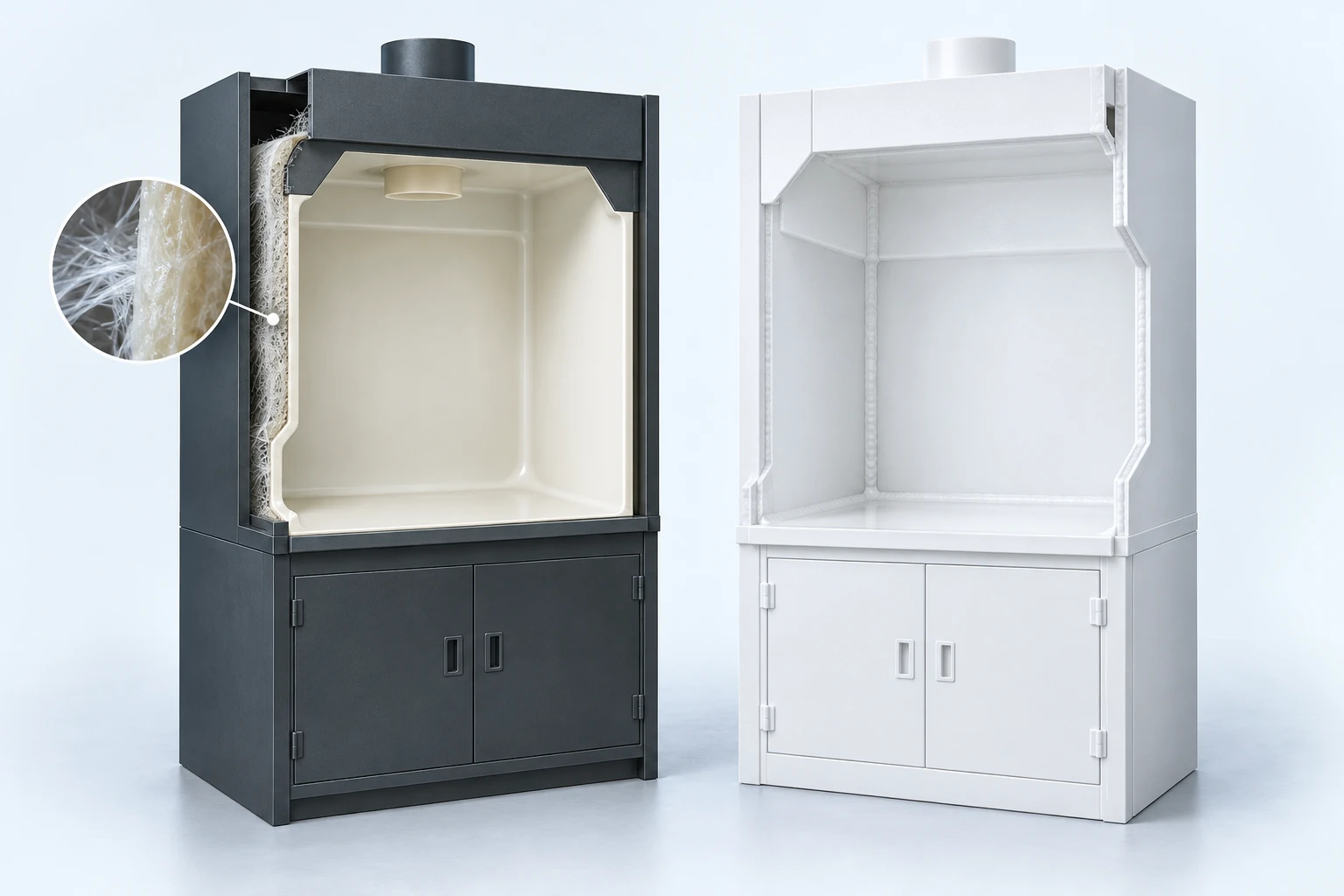
FRP vs PP Fume Hoods at a Glance: Side-by-Side Comparison
| Dimension | FRP | PP |
|---|---|---|
| Construction form | Liner panels or a molded one-piece liner inside a hood body; full FRP bodies exist but are the minority form | All-polypropylene cabinet welded from sheet (8 mm sheet in current product lines); no metal in the chamber |
| Joints and seams | Panel seams are the first points where liner degradation appears; a molded liner eliminates them | Heat-fusion welded; seam material identical to the sheet |
| Chemical-resistance breadth | Broadest spectrum among common liner materials (liner-maker assessment; distributor experience) | Broad acid and alkali list per manufacturer compatibility charts |
| Hydrofluoric acid | No HF rating published in the liner literature reviewed — no claim made either way here | Listed as compatible in manufacturer compatibility charts |
| Strong oxidizers / fuming acids | Not rated for perchloric service as a liner; not for high-temperature strong-acid digestion | Not recommended above 60% nitric acid — the maker’s own stated limit |
| Working temperature | Better thermal headroom than PVC liners (~140°F service, deforming near 160°F); high-temperature duty still needs review | Manufacturer-reported ceiling near 80°C continuous; usable down to about −20°C |
| Weight | Lighter than epoxy or metal liners | Manufacturer-reported 40–60% lighter than comparable metal construction |
| Liner vs full cabinet | Primarily a liner material in North American practice | Always a full-cabinet material |
| Market default position | Default liner choice in North American distribution (practitioner-reported) | The standard full-cabinet answer for HF, trace-metal and metal-free labs |
| Repair approach | Panel replacement, refinishing, or a molded-liner re-spec; repair procedures travel in the bill of materials | Weld-in repair with identical PP sheet |
| Typical fit | General corrosive chemistry, teaching labs, budget-driven liner upgrades | HF-bearing processes, trace-metal work, metal-free chamber requirements |
How to read the comparison
Every cell above traces to a manufacturer document, a distributor’s practice notes, or a product page — not to independent laboratory testing, because none of the public sources reviewed for this guide runs side-by-side testing on fume hood materials. That is a property of this market, not a flaw in the table: material data in this category is published by the sellers.
Three reading rules keep the table honest. First, the temperature row mixes manufacturer-published figures (PP around 80°C) with a liner maker’s comparative assessment (FRP headroom versus PVC), so treat the numbers as stated limits under stated conditions, not as guarantees. Second, the HF row is deliberately asymmetric: PP’s compatibility is a published manufacturer claim, while the FRP side publishes no rating at all — the table records that absence rather than inventing an answer. Third, the weight figures are manufacturer-reported savings versus metal construction, not a measured FRP-to-PP comparison.
You can run your chemical inventory and building constraints down the left column of this table; for most labs, two or three rows will determine the material before price ever enters the discussion.
Chemical Resistance Head-to-Head: Where Each Material Wins
Mineral acids and alkalis
For the middle of the chemical spectrum, both materials hold, and the differences show up at the edges rather than the center. PP manufacturers’ compatibility charts list hydrochloric acid at all concentrations, nitric acid up to 60 percent, dilute sulfuric acid, phosphoric acid, organic acids, and the strong alkalis sodium and potassium hydroxide. That alkali coverage matters: hot caustic service attacks metal liners and hardware, so an all-PP chamber removes a failure mode that metal-built hoods carry. One caveat travels with the chart — exposed components such as sash rails, seals, and drain fittings on a PP hood still need review against the specific chemicals and cleaning agents in use.
FRP’s case in this band is breadth. A liner maker’s assessment ranks FRP panels best in class for combined chemical resistance, working temperature, moisture tolerance, and flame-spread behavior, and the distributor experience quoted earlier points the same way: among common liner materials, FRP covers the widest spectrum at the lowest cost. In practice, ordinary mineral-acid and alkali work — the acids most teaching and research labs actually run — rarely decides between these two materials. The decision lives in the next two subsections.
Hydrofluoric acid and glass-attack chemistries
Hydrofluoric acid etches silicates — glass, silica, ceramics — which is standard chemistry, and it is why HF-bearing work disqualifies many standard liner and window materials outright and narrows the field sharply.
On the PP side, the record is clear: PP manufacturers list hydrofluoric acid among compatible chemistries, and one maker’s chart extends to aqua regia as well. Whatever else divides these two materials, polypropylene is the one with published HF compatibility.
On the FRP side, the honest answer is that no rating exists in the material reviewed for this guide. The leading liner maker’s selection guide, the distributor literature, and the university design guidance consulted publish no HF compatibility rating for FRP liners in either direction. Accordingly, no FRP-HF claim is made here — not “compatible,” not “not compatible.” The FRP product page referenced in this guide makes the same point operationally: it lists hydrofluoric acid, alongside perchloric acid, concentrated oxidizers, and high temperature, among the conditions that require a separate technical review before an FRP hood is specified.
If your process list contains HF or other glass-attack chemistry, that entry alone can decide the material: PP is the documented choice, and the FRP alternative stays unverified until a manufacturer publishes a rating. Where metals stay in the frame for corrosive duty, the materials comparison continues in our guide to PP vs stainless steel fume hoods.
Strong oxidizers and fuming acids
At the top of the oxidizer scale, both materials step back, each at its own line. PP’s makers set their own boundary: fuming nitric acid and nitric above roughly 60 percent are not recommended for PP hoods. FRP’s boundary is set by its liner maker: FRP panels and molded FRP liners are not rated for perchloric acid service and are not suitable for high-temperature strong-acid digestion work. One current PP product page draws the matching operational line on its side, listing strong oxidizers, mixed chemical streams, and high-temperature duty as items requiring dedicated review beyond the hood’s normal-temperature rating.
The pattern across these exclusions is consistent: oxidizer strength plus heat defeats both polymers. What changes between them is which chemistry draws the line — nitric concentration for PP, perchloric and hot digestion for FRP. The upgrade paths out of this corner — PVC, HDPE, and 316 stainless — are covered in the exclusion section below.
If your inventory contains fuming nitric, perchloric, or high-temperature digestion work, those entries — not the acids both materials handle — determine the outcome, and you can run that check against your chemical list in a few minutes.
Key Takeaways
- PP compatibility charts cover mineral acids and alkalis broadly; FRP liners hold the broadest chemical spectrum among common liner materials — mid-spectrum acids rarely decide this choice.
- HF is the sharpest differentiator: PP is the material with published HF compatibility; the FRP liner literature reviewed publishes no rating, and this guide makes no FRP-HF claim in either direction.
- Strong oxidizers disqualify both materials at the top end — above 60% nitric for PP, and perchloric or hot strong-acid digestion for FRP liners.
Temperature, Weight and Installation Limits
The ~80°C ceiling on PP
Two independent PP manufacturers publish nearly the same thermal envelope — one states continuous use at 60–80°C, the other a working range of −20°C to 80°C. Convergence across unrelated sellers makes the ~80°C ceiling a real material property rather than one vendor’s optimism, but it is still a manufacturer-published figure, and the PP product pages behind this comparison rate their cabinets for normal-temperature duty and route anything hotter to a dedicated technical review.
In practice, boiling mineral acids, hotplate work that pushes vessel-wall temperatures past the ceiling, steam or autoclave-adjacent loads, and heat-generating equipment inside the chamber all press against it. Below that line — ambient lab work, warm acid handling, most routine wet chemistry — PP sits comfortably inside its envelope, and the −20°C low end covers unheated rooms and cold rooms.
The check is mechanical: list the highest sustained temperature your chemistry produces at the chamber surface and compare it with the published ceiling. If you cannot answer that from your process sheets, you are not ready to choose a material.
FRP working temperature and panel vs molded seams
FRP’s thermal case has to be told differently: no public source reviewed here publishes a working-temperature number for FRP hood liners, so this comparison gives none. What the sources support is relative. A liner maker ranks FRP panels strongest among liner materials for combined chemical resistance, working temperature, moisture tolerance, and flame-spread behavior, and benchmarks the nearest competitor downward: PVC liners serve around 140°F and deform near 160°F. University design guidance, at background level, adds the counterweight — FRP is not the choice for high application temperatures. The honest statement is a band, not a number: more headroom than PVC, and less than metals or ceramics. Against PP, no direct comparison exists in the source material — the only hard number in this comparison remains PP’s published ~80°C ceiling, because no FRP liner value is published at all. The actual FRP value depends on the resin system, which is why an FRP order names its resin.
Construction matters at temperature too: panel seams are where FRP liner degradation shows first, and heat accelerates the mechanisms; a molded one-piece liner removes the seams and the early failure path. In hot acid service, panel FRP and molded FRP are not interchangeable specifications.
Weight, retrofit and old-building fit
Weight is where PP builders make their loudest claim: PP cabinets run 40–60% lighter than comparable metal construction, per PP manufacturers — a manufacturer-reported, unverified figure whose direction follows from materials physics and that decides real projects: third-floor retrofits, freight elevators of fixed capacity, floor-loading limits above labs. FRP’s weight story is comparative as well — lighter than epoxy and metal liners — and an FRP liner upgrade reuses the existing hood body, its own retrofit economy. What the sources do not say matters too: there is no published PP-versus-FRP weight comparison, so a quote fight on kilograms is marketing, not data.
Reference footprints are effectively identical — current FRP and PP product lines both list 1200/1500/1800 mm widths at 2350 mm height — so this choice rarely changes your lab layout; it changes what it takes to get the hood up the stairs.
If your project runs through an old building, you can run the installation route — door widths, elevator capacity, floor loading — before chemistry ever enters the decision, and that route will often determine which material your installer prefers to carry.
Where Neither FRP nor PP Works
Perchloric acid liners and wash-down boundaries
Perchloric acid is the cleanest disqualifier in this comparison. The leading liner maker states it directly: FRP panels and molded FRP liners are not rated for perchloric acid service. The FRP hood product page in this comparison agrees operationally — perchloric acid sits on its list of conditions requiring separate technical review before specification. PP’s published compatibility charts do not claim perchloric compatibility either, and PP product pages route strong oxidizers to dedicated review on their side.
One boundary has to be kept straight, because search results blur it constantly: the exclusion applies to hood liners and chambers, not to exhaust ductwork. Perchloric exhaust is its own engineering problem — dedicated duct, wash-down systems, and duct materials such as 316 stainless or uPVC — and duct selection follows different rules from hood selection. If your project includes perchloric work, hood and duct are two separate specifications, and the hood side starts with dedicated perchloric equipment, not a materials debate. The specification side of that equipment — wash-down, dedicated duct, placement — is its own subject, covered in our guide to perchloric acid fume hood requirements.
Flammable solvents and explosion-classified rooms
Neither polymer solves flammability. PP’s own makers say so: a polypropylene hood does not make flammable-solvent work safe, and their published limits route high solvent loads to review. Inside explosion-classified atmospheres the requirement is an equipment class — explosion-proof hoods with their own electrical architecture and grounding — not a lining swap. Hazard classification and materials selection are separate questions; an answer to the corrosion question does not answer the flammability question. The equipment class carries its own specification path, covered in our guide to explosion-proof fume hood requirements.
The upgrade path: PVC, HDPE and 316SS
When the chemistry outruns both FRP and PP, the market offers a stepwise escalation. PVC sits one rung down on cost: acid-capable and economical, but thermally weak — around 140°F of service and deformation near 160°F. HDPE one-piece chambers appear on the market for concentrated and hot acid duty; public performance data at this depth is thin, so treat HDPE as a background option to price and verify, not a proven default. 316 stainless is the top rung — the liner maker positions it for the aggressive end of the spectrum, and it is among the accepted duct materials for washed-down perchloric exhaust. Each step buys temperature and oxidizer headroom and pays in cost and weight.
If your chemical inventory contains perchloric acid, fuming nitric, or solvents inside a classified zone, stop comparing FRP and PP — determine the equipment class and the upgrade path first, because no material choice inside this comparison rescues those processes.
Key Takeaways
- Perchloric acid work disqualifies the standard versions of both materials: FRP liners are not rated for it, and PP routes strong oxidizers to dedicated review.
- Flammable-solvent and classified-zone work is an equipment-class decision — explosion-proof hoods — not a materials decision.
- The escalation path when neither polymer fits runs PVC → HDPE → 316 stainless, each step buying temperature and oxidizer headroom at higher cost and weight.
FRP vs PP Fume Hood Choice: The Scenario Decision Tree
The scenario table
| Scenario | Leaning | Deciding criterion |
|---|---|---|
| General mineral-acid teaching or research lab, budget-driven | FRP liner | Broadest chemical spectrum among common liner materials at low cost, in distributor experience; the North American default |
| HF or other glass-attack chemistry in the process | PP | The only material with published HF compatibility in the literature reviewed for this guide |
| Trace-metal or metal-free chamber requirement | PP | Zero-metal welded chamber removes metal contamination points |
| Process temperatures at the chamber surface above PP’s published ceiling | Neither | FRP is unrated for hot strong-acid digestion; PP is outside its envelope — escalate (316 stainless or engineered review) |
| Perchloric acid anywhere in the workflow | Neither | Dedicated perchloric equipment class; the duct is a separate specification |
| Fuming or above-60% nitric acid | PP is out | Beyond PP’s own published limit; an FRP resin system would have to be verified with its maker |
| Old-building retrofit with stairs, narrow turns or floor-load limits | PP full cabinet, or FRP liner where a body exists | Manufacturer-reported PP weight savings; an FRP liner reuses the existing body |
| Corrosive chamber duty with wet-scrubbed exhaust | PP hood + FRP scrubber and duct | The hybrid is a normal market configuration, not a compromise |
A worked example: trace-metal digestion lab retrofit
*(Illustrative example — the lab, workload and figures below are hypothetical; confirm every step against actual manufacturer documentation.)*
Consider an environmental-testing laboratory moving into the third floor of a 1970s university building: trace-metal digestion with nitric and hydrochloric acids on hotplates, an occasional silica digest needing hydrofluoric acid, no perchloric anywhere in the schedule, and a converted office floor whose freight elevator and floor-loading limit the structural engineer has already flagged.
Walk the axes in order. Construction first: this is a full-cabinet decision, because the old hoods leave with the renovation and there is no metal body worth lining. Chemical spectrum second, and here the decision forms: hydrofluoric acid appears even occasionally in the run schedule, and occasional exposure is still exposure — splash, vapor, and cleaning carry it to every interior surface. Polypropylene is the material with published HF compatibility; the FRP liner literature offers no rating in either direction, and a retrofit this size should not be built on an unrated surface. Temperature third, and the example has to be honest: hotplate digestion drives acid temperatures above polypropylene’s published continuous-use ceiling, so the PP direction carries a condition — the digestion step needs a manufacturer review, whether that means engineered hotplate practice or moving the hottest digests to dedicated equipment. The sources behind this comparison force that conflict into the specification as a review item agreed with the hood maker before purchase.
Weight fourth, and the building closes the argument: the installation route runs through a narrow stair turn and that freight elevator, and a full plastic cabinet’s reported weight savings matter more on a third floor than in a ground-floor new build — manufacturer-reported and unverified, but decisive when the alternative is asking a structural engineer to re-rate the floor.
The decision the axes produce: a welded PP chamber specified for HF-bearing trace-metal work, with the digestion-temperature question written into the purchase as a mandatory manufacturer review, and a contingency: if the review rejects hotplate practice, the hottest digests move to a dedicated high-temperature station rather than the material choice flipping. FRP re-enters only as exhaust-side equipment if a scrubber is added later — a duct-and-scrubber decision, not a chamber decision.
You now have the full decision path for this scenario — and the same three-axis walk, construction → chemistry → temperature and building, transfers to any retrofit sitting on your desk. And for labs whose digestion duty borders on perchloric service, our guide to acid digestion vs perchloric acid fume hood separates the two regimes in detail.
Mixed Configurations: PP Hoods with FRP Scrubbers and Duct
Why the hybrid is normal, not a compromise
Marketplace listings that read “PP FRP fume hood” describe a configuration, not a confusion: a polypropylene chamber at the bench handling the corrosive chemistry, with FRP equipment — most often a scrubber tower or duct sections — on the exhaust side. Manufacturers sell exactly this package; one supplier lists a PP fume hood delivered with an FRP scrubber as a single line item, and PP hood makers themselves offer matching polypropylene duct, corrosion-resistant fans, dampers, and wet scrubbing towers as project add-ons.
The logic is materials-to-job matching rather than loyalty to one polymer. The chamber sees splash, vapor, and daily chemical contact, so a zero-metal welded PP box is the right tool where HF or trace-metal work is involved. The exhaust side sees diluted, cooled, and scrubbed streams, where FRP’s strength-to-weight and cost profile suits large duct runs and tower shells. Splitting the system this way puts each polymer where its published strengths actually apply — and it explains why the two material camps in this guide rarely mention each other: they are usually selling different parts of the same installation.
When a vendor proposes a hybrid, treat it as a design answer to be checked rather than a compromise: chamber material against your chemical list, scrubber and duct material against the exhaust stream. If both checks pass, the hybrid is the correct specification, not a fallback.
| Component | Typical material choice | What drives it |
|---|---|---|
| Chamber / work area | Welded PP cabinet | Splash, vapor, and daily chemical contact; HF and trace-metal duty favor zero metal |
| Duct runs | PP or FRP | Diluted, cooled stream; diameter and run-length economics |
| Scrubber tower | FRP | Large shell strength-to-weight and cost at the exhaust end |
| Fan / housing | PP or FRP per stream chemistry | Corrosion at the moving part; engineering-forum practitioners report favoring PP here |
Read as a set, the table explains why the hybrid keeps winning quotes: each row answers to a different exposure. The chamber row carries the full-strength chemistry and therefore the strictest material requirement; the exhaust rows carry diluted streams where fabrication economics and shell size dominate. Where a row’s drivers point at two materials — duct and fan housings — the choice is settled by stream chemistry and fabricator capability, not by whichever polymer the chamber happened to be. Check the rows against your own installation in that order, and you can run the whole hybrid decision as three small confirmations instead of one argument about brands.
Duct is a separate decision
Everything above the chamber — duct sizing, duct material, fan selection, scrubber choice — is its own engineering exercise with its own inputs: exhaust volume, velocity, condensate behavior, and the chemistry of the diluted stream. This guide fixes the chamber decision; the exhaust-side specification deserves its own worked comparison with the same evidence discipline.
When you collect quotes, determine the chamber and the exhaust system as two separate line items — you can then match each to its own chemical and thermal reality instead of inheriting one material’s answer everywhere.
Cost, Lifespan and Total Ownership
What manufacturers report
The published cost-and-lifespan record for this comparison is thin, one-sided, and entirely first-party. What PP makers report: service lives of ten to fifteen years and beyond for polypropylene hoods; material costs described as low, with recyclable sheet; weight savings against comparable metal construction reported at 40–60%. What FRP’s camp reports: liner economics — FRP liners described as the economical liner choice, cheaper and lighter than epoxy, with the broadest chemical spectrum per unit of cost — plus documented repair procedures and approved seal-and-inspect methods for field damage.
Every one of those figures is manufacturer-reported or distributor experience. None of it is independently verified, and the two camps’ numbers were never designed to be compared: they answer different questions about different constructions. Even the trend lists some PP makers publish — VAV control, multi-baffle airflow, external LED lighting — are configuration options, not lifespan data, and they add nothing to the economics picture.
The honest cost unknowns
Three numbers a buyer actually wants do not exist in public form. There is no third-party life data comparing FRP and PP hoods — the ten-to-fifteen-year PP figure is one maker’s claim, and no FRP-side equivalent is published at all. There is no published price delta between an FRP liner upgrade and a full PP cabinet, which is the comparison buyers actually make at quote time; liner and cabinet are priced so differently by construction that a generic percentage would mislead. And there is no public data on replacement or downtime cost — the third leg of total ownership.
The workable framework without those numbers has three columns: acquisition price, where real quotes beat every rule of thumb because the constructions differ too much; expected service life, where the question to ask each vendor is what they will put in writing and what their repair procedure covers; and change cost, which is what a liner refit or a cabinet swap does to your schedule. Weight the answers by how much of each claim the vendor is willing to warranty.
You can run that framework on two quotes in an afternoon. What you cannot do yet is buy the same conclusion from a neutral third party, because the neutral data does not exist — and anyone who quotes you a definitive lifespan delta between these materials is reporting their own product line, not the market — treat such numbers as marketing claims until a maker puts them in writing. That same discipline — written claims over brochure claims — is what the frp vs pp fume hood decision rewards on every axis.
FAQ + Final Verdict
FAQ
Can an FRP fume hood handle hydrofluoric acid?
The liner literature reviewed for this guide publishes no HF rating for FRP in either direction, so no claim is made here. PP is the material with published HF compatibility; if HF is in your process, the FRP option stays unverified until a maker publishes a rating.
Is a PP fume hood good for acid digestion?
For the chemistry, largely yes — manufacturer charts cover nitric up to 60 percent, hydrochloric, and most digestion acids. For the heat, conditionally: hotplate digestion can push past PP’s published continuous-use ceiling, so digestion work needs a thermal review with the hood maker before purchase.
What is the temperature limit of a PP fume hood?
PP makers publish a continuous-use ceiling around 80°C and a usable low end near −20°C. Both are manufacturer-published figures, not guarantees — check the highest sustained temperature your process produces at the chamber surface against them.
Is either FRP or PP acceptable for perchloric acid?
No. FRP liners are not rated for perchloric service, and PP routes strong oxidizers to dedicated review. Perchloric work means dedicated perchloric equipment, with the duct as a separate, washed-down specification.
How do FRP and PP fume hood costs compare?
No published cross-comparison exists. What you have is each camp’s own economics — PP makers report multi-year service lives and low-cost recyclable sheet; FRP’s camp reports liner-level economy and documented repairability — all manufacturer-reported. Quote both constructions for your actual project.
What is a hybrid PP FRP configuration?
A polypropylene chamber paired with FRP exhaust-side equipment, usually a scrubber tower or duct. It is a normal market configuration that matches each polymer to the part of the system it suits — not a compromise.
The verdict
Construction, chemistry, temperature: those three axes resolve the material question in order. An FRP quote is usually a liner inside a body, a PP quote is a welded plastic cabinet, and knowing which one you are pricing decides everything downstream. For HF and trace-metal work, PP is the documented choice; for the broadest liner spectrum at entry cost, FRP holds the default position; above 60 percent nitric or in perchloric service, both step aside. PP’s published ceiling around 80°C governs hot processes, its reported weight savings govern old stairwells, and for FRP the hot-work limit is whatever its specified resin system is rated for — which is why the FRP side of a quote must name its resin.
Match those axes to your chemical inventory and your building before you match prices — that three-axis check is how the frp vs pp fume hood decision gets made, and the material that survives all three is the right one whatever the brochure says. When the decision lands on polypropylene, the pp fume hood page lists the welded-cabinet line; when it lands on fiberglass, the frp fume hood page carries the liner and full-body configurations — the two product sides of the frp vs pp fume hood decision.
Key Takeaways
- FRP is usually a liner, PP is a cabinet: settle the construction question before the material question.
- HF and trace-metal work points to PP; broad-spectrum liner economy points to FRP; perchloric and above-60% nitric point away from both.
- PP’s published ~80°C ceiling is the hardest number in the temperature axis; no FRP liner value is published, and every lifespan figure is manufacturer-reported.
- The frp vs pp fume hood decision resolves on those three axes — construction, chemical spectrum, temperature — before price ever enters it.
Leave a Reply