




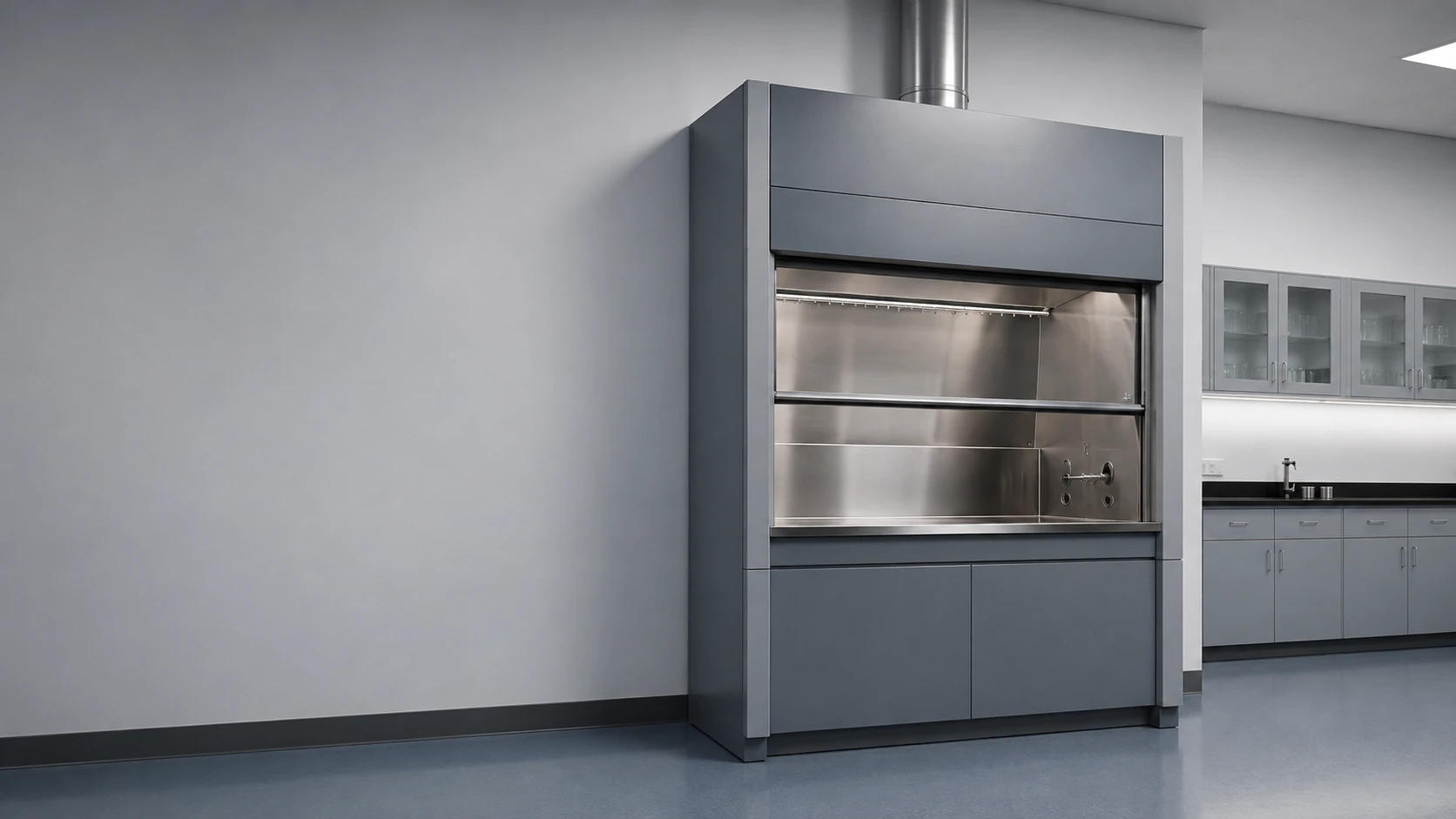
Key Takeaways
- Heating is the only trigger every source shares — WSU, UA, UKY, Columbia, ANSI Z9.5-2012 and NFPA 45-2015 set different concentration triggers for perchloric-acid work; none of them is a universal rule, and your institution’s SOP decides for your lab.
- The salt-deposit mechanism explains every feature — heated perchloric acid vapor condenses on hood, baffle, duct and fan surfaces and reacts with organic materials to shock-sensitive perchlorate salts; wash-down, dedicated exhaust, drainage and compatible materials exist to break that cycle.
- A dedicated wash-down hood is a system, not a cabinet — spray coverage of corners and baffles, run after each use (Flow Sciences cites a typical ≥10-minute cycle), a collection trough with routed drainage, independent non-manifolded exhaust, and a scrubber where your vendor requires one.
- Two wrong answers: carbon-filter ductless hoods and untested legacy systems — ductless carbon filters are excluded for this chemistry (mechanism-based manufacturer analysis); old hoods and ductwork need specialist detection (visual check, BNL swabs, EPA 6850 analysis) before decommission or demolition.
- Confirm at project level before you buy — wash-water supply, drainage routing and treatment, scrubber requirement, service-fixture pre-specification, acceptance per your own criteria and annual certification belong on your checklist, not discovered after install.
Most pages about perchloric acid fume hood requirements open with one concentration number, as if a single threshold decided everything. In practice the trigger depends on the institution whose rules govern your lab, and the design of the hood depends on a mechanism those numbers never explain: heated perchloric acid vaporizes, the vapor condenses on cooler surfaces, and the residue can form shock-sensitive perchlorate salts.
This guide turns those requirements into a decision chain: whether your procedure needs a dedicated wash-down hood, what that hood must include — wash-down coverage, dedicated exhaust, compatible materials and drainage — what is excluded, how to handle a legacy hood, and what to confirm before you buy. Every concentration line below is attributed to its own authority, and your institution’s SOP, not this page, is the final decision line.
Perchloric Acid Fume Hood Requirements: Start With the Perchlorate-Salt Mechanism
Before comparing hood options or threshold tables, settle why this category of equipment exists at all. Heated perchloric acid behaves differently from the acid in the bottle, and that difference drives every requirement in this guide.
The Hazard Is the Condensed Salt, Not the Acid
When perchloric acid is heated, it vaporizes, and the vapor travels with the exhaust stream until it reaches surfaces cooler than itself. As it condenses on the hood interior, the baffles, the ductwork and the fan components, it stops being a vapor and becomes a residue. Washington State University’s laboratory safety manual states the consequence directly in its section on fume hood use: the condensed vapor reacts with organic materials such as gaskets, greases and chemical residues to form explosive perchlorate salts and esters. Esco’s product literature for its Frontier perchloric-acid hood describes the same sequence — heated acid vaporizes, condenses on hood, duct and fan components, and reacts with gaskets, greases and collected material to form explosive salts.
The residue is the real hazard. Flow Sciences’ Q&A on hoods for perchloric-acid service makes the point plainly: the white powder that appears on these surfaces is perchlorate or organic-peroxide residue that can be explosive. An ordinary chemical hood has no built-in mechanism to remove that residue, so it accumulates in the very places no operator inspects routinely, such as the inside of the exhaust duct. That gap is why a dedicated wash-down hood exists as a separate category of equipment rather than as an accessory upgrade to a standard hood.
Where Deposits Form and Why They Accumulate
Deposits form wherever the vapor meets a surface cooler than itself: the interior walls and corners, the baffles, the duct collar and the fan. NEBB, the industry body that publishes testing and decontamination guidance for perchloric-acid systems, lists hood surfaces, baffles, filters, fans, ducts and stacks as the locations where white crystalline deposits are found on legacy equipment — a practical map of every place a wash-down system and its drainage have to address.
What makes the accumulation dangerous is that it is invisible during normal use. Residue builds inside the duct and behind the baffles, where no one looks, and the risk grows with the mass collected and the time between cleanings. The wash-down module later in this guide covers the components designed to remove those deposits before they reach that stage; the point here is the frame: this is a mechanism of accumulation, not a one-time contamination event.
Why the 1947 O’Connor Accident Still Frames the Rules
The stakes are not hypothetical. In 1947 an electroplating operation — the incident is generally referred to as the O’Connor accident — used roughly 1,000 liters of 75% perchloric acid in combination with acetic anhydride; the mixture exploded, killing 17 people and injuring about 150, according to Flow Sciences’ account of the history. The scale and the death toll make it the event most perchloric-acid safety literature cites first.
Read that history as context, not as a model for a modern laboratory: today’s fume hoods, ventilation design and institutional safety programs are not 1947 electroplating baths. But the accident is why institutions treat heated perchloric acid and the salts it leaves as a question about dedicated equipment and trained procedures rather than a standard-hood afterthought. If you can now explain why heated perchloric acid leaves deposits an ordinary hood cannot manage, you have the frame the next module uses to answer the trigger question: when does your procedure actually require the dedicated system?
When Do Perchloric Acid Fume Hood Requirements Apply to Your Lab?
With the mechanism settled, the practical question is which procedures trigger the requirement for a dedicated wash-down hood. The short answer is that heating is the trigger every authority shares; the concentration conditions around it differ, and each institution has adopted its own version of the line.
Heating Is the One Trigger Every Authority Shares
The trigger shared by every source in this guide is heating. Perchloric acid heated above ambient temperature vaporizes, and vaporization is the step that moves the acid out of the container and into the hood, the duct and the fan, where it can condense into the salts described in the previous module. Every trigger line in the table below includes a heating condition in some form — which is why this guide calls heating the red line, regardless of how each institution words it.
National Fire Protection Association standard NFPA 45 states the rule in its chapter on fume hoods: perchloric acid heated above ambient temperature must be handled only in a dedicated hood. That clause is reproduced here as quoted by Flow Sciences in its perchloric-acid hood Q&A; verify it against the current edition of NFPA 45 before relying on it. All six sources in the next table agree that heating moves the work into dedicated-hood territory; what differs is how each describes the concentration conditions beside it.
Six Attributed Trigger Lines, Not One Rule
No single authority’s number should be read as the national rule, because the published lines genuinely differ. Compare them row by row:
| Institution or standard | Trigger line for a dedicated wash-down hood | Source and status |
|---|---|---|
| Washington State University EHS | Cold perchloric acid below 5% does not require a dedicated hood but must be handled in a functioning standard hood; heated or concentrated perchloric acid requires a dedicated hood with built-in wash-down | WSU EHS Laboratory Safety Manual (institutional manual) |
| University of Alabama EHS | Concentrations up to 50% without heating may be handled in a standard fume hood; above 50% with heating requires a perchloric-acid hood with wash-down | UA EHS guidance (institutional guidance) |
| University of Kentucky | Heating, or a concentration at or above 73%, requires a dedicated wash-down hood | UKY Research Safety (institutional page) |
| Columbia University EHS | Work at concentrations up to 70% at room temperature may be done in a chemical hood that contains no organic chemicals | Columbia EHS (captured from search result; page not fully accessible) |
| ANSI/AIHA Z9.5-2012, §3.2.5 | Concentrations at or above 85% must be handled in a perchloric-acid hood | Clause as reproduced by Flow Sciences; verify against the current standard edition |
| NFPA 45-2015, §12.1 | Perchloric acid heated above ambient temperature must be handled in a dedicated hood | Clause as reproduced by Flow Sciences; verify against the current standard edition |
The rows are deliberately separate. WSU, UA and UKY each set their own concentration line; Columbia’s guidance is limited to room-temperature work; the two standards approach the question from concentration (Z9.5) and from temperature (NFPA 45). No row is “the” rule, and averaging them would produce a number no authority actually publishes. The only element present in every row is heating.
Your Institution’s SOP Is the Decision Line
If your procedure is heated or concentrated — the range in which a concentrated perchloric acid fume hood becomes the actual question — do not average the rows. Your institution’s SOP governs: check the written procedure for your lab and the line your EHS office has adopted, and follow whichever applies at your site. If the table looks like conflicting advice, that is the point of showing it — the conflict is real, and only your institution resolves it for you.
When the SOP does not name a line for your concentration and heating method, treat that as a review trigger rather than a gap to fill yourself. Take the temperature, concentration and heating method to your EHS office before the procedure runs.
Worked example: a lab heats 60% perchloric acid to 90 °C for sample digestion — an illustrative scenario, not a threshold published by any source.
Start with the red line: the procedure heats the acid above ambient, so the heating branch of the trigger applies before the concentration question matters. Read the table rows against this scenario — WSU’s line treats heated or concentrated work as dedicated-hood work; UA’s line calls for a wash-down hood above 50% when heating is present, and 60% clears that mark; UKY’s line triggers on heating regardless of its 73% concentration reference, which 60% sits below. Columbia’s room-temperature allowance and Z9.5’s concentration line do not cover a heated case, and NFPA 45’s heated-above-ambient clause does — which is exactly why the rows are kept separate and never averaged into one number.
Do not merge those rows into one number; your institution’s adopted line is the decision rule. In this scenario every heating-based line converges on the same equipment direction — a dedicated wash-down hood with dedicated non-manifolded exhaust and cleanable materials — and that direction becomes your project confirmation list: wash-water supply, drainage routing and treatment, and whether your vendor requires a scrubber, before you finalize a specification.
By the end of this module you can state the trigger line your institution has adopted — or, if you cannot, the action is clear: ask EHS before you heat perchloric acid. With the trigger settled, the rest of the guide moves to what the dedicated system must contain, starting with the wash-down.
The Wash-Down System: Coverage, Run Discipline and Drainage
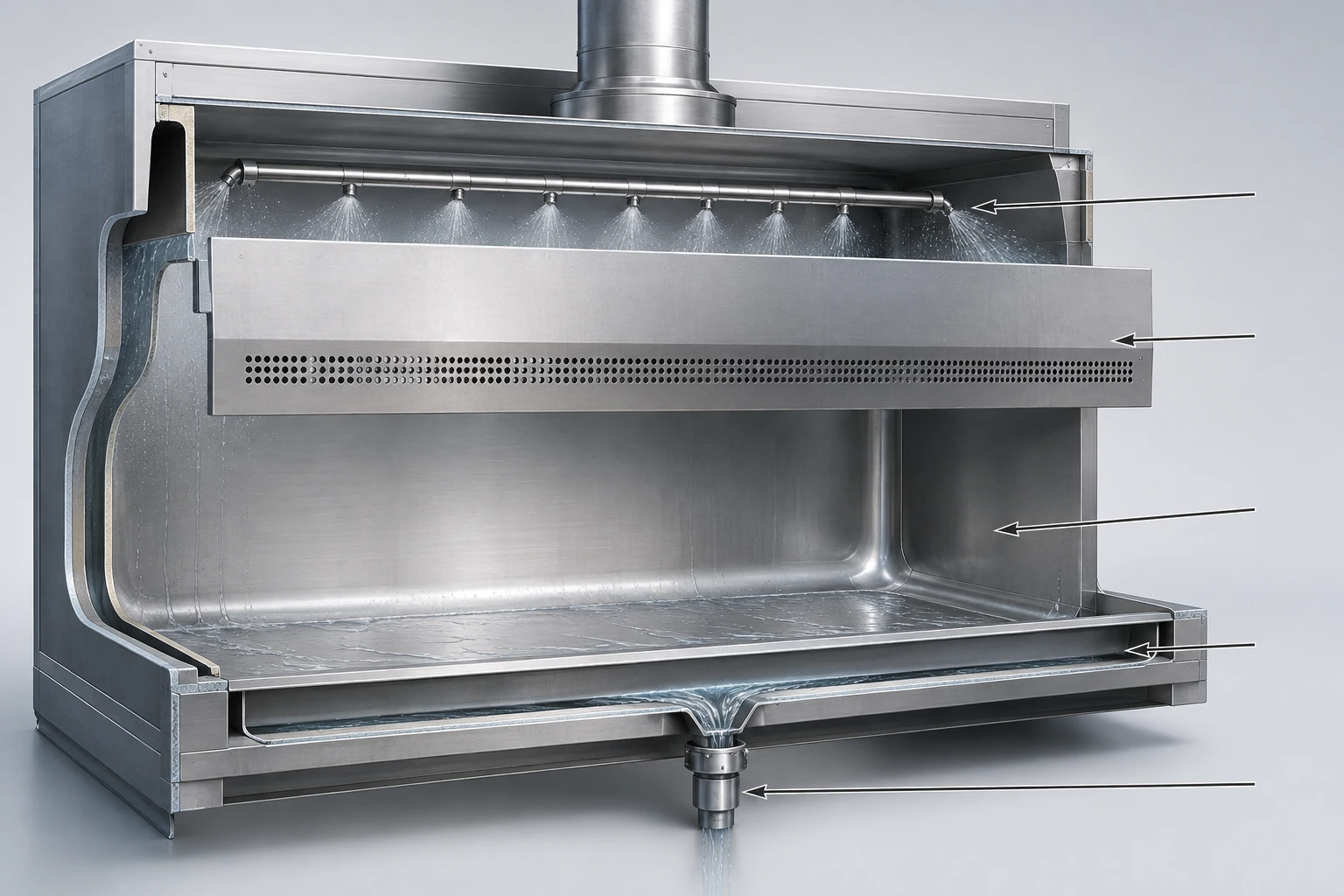
If heating or concentration places your procedure in dedicated-hood territory, the first feature to specify is the wash-down system — the built-in mechanism that removes perchlorate deposits before they accumulate.
What a Wash-Down Must Reach: Corners, Baffles and the Area Behind the Upper Baffle
A perchloric acid fume hood washdown system has to reach every surface where vapor condenses, and that requirement is the design logic behind its parts list. Manufacturers place their sprays accordingly: Esco’s wash-down fires a water sequence at the corners and the baffles, and LOC Scientific mounts its spray bar behind the upper baffle so water reaches the baffle’s hidden face directly rather than relying on runoff from above.
The common thread is that the sprays are aimed at the deposit sites from the first module — corners, baffles and the area behind the upper baffle — rather than at the work surface. When you review a hood’s wash-down specification, ask where each spray is aimed and confirm it covers those locations, not just the interior walls. A wash-down that cannot reach behind the baffles leaves the most protected surface of the hood untreated, which defeats the purpose of the system.
When It Runs: After Each Use, With an Attributed Cycle Reference
Run discipline follows the mechanism: the residue must be removed after each use, before it has time to accumulate. Washington State University’s manual makes the wash-down the user’s responsibility after every use of the hood, and Labconco’s guidance for its perchloric-acid hoods says the same — the hood should be thoroughly rinsed after each use to prevent accumulation. Treat “after each use” as the baseline rhythm, not an occasional maintenance task.
Cycle time is a separate question, and the sources do not speak with one voice. Flow Sciences states that in most cases the wash-down runs for at least ten minutes and covers the hood interior and the ductwork; that duration is one manufacturer’s reference, so confirm the cycle in the operation and maintenance manual for the hood you select and record it in your written procedure. No single cycle duration is universal.
Collection Trough, Drainage Routing and Treatment
Wash-down water has to go somewhere controlled, and the hood’s drainage is part of the wash-down requirement. LOC Scientific builds a full-width collection trough that channels the wash water across the width of the hood, and its installation notes warn that wash-down drainage and treatment systems may be required for the project. That water carries dissolved or entrained perchlorate from the surfaces it just cleaned, so routing it into an ordinary bench drain without review is not a safe default.
Because drainage and treatment depend on your building plumbing and on local discharge requirements, this is a project-level confirmation rather than a hood specification: confirm the drain route, whether treatment is required, and who approves it before you finalize an order. After this module you can state three wash-down facts for your project — which surfaces the sprays reach, the after-each-use rhythm with the cycle your manufacturer specifies, and the drainage route the wash water will follow — before you compare hood options. The next module covers the second defining feature: the dedicated exhaust system and the scrubber question.
Dedicated Exhaust and the Scrubber Question: Ductwork That Stays Separate
Wash-down controls deposits inside the hood; the exhaust system decides what happens to the acid vapor once it leaves the hood interior. For heated perchloric-acid work, that means an exhaust route designed so that salts cannot accumulate in ductwork shared with anything else.
One Hood, One Exhaust System: The No-Manifold Rule
The design consensus across the sources in this guide is that a hood for perchloric-acid service gets its own exhaust system. M.K. Plastics’ design literature on perchloric-acid hoods states the rule in its own words: each hood shall have its own exhaust system, and perchloric-acid hoods should not be manifolded together. Duct rules from the British Columbia Ministry quoted in Flow Sciences’ Q&A say the same: the dedicated hood must have its own exhaust, and its duct must not share a manifold with other exhaust streams.
The reason follows from the mechanism. If the perchloric-acid stream joined ordinary manifold exhaust, the vapor could condense and deposit salts along a duct shared with other hoods and equipment, spreading the residue problem across systems that were never designed to be washed down. An independent route keeps the acid stream and its wash system separate from everything else on the roof.
Shortest Path and Horizontal-Run Limits
The same British Columbia duct rules quoted by Flow Sciences set the layout principles: run the duct by the shortest path to the roof discharge, and avoid horizontal runs. Where a horizontal section cannot be avoided, the guidance is to keep it short, use gentle bends, and slope it toward a drain so liquid cannot pool in the duct.
Duct diameter, static pressure and fan selection are engineering calculations, not checklist items. The confirmation list at the end of this module gives your HVAC engineer the inputs they need; sizing and fan work follow from their design, and dedicated sizing guidance belongs to future engineering guides, not to this page.
The Scrubber Question: Vendor Requirement or Project Decision
At least one manufacturer treats an exhaust scrubber as a required accessory on its perchloric-acid hood. Esco lists its fume scrubber as a required accessory for the Frontier perchloric-acid hood, explaining that it prevents salt formation inside the exhaust system. Read that as a vendor requirement for that product line, not as a universal code mandate.
NEBB describes the scrubber’s function from the testing side: effluent scrubbers prevent acid from migrating into the ductwork, which is why they matter for systems that cannot rely on wash-down alone. Because manufacturers genuinely differ, do not assume that a wet scrubber or a recirculation package is part of the standard hood or required for every installation — treat it as a per-project confirmation with your vendor and engineer, covering the exhaust configuration and any local review your site requires.
What to Hand Your HVAC Engineer
Before the exhaust design starts, assemble these confirmations:
- Route: shortest path to the roof discharge, with no tie-in to other exhaust streams.
- Horizontal runs: identify any unavoidable sections so the design can keep them short, gently sloped and drainable.
- Scrubber: the vendor’s answer on whether a scrubber is required or included for your configuration.
- Duct and fan: left to the engineer’s calculations from your project data.
After this module you can confirm the three exhaust-side facts your project needs — an independent non-manifolded route, a shortest-path layout with horizontal runs flagged, and a scrubber decision reached with your vendor — before the ductwork design moves to your HVAC engineer. The decision this module supports: commit to a dedicated non-manifolded exhaust route now, and decide the scrubber question with your vendor before fabrication. The next module covers what the hood is built from: liner and construction materials.
Liner and Construction Materials: Three Coexisting Vendor Routes
The interior of a perchloric-acid hood has one job beyond containing the work: it must survive the chemistry and the wash-down cycle without giving deposits a place to hide. Manufacturers solve that with different material routes, and all of them appear in the market today.
What the Liner Must Survive: Perchlorate Deposits and Wash-Down Water
The liner faces two aggressive inputs. The first is the acid itself and the perchlorate deposits it leaves when heated work condenses on the interior. The second is the wash-down water that removes those deposits — repeated wetting that the liner must tolerate for the life of the hood without degrading, warping or trapping residue in crevices.
That second point drives construction as much as material choice. A liner with seams, sharp corners or rough joints gives deposits places to collect that no spray can reach, which is why cleanability is treated as a design requirement, not a cleaning convenience. When you review a candidate hood, ask what the interior is made of, how its corners are formed, and how thoroughly it can be flushed.
Coved Liners and Removable Baffles
Two construction features address the cleanability requirement directly, and both appear in the manufacturer sources reviewed for this guide. LOC Scientific forms its liner with coved corners and continuous surfaces to eliminate the collection points where perchlorate deposits would otherwise sit, and fits removable interior baffles so the hidden face behind the upper baffle can be reached for cleaning. IQ-Laboratory takes a related approach with a one-piece 316 stainless steel interior on its Defender-series perchloric-acid hood.
The design logic ties back to the first module: deposits form on baffles and in corners, so the interior is shaped to have as few corners and hidden faces as possible, and the baffles are made removable so the protected surfaces are not permanently out of reach. Add both features to your verification list when you compare hoods.
316 Stainless Steel, PVC and PP Routes
The three material routes seen in the reviewed manufacturer pages are summarized below. They are presented as coexisting vendor routes, each tied to its vendor’s construction and chemistry review; none is treated here as the only compliant answer.
| Material route | Seen in | What the source page says |
|---|---|---|
| Type 316 stainless steel | LOC Scientific; IQ-Laboratory; M.K. Plastics (design literature) | LOC: 316 SS liner, baffles and sash frame; IQ: one-piece 316 construction; M.K. Plastics: “use 316” for perchloric-acid hood construction |
| PVC | Labconco (Protector PVC perchloric-acid hood) | Wash-down system, integral work surface and drainage trough; thorough rinse after each use (product description) |
| Polypropylene (PP) | TopAir (PP perchloric-acid hood product page) | PP body construction route with external roof or wall fan configurations |
One caution when reading vendor pages: TopAir’s PP perchloric-acid hood page reuses “acid digestion” wording in places, so reference it only for its PP construction route and confirm the actual perchloric-acid configuration with the vendor. Material choice is a vendor-and-chemistry decision, not a page-level verdict; for the deeper trade-offs between stainless steel and polymer construction, the PP-versus-stainless fume hood comparison in our fume-hood material guide covers that analysis. After this module you can state which material route each candidate vendor offers and the liner features you will verify — coved interior, wash compatibility and removable baffles — without treating any single material as the only compliant answer. The next module turns to what a dedicated hood is not: ductless carbon-filter units and the operating limits around perchloric-acid work.
What a Dedicated Hood Is Not: Ductless Filters and Operating Limits
Two boundary questions come up whenever a lab considers perchloric-acid work: can a ductless carbon-filter hood handle it, and what handling rules apply around the chemistry? The answer to the first is no, on mechanism grounds; the second is governed by institutional rules, shown here through one university’s example.
Why Ductless Carbon-Filter Hoods Are the Wrong Answer
Flow Sciences’ analysis of perchloric-acid hood requirements addresses ductless units directly, and the reasoning follows the mechanism this guide opened with. Activated carbon is a pure carbon source; when a ductless filter captures perchloric acid vapor or aerosols, the chemistry that forms explosive organic peroxides can take place inside the filter itself. That is Flow Sciences’ mechanism-based manufacturer analysis of why ductless carbon-filter hoods are unsuitable for perchloric acid — treat it as expert analysis, not as a regulatory citation.
Filter selection and the broader safety question of ductless hoods are separate topics with their own guides: our ductless fume hood filter selection article covers how filters are chosen, and our article on whether ductless fume hoods are safe covers the general safety boundary. This page’s job is only to flag that neither topic rescues a carbon-filter unit for perchloric-acid service.
Operating Boundaries: One Institution’s Rules, Labeled as an Example
Beyond the hood itself, institutions publish handling rules that sit beside the hardware requirements. The University of Alabama’s EHS guidance is a representative example, shown here so you can see the shape of such rules — your institution’s SOP, not this list, governs your lab:
- Keep reagent perchloric acid in one-pound or smaller bottles, with glass or ceramic secondary containment, and avoid rubber stoppers.
- Rinse glassware with water after use.
- Heat with hot plates, electric mantles, steam baths or steam-heated sand baths — not with gas flames or oil baths.
- Do not vacuum-distill perchloric acid.
- Clean spills without organic wipes; paper, cloth and similar wipes can ignite.
Read this box as an institutional example (UA), not as a universal rule set. Several of its points — no organic materials in the hood, no vacuum distillation, controlled heating — trace back to the same deposit-and-reactivity mechanism covered earlier, which is why they recur across institutions. The decisions this module supports: choose your institution’s operating rules — not this example box — as the binding list, and rule out ductless carbon-filter units for perchloric-acid work before you specify any equipment. The next module covers what to do with an existing hood before renovation or demolition: legacy systems and how they are tested.
Legacy Hoods and Renovations: Test Before You Decommission
When a renovation or demolition touches a hood, duct or fan system that ever handled heated perchloric-acid work, the structure itself may hold the hazard. NEBB, the industry body that publishes testing and decontamination guidance for these systems, frames a legacy perchloric-acid hood as a testing problem before it becomes a demolition problem — and this module gives you the path pointers and the professional boundary.
Why Old Hoods and Ductwork Become Demolition Hazards
A hood operated before wash-down systems were standard can carry years of dried residue in places no cleaning ever reached: the baffles, the duct interior and the fan. NEBB warns that these dry salts can be combustible and shock-sensitive, which makes the demolition phase the danger point — cutting, grinding or impact on deposit-bearing metal can supply the energy the residue must not receive.
That is why the risk assessment covers the whole exhaust path, not just the cabinet. The ductwork that carried the acid vapor is part of the hazard, and the first decision before any renovation is to treat the system as suspect until it has been assessed.
The Detection Path: Visual White Deposits, BNL Swabs and EPA 6850
The visible sign is the same white deposit described in the first module: NEBB’s guidance identifies hood surfaces, baffles, filters, fans, ducts and stacks as the locations where white crystalline deposits are found on legacy systems. A visual inspection screens for those deposits, but it cannot by itself tell you how much is present or how the system should be handled.
The analysis path NEBB describes uses surface swab samples taken with the BNL procedure — a defined sample area on the surface — analyzed by EPA 6850, the HPLC/MS method, with results classified on a negative, suspect or positive framework. The older methylene blue test is obsolete because it produces false positives and false negatives. Treat this as a pointer: a qualified specialist runs the visual check, takes the swabs and arranges the laboratory analysis, and the results decide whether wash-down, decontamination or controlled demolition is the right path.
Decontamination and Demolition Are Specialist Work
Where deposits are present, NEBB describes a decontamination approach built around a large-volume water flush sustained for at least 24 hours, designed case by case to prevent leaks into surrounding areas. Where removal must proceed, the guidance is to dismantle the system wet, with chemical-protective clothing and ballistic-grade protection for the crew, and to schedule the work during low-occupancy periods.
The rinse water from decontamination is a disposal question with local answers: NEBB notes that disposal varies by municipality, from permitted sewer discharge to collected disposal. This article stops at the pointer — planning and executing detection, decontamination and demolition belong to qualified specialists working with your EHS program. After this module you can make one decision before any renovation touches a legacy perchloric-acid system: schedule specialist detection first, and treat decontamination and demolition as professional scope, not in-house work. The final module turns all of this into the project confirmation checklist you run before you specify or buy.
The Project Confirmation Checklist: What to Verify Before You Specify or Buy
The last module is the deliverable this guide promised: a checklist of the confirmations that decide whether a perchloric-acid hood project is ready to move forward. Work the three groups below before you finalize an order or a specification.
Wash Water, Drainage and Treatment Confirmations
The wash-down system only works if the building supports it. Confirm these items with your facilities team and the vendor:
- Wash-water supply: a dedicated, reliable water source at the hood, with the pressure and quality the wash-down system needs.
- Drainage routing: the collection trough drains to a controlled route you have reviewed, not an unapproved bench drain.
- Treatment: whether the wash-down effluent requires treatment before discharge, per your vendor’s installation guidance and your local requirements.
Each of these is a building-side question with a named owner, which is why they belong on the checklist, not in the hood specification. If the water or drain answer is missing, resolve it before you buy — the wash-down cannot run without it.
Exhaust, Scrubber and Service-Fixture Confirmations
The exhaust-side decisions from the earlier modules become concrete confirmations here:
- Exhaust path: the dedicated, non-manifolded route to the roof is confirmed and the design owner (HVAC engineer) is named.
- Scrubber: your vendor’s answer on whether a scrubber is required or included is on record.
- Service fixtures: LOC Scientific’s installation guidance notes that service-fixture locations must be pre-specified so the liner openings can be made correctly — list every service fixture and its position before fabrication.
The project-confirmation items in this group hand off to the physical install workflow, which has its own requirement set; the fume hood installation requirements article covers that process from the room side. Keep the two lists together: this page confirms what is special about a perchloric-acid project, and the install guide carries the general installation steps.
Acceptance, Annual Certification and the Turnover Boundary
The final group defines what “done” means after install:
- Acceptance: the hood is accepted with airflow balanced and verified per your acceptance criteria. Acceptance testing method is covered by the ASHRAE 110 fume hood test article, and the face-velocity semantics behind “balanced” are covered by the fume hood face velocity requirements article — no single face-velocity figure is stated here.
- Annual certification: Washington State University’s manual requires its perchloric-acid hoods to be recertified annually, and your institution’s certification program should be on the calendar from day one.
- Turnover: once accepted, the hood moves to periodic inspection; the fume hood inspection checklist article covers what that ongoing inspection checks.
After this module you hold a runnable project checklist — water and drainage, exhaust and scrubber, service fixtures, acceptance, annual certification — and you know the acceptance language your project will use. The decision this module supports: do not release the purchase order until every line above is answered in writing — decide that before you brief a supplier. The last module closes the guide: the decision line in one place and the next step for taking the checklist into a specification review.
Your Next Step: Take the Requirements Checklist to a Specification Review
This guide opened with a mechanism and a trigger question; it closes with the decisions those two things support. If you can answer the points below, you are ready to talk to a supplier with a real specification in hand.
The Decision Line in One Place
- Heating is the trigger every source shares, and your institution’s SOP — not any single published number — sets your concentration line.
- A dedicated system means wash-down that reaches corners and baffles, a dedicated non-manifolded exhaust, compatible materials, and drainage you have confirmed.
- Ductless carbon-filter units are excluded for this chemistry, and legacy systems are tested by specialists before any renovation.
- The project checklist from the previous module is your pre-purchase gate: water, drainage, scrubber, service fixtures, acceptance and annual certification.
Nothing in this guide replaces the review your EHS office and your engineer perform; it gives you the questions and the confirmation items so that review starts from a complete list.
The Specification-Review Conversation
Bring the checklist to the conversation with your supplier. A made-to-order wash-down hood for perchloric-acid procedures is quoted on the specific process — the chemistry, the concentration, whether the work is heated, the space, and the exhaust route you have confirmed — so the more complete your checklist, the more specific the quote can be. XICHENG’s made-to-order perchloric acid fume hood is a wash-down enclosure built for reviewed perchloric-acid procedures, especially heated work that can leave hazardous perchlorate deposits in an unsuitable hood or exhaust path; the request-a-quote route is consult-style, and the engineering team reviews the process data before pricing. The hood itself does not include the exhaust installation — the mechanical contractor supplies the dedicated duct and remote fan, and on-site work is contracted separately.
If your scope is heated, concentrated or frequent non-perchloric mineral-acid work — a different chemistry from perchloric acid — the acid digestion fume hood is the adjacent configuration to review. This page does not compare the two hood types; a separate planned guide will cover that comparison. Working through the confirmations above is what turns the perchloric acid fume hood requirements in this guide into decisions your project can defend — decide your next step, which supplier to brief, and let that supplier and your engineer confirm the rest from your complete list.
Frequently Asked Questions
At What Concentration or Temperature Does Perchloric-Acid Work Trigger a Dedicated Wash-Down Hood?
The honest answer is that it depends on your institution. Every authority whose trigger line this guide compared includes a heating condition, and the concentration lines differ — WSU, UA and UKY each set their own, Columbia’s guidance is limited to room-temperature work, and the two standards reproduced by Flow Sciences approach it from concentration and temperature. None of those lines is a universal rule.
The decision line is your institution’s SOP. If your procedure is heated or concentrated and your written procedure does not name the line, take the temperature, concentration and heating method to your EHS office before the procedure runs.
How Often and for How Long Should the Wash-Down Run?
After every use — that is the rhythm the published sources converge on. Washington State University’s manual assigns that rinse to the person running the procedure, making it a user duty, not a scheduled maintenance event; Labconco’s product guidance reaches the same outcome from the equipment side, with the hood rinsed thoroughly when a use cycle finishes so residue has no chance to build up.
Cycle duration is not universal. Flow Sciences gives a typical wash-down of at least ten minutes in most cases, and that figure is a single-source reference, so match the cycle to the operation and maintenance manual for the hood you choose.
Can I Use a Ductless Carbon-Filter Hood for Perchloric-Acid Work?
No. Flow Sciences’ mechanism-based analysis explains why: activated carbon is a pure carbon source, and captured perchloric acid vapor or aerosols can form explosive organic peroxides inside the filter. Treat that as expert manufacturer analysis, not a regulatory citation.
Ductless filter selection and the general safety of ductless hoods are separate topics with their own guides; neither changes the answer for this chemistry.
How Do I Know Whether an Existing Hood Has Perchlorate Deposits?
The visible sign is white crystalline deposit on hood surfaces, baffles, filters, fans, ducts or stacks. A visual inspection screens for it, but it cannot quantify what is present.
Confirmation is a specialist task: NEBB describes surface swabs taken with the BNL procedure and analyzed by EPA 6850 (HPLC/MS), with results on a negative, suspect or positive framework. The older methylene blue test is obsolete because it produces false positives and negatives.
What Must I Confirm Before Renovating or Demolishing a Legacy Hood?
Schedule detection first. The system is treated as suspect until a specialist has run the visual check, taken the swabs and arranged the laboratory analysis.
If decontamination or removal proceeds, it is professional scope: NEBB describes a large-volume water flush sustained for at least 24 hours, wet demolition with chemical-protective and ballistic-grade protection, and rinse-water disposal decided against your local requirements.
What Should I Confirm Before Buying a Dedicated Wash-Down Hood?
Run the project confirmation checklist from the previous module: wash-water supply, drainage routing and treatment, the scrubber answer from your vendor, service-fixture locations pre-specified before fabrication, and acceptance plus annual certification defined before install.
With those items confirmed, take the checklist to the specification review and let the engineering team confirm the configuration against your process data before a quote.
Leave a Reply