




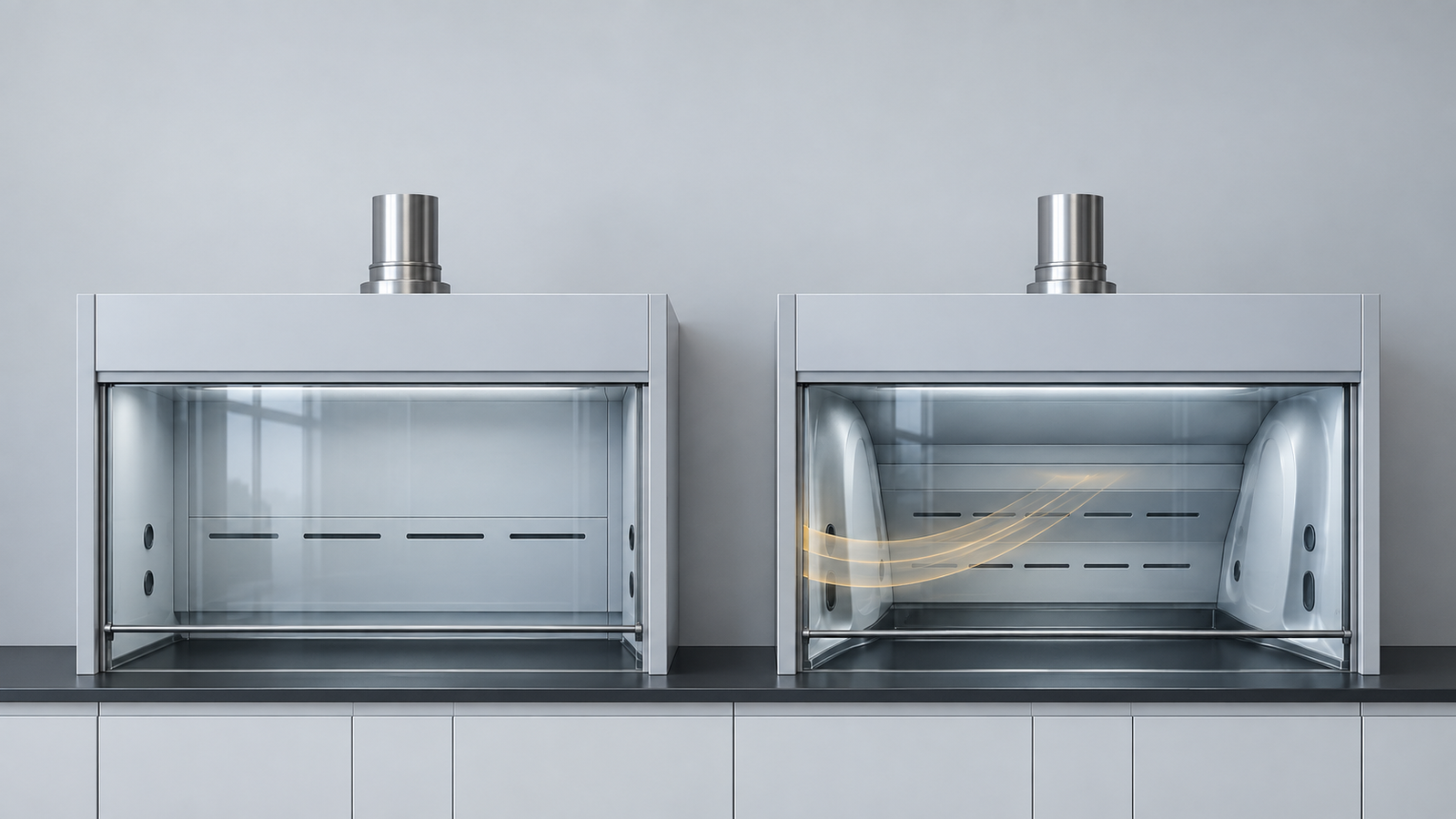
The low flow vs standard fume hood question is a decision, and it is a decision about verified containment at a lower exhaust rate — not a vote for or against energy savings. A standard fume hood is a hood operated at the conventional face velocity your institution or local code expects. A low-flow hood is one that demonstrably holds containment while exhausting materially less air. Between those poles sit five competing numbers, three control strategies, and a short list of preconditions that decide whether the saving is real. This article reconciles the calibers, prices the energy chain, separates hood from control strategy, and closes with a five-input framework.
Key Takeaways
- The answer is never a two-way choice. It is one of three verdicts: Stay Standard, Downgrade with Verification, or Upgrade to High-Performance.
- The verdict is weighted from five inputs: chemical risk tier, usage intensity, room airflow conditions, existing control strategy, and budget/retrofit constraints.
- Red line: if containment cannot be field-verified as-used at the target velocity, the projected saving does not exist — operate at the velocity your safety officer verifies.
- Every hard number carries its caliber: who defined it, at what sash position, in what role. Mixing calibers is the most common source of bad selection decisions.
Low Flow vs Standard Fume Hood: What “Standard” and “Low-Flow” Actually Mean
Ask three labs what the standard fume hood face velocity is and you can get three defensible answers. The traditional convention was 100–120 FPM at the sash — the number older design guides were written around, per Payette. UW’s environmental health office defines its standard-flow hoods operationally: 100 linear feet per minute (LFM) at an 18-inch sash. Neither figure is a law of physics; both are inherited operating calibers.
On the low side, they diverge further. SEFA — the Scientific Equipment and Furniture Association — certifies a high-efficiency hood to run at 60 FPM or below with the sash fully open, per the SEFA definition Labconco quotes. ANSI/AIHA Z9.5-2012 permits low-velocity hoods down to 60 FPM but suggests a conventional minimum of about 80 FPM (via manufacturer Kewaunee). UW operates its approved low-flow models at 70 LFM at an 18-inch sash — an operating choice between those bookends, not a certification claim. The 40 FPM figures in manufacturer test reports are design margin: proof containment survives below the operating minimum, not a run recommendation (Labconco; Payette).
| Caliber | Number | What it actually is | Source & status |
|---|---|---|---|
| Historical convention | 100–120 FPM | Inherited default from older practice, not a current-standards requirement | Payette [S-04] |
| Institutional operating standard | 100 LFM at an 18-inch sash | One university’s operational definition of a standard-flow hood | UW EH&S [S-03] |
| SEFA-certified low velocity | ≤60 FPM with sash fully open | Certification definition: containment must still pass ASHRAE 110 at full sash | SEFA, quoted by Labconco [S-02] |
| Institutional low-flow standard | 70 LFM at an 18-inch sash | Operating set point for approved low-flow models — between SEFA’s ≤60 and Z9.5’s ≥80 | UW EH&S [S-03] |
| Consensus guideline | ≥80 FPM conventional; low-velocity down to 60 FPM | Z9.5-2012 guidance, cited via a manufacturer summary | Kewaunee [S-01] |
| Design margin, not a set point | 40 FPM | Test-report headroom below the operating minimum — never an operating recommendation | Labconco; Payette [S-02, S-04] |
Read the table by role, not rank — none of these calibers overrules your safety officer.
SEFA-1 2010 adds a split most vendor content blurs: Low Flow and Low Velocity are different mechanisms. A low-flow hood reduces exhaust by shrinking the sash opening; a low-velocity hood reduces face velocity itself — down to 60 FPM — while still passing containment testing (per SEFA-1 2010 as summarized by Kewaunee). So a standard hood under strict sash discipline is already “low flow” in SEFA’s first sense; a genuine low-velocity hood lowers exhaust at *any* sash position. When a vendor says “low flow,” ask which mechanism and which caliber.
This caliber mixing is the top selection error in the low flow vs standard fume hood decision. A spec line asking for “a 70 FPM hood” conflates UW’s operating caliber with SEFA’s certification caliber; a line written at “40 FPM” buys margin, not an operating point. Decide the caliber first.
Containment: What Changes at 60–70 FPM
The containment bar comes first, because energy only counts if containment holds. Per SEFA’s definition (quoted by Labconco), a low-velocity hood’s containment must be at least equal to ASHRAE 110 test results of 4.0 AM 0.05 and 4.0 AI/AU 0.10 while operating at 60 FPM or below with the sash fully open. In plain terms: at the standard test conditions, tracer-gas leakage at the sash plane must stay at or below those concentrations. Those thresholds are the pass/fail line the certification caliber refers to — not a graded comfort scale. For how the test is actually run, see our ASHRAE 110 fume hood test walkthrough.
Here is the threshold that kills most casual claims: “able to run at 60 FPM” is not the same as High Performance. Per Labconco’s reading of the SEFA definition, a manufacturer must demonstrate containment with the sash open to at least 25 inches before the high-performance label is honest. A hood that only contains at 60 FPM because the sash is lowered to a few inches is telling a sash-discipline story, not a low-velocity story — and sash discipline works on any hood, free. So when a datasheet quotes a low face velocity, the first question is: at what sash position? The second: does containment pass at that position, or only at a lower one?
Even with the label honest, low velocity is a *conditional* claim. The face-velocity figures that matter depend on four factors — hood design, the hood’s location within the lab, the quality of supply-air distribution, and user work practices (Kewaunee’s four factors, which we treat as preconditions rather than preferences). At 100 FPM, a marginal room can be forgiven; at 60–70 FPM the capture margin is thinner, so each factor bites harder. A hood beside a door that swings open, under a supply diffuser that blows across the face, or operated with fast arm movements can fail at a velocity that passed on the test floor. That is why field verification, not catalog numbers, is the containment deliverable (more on that in the implementation module).
Two failure modes sit at the extremes. First, faster is not safer: per Labconco, face velocities above roughly 150 FPM create turbulence at the sash opening that can pull contaminants back out of the hood. Over-velocity is a real containment failure mode, which is one reason “raise the set point” is not a universal fix — and why a velocity reading too high or too low deserves diagnosis, not reflexive adjustment. Second, supply-air starvation: cutting exhaust without rebalancing supply air drives the room more negative, and a starved lab competes for air in ways that degrade every hood in it (Labconco). The EPA’s laboratory ventilation guidance makes the complementary point: more exhaust does not improve containment in a poorly arranged hood.
The lesson runs both directions — containment is a system property of hood, room, and user, and the velocity number is only one coordinate of it. Your next step: treat any set point below roughly 80 FPM as a claim your room must verify as-used, not a number you can buy off a datasheet.

Energy and Cost: From Face Velocity to Dollars
The physics is arithmetic. Exhaust CFM equals the face opening area multiplied by face velocity (Payette’s formulation). So Payette’s worked example for a 5-foot hood: at 100 FPM the hood moves roughly 640 CFM; at 60 FPM it moves roughly 380 CFM — about a 40% reduction in conditioned air leaving the building. Same hood, same footprint, same containment intent, 260 CFM difference at the same sash opening.
Price that delta. Kewaunee’s operating-cost band for conditioned lab exhaust is $3–9 per CFM-year. Applied to the 260-CFM delta above, that is roughly $780–2,340 per hood per year at the same sash opening. Treat that as a derived screening figure: it combines two sources’ calibers (Payette’s geometry example with Kewaunee’s cost band) and assumes the hood actually runs at the lower velocity with the sash open. It is an order-of-magnitude tool, not a budget line.
For whole-hood context, two calibers are worth quoting side by side. The Lawrence Berkeley National Laboratory analysis by Sartor and Mills (2006) puts a standard 6-foot hood’s annual energy cost at about $4,600 per year in a moderate climate (Los Angeles) rising to about $9,300 per year in an extreme cooling climate — the verified climate-banded range. Labconco’s own scenario estimate for a 6-foot constant-volume hood lands near $8,260 per year — labeled here as exactly what it is: a scenario estimate from a manufacturer, not a universal figure. Against those baselines, a 40% exhaust cut on a heavily used hood is plausibly a three- to four-figure annual saving per hood, depending on its baseline climate and rates — which is why the low flow vs standard fume hood arithmetic gets board-room attention once the hood count reaches double digits.
The sequencing rule matters more than any single number, and it comes from Payette: reduce hood count first, then face velocity. An eliminated hood saves its entire energy line — exhaust, supply, conditioning, all of it. A slowed hood saves only the difference and carries a verification cost. If your real problem is that the lab accumulated more hoods than its science needs, decommissioning beats downgrading on pure economics.
If you want this arithmetic for your own sash dimensions, hood count, and utility rates, run it through our fume hood airflow calculator — it does the CFM-to-dollars conversion with your numbers instead of a 5-foot example. Your next step: determine how many hoods you can eliminate outright before you price any velocity change on the survivors.
Controls: CAV, VAV and Two-State
The most common conceptual error in this product category is collapsing two orthogonal choices into one. Low-flow is a property of the hood and its verified set point. CAV, VAV, and two-state are control strategies — they describe how the building delivers whatever flow the hood requires. A hood can be standard or low-flow in class and controlled by any of the three. That is a 2×3 matrix, and most of the confusing marketing in this space is one cell sold as the whole grid.
| CAV | VAV | Two-State | |
|---|---|---|---|
| Standard hood | Constant exhaust at design flow regardless of sash — the most expensive baseline | Exhaust tracks sash position; savings come from closed sashes even at conventional velocity | Two set points (occupied/unoccupied or sash states); cheaper, coarser compromise |
| Low-flow hood | Lower constant flow at design sash; savings from the hood class alone | Both mechanisms stack: lower design flow *and* sash tracking — the deepest reduction | Lower low-state; savings capped by the coarse two-point control |
Read the matrix by rows and columns. A standard hood on VAV already captures the sash-management savings without touching the velocity caliber — which is why “we have VAV, so we already did low-flow” is a category error in one direction, and “we bought a low-flow hood, so controls don’t matter” is the error in the other. A VAV system tracks sash position continuously and modulates the exhaust to match; a two-state system jumps between a high and a low set point on a trigger (occupancy, sash state, or a timer). Two-state is the compromise: cheaper than full VAV modulation, but it leaves savings on the table whenever the lab sits between its two operating points; a low-flow hood on two-state control only realizes its full benefit at the low state.
Alarms close the loop between controls and safety. UW’s practice alarms when measured flow falls to roughly 80% of the design velocity — a signal that the control system is losing its set point or the sash has moved beyond the design condition, not a containment-failure verdict. Treat it as a prompt to recheck sash and system status, and log the event. The deeper comparison of these strategies — including where each one fails — is covered in our guide to CAV vs VAV fume hoods. Decision to carry forward: settle the control strategy your building can actually operate first, then choose the hood class your containment program can verify — never the reverse.
Low Flow vs Standard Fume Hood: The Five-Input Decision
No single number answers the low flow vs standard fume hood question. Competitors stop at definitions; the decision is a weighting across five inputs resolving to one of three verdicts: Stay Standard, Downgrade with Verification, or Upgrade to High-Performance.
Input 1 — Chemical risk tier. What your hoods routinely contain decides how much containment margin you may trade. Dilute buffers tolerate a thinner margin; flammable-solvent synthesis and high-hazard sash-plane work do not. Risk tier is the first veto: it can end the conversation before any arithmetic.
Input 2 — Usage intensity. Two numbers: sash-open hours per hood per day, and hood count times those hours lab-wide. A hood open at working height eight hours a day is where a lower set point earns; one cracked open twenty minutes a week is not.
Input 3 — Room airflow conditions. Supply-air distribution quality, cross-drafts, door traffic, and thermal loads determine whether a lower face velocity is physically possible in *your* room (the containment module’s four preconditions). This is the second veto: bad room air disqualifies the downgrade regardless of the datasheet.
Input 4 — Existing control strategy. An installed VAV platform makes the downgrade mostly a set-point and verification exercise. A fixed CAV lab means the decision is “controls retrofit plus velocity change” — a different project with a different budget.
Input 5 — Budget and retrofit constraints. New purchase or retrofit; commissioning funded or not. As-used verification is not optional: a budget without a verification line is a budget without a verdict.
| Scenario | Input combination | Verdict |
|---|---|---|
| Teaching lab, dilute reagents, hoods occupied a few hours a day, older CAV | Low risk × low usage × unverified room air × CAV × tight budget | Stay Standard |
| Research lab, mid-tier solvents daily, sashes open most of the workday, good supply air, VAV installed | Moderate risk × high usage × good room air × VAV × commissioning budget | Downgrade with Verification |
| Synthesis lab, flammable sash-plane work, hoods beside a busy door | High risk × high usage × cross-drafts × any controls × any budget | Stay Standard (conventional velocity) |
| New build, high electricity rates, large hood count, dedicated makeup air, commissioning funded | Mixed risk × high aggregate hours × engineered room air × new VAV × capital budget | Downgrade with Verification; HP for the highest-intensity stations |
| Existing lab, fixed CAV, controls retrofit not funded this cycle | Any risk × any usage × unknown room air × CAV × no retrofit budget | Stay Standard this cycle; revisit with the controls project |
| Instrument and storage hoods, sashes predominantly closed | Low risk × minimal open-sash hours × any room air × VAV | Stay Standard — a class downgrade earns nothing here; manage the sash instead |
| Campus or local code pins the face velocity | Any inputs; the constraint dominates all five | Stay Standard until a variance or code change lands |
How the weighting works: risk tier and room airflow are gating inputs that can veto the downgrade outright. Usage intensity scales the stakes — whether the saving is worth chasing. Control strategy and budget choose the path — set-point change, controls project, or capital purchase. Run the inputs in that order; the verdict falls out of the table.
When to Stay Standard
Staying standard is not timidity; it is the verdict whenever one of the red lines holds. Each line below maps to an input from the framework, and any single one is sufficient.
| Red line | Framework input | What it rules out | What to do instead |
|---|---|---|---|
| High-hazard chemical tier at the sash plane | Input 1 (risk) | Any velocity downgrade without explicit safety-officer sign-off | Keep the conventional caliber; harden work practices |
| Poor room airflow or cross-drafts | Input 3 (room air) | The downgrade verdict, regardless of datasheet | Fix the room first, or leave the set point alone |
| No budget for as-used field verification | Input 5 (budget) | The downgrade verdict — a paper saving | Stay Standard; fund verification before revisiting |
| Local or state code locks the face velocity | Input 5 (constraint) | Operating below the prescribed velocity | Seek a variance, or comply at the code velocity |
| Low usage intensity (a few sash-open hours weekly) | Input 2 (usage) | Any payback for the downgrade project | Manage the sash; revisit only if usage changes |
- High-hazard chemical tier. If routine work at the sash plane includes flammable, highly toxic, or sensitizing chemistry, the conventional velocity’s capture margin is part of your defense. Trade it away only with your safety officer’s explicit sign-off — which, for this tier, is rarely given.
- Poor room airflow or cross-drafts. Door swing traffic, supply diffusers blowing across the face, or crowded bench layout can defeat containment at a conventional velocity. At 60–70 FPM the failure arrives sooner. If the room cannot be fixed, the hood should not be slowed.
- No budget for as-used field verification. A downgrade that is never verified as-used is a paper saving. If the project cannot fund ASHRAE 110–style verification at the installed location, it cannot fund a downgrade — full stop.
- Local or state code locks the face velocity. Per Kewaunee’s summary of the regulatory picture, some jurisdictions prescribe specific face velocities and require special approval to operate below them. Until a variance is secured, the code answer is the verdict.
- Low usage intensity. At a few sash-open hours per week, the exhaust delta never recoups the verification and control work. The honest verdict for a lightly used hood is: leave the set point alone and manage the sash instead.
Two clarifications keep this list honest. First, staying standard does not mean accepting the energy bill: sash management plus VAV control on a standard hood captures much of the low-hanging saving without ever touching the velocity caliber. Second, if your standard hood’s velocity already reads out of band — too high or too low against its own design caliber — that is a diagnostic problem to fix first; see our guide to face velocity too high or too low before making any class-of-hood decision at all. Decide this cycle: if any red line in the table holds, your verdict is Stay Standard — spend the budget on sash discipline and controls instead.
When Low-Flow Pays (and When It Doesn’t)
On the other side of the framework sit the economics behind the other two verdicts: the Upgrade-to-High-Performance case and the Downgrade-with-Verification case. High-performance hoods cost more than conventional ones — Payette is direct about this — and the premium only pays back through verified energy savings. That makes payback a function of three amplifiers: electricity price, run hours, and hood count. High rates and long sash-open hours compress payback; cheap power and dead hours dilute it until the premium never returns.
Payette’s position deserves quoting in substance: if your project does not intend to operate below roughly 70 FPM, paying the high-performance premium may not be worth it. You would be buying certified capability at ≤60 FPM full-sash that your operating plan never uses — while a well-chosen standard hood on VAV captures most of the sash-management savings anyway. The flip side is equally direct: if the plan is to run 60 FPM at a fully open sash for hours every day, certified containment at full sash is precisely the thing you are buying, and the premium is the price of doing that defensibly.
New purchase and retrofit produce different answers to the same question. On a new build, the high-performance premium competes inside the capital budget and is cheapest at design time, when room airflow is being engineered rather than negotiated. On a retrofit, the calculus inverts: some standard hoods demonstrably contain at around 70 FPM (Payette’s observation), so the cheapest low-flow hood you can own is often the standard hood you already have — if it passes as-used verification at the target set point. Buying a high-performance hood and then running it at conventional velocity is paying twice for the same containment; testing what you own before buying anything is the sequencing that pays.
Where it does not pay: labs with few hood-hours, cheap power, or small hood counts, where the delta from the energy module never covers the premium plus verification. And where it pays most: high-rate utilities running large fleets of heavily used hoods, where per-hood savings of the size we derived in the energy module compound into a facilities line item. If you are modeling your own payback, the cost-side assumptions live in our fume hood cost guide. Decide this way: pay the high-performance premium only when verified full-sash operation at ≤60 FPM is in your operating plan — otherwise verify the hood you already own before you buy anything.
Implementation: Specifying, Testing and Commissioning
Once the verdict is “downgrade” or “upgrade,” the deliverable is a spec and a test plan, not a purchase order. On paper, require the manufacturer’s test reports with every face-velocity claim, and require each claim to state the sash position it applies to — Labconco is emphatic that a velocity number without its sash position is not a specification. Remember who owns the set point: per Labconco, the operating face velocity is set by the laboratory safety officer or by code, not by the manufacturer. The manufacturer certifies capability; your institution chooses the operating point.
Use this checklist as the minimum spec-and-verification package for either verdict:
| Checklist item | What it must state | Why it matters |
|---|---|---|
| Manufacturer test report | Model, size, sash type, test mode (AM/AI/AU), sash position, face velocity, exhaust flow | A velocity claim without its sash position is not a specification |
| Operating set point authorization | Safety officer or code, with the exact velocity and sash condition | The set point belongs to your institution, not the manufacturer |
| As-used field verification | The installed room, the sash positions your chemists actually use, acceptance criteria | The four preconditions are properties of your lab, not the catalog |
| Retest schedule | Fixed cycle (UW: ~18 months) covering velocity, sound, containment, monitor, VAV tracking | A set point is a maintenance obligation, not a one-time purchase |
| Alarm logic | Set point, threshold (UW: ~80% of design), staff response and logging | An alarm is a drift signal; trained response is part of containment |
In the room, insist on as-used verification of the installation itself. Payette’s rule for manufacturer low-velocity claims — especially anything near 40 FPM — is that they require ASHRAE 110 As-Used verification at each installation, because the four preconditions (hood design, location, supply air, work practices) are properties of your lab, not of the catalog. The verification protocol should sample the sash positions your chemists actually use, not just the full-open and closed extremes that flatter the datasheet.
After commissioning, the set point becomes a maintenance obligation. UW retests its hoods on roughly an 18-month cycle, covering face velocity, sound levels, containment, airflow monitor function, and — where fitted — VAV tracking. Keep UW’s ~80%-of-design alarm logic meaningful (see the controls module): an alarm is a set-point drift signal, not a containment verdict. A monitor that alarms and a staff that knows what the alarm means are part of the containment system, as surely as the baffles are. Monitoring hardware that implements this alarm logic is listed on our fume hood airflow monitor product page.
The discipline this module describes is what turns a catalog argument into an engineering outcome. Specify the caliber, verify it as-used, retest on a fixed cycle, and alarm on drift — then the low flow vs standard fume hood question is no longer decided by which brochure was more persuasive. It is decided by which hood your institution can prove contains, at the stated sash positions, in the room where it actually stands. That proof, not the number on the sticker, is what you are buying.
FAQ: Low-Flow vs Standard Fume Hood Questions and the Final Verdict
Is 60 FPM safe?
Per SEFA’s definition, a hood at 60 FPM or below with the sash fully open can be certified — but only when containment still passes ASHRAE 110. Safety belongs to the verified installation, not the number. A hood that passes as-used at 60 FPM in your room is safe at 60 FPM; the same number unverified is a claim.
Is low-flow the same as VAV?
No. Low-flow is a property of the hood and its set point; VAV is a control strategy that tracks sash position. They are orthogonal and stackable — standard hood on VAV and low-flow hood on CAV are both real configurations. Buying one is not buying the other.
Can an existing standard hood be converted to low-flow?
Sometimes. Some standard hoods demonstrably contain at around 70 FPM (Payette’s observation), which would make your existing hood the cheapest low-flow hood available. But conversion is a verification project — as-used testing at the new set point, possibly control work, and safety-officer sign-off — never a settings change.
Which caliber is right — 70 LFM or 60 FPM?
They answer different questions. 70 LFM at an 18-inch sash is UW’s institutional operating standard; ≤60 FPM at full-open sash is SEFA’s certification definition. Neither overrules the other, your safety officer, or your local code. Pick the caliber that matches the document you are writing — an operating set point or a procurement specification.
How much more does a high-performance hood cost, and is it worth it?
The premium is real but project-specific — we found no verified universal dollar figure in our sources, so we won’t invent one. Payette’s position: if you will not operate below roughly 70 FPM, the premium may not pay. Model payback from your electricity rates, sash-open hours, and hood count first.
What does the 80% alarm mean?
Per UW’s practice, the alarm fires when measured flow falls to roughly 80% of the design velocity. It means the control system is losing its set point or the sash has moved beyond design. It is a prompt to check the sash and the system, not an automatic declaration of containment failure.
Final Verdict
The low flow vs standard fume hood decision is a three-way verdict, and the verdict is earned, not chosen:
- Stay Standard when chemical risk tier, room airflow, verification budget, code constraints, or low usage intensity make the conventional caliber the defensible operating point — capture savings through sash management and controls instead.
- Downgrade with Verification when containment demonstrably holds as-used at a lower set point; the verified test at your sash positions is the product, not the catalog number.
- Upgrade to High-Performance only when certified containment at a fully open sash and high-intensity use justify the premium.
- Under every verdict: no velocity is safe until it is verified in your room, at your sash, by your safety officer.
When your verdict lands on Upgrade to High-Performance, our low flow fume hood product line is configured around verification-ready operating schedules.
Leave a Reply