





Key Takeaways
- The price is the system, not the cabinet. A fume hood project cost is the cabinet plus ductwork, fan, controls, installation, certification, and years of operation — no single figure covers it.
- Never budget from a web range. Online fume hood cost figures span a multiple of ten because they omit your size, chemistry, exhaust, and site; a real number comes from a defined scope.
- Ducted and ductless cost different lines. Ducted pays for ductwork and makeup air; ductless pays for filters and chemical compatibility limits.
- VAV can pay for itself, or not. Variable air volume raises first cost and cuts energy; it earns back only when a hood runs many hours.
- Budget the structure, then ask. Estimate your own cost layers, then ask a supplier about the ones you cannot size yourself.
Ask “how much does a fume hood cost?” and you will get a number that means almost nothing. Online sources quote bench and standard cabinets from roughly $2,000 to $15,000, walk-in units from $10,000 to $25,000 or more, and installation for ducted projects often adding another $5,000 to $20,000 — a spread wide enough, with definitions that differ by source, to prove that no web range can budget your lab. A fume hood is not a product with a single price tag; it is a system. The cabinet is one layer; ductwork, an exhaust fan, controls, makeup air, installation, certification, and years of filters and energy are the rest, and together they usually exceed the cabinet. This guide works each of the five layers mechanically, shows the decisions that move money between them, and gives you a first-pass model so you can estimate your own project and ask any supplier the questions that turn a rumor into a real number. A fume hood cost decision, done right, ends with a budget structure, not a web range.
How Much Does a Fume Hood Cost? The Cost Is the System
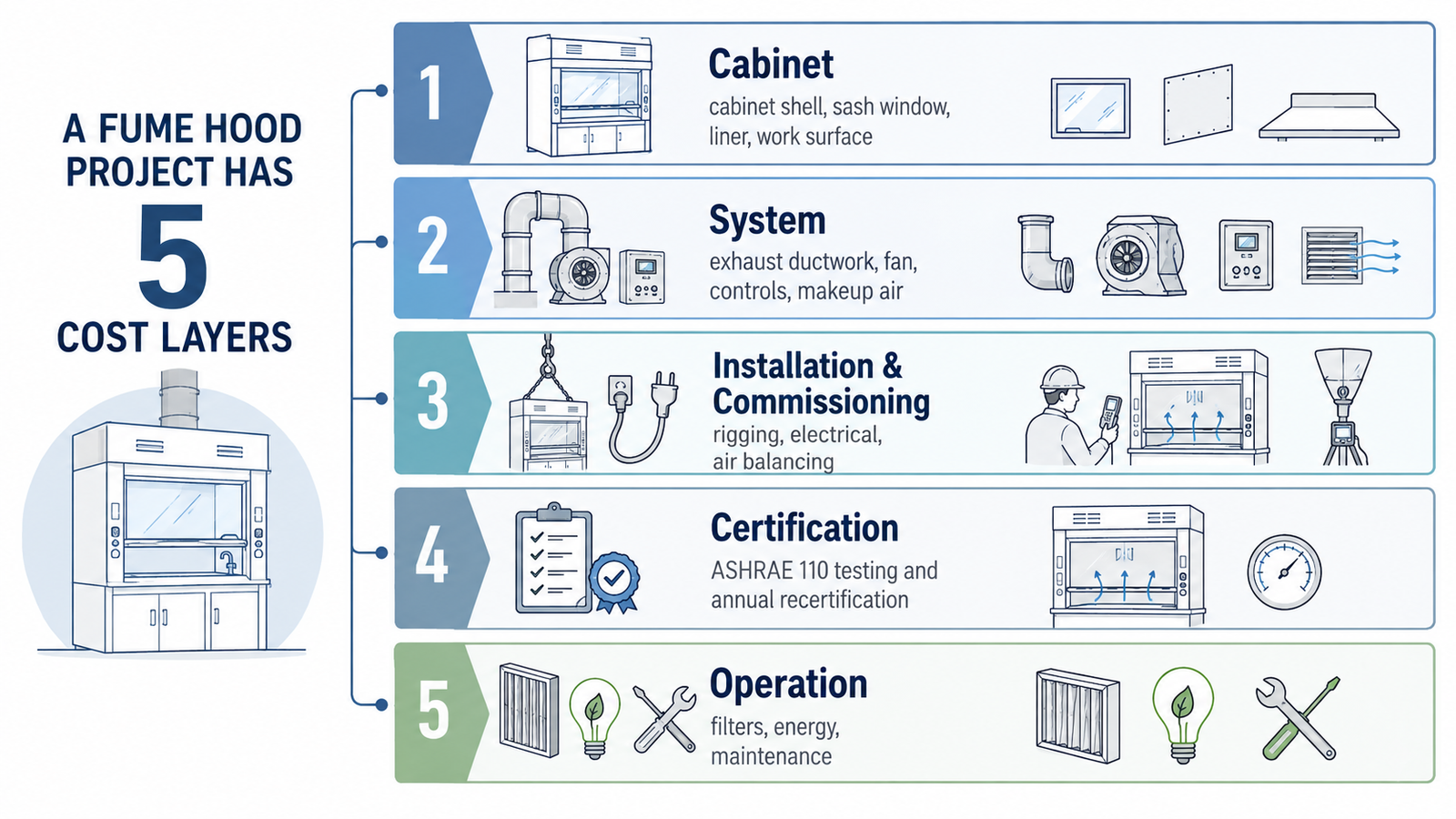
The honest answer to “how much does a fume hood cost” has two parts. One: the ranges you see online are real but not comparable — sources quote bench and standard cabinets from roughly $2,000 to $15,000, walk-ins from $10,000 to $25,000 or more, and ducted installation often adding $5,000 to $20,000, with definitions that differ by source, which is exactly why no single figure can be your answer. Two: the useful number is a structure of five layers, and the one layer you can compare on a spec sheet is the cabinet, which is also the layer most likely to mislead a budget.
| Cost layer | What it covers | What drives it |
|---|---|---|
| Cabinet | Shell, sash, liner, work surface | Size, material, special construction |
| System | Ductwork, exhaust fan, controls, makeup air | Ducted vs ductless, total airflow |
| Installation | Rigging, electrical, positioning, commissioning | Site complexity, new vs retrofit |
| Certification | Performance testing and annual recertification | Standard and schedule |
| Operation | Filters, energy, maintenance | Total airflow, run hours |
One engineering fact makes the whole structure legible: airflow. A fume hood is accepted at a face velocity near 100 fpm at the working sash height (UCSC EHS), so the airflow each hood draws equals the open sash area times that velocity. A 4-ft hood with a 12-inch sash draws about 4 sq ft times 100 fpm, roughly 400 cfm; a 6-ft hood draws about 600 cfm. Total that across every hood and you have the single number behind the system, installation, and operation layers. That is why two “fume hoods” can have project costs that look unrelated: the cabinet price is the anchor most people start from, and it is the wrong anchor to finish on.
After this section you can state that your project’s fume hood cost is a system cost, and you can name the five layers and the airflow number that sits behind them.
The Five Cost Layers of a Fume Hood
Cabinet
The cabinet is the box the reader pictures: the shell, the glass sash, the interior liner, and the work surface. Size drives the first order of the price — a 4-ft, 5-ft, and 6-ft cabinet are different fabrications with different airflow footprints. Material drives it harder when the chemistry demands it. A standard epoxy-coated steel cabinet suits general chemical work. Polypropylene replaces the liner and interior with a corrosion-resistant plastic for aggressive acids. Stainless steel adds heat and acid-digestion resistance where PP will not do. FRP serves specific corrosive combinations. Perchloric acid work adds a wash-down construction with a watertight interior and dedicated exhaust — a different cost class entirely. The cabinet layer is the one layer you can price from a spec sheet, which is why it anchors budgets; it is never the whole answer, and it is the layer where a “cheap cabinet” can hide the largest system behind it.
System
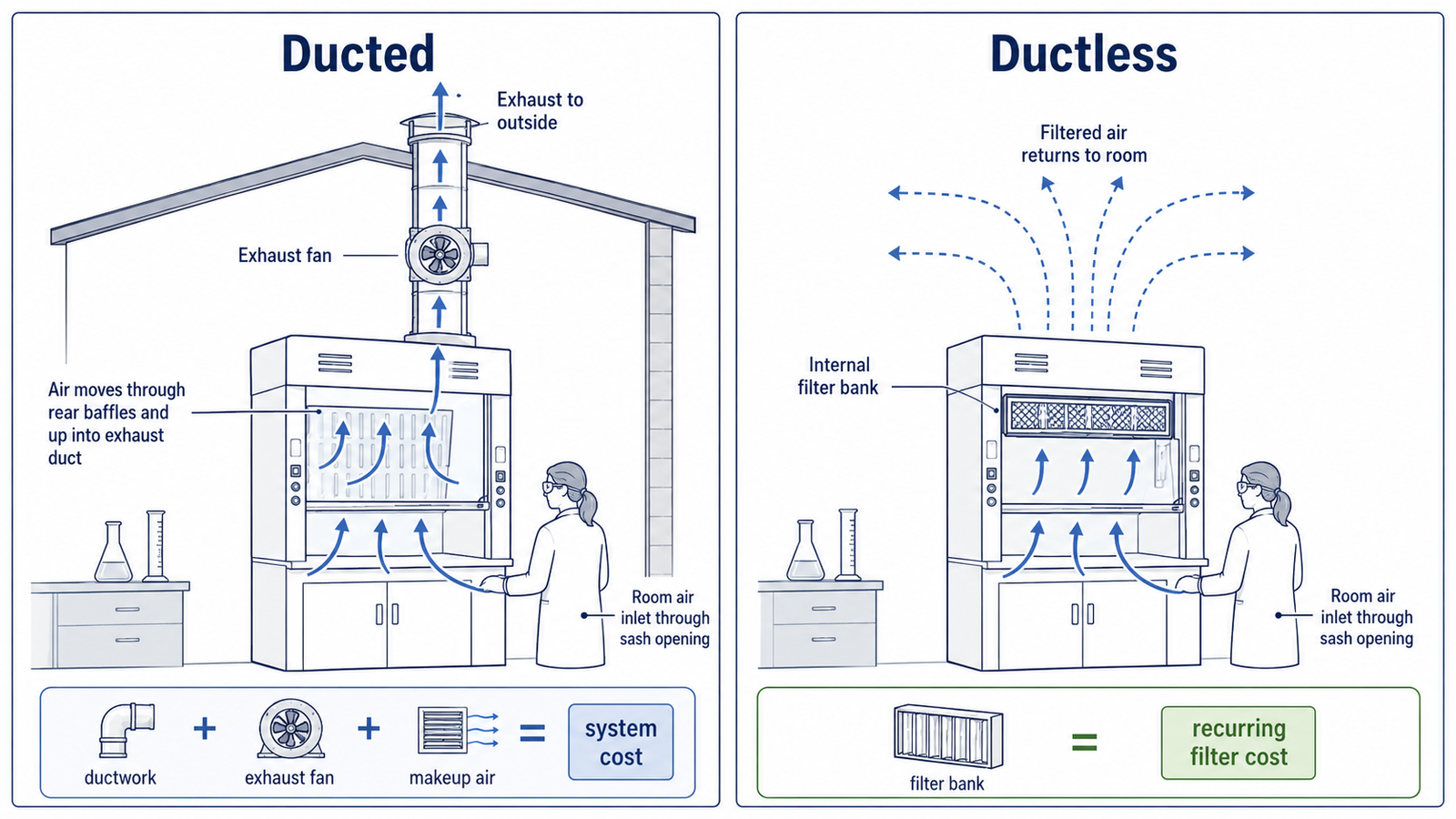
The system layer is where ducted and ductless diverge, and it is often the largest single cost. A ducted fume hood needs an exhaust duct run, an exhaust fan sized for the CFM, a control arrangement, and makeup air to replace what leaves the room. The engineering is straightforward and consequential: duct diameter follows airflow, the fan must move the total CFM against the static pressure of the run, and the controls have to keep the face velocity at target as the sash moves. None of that scales with the cabinet price — it scales with the total airflow.
A ductless fume hood replaces the duct and fan with an internal filter bank that returns filtered air to the room, removing the ductwork and fan lines but adding a filter line and a hard chemical-compatibility limit. The choice of ducted versus ductless does not change one line item — it changes which layer of the project carries the money, which is why it is the single most important cost decision in the whole structure.
Installation and certification
Installation covers rigging the cabinet into place, connecting electrical and any plumbing, running the duct, and commissioning the airflow. Its cost tracks the site: a ground-floor new lab with an open ceiling is one thing, a retrofit on an upper floor with a long duct run is another, because labor and access dominate this layer. Certification is the acceptance layer — performance testing to ASHRAE 110, which measures containment instead of trusting a face-velocity reading, plus the facility’s annual recertification schedule. Both layers are easy to underestimate and are exactly where a “cheap cabinet” budget gets exceeded, because they are the layers with no spec sheet to compare.
Operation
Operation is the layer nobody puts in the first budget, and it compounds every year. Ductless hoods consume filters on a schedule tied to chemical load. Ducted hoods consume energy proportional to the CFM they move and the hours they run, and the physics is unforgiving: a hood that exhausts 600 cfm moves 600 cubic feet of conditioned air out every minute it runs, and the building must heat or cool replacement air to replace it. Annual certification repeats. The operation layer is why a low first cost can be the expensive choice over five years.
After this section you can name the layers likely to dominate your own project, and the ones you have not priced yet.
The Decisions That Move Money
Four decisions move money between the five layers. Work them in order, and the shape of your project’s cost becomes visible before you ask anyone for a quote.
Size sets the airflow floor
Size sets the airflow floor, and airflow is the multiplier behind most of the non-cabinet layers. The open sash area times 100 fpm gives the draw:
| Hood width | Sash height | Open area | Airflow at 100 fpm |
|---|---|---|---|
| 4 ft | 12 in | ~4 sq ft | ~400 cfm |
| 5 ft | 12 in | ~5 sq ft | ~500 cfm |
| 6 ft | 12 in | ~6 sq ft | ~600 cfm |
Oversizing costs twice: a bigger cabinet costs more, and it exhausts more air that the system and the conditioning have to carry. The correct size is the one that fits the equipment and the procedures, not the largest available.
Material follows the chemistry
The chemistry decides the material, and the material decides the cabinet-layer cost. Standard epoxy-coated steel suits general chemical work. Polypropylene resists most acids and is a common choice for aggressive-corrosion labs. Stainless steel suits heat and certain acid digestions. FRP serves specific corrosive combinations. Matching the material to the chemical inventory is a safety decision first and a cost decision second; the wrong material fails, and a failed liner is a replacement project, not a repair.
Ducted or ductless moves the system layer
The exhaust decision is where the money migrates between layers. Ducted moves the cost into ductwork, an exhaust fan, makeup air, and balancing — higher first cost on the system layer, no filter consumable. Ductless removes the duct and fan but adds a matched filter bank and a recurring replacement cost, and it is only an option when every chemical is compatible with the selected filter. The ducted versus ductless trade and the ductless fume hood page cover the compatibility and selection detail; for cost, the rule is that each choice spends the money in a different place.
Controls decide the operating line
Controls decide how the airflow behaves, and that changes both the system layer and the operation layer. A constant-air-volume (CAV) hood keeps the exhaust airflow fixed regardless of sash position; it is simpler and lower first cost, and it exhausts at full rate all day. A variable-air-volume (VAV) hood modulates airflow with the sash, raising the control cost but cutting the exhausted and conditioned volume when the sash is low. VAV earns its premium only where hoods run many hours with the sash frequently closed; a hood used a few hours a week never pays it back. The controller and VAV control damper pages cover the equipment; for budgeting, run hours decide whether VAV is an investment or an expense.
After this section you can list the four decisions for your own project and say which layers each one moves money into.
Installation and Site Costs
Installation is where a real project surprises a budget built from a cabinet price. The work includes getting the cabinet into place, electrical connection, duct runs for a ducted system, makeup air provision, and airflow commissioning. Three site facts change the cost the most.
| Site factor | Cost impact | What to check |
|---|---|---|
| New build vs retrofit | New build with planned ducts is far lower; retrofit adds demo and routing | Is the exhaust path and electrical already there? |
| Floor and access | Upper floors and occupied space add rigging | How does the cabinet reach the room? |
| Duct run length and route | Longer runs cost more material and fan capacity | How far is the exhaust termination? |
Makeup air is a hidden part of the installation layer. A ducted hood removes conditioned air at its rated CFM, and the room must replace it; a lab with two 6-ft hoods at 600 cfm each needs roughly 1,200 cfm of makeup air before the exhaust is even balanced. The OSHA laboratory standard requires containment for particularly hazardous substances, so the commissioning step is a compliance input, not an extra: the hood should be performance-tested, typically to ASHRAE 110, and the facility’s annual schedule starts from there. A hood that is installed but never tested is a budget line that came out wrong — the containment it was bought for was never verified.
After this section you can decide whether your site is a low- or high-complexity installation and include the makeup air and commissioning steps in the plan.
Operating and Lifecycle Costs
The operating layer repeats every year, and for a ducted hood it is mostly energy. The mechanism is a standard HVAC relation: the annual sensible energy to condition makeup air is roughly proportional to the airflow, the temperature difference, and the run hours — about 1.08 times CFM times the temperature difference in Fahrenheit times the hours. Work one hood: 600 cfm, a 20 °F design difference, 2,000 operating hours a year, and the sensible energy is on the order of 26 million Btu a year — before anyone adds latent load or equipment efficiency. At a commercial rate (use your local $/kWh as the multiplier), that is a recurring line large enough to dominate a five-year budget, and it runs whether or not anyone is at the hood unless VAV closes the sash.
| Operating line | Ducted fume hood | Ductless fume hood |
|---|---|---|
| Filters | None on the hood | Filter bank, replaced on a schedule tied to chemical load |
| Energy | Scales with CFM × run hours | Lower exhaust volume, still recirculates with fan load |
| Certification | Performance test, typically annual | Filter and HEPA checks, same discipline |
| HEPA | Not on the hood | 99.97% grade filter in the bank |
For a ductless hood, the operating layer shifts to filters: the filter bank has a service life tied to the chemical load, and replacement is a recurring line that does not exist for a ducted unit. Certification is the third operating item — fume hoods are recertified on the institution’s schedule, typically annual.
The life-of-project view is where the choices above come together. A low first cost on the cabinet can be buried by system and installation costs; an energy-hungry ducted setup can outweigh a higher first cost elsewhere over years. Budgeting only the cabinet is how a project’s real fume hood cost becomes clear only after the invoice.
After this section you can decide whether your project’s lifecycle cost will be dominated by energy, by filters, or by first cost, and you can run the energy relation against your own total CFM and run hours.
Fume Hood Cost in Practice: A Worked Example and a First-Pass Model
Put the layers together with one example, and do the arithmetic the way you can for your own lab. A teaching chemistry lab plans three ducted benchtop hoods — one 6-ft and two 4-ft — used most of the workday, in a new-build lab with an open ceiling and planned duct runs.
- Cabinet. Three steel cabinets: one 6-ft, two 4-ft. This is the spec-sheet layer, comparable across suppliers.
- System. Ducted exhaust. Total airflow: 6-ft at 600 cfm plus two 4-ft at 400 cfm each = 1,400 cfm. The ductwork is sized to that total, the exhaust fan must move 1,400 cfm against the static pressure of the run, and the controls hold 100 fpm at the sashes. This layer is the largest single cost, and it scales directly with that 1,400 cfm.
- Installation. Open-ceiling new build, so rigging and duct are straightforward; commissioning tests each hood to its 100 fpm target.
- Certification. Initial ASHRAE 110 testing plus the annual schedule.
- Operation. Three hoods at 1,400 cfm total, long run hours — this is where VAV would pay, because the sashes will be closed between experiments; with CAV, the energy runs at full exhaust all day, and the 1.08 energy relation against 1,400 cfm and 2,000 hours is the line to watch.
The relative shape — cabinet small, system large, installation medium, operation recurring — is typical for a ducted multi-hood lab. Change one driver and the shape changes: switch to ductless and the system layer collapses but a filter line appears; run the hoods two hours a day and VAV stops paying.
To run the same shape against your own project, build the first-pass model in four steps. First, total your airflow: list every hood, use the open sash area times 100 fpm for each (4 ft at 12 in ≈ 400 cfm, 6 ft ≈ 600 cfm), and sum them. Second, assign each layer a relative weight from the shape above. Third, run the energy relation (1.08 × total CFM × temperature difference × run hours) to size the operation layer in your own units. Fourth, fill the self-check:
| Self-check item | What to compute or ask | Your value |
|---|---|---|
| Total airflow | Sum each hood’s CFM (width × open sash height × 100 fpm) | e.g. 1,400 cfm |
| Cabinet | Size and material the chemistry requires | — |
| Exhaust | Ducted or ductless? | — |
| Run hours | Hours per week × weeks per year | e.g. 2,000 hrs/yr |
| Energy line | 1.08 × total CFM × ΔT × hours, at your local rate | — |
Then take five questions to any supplier: What CFM does this hood need at my target face velocity? What does the full ducted system add beyond the cabinet — duct, fan, makeup air, balancing? What is the installation scope, and what is excluded? What is the certification and commissioning included, and what is the annual recertification? What is the filter or energy cost per year for my run schedule? A supplier who answers all five with defined scope gives you a real number; a supplier who answers with a range and nothing else is quoting the web back to you.
After this section you can estimate your own project’s total CFM, run the energy line against it, fill each layer with a real value, and carry the five supplier questions into any conversation.
Fume Hood Cost Mistakes to Avoid
| Mistake | What it costs you | The rule |
|---|---|---|
| Budgeting from a cabinet price | The system, installation, and operation layers were never in the number | Build the five-layer structure; the cabinet is rarely the largest layer |
| Trusting a web range | Ranges swing by an order of magnitude and cannot be verified | Ask for a defined-scope quote at your target, such as 100 fpm and the CFM it implies |
| Assuming ductless is always cheaper | Ductless removes duct but adds filters and chemical limits | Compare the layer each choice moves money into |
| Buying VAV “to save energy” | Pays back only with long run hours and frequent sash movement | Match VAV to the operating profile, not to a brochure |
| Ignoring installation and certification | The two layers where a “cheap cabinet” budget gets exceeded | Include rigging, duct, makeup air, and the annual test in the plan |
| Forgetting operation | Energy and filters repeat every year and can outrun first cost | Run the 1.08 energy relation against your CFM and hours |
The pattern behind the rows is the same: each mistake treated a fume hood as a product to price instead of a system to budget. Most of them trace back to the airflow math — a 100 fpm face velocity target and the 400–600 cfm per hood it implies — and to the layers those numbers push cost into. If your lab is at the budgeting stage and you want to check your cost structure against a real project, XICHENG can walk you through it, and the Laboratory Fume Hoods range is the reference if you move to selection.
After this section you can rule out the common fume hood cost mistakes and carry a five-layer budget structure with a real airflow number, not a web range, into your next conversation.
FAQ
How much does a fume hood cost?
There is no single figure. Online ranges span too wide to budget from; a fume hood project cost is the cabinet plus ductwork, fan, controls, installation, certification, and operation, and the useful answer is a five-layer structure for your own scope.
Is a ductless fume hood cheaper than a ducted one?
Ductless removes the ductwork and fan but adds a matched filter bank and a recurring replacement cost, and it is limited to chemicals the filter can handle. It moves money between layers instead of simply removing cost.
What does fume hood installation include?
Rigging the cabinet in place, electrical connection, duct runs for a ducted system, makeup air, and airflow commissioning. Site complexity changes the scope and the cost.
How much does a ductless fume hood filter cost?
Filter cost is set by the service life under your chemical load and the replacement schedule, not by a single price; ask the supplier for the filter life under your specific chemistry.
Does a VAV fume hood save money?
VAV cuts energy only when the sash is closed and the hood runs many hours. For a hood used a few hours a week, the added control cost never pays back.
Leave a Reply