





Key Takeaways
- A fume hood sash height requirement is the sash opening, measured from the work surface to the bottom of the sash, at which a specific hood was tested and shown to hold its face velocity; the fume hood sash height requirements that apply to your hood are the ones printed on your own certification record, not a general rule of thumb.
- Published working heights differ across institutions (12 to 18 inches, 18 inches, 12 or 16 inches, 15 inches, 14 to 18 inches, and 18 or 28 inches) because hood width, bypass design, control style, as-installed test results and shared-fan diversity differ, not because one source is wrong.
- Opening area times target face velocity gives the exhaust volume a hood needs: a 4 ft wide hood at 100 fpm needs about 600 CFM at an 18 inch opening, 400 CFM at 12 inches and 200 CFM at 6 inches.
- At fixed airflow, halving the opening roughly doubles face velocity, and the published ceiling on that rise is two to three times the fully open value.
- The certified or test opening, the working opening and the closed position are three different numbers for the same hood, and a closed sash still has an exhaust minimum.
- A sash position reading or a monitor display shows where the sash is and whether the signal is in its calibrated range; neither one proves that the breathing zone is protected.
Question: how high should this hood’s sash be open, and what changes when you move it? The honest answer starts with a correction: there is no single number. US federal OSHA sets no sash height in its laboratory standard at all, and fume hood sash height requirements therefore belong to individual hoods rather than to a code. What exists instead is a per-hood number created when the hood was tested, printed on a sticker or built into a mechanical stop, and tied to the face velocity that test measured. Follow the sash opening as one variable from that number through the rest of the decision.
Direct answer: A hood’s permitted working opening is created by its own certification test and marked on the hood itself. Federal OSHA publishes no sash height. Work to the marked opening; if you cannot find a mark, treat that as a records problem to fix before the next experiment.
The Sash Opening as a Controlled Variable in Laboratory Airflow
What counts as the working opening under OSHA 1910.1450
A chemical fume hood is defined as a five-sided enclosure whose remaining side is a moveable sash, and the definition adds a condition that laboratories often overlook: the hood must allow chemical work “without insertion of any portion of the employee’s body other than hands and arms.” That sentence is the closest thing US federal law comes to a sash rule, and it is a geometric requirement rather than a measurement. Your working opening is the aperture your hands and arms pass through while the rest of you stays outside it.
Walk-in hoods are covered by the same definition, with their own qualifier: sashes must be “adjusted during use so that the airflow and the exhaust of air contaminants are not compromised.” The regulation therefore treats sash position as an operating condition that has to be managed, and it never converts that condition into inches.
Why there is no single federal sash height
The federal laboratory standard contains no sash height value of any kind. Its control strategy runs through permissible exposure limits, a written chemical hygiene plan and engineering controls, and the hood is one of those engineering controls. Nobody drafted a universal number because a sash height only means something together with a specific hood, a specific exhaust volume and a specific measured face velocity.
Numbers live at the institutional layer instead. A university EHS office, a state construction standard or a provincial regulator can require a height, and several of them do, each tied to its own fleet and its own test result. That is why the same phrase produces a different figure in every document you open, and why the figures are not competing answers to one question.
How the opening term reaches every other part of the decision
Sash opening is a variable you can move, measure, transmit and control, which is what makes it the hinge of this whole subject. Face velocity at the hood face is exhaust volume divided by opening area, so the opening appears in the arithmetic. Hoods have more than one official opening, so the same hood carries more than one number. Control systems consume the position signal, and alarms watch the reading that comes back.
Two boundaries keep that scope honest. The full exhaust volume calculation, including unit conversions and a calculator, belongs to how exhaust volume is calculated. Choosing among hood configurations is a separate decision, covered in hood configurations. The sash opening, the working opening and the position signal are one variable, and the sections that follow stay with it.
A variable, not a slogan
Treat the sash as a variable with a value that someone derived for your hood, and the rest of the subject becomes mechanical: read the value, keep work inside it, check what happens when it moves. If you are planning laboratory space rather than running it, select hood and control configurations using the opening as a design input, then record the value that testing produced. The questions that decide your next step are which number applies to your hood and where it came from, so start there.
Why fume hood sash height requirements differ from hood to hood
The permitted opening on your hood comes from its own test
The number that governs your hood was produced by a measurement, then made visible. WorkSafeBC’s published policy for British Columbia describes the sequence directly: raise the sash to its highest position, take a six-point average across the opening with a calibrated anemometer, lower the sash step by step and re-measure until the required average is reached, then mark that height on the hood. It also sets a floor of 12 inches for the marked height in that jurisdiction. The marked number is a test result, not a design preference.
Certification keeps that number current. Southern Methodist University certifies every hood yearly and attaches a survey sticker listing the hood identification number, the measured face velocity, the certification date and the certifier’s initials. The University of New Mexico puts an arrow on the sticker showing the maximum safe operating sash height, and adds that where a restriction has been placed on a hood, it must not be used above the designated mark. SUNY Geneseo calls the same feature a “Working Height” arrow.
What institutions publish, and under what conditions
Read the table as a set of conditional values, not as competing answers. Each row belongs to a named institution, a named control situation and, in most cases, a named test procedure.
| Institution / source | Published sash figure | Conditions attached |
|---|---|---|
| Tulane University | Working sash height 12–18 inches | Work with hands about 6 inches inside; verify the certification sticker is within the last 12 months; monitor should read 80–120 fpm |
| University of Kentucky | Working sash height between 12 and 18 inches | Average capture velocity 100 fpm at the sash; a 12 inch setting may not suit personnel well above 6 ft |
| Wayne State University | 12–18 inches, ideal ≈100 fpm at 15 inches | Sash stoppers or arrows mark the position; certification passes at 70–130 fpm; above 250 fpm is hazardous |
| USC Environmental Health & Safety | Maximum 12 or 16 inches, per hood | Face velocity measured in the sash plane between 12 and 16 inches; mean 100–150 fpm |
| University of New Mexico | 80–125 fpm at an 18 inch sash height | Arrow on the sticker marks the maximum safe operating height as recorded at the annual certification |
| Penn EHRS specification | 18 inch sash height | Average 80–120 fpm with no point more than ±20% of average; low-flow alarm below 80 fpm |
| Colorado State University technical standard | 18 inch measured from the top of the air foil | 80 fpm (high performance) or 105 fpm (standard) minimum; sash stops at 18 inches with override release |
| Marquette University test procedure | Test opening 18 inches | Pass band 100–150 fpm; 6 inch opening must not exceed 300 fpm |
| Labconco (manufacturer) | Typically 18 or 28 inches | Operational face velocity quoted as 60–125+ fpm without further conditions; low-flow hoods do not share one number |
| University of Guelph | 18 inches for bypass (CAV) hoods | 80–130 fpm at that height; VAV hoods quoted as 100–130 fpm regardless of sash height |
| Stanford University | Typically 18 inches | Sash stops required on new vertical-sash hoods; alarm below 80% of set point |
Four reasons two similar hoods carry different numbers
Width and bypass design change how velocity behaves as you lower the sash. A hood with a bypass grille admits air as the sash descends so that face velocity rises slowly. Colorado State’s standard writes that requirement as a number: with the sash lowered to 6 inches, the bypass must limit the increase to a maximum of three times the average face velocity at the fully open position.
Control style determines whether the airflow follows the sash. The University of Guelph publishes one band tied to an 18 inch working height for bypass hoods and a different band for VAV hoods that holds “regardless of sash height”, because a VAV system resets volume as the opening changes. Comparing the two control styles behind those numbers is a system selection decision. Machine-level response to the same sash movement comes back in the signal section of this decision.
The as-installed containment result, not the catalog sheet, sets the marked height. WorkSafeBC requires containment to be demonstrated by the ANSI/ASHRAE 110 method and the installation to be certified by a registered professional engineer, which is the step that produces a hood-specific number. Two hoods of the same model in different rooms can therefore legitimately carry different marks.
Shared exhaust fans add a system-level variable. Where several hoods connect to one fan, sash position and on/off state interact across the group, and the balancing report records the assumption used. Interface Engineering illustrates the convention with a line such as “no diversity was used during TAB”, meaning all hoods were opened per design during testing. The same warning appears in WorkSafeBC’s policy: after adjusting one hood in a manifolded system, all hoods must be re-checked, sometimes repeatedly.
Sash stops, and why removing one voids the number
A sash stop is a physical limit on the sash path, and it exists so that an operator cannot open a hood beyond the height it was tested at without noticing. Stanford requires sash stops on newly purchased vertical-sash hoods, typically limiting the open face to about 18 inches, and USDA ARS describes hoods with stops that park the sash near a 14 inch working position.
Removing or defeating a stop puts the hood outside its certified performance envelope, and the loss is not visible on the monitor. A regulatory policy in British Columbia requires all hoods in a manifolded system to be re-checked after a height change, and a Lawrence Berkeley National Laboratory study of campus hoods notes that stops and sashes are routinely removed by users. Annual ratings can also be issued per opening, with the University of Guelph listing outcomes such as satisfactory at an 18 inch working height, adequate with a sash adjustment to a lower height when velocity is low, adequate at fully open when velocity is too high, and unsatisfactory meaning the hood is out of service.
Decide your own number by reading it off the hood rather than repeating one from a web page, then choose whether that number needs re-verification. If the sticker, arrow or stop is missing, treat it as a records failure to fix before experiments resume, and bring the certification date and measured velocity into the records list described later in this guide.
Sash Opening Arithmetic: How Opening Size Sets CFM and Face Velocity
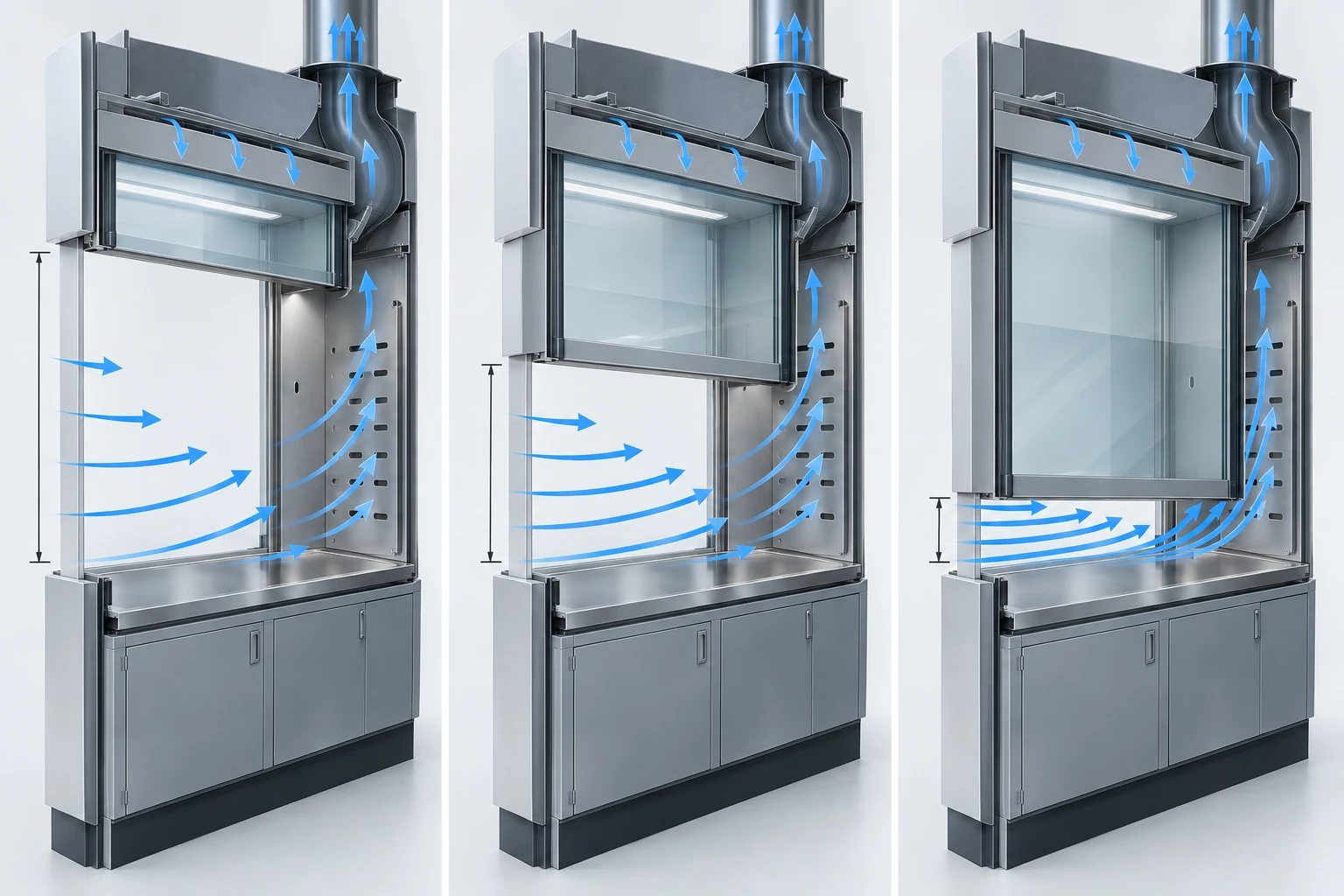
Opening area is the term you control. The relationship between sash opening and airflow is not controversial: the National Environmental Balancing Bureau describes what face velocity tells us as “the volume of air flowing into the hood (speed x sash opening)”, and Labconco states that face velocity depends on both the amount of air going through the hood and the size of the opening. Two numbers define the arithmetic. Opening area is sash height multiplied by hood width. Exhaust demand is that area multiplied by the target face velocity.
The relationship you can substitute numbers into
The substitution is short enough to do at a bench. A hood 4 ft wide with the sash at 18 inches exposes an opening 4 ft wide by 1.5 ft high, or 6 ft². At a target of 100 fpm, the hood needs about 600 CFM. The same arithmetic at other openings and other hood widths appears below.
| Hood width | Sash opening | Opening area | CFM for 100 fpm | CFM for 80 fpm |
|---|---|---|---|---|
| 4 ft | 18 in | 6.0 ft² | 600 | 480 |
| 4 ft | 12 in | 4.0 ft² | 400 | 320 |
| 4 ft | 6 in | 2.0 ft² | 200 | 160 |
| 6 ft | 18 in | 9.0 ft² | 900 | 720 |
| 6 ft | 12 in | 6.0 ft² | 600 | 480 |
| 8 ft | 18 in | 12.0 ft² | 1,200 | 960 |
These are engineering inferences from area multiplied by velocity, not field measurements, and they assume a uniform velocity profile across the opening. The full calculation method, including unit conversions, belongs to the exhaust-volume calculation guide, and this section uses only the opening term. Read the table as a reason to know your own number: doubling hood width doubles the exhaust a hood needs at the same opening and the same target velocity.
What happens at fixed airflow when you lower the sash
At a fixed exhaust volume, opening area and face velocity move in opposite directions. If the system holds 400 CFM regardless of sash position, a 4 ft hood runs at roughly 67 fpm with the sash at 18 inches, 100 fpm at 12 inches, and 200 fpm at 6 inches. Halving the opening roughly doubles the velocity, and going from 18 inches to 6 inches triples it.
That rise has a published ceiling. A 1978 laboratory fume hood standards report prepared for the US Environmental Protection Agency states that control velocity as the sash is lowered “must increase to twice but not more than three times the velocity for full open sash position”, and its text treats three times as the upper limit that can be allowed. The document is a research report, not a regulation, and it is dated 1978, so treat the ratio as a historical design criterion. A modern construction standard reaches a similar place from the other direction: Colorado State requires that a bypass limit the velocity increase to a maximum of three times the fully open value when the sash is lowered to 6 inches.
Worked example: one hood, three openings
Take a 4 ft wide hood on a constant-volume system delivering a measured 400 CFM, with a target of 100 fpm. At 18 inches, the opening is 6 ft² and velocity is about 67 fpm, below the 80 fpm low-flow alarm threshold that several programs specify, so the alarm logic would flag it. At 12 inches, the opening is 4 ft² and velocity is about 100 fpm, on target. At 6 inches, the opening is 2 ft² and velocity is 200 fpm — three times the 67 fpm at the 18 inch reference above, so a six-inch working opening already sits at the top of the two-to-three-times band measured against a fully open sash, and it is still below the 250 fpm hazard level.
Change one condition and the conclusion moves. If the system is VAV and resets volume with the sash, holding 100 fpm at 18 inches requires about 900 CFM instead of 600, and the controller must be able to deliver it. If the hood is 8 ft wide instead of 4 ft, every volume doubles: 1,200 CFM at 18 inches and 800 CFM at 12 inches. The number marked on the hood is what keeps this arithmetic anchored to a tested condition.
When a lower sash makes things worse
Lowering the sash is not automatically the safer move. On a constant-volume hood, closing part of the opening raises the face velocity, and a distributor technical blog (nationallaboratorysales.com) explains the consequence plainly: closing the sash on a CAV hood increases face velocity, which could push contaminated air back into the room. Wayne State treats high velocity as a hazard in its own right, noting that velocities above 250 fpm create hazardous conditions. USDA ARS training material puts the upper edge lower still for carcinogens, reproductive toxins and acutely toxic substances, noting that above 125 fpm turbulence can carry contaminants into the breathing zone.
The practical inversion is documented. Drexel University advises a sash height of 15 to 21 inches and adds that when a hood fails certification because air face velocities exceed 120 fpm, the sash should be raised to reduce velocity to an acceptable working range. A hood can therefore fail at both ends, and the corrective action differs by direction. When face velocity reads outside its band, use the diagnostic path for a face velocity that is too high or too low rather than assuming one direction is always safer.
Why a single number is not the whole answer here
The relationship itself is already well covered. Two ranking sources state the formula, so the value added here is the substitution and its consequences, not the concept. Apply the arithmetic to your own hood and two questions follow: whether the demand at your working opening matches the exhaust your system actually delivers, and whether the velocity rise at a lower opening stays inside the published ceiling.
Use the target band your institution publishes, then determine which bound is at risk in your operating range. If your system holds volume constant, the binding constraint is likely the upper velocity limit at small openings. If your system resets volume with the sash, the constraint is the minimum volume the controller can hold. Both cases send you to the next decision: which opening you are actually working at. What 60, 80 and 100 fpm mean explains the band values themselves, and the full calculation method covers systems where duct and fan capacity limit the achievable volume.
Three Different Openings: Certified, Working and Closed
One hood carries more than one official opening, and mixing them up is the most common source of confusion about sash height. A certified or test opening is the height at which the hood was measured. A working opening is the height an institution allows you to work at. A closed or unoccupied position is a third state with its own airflow floor. All three can coexist on the same hood without contradiction, because each one answers a different question.
Certified or test opening: the height the hood was tested at
Containment and face velocity testing happen at a defined sash position, and that definition travels with the result. Marquette University positions the sash so the raised opening is 18 inches before measuring, University of Windsor tests hoods at both 18 inches and 6 inches, and USC measures face velocity in the vertical plane of the sash between 12 and 16 inches. Colorado State goes further and requires submittals showing the relationship between containment, CFM, face velocity and sash height from 12 inches to fully open, plus a manufacturer containment test at 50 fpm with the sash at 28 inches or greater.
The distinction that matters operationally is the one research safety offices draw between a maximum operating position for vertical sashes and a test opening for horizontal sashes. A flow rate measured at a test opening does not transfer automatically to a different opening, which is why containment testing at a defined opening is the only documentation that shows what the hood does at the height it was approved for.
Working opening: the height institutional rules allow you to work at
Working rules are usually written as a range with a human constraint attached. Tulane University sets a working sash height of 12 to 18 inches and adds that the bottom of the sash must stay below the user’s face. Kentucky allows 12 to 18 inches and notes that a 12 inch setting may not suit personnel well above 6 ft. Wayne State expects work at the height marked by arrows or stoppers, between 12 and 18 inches measured from the bottom of the opening, with an ideal near 100 fpm at 15 inches.
Two constraints define the ends of that range. The lower end is ergonomic and task-driven, because a sash that is too low prevents safe handling and forces awkward postures. The upper end is aerodynamic, because opening beyond the marked position lowers face velocity and, in the language of one research safety office, allows vapors to escape into the room.
Closed or unoccupied position: a state with its own airflow floor
A closed sash is not an off switch. Regulatory guidance reproduced in a manufacturer’s standards compilation states that hood exhaust airflow should not be reduced to less than 25 ft³/min/ft² of internal hood work surface even when the sash is fully closed, `per NFPA 45-2000 A6.4.6, as reproduced by TSI LC-125`. Applied to a 6 ft by 2 ft work surface, that floor is about 300 CFM, an engineering inference from the cited density rather than a published value for any specific hood.
Unoccupied states also have their own control targets. Stanford’s ventilation program allows the face velocity to drop from 100 fpm to 60 fpm in setback mode once a user is no longer detected, and the same compilation notes that emergency override should permit full design flow even with the sash closed. The closed position is therefore a controlled operating state, not the absence of one.
Why one hood can legitimately be three different numbers
The three openings can be brought together in a single view, and the reason they differ is visible in the middle column.
| Opening | What it answers | Where the value comes from |
|---|---|---|
| Certified or test opening | At what height was this hood measured and approved? | Certification record and sticker; test procedure such as 18 inches, or 18 and 6 inches, or 12 to 16 inches |
| Working opening | At what height may a person work? | Institutional working rule, typically 12 to 18 inches, constrained by ergonomics and by the marked maximum |
| Closed or unoccupied | What airflow is still required, and what does the control system do? | Minimum flow floor, unoccupied setback targets, and emergency override capability |
Use the table as a sorting test rather than a lookup table. When a number appears in a document without a label, ask which of the three questions it answers; that step determines whether the number governs how you work, how the hood was approved, or what the system must still do while nobody is present.
Your next step is to compare the three values for your own hood and check for contradictions, such as a working rule that permits a height above the certified maximum. Where two of the three disagree, the annual inspection record is the document that settles which value was actually verified.
How Sash Opening Signals Drive Airflow in fume hood sash height requirements
A sash opening becomes a number in a control system through one component: a sensor that reports travel. Everything downstream depends on that number being calibrated, transmitted and interpreted correctly. This section follows the path from window position to exhaust demand, and then explains why the same sash movement produces opposite results on a constant-volume hood and on a variable-volume hood.
What the position signal is, and what it is not
Position sensing on a vertical sash is usually a draw-wire device, and the position-sensor documentation states its boundary directly: the sash position sensor reports travel, it does not drive the sash, and it does not decide when movement is allowed. That distinction shapes the whole control chain, because a reading is an input, never an action.
Signal configuration adds a failure mode that is easy to miss. Where the resistance output is wired for the wrong input range, the signal may still change as the sash moves, but the displayed position and the airflow mapping derived from it can be wrong. Calibration therefore requires defined closed and open points plus one independent physical check at an intermediate position, since the electronics will happily report a smooth curve that does not correspond to the opening.
How a controller turns opening into exhaust demand
In position-sensor control mode, the controller combines sash-opening information with the selected face-velocity requirement to calculate exhaust demand, adjusts the connected VAV device, and uses measured airflow with the opening area to calculate average face velocity. In plain terms, the controller multiplies your opening area by the target velocity to obtain a volume, then drives a damper to deliver it. One XICHENG controller operates this way through a single analog input from a sash position sensor or a face velocity sensor, and it does not generate airflow by itself: it cannot replace the hood, sash, damper, fan, ductwork or containment testing.
A mechanical limit runs alongside the electronic one. Actuator travel times published for the same controller family range from 2.0 seconds for a 5 N·m rotary unit to 9.0 seconds for a 30 N·m unit, with a linear option at 3.0 seconds per 100 mm. Those are stroke times, not loop response times, and the two must not be treated as interchangeable when a project specifies response requirements.
CAV and VAV responses to the same sash change
Constant volume and variable volume systems answer the same opening change in opposite ways. A CAV hood moves a constant flow of air whether the sash is open or closed, so covering more of the face lowers velocity and closing the sash raises it — the distributor explanation that closing the sash on a CAV hood increases face velocity and can push contaminated air back into the room is that same mechanism stated as a consequence. A VAV hood varies the exhaust volume as the opening changes, which is why the University of Guelph can publish a band that holds regardless of sash height.
| System response | Face velocity as the sash is lowered | What sets the airflow |
|---|---|---|
| Constant air volume (bypass hood) | Rises; the published ceiling is two to three times the fully open value | Fixed exhaust volume, modified only by bypass air |
| Variable air volume | Held near the set point by reducing or increasing exhaust | Position signal plus measured airflow against the target velocity |
Choosing between these two approaches is a system selection decision covered in the comparison of CAV and VAV systems. What matters at the sash is narrower: on a constant-volume hood your opening choice is the only variable you control, while on a variable-volume hood the control loop takes part of that decision back.
Where the signal becomes a display and an alarm
The last stage is presentation. A hood airflow monitor can display face velocity, sash opening or travel, airflow progress and exhaust temperature, and its documented alarm list includes excessive sash opening alongside low face velocity, high exhaust temperature and communication loss. The monitor does not create the measurements shown on screen and does not regulate exhaust airflow on its own, so it should be read as one link in the chain rather than as the chain itself.
One reset behavior deserves attention before you need it. Acknowledging an alarm silences or clears the panel indication, and it does not correct the underlying fault. With the signal path now defined, the next question is timing: how fast a sash moves, how quickly the loop responds, and how long an alarm may take to appear. Choose your own operating height with that timing in mind, and select alarm settings from the project requirements rather than from panel defaults.
Faster Sash Movement, Response Time and the Alarm Window
A sash is an object in motion, and motion is a variable in its own right. Sash movement speed affects the airflow pattern at the hood face, response time determines how quickly the exhaust follows, and alarm timing determines what an operator can still notice before exposure occurs. Three published sources cover these three quantities, and they should be kept separate rather than averaged together.
Sash movement speed is itself a variable
Hardwick’s 1997 US Department of Energy conference paper, written by an author at TSI Incorporated, studied hoods with sashes moving from closed to open at 2, 1.5 and 1 ft per second on both constant-volume and variable-volume systems. The finding was directional rather than numeric: sash movements can disturb airflow patterns at the face, and the faster movements of 2 ft/s and 1.5 ft/s had a greater effect than the slower movement of 1 ft/s. A slow, deliberate sash movement is therefore a control measure available to the operator at no cost.
Response time and stability targets
The compilation of standard clauses reproduced by TSI states that VAV response must bring flow or face velocity within 90% of target within 5 seconds or as defined by the design documents, and that stability must prevent deviation of more than 10% from the design value, `per ANSI/ASSP Z9.5-2022 §7.2.3.4.5, as reproduced by TSI LC-125`. The same section’s notes treat a response time of less than 5 seconds as acceptable for most operations and describe overshoot or undershoot as 10% of the steady-state value.
Measured numbers exist as well, and they carry a narrower condition. The same manufacturer measured 3.1 seconds on a 4 ft hood and 2.7 seconds on an 8 ft hood with a 100 fpm set point and the sash opening at 1.5 ft/s, and its 1994 application note describes the measurement definition itself as the open question: a vendor-defined time to 90% travel with flow to 90% value produced an apparent 0.8 seconds, which the manufacturer declined to recommend because the industry-standard definition in ASHRAE 110 is the proper one to use. Treat recall-based or vendor-defined figures as comparisons, not thresholds.
When the alarm should fire, and how long it may take
Flow monitoring requirements are written with a margin. Hoods must be equipped with a flow indicator, flow alarm or face velocity alarm indicator able to signal improper flow when flow is high or low by 20%, calibrated at least annually, and the accompanying note directs the alarm to warn when flow is 20% low, that is 80% of the set point value, `per ANSI/ASSP Z9.5-2022 §4.3.3, as reproduced by TSI LC-125`. The same notes add that tissue paper and strings do not qualify as the sole means of warning.
Field behavior matches the direction of that requirement without matching its number. The University of South Carolina documents that raising the sash above the mechanical stop at 18 inches causes the alarm to sound, and that the hood changes to emergency mode within minutes, with alarms monitored by the energy management system. Queen’s University records that a fully raised sash drops face velocity to about 60 fpm and sounds the alarm, and that this position is for setup only. An alarm delay matters because a transient excursion can be real and still fall inside the window.
What to do in the first minute after an alarm
Lower the sash to the marked working height first. The University of North Alabama’s chemical hygiene plan states the corrective action plainly: if the monitor is alarming, lower the sash to the marked working height, and if a low-flow alarm engages, lower the sash until the alarm stops rather than overriding the safety alarm. Reverse the move if the alarm is reporting excessive velocity instead, since the two failure directions have opposite corrections.
Do not silence the indication without addressing the cause. Reset acknowledges a condition; it does not restore airflow, and a hood that alarms again after reset has told you something about the system rather than about the panel. Your next step is to record the sash position and the reading at the moment of the alarm, compare the sequence against the daily checks and alarm records your institution requires, and follow the diagnostic path for a face velocity that is out of range before returning the hood to service.
Closed or Left at the Certified Height: Two Rules With Different Purposes
Two instructions circulate in the same buildings and appear to contradict each other. One says close the sash when the hood is not in use. The other says leave the sash at the marked height so the hood keeps the airflow it was certified to deliver. Both come from credible sources, and the resolution is not to pick the stronger authority but to notice that each rule answers a different question.
The field conflict, stated plainly
An industrial hygiene forum thread recorded the disagreement in operational form: a technician reporting an annual qualitative hood check found that approximately 25% of the hoods were closed rather than at their dictated sash heights. The poster told the workers to open the hoods to the indicated sash height so the specified air velocity would be maintained; in one area the worker said they had been instructed to keep the sash closed unless they were working with materials in the hood, and the poster found that several published sources agree with that instruction.
Both positions have a basis. Closing the sash when nobody is working supports containment and energy use, and a closed sash rests against an airfoil that still admits air. Leaving the sash at the marked height supports the velocity the hood was certified at. Neither statement is wrong; each is a rule about a different purpose.
Containment and energy point to closing
Regulatory and institutional sources both treat the closed position as the resting state. University instructions state that the sash should be kept closed when not in use and should usually be closed when the work is not being actively performed. A closed sash also acts as a physical barrier that remains in place regardless of airflow.
The energy case is quantitative but strictly conditional. A Lawrence Berkeley National Laboratory study estimated annual costs from $3 to $11 per CFM depending on climate, with a US average of $5,624 per hood per year and $6,031 in California at 2003 electricity prices, and modeled per-hood costs ranging from about $4,600 in Los Angeles to about $9,300 in Singapore.
The study’s larger savings figures, 50% to 75% per hood, are attributed to emerging technologies as a package rather than to closing the sash alone, and the authors state that each hood user must close the sash properly for a system to achieve its full savings potential, noting that stops and sashes are routinely removed. Any percentage attributed to sash closure without a primary measurement should not be relied on.
Verification points to the certified height
Face velocity is meaningful only at a defined opening. Certification records state the measured velocity alongside the height it was measured at, testing procedures specify the sash position first and then the velocity band, and rating schemes issue their verdict per opening rather than as a single house number, with the outcomes described in the section on how published working heights differ. A hood that has been kept closed all week has no current evidence at the height where it will be used.
Verification also has a frequency and a formality. Containment testing is performed by the tracer gas method at a specified opening, and one university’s design specification requires the test report to be stamped by a registered professional engineer. Above sash-height decisions sits the containment method itself, which is why the containment test at a defined opening is the document to read before changing how a hood is operated.
What the rules require when the sash is fully closed
Closing a sash does not stop exhaust. As set out where the closed position is defined, the compiled floor of 25 ft³/min/ft² of internal hood work surface applies even with the sash fully closed, so a 6 ft by 2 ft work surface still requires roughly 300 CFM. The same compilation notes that emergency override should permit full design flow even with the sash closed, which is the provision that keeps a purge or spill response possible while the sash is down.
Automatic systems encode the same two purposes in one device. Stanford’s program describes automatic sash control that detects a user, waits a specified period after the user is no longer detected, and then shuts the sash, with the unoccupied state allowing face velocity to fall from 100 fpm to 60 fpm as a setback target. The hood is still exhausting; it is simply running at its unoccupied value.
Worked example: the same hood in use and at rest
Consider a 6 ft wide hood with a 2 ft deep work surface, a certified working height of 18 inches, a certified face velocity of 100 fpm, and an unoccupied setback target of 60 fpm. At the certified height, the opening is 9 ft² and the hood needs about 900 CFM to hold 100 fpm. With the sash closed, the exhaust floor is about 300 CFM, and the setback target of 60 fpm applies to whatever area the bypass or airfoil leaves open rather than to a closed face of zero.
Both states are correct for their purpose. Verification at 18 inches tests the hood at the condition where it was approved; operating closed between experiments reduces exhaust while keeping the floor required by the compiled standard. If the hood belongs to a manifolded exhaust system, closing it changes the pressure available to other hoods, so check the balancing report’s diversity assumption before treating closure as free. If the work involves higher-risk materials, decide the operating state with EHS and verify containment at the opening you will actually use, since the two rules coexist rather than compete.
What Sash Readings Prove, and the Opening Records to Ask For
A reading is evidence of one thing only: the sensor and the control configuration produced that number. Whether the breathing zone is protected is a separate claim, established by a different test. The last part of this decision separates those two claims, then turns the operating values you have collected into a request list for suppliers and a field check you can repeat.
What a position reading can and cannot prove
A position signal is useful and narrow. It shows where the sash is, and whether the signal sits inside its calibrated range. It cannot show that the descending sash path is clear, because obstruction detection is a different function with its own sensing, and it cannot show that the air moving past the operator is doing its job. The signal path described earlier ends at a number that describes position; it does not describe protection.
Calibration is what connects the number to the physical world, which is why a misconfigured resistance range is a safety-relevant error rather than a display nuisance. The signal may still change as the sash moves, but the reported position and the airflow mapping derived from it can be wrong, and nothing on screen reveals the error.
What a monitor display actually shows
A hood airflow monitor gives you a local view of measured values. A typical panel displays face velocity, sash opening or travel, airflow progress and exhaust temperature, and its documented alarms include low face velocity and excessive sash opening. That panel does not create the measurements shown on screen and does not regulate exhaust airflow on its own, and screen resolution does not determine measurement accuracy.
The controller behind the panel has its own boundary. It converts a position signal into exhaust demand and drives a damper, but it does not generate airflow, and it does not replace the hood, sash, damper, fan, ductwork, electrical supply, building management programming, containment testing or final face velocity verification. A displayed actuator position alone is not proof of performance.
What the readings do not establish
| Claim | Supported by a position or airflow reading? | What actually establishes it |
|---|---|---|
| The sash is at a specific height, and the signal is in its calibrated range | Yes | Sensor output plus calibration at defined closed and open points |
| The exhaust volume delivered matches the demand calculated from the opening | Yes, when airflow is measured independently | Airflow measurement with the opening area calculation |
| The descending sash path is unobstructed | No | Dedicated obstruction detection, not a position reading |
| The breathing zone is protected during a given operation | No | Tracer gas containment testing at the opening you will use |
| The hood is operating inside its certified envelope at that opening | No | Certification record and periodic re-verification at the marked height |
When you need a containment test instead
Containment is demonstrated, not inferred. The tracer gas method evaluates a hood at a specified opening, and some institutional specifications require the report to be stamped by a registered professional engineer before a new hood is used. Where a hood is operated above its marked height for setup, where the work changes to higher-risk materials, or where the exhaust system has been modified or re-balanced, verification is the evidence that closes the gap.
Instrument shortcuts do not substitute for that test. Flow monitoring requirements carry an explicit warning that tissue paper and strings do not qualify as the sole means of warning, because a tissue strip confirms that air is moving, not that it is moving in the right pattern at the right speed.
The Sash Opening Check: five fields to record and request
The output of this decision is a short record you can build from documents you already have and questions you can put in writing.
| Field | Where the value comes from | Why it matters |
|---|---|---|
| Permitted working opening | Certification sticker, arrow, painted line or mechanical stop | Defines the height the hood was approved at |
| Current working opening | Measured at the bench, with the sash at the position you actually use | Turns a rule into a comparison |
| Certified face velocity and certification date | Certification sticker fields: measured velocity, date, hood ID, certifier initials | Gives the value its condition and its age |
| Alarm set point and response requirement | Project specification or control documentation | Sets the threshold at which the hood reports a problem |
| Minimum or unoccupied exhaust volume | Control sequence documents or balancing report | Shows what the system must still do with the sash closed |
Two more items belong in the same request when more than one hood shares an exhaust fan: the diversity assumption recorded in the balancing report, and the containment or certification record for each affected hood. For a new project, ask for the submittal showing containment, CFM, face velocity and sash height across the range from 12 inches to fully open, and for sash stops at the working height with an override release.
A request built this way is short and hard to dodge: name the hood, cite the marked working height, and ask for the certified face velocity with its date, the alarm set point and response requirement, the minimum or setback volume, and the diversity basis. Use the operating values you collected to write your next request, and use the fields an inspection record keeps as your filing standard so the next review starts from documented values rather than from memory.
FAQ
How high should a fume hood sash be open?
Work at the height marked on the hood, which is the height at which it was tested and approved. Where no mark exists, obtain one before relying on the hood, since institution ranges such as 12 to 18 inches are defaults, not a substitute for your own certified value.
What is the maximum working sash height on my hood?
Read it from the certification sticker, the arrow, the painted line or the mechanical sash stop, and treat the annual certification record as the authority when the label is damaged. Typical published values include 18 inches, 12 or 16 inches, 15 inches and a 12 to 18 inch range, each tied to the hood and procedure it came from.
Does a sash position sensor prove containment?
No. A position sensor reports travel and shows where the sash is, and the position-sensor documentation states directly that a valid position reading cannot replace obstruction detection. Containment is demonstrated by tracer gas testing at a defined opening.
What happens to exhaust volume when I close the sash?
Volume drops but does not reach zero. Compiled standard text requires no less than 25 ft³/min/ft² of internal work surface even with the sash fully closed, `per NFPA 45-2000 A6.4.6, as reproduced by TSI LC-125`, which is about 300 CFM for a 6 ft by 2 ft surface as an engineering inference. Reduced unoccupied set points also exist under a different condition: compiled guidance reports unoccupied hoods containing fumes at a reduced face velocity of 60 fpm per ASHRAE CH-99-09, as reported by Phoenix Controls, which is not the same condition as a fully raised sash dropping a hood to about 60 fpm as a field reading.
Why is face velocity tested at 18 inches, or at 12 to 16 inches?
Because a velocity value only means something at a stated opening. Test procedures position the sash first and then apply a velocity band, and some programs test two openings, such as 18 inches and 6 inches, or require a curve from 12 inches to fully open.
Which records should I attach to an RFQ for a VAV hood?
Ask for the permitted working opening, the certified face velocity with its date, the alarm set point and response requirement, the minimum or standby exhaust volume, and the sash stops with override release. Where several hoods share a fan, add the diversity assumption from the balancing report.
Final Verdict: your next step after the opening check
The comparison you are now able to make is small and decisive: the marked working height against the height you actually work at, the certified velocity and its date against the alarm set point, and the closed-state volume against the standby value your system can hold. Where those values agree, you have a documented operating range you can maintain. Where they disagree, you have a specific request to send rather than a general concern to raise.
Plan the closing step the way the rest of this decision was planned. Confirm the marked opening with whoever certifies hoods at your site, request the certified values in writing, verify containment at the opening you will use whenever the work or the exhaust system changes, and keep the signed record with the hood so the next person can determine fume hood sash height requirements from documented values rather than from memory.
Leave a Reply