


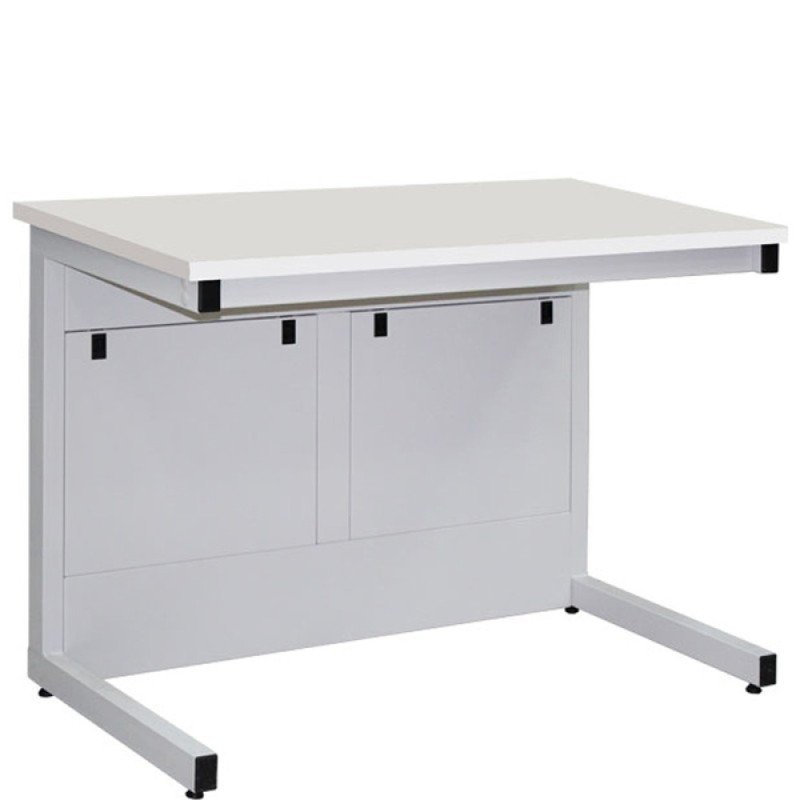
Description
A laboratory instrument table is a dedicated equipment-support workstation planned around the instrument rather than around a generic room-furniture module. Its depth must accommodate the equipment body, rear connectors and service access; its support structure must match distributed and concentrated loads; and its shelves, openings, power and tubing must follow the actual instrument arrangement. These requirements distinguish an analytical instrument table from an ordinary wall bench that happens to have equipment placed on it.
The table provides a physical platform and organized interfaces. It does not guarantee instrument accuracy, calibration, vibration isolation, acoustic performance or temperature control. Those outcomes depend on the selected table configuration, building environment, equipment requirements and commissioning work. Where quantified vibration isolation is required, use an anti-vibration balance table designed for that purpose.
Key Specifications and Selection Summary
Comparable Product-Family Data
The values below establish the fields buyers should compare before choosing a laboratory instrument bench. They represent available configuration families, not a single model that combines every size, load, shelf and accessory.
| Decision Field | Reference or Available Option | Confirm for the Order |
|---|---|---|
| Product type | Fixed instrument table, rack-equipped analytical workstation, mobile service station or reinforced equipment table | Instrument and peripheral-equipment layout |
| Reference dimensions | 600-1800 mm recurring widths; about 483-1050 mm documented depths; 750-900 mm fixed work heights | Equipment body, rear access, operator position and room fit |
| Upper structure | Open worktop or upper rack/shelf; GC/LC examples can reach about 2000 mm overall height | Instrument stack, bottle/column access, center of gravity and delivery route |
| Support | Leveling feet, locking casters, caster-plus-adjuster or selected electric columns | Stability, relocation, floor condition and post-move recommissioning |
| Worktop | Chemical-resistant faced top, phenolic-composite construction, stainless option or selected laboratory surface | Chemicals, cleaners, temperature, cutouts and equipment feet |
| Load | Configuration-specific uniformly distributed values and separately reviewed point/dynamic loads | Weight, foot positions, vibration, support spacing and operating condition |
| Power and cable management | Power strip or recessed outlets, cable holders, pass-throughs and equipment cords where selected | Voltage, socket, current, circuits, UPS, grounding and cable route |
| Tubing and services | Selected hose/tube units, gas, vacuum, cooling, drain, data or exhaust interfaces | Media, pressure/flow, materials, connection and building responsibility |
| Maintenance provisions | Rear clearance, shelves, pull-out trays, access panels or ventilated compartment options | Service side, heat load, filter/pump removal and flexible connections |
What to Check Before Selecting a Table
Begin with the complete equipment set. Record the main instrument, pumps, chillers, gas generators, computers, monitors, bottles, waste containers and any future modules. For each item, provide dimensions, operating weight and the position of feet or mounting points. The table depth and support arrangement should be set from this envelope, not from a nominal instrument width alone.
Next, identify how the equipment is operated and serviced. Doors, lids, autosamplers, column compartments, filters and rear panels require clearance beyond the static footprint. Cable bends, tubing loops and ventilation outlets also consume depth. If a component must slide out for maintenance, show the pull-out path and the temporary load it places on the table or tray.
Finally, coordinate services and support. A caster-supported station may simplify access but requires brakes, flexible connections and a plan for re-leveling or equipment checks after movement. A fixed table can provide a more direct load path but still needs floor leveling and maintenance clearance. Send the equipment layout and interface schedule with the quotation request so the proposed configuration can be evaluated as one working station.
Product Scope and Equipment Boundary
Core Table Package
The core laboratory instrument table package includes the selected worktop, structural frame or support system, leveling components and the finished edges and basic cable openings stated in the quotation. A fixed general-purpose configuration may use a welded steel frame with leveling feet and an open equipment area. Rack-equipped or mobile configurations use different supports and must be scheduled separately.
The table is sized for the listed equipment and working method. Equipment itself, computers, pumps, chillers, gas generators, bottles, waste containers and analytical accessories remain outside the furniture supply unless expressly named. A photograph showing an instrument stack does not make that equipment part of the table package.
Equipment-Specific Options
Upper shelves and racks can organize stacked LC/HPLC modules, columns, bottles or smaller peripherals while preserving the main work surface. Shelf height, depth and load must match the equipment and keep controls and consumables reachable. Tall racks also change the center of gravity, delivery height and anti-tip requirements.
Power strips, recessed outlets, cable holders, pass-through holes, hose or tubing units and collection boxes can be placed from the equipment interface drawing. Drawers and trays can store tools or allow selected peripherals to slide out for service. Locking casters can support planned relocation, while caster-plus-adjuster arrangements can separate movement from the final supported condition.
Enclosed equipment compartments, fans, acoustic treatment, vibration-damping platforms and temperature alarms belong only to specialist configurations that list them. They are not default functions of every lab equipment table. The quotation must describe the supplied fan quantity, openings, tray, lining or alarm when any of these features is required.
Instrument and Building Responsibilities
The instrument manufacturer or project engineer remains responsible for equipment-specific site requirements, including allowable vibration, heat rejection, ventilation, ambient conditions, electrical quality, grounding, gas purity, exhaust, cooling and calibration. The furniture can be configured around those requirements, but the table does not replace the instrument site-preparation specification.
Building-side power circuits, UPS, gas and vacuum distribution, cooling water, drainage, data networks and room exhaust remain separate unless specifically included. Factory-mounted sockets or tubing brackets terminate at the agreed interface; they do not mean the upstream building system is designed, certified or commissioned.
The approved drawing should identify the boundary for each connection and the access needed to install, inspect and disconnect it. This is especially important for mobile stations: moving a loaded table can require shutdown, disconnection, securing of modules, re-leveling and instrument checks before operation resumes.
General, GC/LC and Heavy-Duty Configurations
Reference Configurations for Different Equipment Tasks
One laboratory instrument table cannot serve every instrument layout with the same dimensions, accessories and load condition. The three configurations below establish useful reference points. Each row keeps its worktop, support and accessories together, so buyers can compare a complete arrangement rather than selecting isolated numbers.
| Configuration | Reference Size and Support | Worktop and Interface Scope | Typical Fit and Confirmation Items |
|---|---|---|---|
| General fixed instrument table | 600-1800 mm width; 600/620/750 mm depth; 750 or 900 mm fixed height; welded steel frame and leveling feet | Selected laboratory worktop; optional pull-out drawers; series reference up to 500 kg/m2 distributed load | General analytical and measuring equipment; confirm actual top, span, point loads and chosen size |
| GC/GC-MS analytical instrument table | 1500 W x 900/1050 D x 850 worktop H / 2000 overall H; steel powder-coated frame | Chemical-resistant faced BF top; 200 kg uniform top load; one eight-outlet strip, one cross hose/tube unit, one shelf, one collection box and four cable holders | GC or GC/MS with its specified peripherals; confirm equipment stack, tubing route and destination electrical standard |
| Heavy analytical instrument table | 1200 W x 900 D x 650 worktop H / 1650 overall H; caster or leveling support | 45 mm phenolic-composite-core top; chemical-resistant coated-steel body; four recessed duplex outlets | Heavier equipment configuration; about 300 kg uniform load on casters or 500 kg on leveling support, subject to the selected support condition |
A lab equipment table should never be chosen solely because it has the highest published load in a comparison table. The GC/GC-MS configuration, for example, is built around a tall rack, tubing organization and a defined uniformly distributed top load. The heavy analytical configuration changes the support condition and worktop construction. The general fixed table has a wider size matrix but requires the final top and load condition to be selected for the actual equipment.
Vertical Equipment Organization
Analytical workstations often need vertical organization for modules, bottles, columns, computer displays or service components. An upper shelf can make a compact footprint workable, but it changes access, center of gravity and total transport height. It should be treated as an equipment-specific structure, not as a decorative add-on.
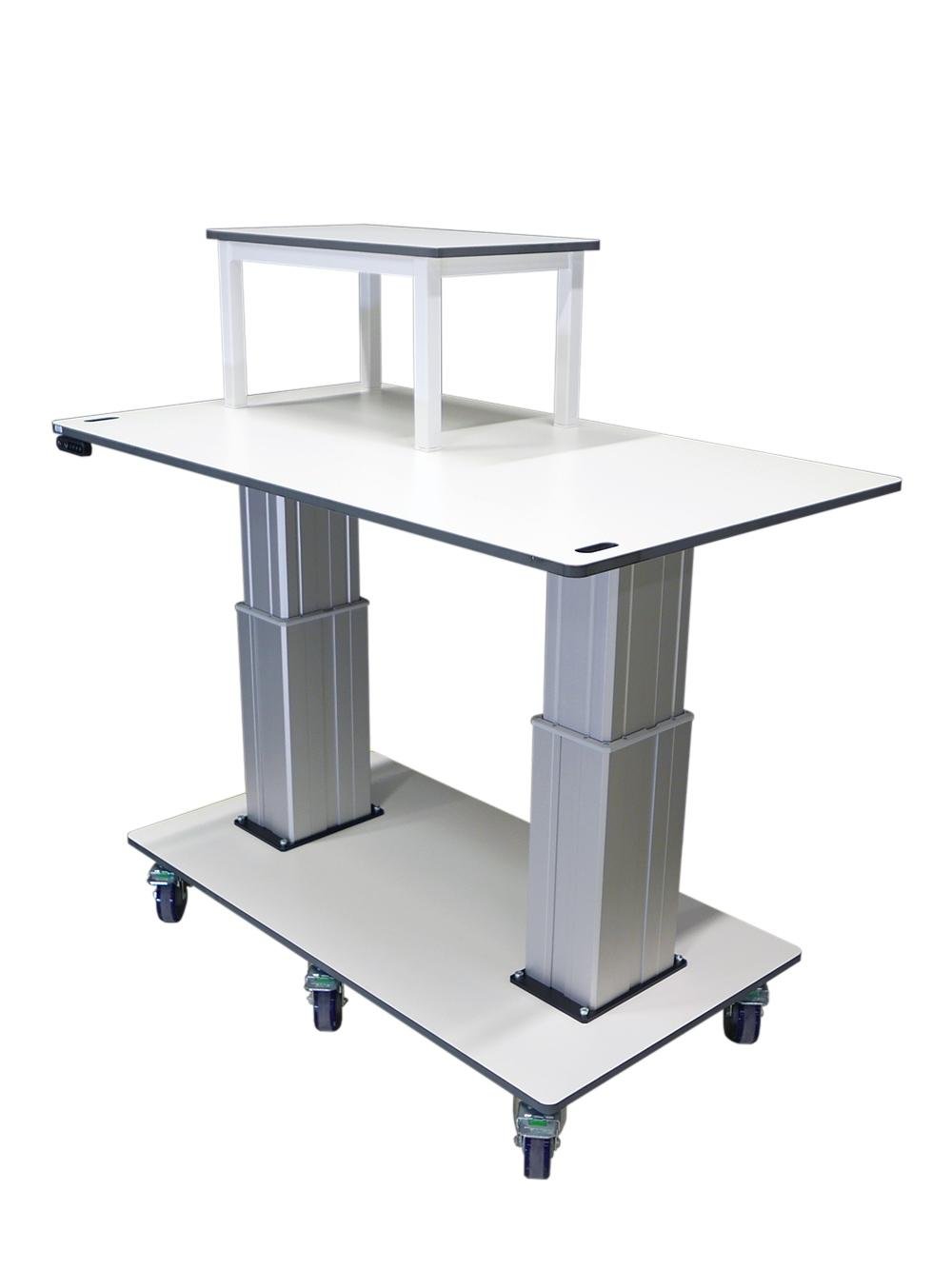
Before adding an upper level, confirm whether the user can reach controls, bottles and consumables without climbing or moving the instrument. The structure must also leave room for heat dissipation, rear connections, tubing bends and later replacement of a module. For high or top-heavy stacks, the support arrangement, caster brakes, leveling points and anti-tip measures should be defined with the equipment layout.
Mobile and Enclosed Peripheral Configurations
Some analytical systems require a table that moves for service or a compartment that keeps pumps, chillers or other peripherals organized below the worktop. These arrangements solve a specific access problem; they are not automatically appropriate for every laboratory instrument bench. Moving a station requires a planned shutdown and reconnection sequence, and an enclosed compartment requires a defined service and heat-management design.
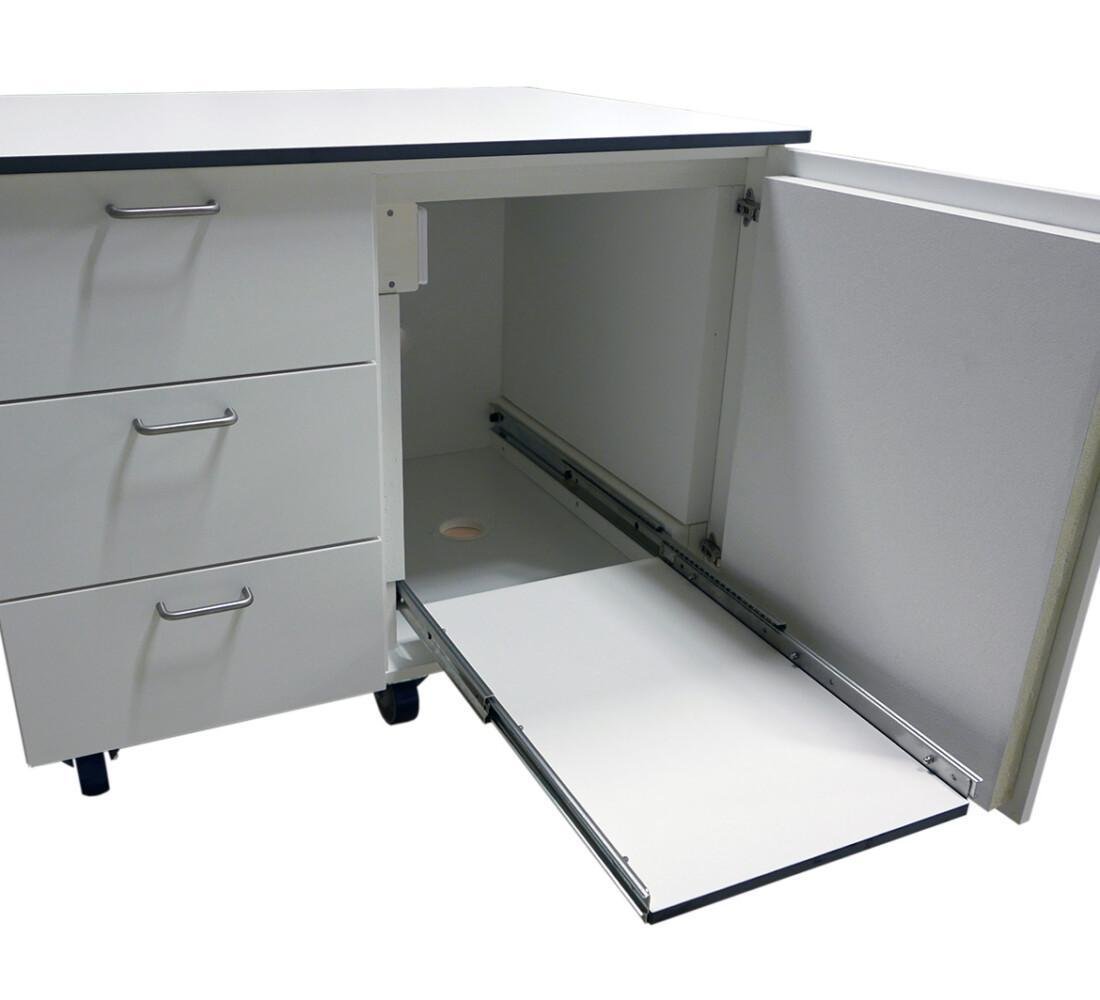
Locking casters improve repositioning but do not make a table equivalent to a permanent fixed installation. Confirm flexible cables, tubing, drain connections and equipment restraint before movement, then re-level and inspect the equipment after the station is returned to service. A pull-out tray can make pumps or small peripherals accessible without lifting them over a bench, but its slide system, extension length and service load must be defined for the selected unit.
Worktop, Frame and Load Planning
Worktop and Frame Selection
The worktop should be selected from the equipment and laboratory task. Chemical-resistant faced boards, phenolic-composite constructions, stainless options and other laboratory surfaces have different behavior around cleaners, solvents, heat, cutouts and localized supports. A named worktop material does not automatically establish compatibility with all media; the actual chemical list, concentration, temperature and contact duration should be reviewed for the selected surface.
The frame carries the load from the worktop to the floor. A welded steel frame with leveling feet, a coated all-steel cabinet base, a caster-supported station and an electrically adjustable structure are separate product types. The quotation should identify frame type, support spacing, leveling method, any lower shelf and the relation between a rack or shelf and the main equipment load.
Distributed, Point and Dynamic Loads
Distributed load spreads weight over the worktop area. Point load is concentrated through small feet, rails or a narrow base. Dynamic load adds movement, vibration, pulling forces or rolling equipment. These conditions can create very different stresses even when the total instrument mass is the same.
For each major item, provide operating weight, foot count, foot dimensions, center of gravity, vibration behavior and installation position. A 200 kg uniformly distributed reference applies only to the associated tabletop configuration and does not prove that a 200 kg instrument can stand on four small feet near an unsupported cutout. The approved configuration must state the appropriate load condition and any local reinforcement, additional support or floor restraint.
Equipment Footprint and Maintenance Envelope
The table must fit the operating envelope, not just the instrument’s shipping dimensions. Allow for doors, lids, autosampler movement, rear panels, column access, hoses, waste containers, cable bends, airflow paths and removal of filters or pumps. Show the service side on the drawing and reserve enough space to reach it without dismantling the entire instrument stack.
The worktop depth should include both the instrument body and usable service space. Adding a rear rack, backsplash or cable channel reduces the effective work depth. If an instrument requires ventilation from the rear, underside or side, do not place it against a closed cabinet panel unless the manufacturer’s clearance and airflow requirements are met.
Power, Cable, Tubing and Ventilation Interfaces
Electrical and Data Planning
Power distribution should begin with the destination country and equipment schedule. Specify voltage, frequency, plug/socket family, number of circuits, maximum current, residual-current protection, UPS requirement, emergency disconnect, grounding and cable-entry direction. A power strip, recessed outlet or IEC-type equipment cord shown in an image is only suitable when it matches these project requirements.
Data ports, network switches, monitor mounts and computer locations should be arranged so cables are protected but still replaceable. Cable holders and pass-through holes reduce clutter when they match the actual device connectors and bend radii. Do not route mains and signal cables together where the equipment manufacturer or local electrical practice requires separation.
Gas, Vacuum, Cooling and Exhaust
GC, GC-MS, LC, HPLC and other analytical instruments can require carrier gas, vacuum, cooling, exhaust, waste or drainage interfaces. The table can provide routes, holders, cutouts or a rack location, but it does not create the required gas purity, pressure, flow, exhaust capacity or cooling performance. List every interface, material, route and connection point in the project schedule.
Where liquid waste, solvents or sample lines are used, keep containers accessible and define leak containment, drainage and maintenance boundaries. Gas cylinders, generators, pumps and chillers may need their own floor position, restraint and ventilation arrangement rather than being placed in an unspecified lower cabinet.
Ventilated Equipment Compartments
An enclosed equipment compartment can organize peripherals below the main work surface and can be configured with ventilation where the equipment heat load and air path are defined. It is a specialist option rather than a general promise for every laboratory instrument table.
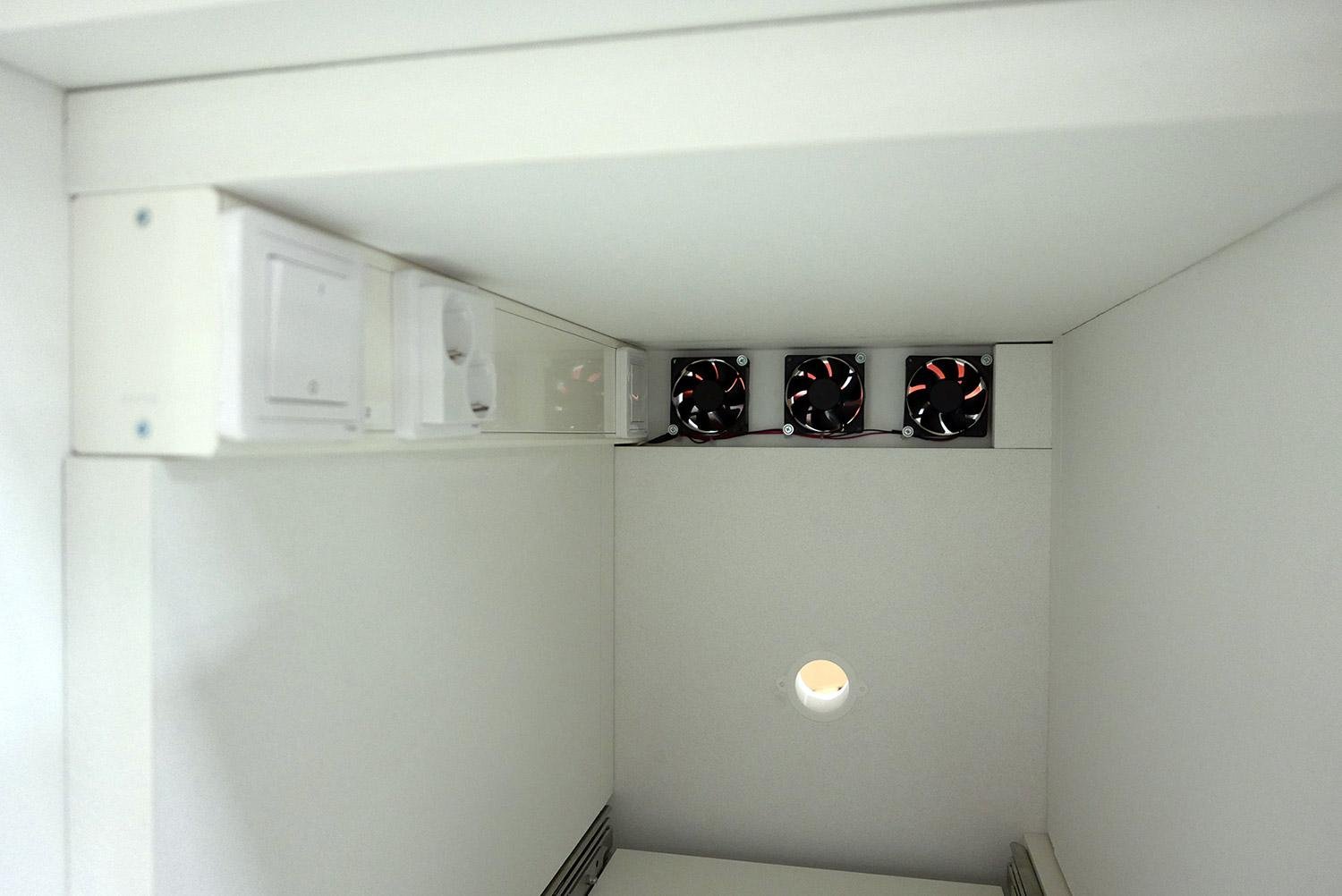
Before using an enclosure, determine what must be ventilated, where intake and discharge air can travel, whether filters are required and how fans, cables and peripherals will be serviced. Do not imply a temperature reduction, acoustic rating or equipment compatibility unless it is specified and verified for the delivered arrangement.
Applications and Product Fit
General Analytical Equipment
A laboratory instrument table is appropriate for measurement, monitoring and analytical equipment that needs a stable, organized work zone with defined access to power and services. Typical installations place the main instrument on the worktop and reserve nearby space for a computer, monitor, sample preparation tools, consumables and peripheral equipment. The table should be configured around the actual operating sequence so that users do not have to move heavy modules merely to reach controls or carry out routine maintenance.
General analytical equipment benefits from a worktop that matches the cleaning method and an under-bench arrangement that protects but does not obstruct services. Leveling feet can suit a fixed position; casters can suit a planned service process when brakes, flexible utilities and re-leveling are included in the procedure. The equipment manufacturer’s site-preparation instructions remain the reference for vibration, electrical quality, ventilation and environmental conditions.
GC, GC-MS, LC and HPLC Workstations
GC and GC-MS systems often need a rear utility area for tubing, gas paths, power and peripheral organization. A rack-equipped analytical instrument table can keep selected components above or behind the main instrument while preserving access to the front controls. The final rack height must account for columns, bottles, exhaust routing, service panels and safe handling.
LC and HPLC systems can use similar worktable dimensions but may need different line routing, solvent/waste organization, module stacking and maintenance access. Do not assume that a GC accessory package is automatically appropriate for HPLC, or that an LC layout includes all GC hose/support components. The equipment list and site-preparation data decide whether the table needs one or more tubing supports, a shelf, cable holders, a collection area or a separate mobile peripheral station.
Mass-spectrometry projects may require a separate lower enclosure or nearby position for pumps, chillers, gas generation or computer equipment. These peripherals have their own heat, access and noise considerations. Their placement should be decided from equipment documentation and room services rather than by filling every available cabinet bay.
When Another Table Fits Better
Choose an anti-vibration balance table when the purchasing requirement is vibration isolation for precision weighing. A general instrument table can be structurally stiff without providing a defined isolation system.
Choose an adjustable-height laboratory bench when repeated ergonomic height adjustment is the central requirement, rather than an occasional equipment-access configuration. Choose a mobile laboratory bench when a general movable workstation is needed without dedicated analytical racks or equipment-service provisions.
For a microscope-centered workspace, use a microscope table that can be planned around optical equipment, operator position and appropriate vibration considerations. When the project only needs a material-specific work surface on an existing support system, select a laboratory countertop rather than purchasing a complete instrument-table structure.
Planning, Installation and Maintenance
Site and Delivery Coordination
Before production, confirm the room layout, floor condition, door and elevator dimensions, turning space and final location. The drawing should show the main instrument, peripherals, rear clearance, operator access, service routes and any wall, floor or ceiling interfaces. A tall GC/LC rack can introduce a total height that matters during delivery as much as it does during daily operation.
Select the support method from the intended use. Fixed leveling feet help establish a stable final position. Casters need brakes and a documented relocation procedure. A hybrid arrangement can use casters for movement and adjustable supports for the final operating condition. Any floor anchoring, wall restraint or seismic requirement is project-specific and should be identified before installation.
Commissioning and Future Service
After the table is placed, level the work surface and verify that cabinet doors, drawers, trays and shelves can operate without conflicting with the instrument or room. Connect power, data, fluids and exhaust only through the agreed interfaces. Inspect cable paths, tubing bends, ventilation clearances and access to filters, pumps and rear panels before equipment is commissioned.
If the station is moved later, disconnect and secure equipment in accordance with its manufacturer instructions, move the bench only when the load and support arrangement permit it, reapply brakes/supports, level the work surface and complete any required equipment checks. The furniture provides access and support; calibration, performance verification and safety commissioning remain part of the equipment and site process.
Information Needed for a Project-Ready Quotation
Provide the following information to configure a laboratory instrument table accurately:
- Main instrument and peripheral equipment make/model, layout and operating sequence.
- Overall dimensions, working weight, feet or mounting points and center of gravity.
- Point loads, distributed loads, vibration, impact and any future equipment allowance.
- Required worktop length, depth, height, rear clearance and overall rack height.
- Equipment doors, lids, service panels, ventilation paths and removal requirements.
- Preferred worktop material, chemicals, cleaners, temperature, cutouts and local reinforcement.
- Fixed leveling feet, casters, hybrid support or adjustable-height requirements.
- Power voltage, plug/socket standard, current, circuits, grounding, UPS and emergency-disconnect needs.
- Gas, vacuum, cooling, drainage, exhaust, data and tubing/cable routing requirements.
- Shelves, racks, drawers, trays, collection areas, quantity, destination and requested installation scope.
The quotation and drawing should identify the final dimensions, worktop and frame construction, support arrangement, load conditions, equipment-specific accessories, interface positions, delivery split, inclusions and exclusions. These approved fields are the basis for the supplied table.
Related Laboratory Furniture
Use an anti-vibration balance table when precision weighing requires a separate isolation arrangement, or a microscope table for an optical workstation centered on operator posture and instrument stability. An adjustable-height laboratory bench suits repeated ergonomic adjustment, while a mobile laboratory bench suits planned repositioning. Select a laboratory countertop when only the work surface is required.
Frequently Asked Questions
What makes an instrument table different from a standard lab bench?
A laboratory instrument table is configured around equipment footprint, support conditions, rear access, power, cables, tubing, ventilation and future service. A general lab bench may provide a work surface, but it does not automatically include the depth, load review, rack, utility routing or equipment-access features needed for an analytical installation.
What dimensions should be used for an analytical instrument table?
Real configuration families range from 600 to 1800 mm in width, about 483 to 1050 mm in depth and 750 to 900 mm in fixed work height. A 1500 mm width appears frequently, but the correct dimensions depend on the main instrument, peripherals, rear access, user position, service paths and delivery route. Rack-equipped configurations can be approximately 2000 mm high overall.
How is table load capacity confirmed?
Capacity is confirmed for the selected top, frame, support mode, span and equipment position. Provide the working weight, foot dimensions, center of gravity, point loads, dynamic behavior and future equipment allowance. Distributed-load figures cannot be used as proof of local point-load capacity without reviewing the full configuration.
Can the table support GC, GC-MS, LC or HPLC equipment?
Yes, a laboratory instrument table can be configured for these applications when the equipment layout and services are known. GC/GC-MS and LC/HPLC workstations can use different tubing, shelf, bottle, waste and access arrangements, so the table should be configured from the actual instrument set rather than from the application name alone.
Can power outlets, shelves and tubing supports be included?
They can be included as selected options. Confirm voltage, socket type, circuits, current, grounding, cable routing, shelf load, tube materials, connection locations and maintenance access before they are added to the drawing. Building-side electrical and process services remain separate unless included in the defined scope.
Should the table use leveling feet or casters?
Leveling feet suit a fixed operating position. Locking casters suit planned movement and service access, provided the instrument can be moved safely and utilities can be disconnected or routed flexibly. Some projects use a hybrid arrangement that rolls for positioning and transfers the operating load to adjustable supports.
Does an instrument table provide vibration isolation?
Not by default. A structurally stable equipment table is not the same as a table with a defined vibration-isolation system. For precision weighing or applications that require controlled isolation, evaluate an anti-vibration balance table with the appropriate performance requirements.
What equipment data is needed before production?
Provide the instrument and peripheral layout, dimensions, operating weight, foot positions, services, heat and ventilation directions, access requirements, desired worktop, support type, accessories, delivery route and destination. This information allows the supplied table and interfaces to be defined on the quotation and drawing.
Contact the Xicheng Engineering Team Today
Send the Xicheng engineering team the instrument layout, equipment dimensions and weights, support/footprint information, service schedule, desired worktop, rack or storage arrangement and destination. We will return a coordinated laboratory instrument table configuration and quotation within 24 hours, with any project-specific interfaces clearly identified.
Shenzhen Office: No. 34 Zhenxing Road (Shengtaian Heavy Industrial Park B), Loucun, Guangming New Dist, Shenzhen, Guangdong, China
WhatsApp: +86 18126478161
Engineering Mailbox: fanalax34@gmail.com