




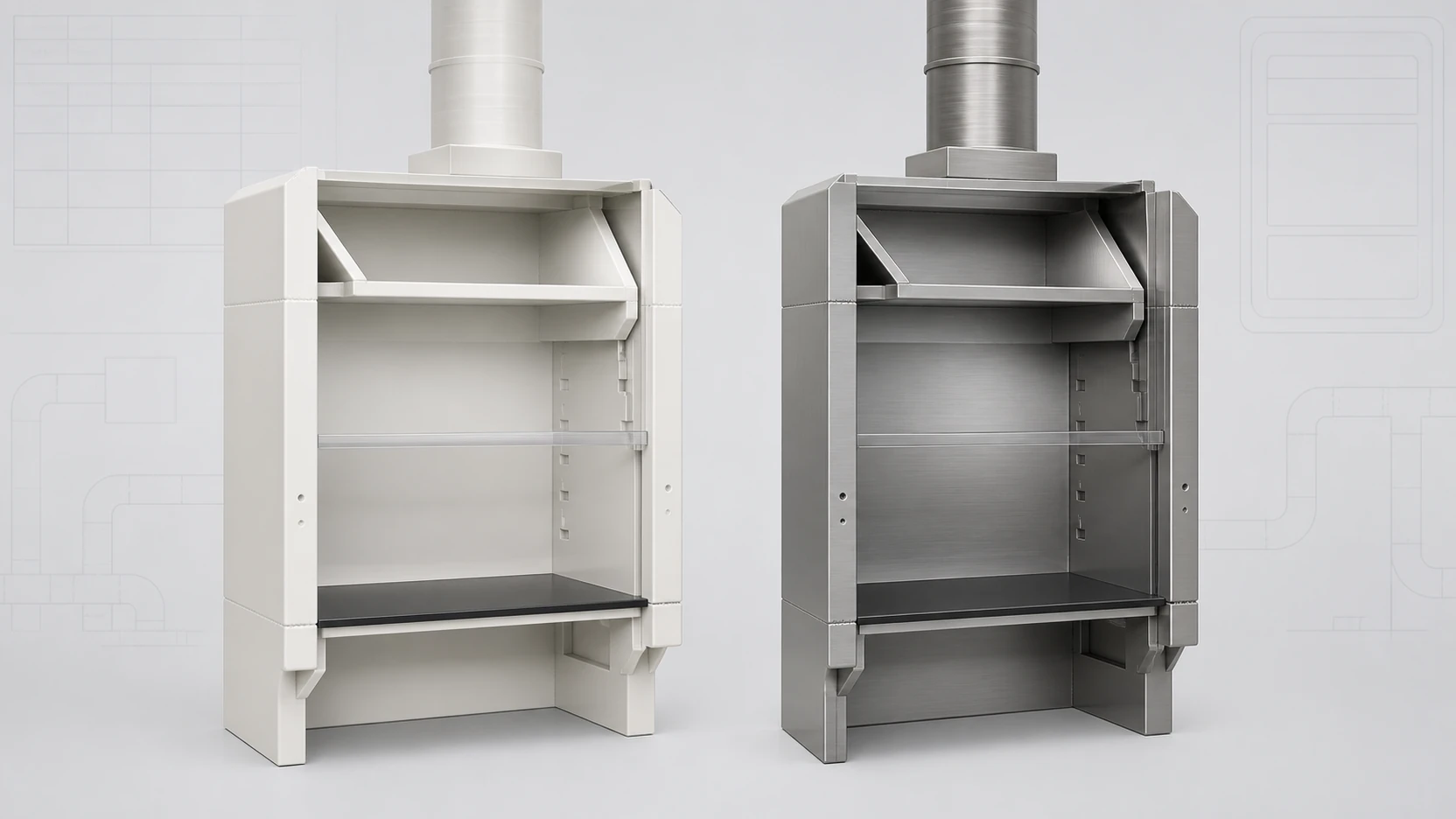
Key Takeaways
- A PP vs stainless steel fume hood decision starts with the chemical schedule, not the material name. A PP fume hood is a welded polymer enclosure; confirmation requires exact chemical, concentration, temperature, duration, stress, cleaning and component evidence.
- Keep PP under consideration only when exact component compatibility evidence is supplied. An 8 mm welded PP construction identifies a possible scope; it does not approve a named chemical, mixture, temperature or duration.
- Choose stainless steel as a candidate only with a defined grade. 316’s 2–3% molybdenum can improve chloride-pitting resistance relative to 304, but neither grade is a universal corrosion approval.
- Map every exposed component before naming the cabinet material. Liner, worktop, welds, fasteners, drains, duct, fan and treatment equipment can have different exposure limits.
- Stop a standard comparison when special chemistry appears. Perchloric acid and HF work needs designated-hood review; oxidizers, heat, flammables and unknown mixtures are conservative project-review triggers.
A PP vs stainless steel fume hood comparison fails when a material name replaces an exposure review. Polypropylene, 304 stainless steel, and 316 stainless steel describe cabinet or component materials; they do not identify the concentration, temperature, contact time, cleaning chemical, condensate, spill route, or exhaust component that will see the process. The useful question is not “Which material is better?” It is “Which submitted exposure profile can this specific hood and its exposed parts support?” This guide turns that question into a chemical schedule, a component map, a conditional material decision, and an RFQ input set. It also shows when ordinary material selection must stop.
Direct Answer: PP vs Stainless Steel Fume Hood Selection
A PP vs stainless steel fume hood decision should begin with three evidence states: PP under consideration, grade-defined stainless under consideration, or specialist/project review. PP may remain under consideration only when documented compatibility for the exact chemical, concentration, surface temperature, duration, stress, cleaning regime, and each exposed PP component is supplied. Grade-defined stainless may remain under consideration only when the same exposure evidence supports the specified 304 or 316 scope. A sourced designated-hood case, such as relevant HF or perchloric-acid work, requires specialist review; oxidizers, heat, flammables, heavy condensate, and unknown mixtures are conservative project-review triggers until their process evidence is assessed.
| Evidence state | Continue only when | Do not infer |
|---|---|---|
| PP under consideration | Exact chemical/component compatibility evidence, including concentration, surface temperature, duration, stress, cleaning, spills, condensate, and every exposed part, is supplied. | A cabinet made from 8 mm welded PP on one XICHENG configuration is a universal approval for every PP hood or process. |
| Grade-defined stainless under consideration | The project identifies 304 or 316, the same exposure profile, surface/cleaning requirements, weld and hardware scope, and downstream exhaust components. | A request for “stainless” automatically means 316 or that a named grade suits every acid, halide, oxidizer, or wet service. |
| Specialist/project review | EHS, supplier, and project engineering assess a designated hood and exhaust-system approach from complete process data. | A standard PP-versus-stainless comparison can approve a designated-hood case or an unverified process. |
PP may remain under consideration only after the complete exposure profile and exact component compatibility evidence are supplied. On XICHENG’s PP hood configuration page, the quoted welded 8 mm construction is a starting point for a component-level RFQ—not a generic chemical-compatibility promise for every solvent, oxidizer, mixed fume, elevated-temperature process, or long-term exposure.
For RFQ orientation only, 8 mm converts to about 0.315 inches; XICHENG’s 1200 mm, 1500 mm, 1800 mm, and connected 2400 mm references convert to about 47.2 inches, 59.1 inches, 70.9 inches, and 94.5 inches. Its stated 0.3–0.5 m/s reference face velocity converts to about 59–98 fpm. These are configuration conversions from the cited product references, not material-compatibility, containment, or acceptance values.
A cleanable metal work zone may point a project toward a defined stainless scope. XICHENG’s stainless configuration page frames 304 or 316 as a project-condition choice; the ASSDA Grade 316 note explains why its 2–3% molybdenum can improve chloride pitting and crevice-corrosion resistance relative to 304. That mechanism does not make 316 immune to hot chloride service, so a grade name remains an input to review rather than an approval.
Decision landing: You can now keep PP or a defined stainless grade under consideration only where evidence exists, or route the project to specialist review; the next step is to document the exposure profile before choosing a material.
Build the Chemical Exposure Profile Before Naming a Material

*Illustration only: use the copy-ready schedule below as the project record; the image is not compatibility evidence or a supplied-product drawing.*
An exposure profile is the first deliverable of a PP vs stainless steel fume hood project. It records what the hood will actually contact: the chemical identity, the concentration at the hood rather than the stock-bottle label, the physical form, the process and surface temperature, the contact pattern, the cleaning regime, and the abnormal events that change the worst case. Both XICHENG’s PP and stainless configuration pages ask for chemical name, concentration, temperature, physical form, contact duration, cleaning, and spill information; use that shared checklist as the start of the exposure record, not as a material recommendation.
Chemical Identity and Concentration Are Not Enough
A schedule should distinguish a single reagent from a blend, note whether the process is liquid, vapor, aerosol, or condensate, and identify the actual concentration at the hood. A mixture can behave differently from its components: an acid bath with a surfactant wets surfaces differently, and a digesting sample can release gases the stock solution never shows. Record the working concentration and the concentration that can build up on a surface after evaporation, not just the label on the source container.
The concentration field also sets the evidence requirement. A material claim that holds for a 10% solution does not automatically transfer to a 37% solution of the same acid at the same temperature; time and temperature can reverse the order of suitability. Write the concentration range the process can actually produce, including cleaning steps, and require the supplier’s evidence to match that range.
Temperature, Contact Duration and Exposure Mode
Temperature, contact duration, and exposure mode can reverse a material assumption that looks reasonable at room conditions. Thermo Fisher’s PPCO labware guidance reports chemical ratings at 20 °C (about 68 °F) and separates 7-day (about 168 hr) from 30-day (about 720 hr) continuous exposure categories. Those figures belong only to PPCO labware, not a PP hood, its welds, its stress state, or its exhaust system; use them once as a caution that time and temperature need their own evidence, not as a hood rating.
Record the temperature at the exposed surface and in any likely condensate, not only the room setpoint or vessel label. Note whether contact is intermittent, continuous, splashing, immersion, vapor-only, or a deposit that remains after operation. Airflow and sash conditions can influence where vapor or condensate travels, but they do not establish material compatibility; record them as a separate containment-design input.
Cleaning, Condensate and Off-Normal Events
Cleaning chemicals, condensate, and off-normal events belong in the same profile as the process chemical. A work surface may be wiped with a different agent than the reagent in the vessel, while condensation may change local composition or concentration depending on volatility and process conditions. State the cleaning agent, its concentration, cleaning temperature, dwell time, rinse method, and whether the cabinet will see wet deposits between operating cycles.
Off-normal events define the limits of a basic material comparison. Include likely spills, container breakage, washdown, blocked drainage, heated residues, and a loss of exhaust condition in the project discussion. The University of Wisconsin–Madison EHS guidance says that not all hoods may be used for all chemicals and identifies high-concentration or evaporating perchloric acid and HF work as examples requiring specially designed hoods.
| Exposure field | What to record | Why the reviewer needs it | Example entry |
|---|---|---|---|
| Chemical identity | Exact name, formulation, blend components | Compatibility claims are chemical-specific | Aqueous hydrochloric acid, no surfactants |
| Concentration | Working %, maximum achievable %, evaporative concentration | Transfers between concentrations are not automatic | 10% working; 15% possible after evaporation |
| Physical form | Liquid, vapor, aerosol, condensate, mist | Contact mode changes material demand | Vapor + occasional splash |
| Temperature | Process temp, surface temp, condensate temp | Ratings are temperature-dependent | 20–25 °C process; surface same |
| Contact pattern | Continuous, intermittent, immersion, residue | Duration logic applies per mode | Intermittent; 15-minute transfers |
| Cleaning regime | Agent, concentration, temp, dwell, rinse | Cleaning can be the harshest exposure | Alkaline detergent, weekly |
| Condensate route | Where vapor condenses, what it carries | Local composition can change | Rear baffle and exhaust collar |
| Off-normal events | Spills, breakage, washdown, blocked drain, exhaust loss | Sets the worst-case review basis | Quarterly washdown |
Decision landing: You can now issue an exposure profile with chemical, concentration, temperature, contact mode, cleaning, condensate, abnormal-event, and evidence-status inputs that the next component map requires.
Map Every Exposed Component, Not Just the Cabinet
A corrosion resistant fume hood material is a component map, not a cabinet label. The map lists every surface and part that can contact liquid, vapor, mist, condensate, residue, or cleaning agent: cabinet shell, liner, worktop, baffle, seams, fasteners, drain, sash guide, exhaust collar, duct, fan, and treatment equipment. Each row names the component’s material, the evidence needed for the submitted exposure, the owner who supplies that evidence, and whether the entry is confirmed, pending, or not applicable. A blank or unowned row means the material decision for that part is not ready. As one operating benchmark, XICHENG’s FRP guidance suggests placing the emission source at least 150 mm (about 5.9 inches) behind the sash plane when the approved procedure allows it; that placement benchmark belongs to containment practice, not to a material compatibility claim.
| Component group | Material requested | Evidence needed | Owner | Open status |
|---|---|---|---|---|
| Cabinet, liner, worktop, baffle | Supplier identifies each exposed face and its construction | Compatibility record for the exact exposure; fabrication details | Supplier + process owner | Confirmed / pending / not applicable |
| Welds, seams, fasteners, drain, sash guide | Joint, seal, hardware, and drain materials | Wetting, cleaning, residue, and crevice review | Supplier + EHS | Confirmed / pending / not applicable |
| Collar, duct, fan, treatment equipment | Each material, seal, housing, and contact surface | Vapor, condensate, cleaning, and upset review | Facilities + supplier | Confirmed / pending / not applicable |
Cabinet, Liner, Worktop and Baffle
On XICHENG’s PP configuration page, one quoted configuration uses welded 8 mm PP plate and reference widths of 1200 mm, 1500 mm, and 1800 mm, plus a connected 2400 mm configuration. For a mixed-unit RFQ, those references convert to about 0.315 inches, 47.2 inches, 59.1 inches, 70.9 inches, and 94.5 inches; its stated 0.3–0.5 m/s reference face velocity converts to about 59–98 fpm. They are useful configuration fields because size and construction affect which components exist, but they are not chemical-resistance ratings or universal dimensions. Confirm the actual cabinet, liner, worktop, and baffle construction against the submitted exposure profile.
The work surface carries longer liquid contact than the cabinet walls, so it deserves its own material entry even when the shell is acceptable. A raised-edge profile, cup sink, drain, or equipment cut-out changes how spills and cleaning water travel through the cabinet. Record each penetration on the drawing and state its material separately rather than assuming it matches the panels. On the stainless side, XICHENG’s stainless configuration page offers a cleanable metal work zone with the grade selected against process conditions; the worktop, liner, and baffle can each be specified separately when one faces harsher exposure than the rest.
Welds, Seams, Hardware and Drains
Welds, seams, hardware, and drains sit in the crevice zone where compatibility assumptions fail first. A welded PP enclosure removes many fastener gaps, but the weld itself, the drain body, the sash guides, and the seals still face the exposure independently. For stainless, joints and weld-adjacent areas are where chloride pitting and crevice corrosion typically start, so the supplier must identify the material scope of weld-adjacent parts, fasteners, drains, and seals rather than assuming they match the cabinet.
As ASSDA’s Grade 316 guidance explains, 316’s roughly 2–3% molybdenum helps explain its improved chloride-pitting resistance relative to 304, not an exemption from pitting or crevice corrosion. Ask the supplier for the material of every wetted fastener, hinge, drain component, and service fitting; a cabinet made of one material does not make its hardware compatible.
Exhaust Collar, Duct, Fan and Treatment Boundary
The exhaust collar, duct, fan, and treatment equipment sit on the same exposure path as the cabinet but are a separate material decision. XICHENG’s PP and stainless configuration pages both call for component-by-component review that includes exhaust connections and downstream equipment. A cabinet that is an acceptable candidate does not establish the material of a duct, fan housing, impeller, seal, scrubber, or discharge component. If the project has not yet decided between outdoor exhaust and recirculating filtration, resolve that system boundary first with the ducted vs ductless fume hood comparison; only then can the downstream component map be complete.
Condensate often changes the downstream requirement. Vapor that is harmless to a panel can condense in the collar, duct, fan housing, or treatment equipment, and the condensed liquid can concentrate residue over repeated cycles. Record the condensate chemistry and the cleaning that the duct and fan will receive. If a component’s material is not confirmed, keep its status open and carry it into the decision matrix rather than assuming the cabinet’s material extends downstream.
Decision landing: You can now issue a component map with each exposed part’s material, evidence, owner, and open status, ready to feed the PP-versus-stainless candidate review.
Compare PP, 304 and 316 Under the Actual Exposure
Material selection for a fume hood body means comparing candidate scopes against the exposure profile from M2 and the component map from M3. There is no universal “PP wins” or “stainless wins” table in this guide, because the decisive variables are chemical, concentration, temperature, contact pattern, stress, cleaning, and the exact components involved. The comparison below defines what each candidate must prove before it can remain under consideration.
When PP May Remain Under Consideration — and What Evidence Is Still Needed
PP may remain under consideration only when documented compatibility for the exact chemical, concentration, surface temperature, duration, stress, cleaning regime, and each exposed PP component is supplied. XICHENG’s PP configuration page describes one ducted, floor-standing option with welded 8 mm PP plate, a PP worktop, and PP hardware in a normal-temperature configuration. That construction identifies a possible PP material scope for an RFQ; it does not support a compatibility conclusion for a named chemical, mixture, temperature, or duration.
The evidence request must cover the reagent schedule, liquid/vapor contact, cleaning agent, spill route, and the materials of seals, drains, exhaust connections, duct, fan, and treatment equipment. XICHENG’s stated 0.3–0.5 m/s reference face velocity converts to about 59–98 fpm at its stated sash condition; its cited 1200 mm, 1500 mm, 1800 mm, and 2400 mm widths convert to about 47.2 inches, 59.1 inches, 70.9 inches, and 94.5 inches. Record these only as configuration references, never as material evidence. Keep the status as “PP under consideration — exact component compatibility evidence pending” until a material-specific source addresses the submitted exposure. Do not use a generic PP description or an unrelated labware rating to bridge the missing evidence.
When Stainless Steel Is a Candidate: 304 vs 316
Stainless steel is a candidate when a cleanable metal work zone fits the workflow and the project specifies the grade rather than asking for unspecified “stainless.” XICHENG’s stainless configuration page frames 304 or 316 against process conditions and calls for chemical, concentration, temperature, form, time, cleaning, spills, and exposed components to be reviewed. That distinction matters because “stainless steel” does not identify the pitting, crevice, weld, or cleaning boundary that the project must evaluate.
ASSDA’s Grade 316 guidance attributes 316’s stronger chloride pitting and crevice-corrosion resistance relative to 304 to its roughly 2–3% molybdenum; grade 316 accounts for about 20% of all stainless steel produced. The same guidance says 316 can still pit, crevice corrode, or stress-corrosion crack in hot chloride conditions, including tensile-stressed service above about 50 °C. Choose a defined stainless candidate only after the project documents the chloride source, wetting, temperature, exposure time, joints, cleaning, and the material of all exposed components; do not turn 316 into an all-acid or all-chloride approval.
When PP vs Stainless Is the Wrong Question
PP versus stainless is the wrong question when the exposure profile demands a different material system or a dedicated hood design. XICHENG’s FRP hood page makes the useful boundary clear: FRP is a composite family, not a fixed grade, so resin matrix and exposed surface still need their own compatibility record. It is a third project path, not evidence that either PP or stainless has failed.
Stop the ordinary comparison when the process contains special chemistry, heat, a volatile mixture, severe condensate, or an exposure route that no submitted material schedule addresses. If the unresolved question is hood type rather than material, first use the types of fume hoods guide to settle that category; then give EHS, the hood supplier, and the exhaust-system designer the complete exposure profile for a dedicated review. Detailed PP-versus-FRP comparison remains the FH-B16 boundary; this article only establishes when a binary choice is not defensible.
Decision landing: You can now keep PP, a defined 304/316 scope, or a third-material path under consideration only with the confirmation fields that evidence requires.
Decision Matrix: PP vs Stainless Steel Fume Hood
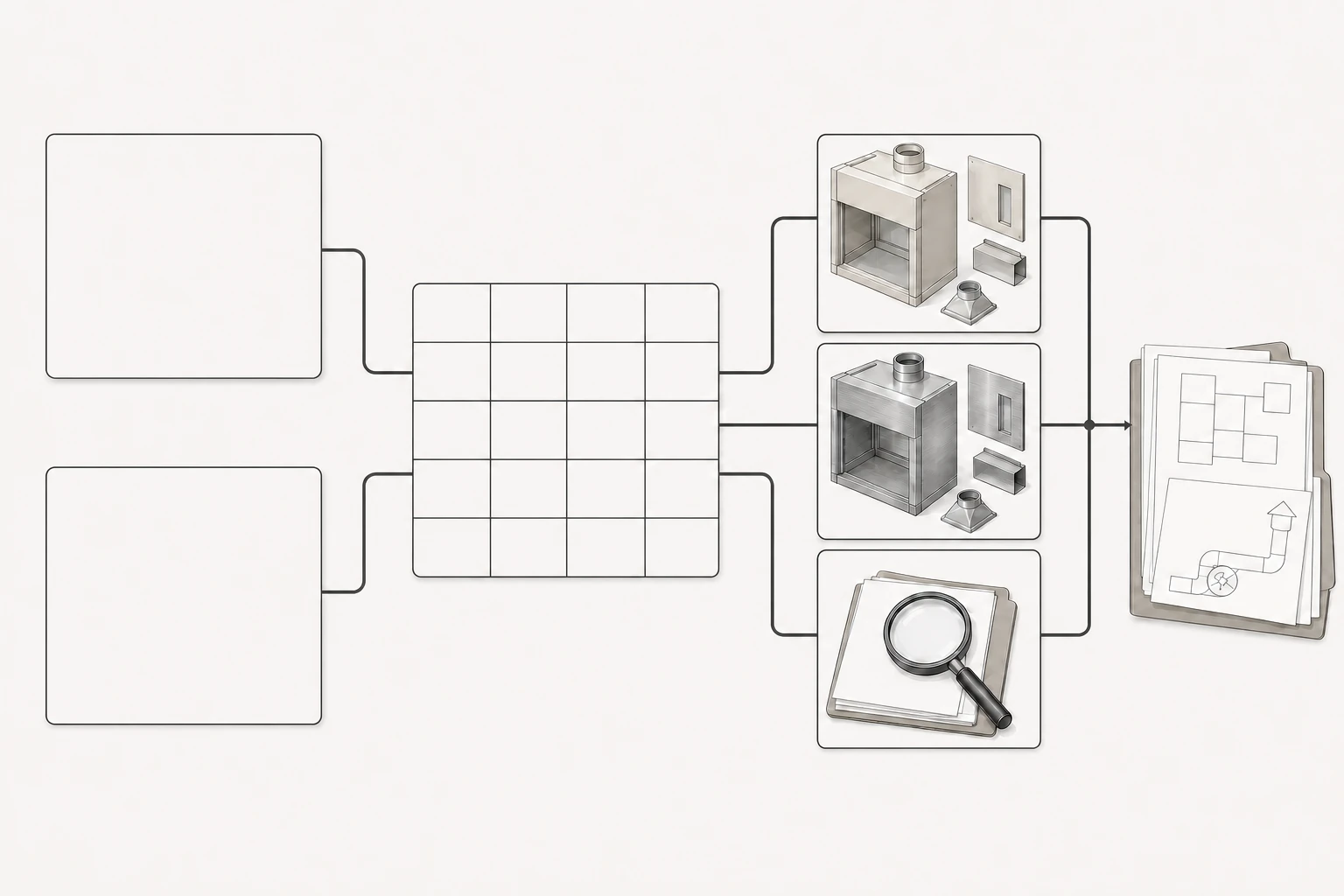
*Illustration only: use the evidence matrix below for decisions; the schematic is not compatibility evidence or a supplied-product drawing.*
The PP vs stainless steel fume hood matrix below is a meeting tool, not a chemical-compatibility chart. Start with the submitted chemical schedule and component map, then use each row to decide whether PP or a defined stainless scope remains under consideration, evidence is unresolved, or specialist review is required. A blank field is not neutral: it means the material decision is not ready.
| Evidence record | What must be supplied | PP under consideration | Defined stainless under consideration | Owner / disposition |
|---|---|---|---|---|
| Exposure profile | Exact chemical, concentration, surface temperature, duration, stress, physical form, cleaning, condensate, and upset route | No PP conclusion until the record covers each exposed PP component | No 304/316 conclusion until the same record covers each exposed steel component | Process owner supplies record; blank field = material unresolved |
| Material scope | Resin/construction for each PP part; or exact 304/316 grade, finish, and fabrication scope | A cited 8 mm PP cabinet construction identifies one configuration field, not compatibility evidence | A grade request identifies scope, not compatibility evidence; 316 has about 2–3% molybdenum but still needs the exposure record | Supplier returns schedule and source; unlisted part = open item |
| Component map | Cabinet, liner, worktop, baffle, joints, hardware, drain, collar, duct, fan, treatment equipment | Confirm every exposed PP part and its joint/seal path | Confirm every exposed stainless part and its joint/seal path | Supplier, facilities, and EHS assign owner and status |
| Designated or conservative review trigger | Sourced designated-hood case, or a project condition outside submitted evidence | Do not choose PP from a generic description | Do not choose 304/316 from a generic grade description | Relevant HF/perchloric-acid work requires specialist review; oxidizers, heat, flammables, heavy condensate, and unknown mixtures are conservative project-review triggers |
| RFQ disposition | Evidence source, reviewing party, remaining open item, and change-control condition | “PP under consideration — exact evidence pending” | “Defined stainless under consideration — exact evidence pending” | “Material unresolved” or “specialist review” until the record is complete |
Use the matrix in the order shown. First, verify the exposure profile. Second, verify the material and joint at each exposed component. Third, select a candidate state only when the evidence supports it. The matrix does not rank PP above stainless or stainless above PP; it prevents a team from answering a system question with a cabinet material label.
The matrix also separates material review from containment performance. Record hood geometry, sash conditions, airflow design, and acceptance responsibility in the RFQ, but do not use any of those fields as chemical-compatibility evidence. For example, a cited 8 mm panel is about 0.315 inches, a cited 0.3–0.5 m/s face-velocity reference is about 59–98 fpm, and cited 1200 mm, 1500 mm, 1800 mm, and 2400 mm widths are about 47.2 inches, 59.1 inches, 70.9 inches, and 94.5 inches. All conversions belong in the configuration field with their source condition, not in a compatibility cell.
XICHENG’s PP configuration page can inform the ordered scope; the supplier still needs to return the exposure-specific material schedule. For the separate question of how sash position and test method become acceptance evidence, use the fume hood face velocity requirements guide rather than treating an RFQ reference velocity as a materials claim.
Decision landing: You can now mark every project row as PP under consideration, defined stainless under consideration, material unresolved, or specialist review and keep the RFQ open until evidence is supplied.
Conditions That Stop a Standard Material Comparison
A standard PP-versus-stainless comparison must stop when the chemical or process creates a specialist-design question. Stopping does not mean the project has failed; it means the team has identified that a cabinet material choice cannot safely settle the issue. Mark the trigger in the RFQ, isolate the process facts, and ask EHS, the hood supplier, and the exhaust-system designer for a dedicated review.
Perchloric Acid and HF: Designated-Hood Boundary
Relevant perchloric-acid work and HF should move the project from a generic material comparison to designated-hood review. The University of Wisconsin–Madison EHS guidance states that high concentrations of, or operations evaporating, perchloric acid fumes require a perchloric-acid hood with a water spray system that washes the exhaust duct, baffle, and wall; it also says HF hoods must be specifically designed to resist that service, including nonmetal construction examples.
Treat strong oxidizers and other special chemistry as conservative project-review triggers when the submitted evidence does not address the exact chemical, concentration, temperature, component, and exhaust exposure. That is a screening action, not a claim that one standard hood type or material will always be required. The review record should identify the governing process information and the party accountable for the next decision.
Heat, Flammables, Unknown Mixtures and Heavy Condensate: Conservative Review Triggers
Heat, flammables, unknown mixtures, and heavy condensate are conservative project-review triggers because they can add exposure routes that the cabinet label does not describe. A warm process may change polymer behavior, chloride-corrosion risk, condensation location, and the service condition of a duct or fan. Flammable-vapor work also adds containment, ignition-control, ventilation, and project safety questions that no “PP” or “stainless” label proves.
Treat the trigger as a request for missing project evidence, not as a material conclusion. Record the exact process condition, source of heat or vapor, likely liquid or condensate route, ventilation arrangement, component map, and the EHS or engineering owner who will decide whether standard material comparison can resume. The worked example later uses a 10% acid, 5% base, 20–25 °C, 15-minute baseline only as an input set; a change to heat, concentration, contact duration, or an unknown mixture reopens the review record rather than extending that illustrative case.
A Specialty Hood Is a System Decision
A specialty hood is a system decision because the cabinet, liner, baffle, drain, exhaust connection, duct, fan, treatment equipment, washdown method, controls, and commissioning plan can all change together. The University of Wisconsin guidance warns users not to modify baffles, sashes, airfoils, liners, or exhaust connections without consulting the responsible facility or EHS group. That warning is a practical reason to keep material review connected to the full containment system.
The project should return a short escalation record instead of an unsupported material selection: chemical and concentration; process and surface temperature; vapor, liquid, mist, and condensate routes; expected duration; cleaning method; each exposed component; exhaust-system scope; and the authority who will approve the next design step. Use the project’s own operating and control requirements rather than importing an unrelated institution’s operating settings into a material decision.
Decision landing: You can now identify a red-flag process, stop the ordinary PP-versus-stainless selection, and issue a specialist-review record with the project facts that a dedicated hood and exhaust-system decision needs.
Worked Example and RFQ Inputs for Material Confirmation
A worked selection example is useful only when it shows the inputs that can change the answer. The following scenario is illustrative, not a chemical-compatibility approval for PP, 304, 316, or any XICHENG configuration. Its purpose is to show how a project team converts a process description into an evidence request and an RFQ that a supplier and EHS reviewer can check.
Worked Example: Evidence Collection for a Corrosive Wet Process
The example starts with a documented wet process inside a ducted 1200 mm-wide hood. The hypothetical chemical schedule lists aqueous 10% hydrochloric acid and aqueous 5% sodium hydroxide in separate, closed source containers; the process temperature is 20–25 °C (about 68–77 °F); transfers are intermittent and limited to 15 minutes (about 0.25 hr) per operation; and the planned cleaning agent is still to be named. The team records possible liquid splash at the worktop and drain, vapor at the baffle and exhaust collar, and wet residue at joints after cleaning. The numbers are scenario inputs only, not compatibility evidence for either material.
The correct first result is material unresolved — exact component compatibility evidence required. Send parallel evidence requests for a PP scope and for a defined 304 or 316 scope: exact chemical/concentration compatibility, surface-temperature and duration limits, cleaning compatibility, and the material of the cabinet, worktop, joints, drain, seals, collar, duct, fan, and treatment equipment. The 1200 mm reference shown on XICHENG’s PP configuration page is a project-size field, not evidence that either material contains the process or resists the listed chemicals.
Do not let one material become the default while those records are missing. If documented compatibility returns for one complete material/component scope, that scope may move under consideration; if a relevant HF or perchloric-acid case appears, or if the project evidence remains incomplete, route it to specialist review. The example demonstrates that a PP vs stainless steel fume hood decision follows evidence status, not an assumed material preference.
RFQ Inputs: Chemical Schedule, Component Schedule and System Scope
An RFQ should package the evidence in three linked schedules. The chemical schedule identifies each chemical, concentration, quantity, temperature, physical form, contact duration, cleaning agent, expected spill/condensate route, and abnormal events. The component schedule lists cabinet, liner, worktop, baffle, seams, fasteners, drain, sash guide, exhaust collar, duct, fan, and treatment equipment with their required material or “supplier to confirm” status. The system-scope schedule identifies ducted or filtered arrangement, exhaust route, utilities, controls, project location, and the party responsible for final containment and commissioning.
| RFQ field | Example entry | Why the reviewer needs it |
|---|---|---|
| Chemical schedule | 10% hydrochloric acid; 5% sodium hydroxide; 20–25 °C; intermittent 15-minute transfers | Establishes identity, concentration, temperature, duration, and physical exposure; does not establish compatibility by itself. |
| Component schedule | Cabinet, worktop, baffle, joints, fasteners, drain, sash guide, collar, duct, fan, and treatment unit marked “confirm material” | Prevents a cabinet choice from hiding an incompatible component. |
| Hood and airflow scope | Ducted 1200 mm reference hood; 0.3–0.5 m/s reference face velocity at stated sash | Configuration and containment-planning fields only; acceptance follows the project test method. |
| Material evidence request | Parallel PP and defined 304/316 compatibility records for every exposed part | Keeps both candidates under consideration with equal evidentiary weight. |
| Cleaning and change control | Cleaning agent to be named; any new chemical, concentration, heat, or mixture requires re-review | Cleaning can be the harshest exposure; change control protects the evidence chain. |
| Ownership fields | Process owner, supplier contact, EHS reviewer, and review date per row | A confirmed row needs an accountable reviewer, not just a document. |
The completed RFQ produces a traceable result: material unresolved — exact evidence pending for every exposed component and exhaust-side material until returned evidence resolves each open item. A supplier can then return parallel PP and 304/316 material schedules rather than a generic claim, and EHS can see what changed if the process is revised. No material should move under consideration until the returned evidence resolves each open component and any designated-hood case.
Decision landing: You can now turn a defined process into an evidence request, list the confirmation gaps, and issue an RFQ that prevents a cabinet material name from being mistaken for a complete system decision.
Common Material-Selection Mistakes
A material comparison improves when each correction produces a document another person can verify. For example, 10% acid, 5% base, 20–25 °C, and 15-minute are incomplete without identity, physical form, cleaning, contact route, and component scope; copying only those values would repeat the same error. The chemical schedule explains what can contact the hood. The component map explains where it can contact. The system scope explains which equipment sits beyond the cabinet. Together, those three records let a supplier and EHS reviewer state what has been confirmed and what needs specialist review.
| Mistake | Why it fails | Corrected record |
|---|---|---|
| Asking whether PP or stainless is “better” without a chemical schedule | The answer becomes a preference statement rather than a material decision | Submit chemical identity, concentration, temperature, phase, duration, cleaning, condensate, and abnormal conditions |
| Naming only the cabinet material | A worktop, baffle, joint, fastener, drain, collar, fan, or duct can remain unspecified | Create a component map and mark every exposed part with a material or “confirm material” status |
| Treating 316 as a universal upgrade | Chloride, heat, wetting, crevices, welding, cleaning, and time can remain unreviewed | Ask for the actual grade and the evidence for every exposed stainless component |
| Copying a labware chart into a hood RFQ | A rating may apply to a different polymer, geometry, temperature, duration, and stress condition | Use the chart only to identify missing exposure fields; obtain hood-component confirmation separately |
| Treating cabinet size or face velocity as material data | The team confuses geometry or containment targets with chemical compatibility | Keep the cited 0.315 inches panel conversion, 47.2 inches, 59.1 inches, 70.9 inches, and 94.5 inches reference widths, sash conditions, airflow design, and material selection as linked but separate RFQ fields |
| Ignoring cleaning and condensate | The process chemical is reviewed while a different agent or wet deposit attacks a seam or exhaust component | Include cleaning agents, dwell/rinse conditions, condensate routes, and spill cleanup in the same schedule |
| Waiting to mention a red flag | A standard hood may be priced before the specialty design need is visible | Flag HF, perchloric acid, oxidizers, heat, flammables, heavy condensate, and unknown mixtures at the start of review |
Do not try to repair an incomplete comparison by adding more marketing terms. A more specific product description still cannot replace a material schedule, a defined grade, or a named cleaning agent. The next action is to convert the corrected records into the right product-path request and an accountable next step.
Decision landing: You can now detect the errors that make PP-versus-stainless claims unreliable and correct the missing project record before asking a supplier to select or quote a hood.
Next Steps: Confirm the Exposure Before You Configure the Hood
The next step is to submit the exposure profile and component map before asking for a configured hood. Start with the chemical schedule, expected quantities, process temperature, contact mode, cleaning method, and off-normal conditions. Add the desired hood size, exhaust arrangement, target sash/opening condition, available utilities, project location, and the party responsible for final containment and commissioning. Where the RFQ adopts XICHENG reference configurations, label 47.2 inches, 59.1 inches, 70.9 inches, 94.5 inches, and the cited 59–98 fpm reference face-velocity conversion as configuration fields—not exposure, compatibility, or acceptance values. Those inputs let a supplier explain which material scope can be confirmed and which scope still needs EHS or project review.
Once the returned material schedule covers every exposed component, use the product page that matches the documented scope to start a configuration conversation. A complete PP record can move into the polypropylene PP laboratory fume hood discussion; a complete defined-steel record can move into the stainless steel fume hood discussion. Neither page replaces the chemical schedule or component confirmation—those are the evidence that makes the conversation worth having.
The system-type, airflow-acceptance, and broader type-selection questions have already been resolved at the decision points where they change the outcome. At this stage, keep the next action narrow: send the completed exposure and component record to the supplier, then ask which configuration details remain open.
| Record to send before configuring | What it contains | Who owns it |
|---|---|---|
| Chemical schedule | Chemical identity, concentration, temperature, physical form, contact duration, cleaning agent, spill and condensate routes | Process owner |
| Component map | Every exposed part with material or “supplier to confirm” status, evidence source, and owner | Supplier + process owner + EHS |
| Review boundary | Designated-hood cases and conservative triggers already assessed; escalation record if a red flag exists | EHS / project engineering |
| RFQ disposition | Candidate states per component, open items, change-control condition | Buyer + supplier |
Each row in the table answers a question the supplier will ask in the first call. If a row is empty, expect the configuration conversation to stall on material risk instead of moving to dimensions, services, and exhaust integration. Complete the rows first, then start the product-page conversation.
Decision landing: You can now send a completed exposure and component record into the PP vs stainless steel fume hood product-path conversation, knowing exactly which configuration details remain open for the supplier.
FAQ: PP vs Stainless Steel Fume Hood Questions
What is the difference between a PP and a stainless steel fume hood?
A PP fume hood is a welded polymer enclosure typically specified for corrosive acid and alkali service at normal operating temperatures. A stainless steel fume hood is a metal enclosure with a cleanable work zone, specified in 304 or 316 against the process conditions. The operational difference matters less than the evidence question: which submitted exposure profile each material’s components can support.
Which chemicals are polypropylene fume hoods compatible with?
No generic answer supports a purchase decision here. Compatibility depends on the chemical, concentration, surface temperature, contact duration, stress, cleaning regime, and each exposed component. PP is commonly associated with many acid and alkali applications, but concentrated oxidizers, solvent-rich mixtures, elevated temperatures, and long-term exposure each need a material-specific record. A general resistance chart is a screening tool, not approval.
When should I choose 304 vs 316 stainless steel for a fume hood?
Choose 316 when the exposure profile includes chlorides and the project can document why the 2–3% molybdenum benefit matters for that concentration, temperature, and contact pattern. 304 remains a common cleanable option for general laboratory work. In hot chloride service both grades can still pit, crevice corrode, or stress-corrosion crack, so the grade choice follows the evidence, not a habit.
Can a stainless steel fume hood handle hydrochloric acid?
Hydrochloric acid can attack stainless steel depending on concentration, temperature, wetting, crevices, and duration. A short-contact, well-cleaned, low-temperature operation may be reviewable for a defined grade; a hot, concentrated, or long-duration exposure may not. Submit the complete exposure and component record rather than accepting a yes-or-no claim.
What should a material-confirmation RFQ include?
Include the chemical schedule, concentration, quantities, temperature, contact duration, physical form, cleaning method, expected spills or condensate, hood size, component schedule, exhaust arrangement, target sash/opening condition, available utilities, project location, and final containment/commissioning responsibility. The response should identify a candidate and any confirmation still required.
Decision landing: You can now use the FAQ answers to recognize whether your next step is a component confirmation request or specialist review, without turning a short answer into a material guarantee. In every case, the PP vs stainless steel fume hood question resolves only when the submitted evidence resolves it.
Leave a Reply