





Key Takeaways
- This is not a “which is better” choice. Activated carbon vs HEPA fume hood filter is a false comparison, because one medium is an adsorption stage for vapor and gas and the other is a mechanical stage for particles.
- Sort the process before you sort the media. Write what your process releases into two columns: vapor or gas on one side, particle or aerosol on the other. That split decides the main medium.
- 0.3 micrometers is the worst case, not the limit. The US EPA states that a HEPA filter can theoretically remove at least 99.97% of particles with a size of 0.3 microns (µm), and that 0.3 µm is the most penetrating particle size; larger and smaller particles are trapped with higher efficiency — that definition comes from the agency’s indoor air quality guidance, whose subject is air cleaners rather than laboratory containment.
- Neither medium is one product. Carbon is supplied in chemically specific families, and particle media are specified by performance level and construction grade in the order.
- Combined filtration is a condition, not an upgrade. You add a second stage when the process releases both vapor and particles, and the stage order follows from which stage does the primary removal.
Why “Which Is Better” Is the Wrong Question for a Ductless Hood
Activated carbon vs HEPA fume hood filter is the wrong frame for a decision that is about hazard form: this hood must handle either vapor and gas, or particles and aerosols, or both. That sentence sounds like a slogan until you write your own process into it. Then it becomes a specification decision with a right answer for your bench and a wrong answer for the bench next to it.
What follows stays inside one subject: which medium removes which form, why the two media cannot cover for each other, how to set the order when you need both, and who holds the responsibility for specifying and verifying the choice. Filter replacement schedules and cost figures belong to other pages that own those subjects.
The question behind the question: what are you trying to remove
Every filtration question starts with a hazard form, not a product category. Ask what leaves your vessel during the operation, because that answer decides which medium does the work and which medium does nothing.
Two containers on the same bench can require opposite answers. An open beaker of solvent releases vapor that a pleated particle medium passes straight through. A weighing operation with a fine powder releases solid particles that a carbon bed cannot capture to any useful degree. Same room, same hood style, two different media.
Vapor, gas, fume, aerosol and particulate: five words that decide your medium
These five terms are not synonyms, and suppliers use them precisely. A vapor is a substance in the gaseous state that is a liquid at standard temperature and pressure, and the SEFA Desk Reference states that definition in those terms and gives formaldehyde, xylene and acetone as examples. The definition also answers the comparison a buyer usually brings: on a carbon filter vs hepa filter fume hood decision, the substance in front of you is either a vapor, which one stage removes, or a particle, which the other does. The same reference defines fume as condensed solid particles produced by physicochemical reactions such as combustion, sublimation, or distillation, which is where the laboratory vocabularies diverge and why a vapor versus particulate filter decision has to start from the phase rather than from the word.
A particulate identifies a solid particle or a liquid droplet small enough to stay airborne, which is the physical form a particle stage is built to capture. An aerosol is the mixture of those particles or droplets with the air carrying them, so the aerosol is what travels through the enclosure while the particulate is what the medium retains. That distinction produces most of the vapor versus particulate filter confusion you will meet, because both sides of the argument use the same word for different things.
The same split appears in respiratory protection, where cartridges and filters are separate product lines for the same reason. The logic is identical in a ductless enclosure; only the selection process differs, because the unit serves the room rather than one wearer. Name the form first, and the medium argument usually ends there.
What a ductless hood means in a laboratory (and what it does not mean)
A ductless fume hood is a laboratory enclosure that draws air through a filter package with an internal fan and returns the filtered air to the room, so the hood belongs to a family of related designs rather than standing alone. The category question, what separates these designs from ducted ones, is answered on our page on types of fume hoods.
Without the words fume hood, ductless hood is ambiguous in ways that cost money. Searches for ductless hood filter types return residential and commercial kitchen ventilation, appliance filters, and grease baffles, with no laboratory content at all. A laboratory worker who searches that phrase gets a shelf of kitchen products, which is the practical reason the medium logic here is stated in the laboratory sense, without assuming the reader already knows it.
Do ductless fume hoods have HEPA filters? The answer depends on the hazard
A ductless hood is not supplied with particle media by default, and it is not barred from carrying it. Our working rule is to treat the medium as a consequence of the process rather than of the product category. Vapor work pulls an adsorptive stage; powder, aerosol, biological and radioactive particle work pulls a particle stage; a process that produces both pulls both.
The standard that governs ductless filtration classes names particulates among the hazards a filtration class covers, and requires ductless hoods to use its highest filtration class. The published text of that standard does not use the term HEPA, so it cannot be quoted as a rule that every ductless hood carries particle media. The separating variable is the hazard your process releases, not the hood category.
The two-column worksheet: sorting your process before you talk to anyone
Build a two-column worksheet now, before the vendor call and before the EHS review. In the left column write the vapor and gas side of the process: chemical names, what the material releases while you handle it, approximate quantities, temperature, and whether anything boils or sprays. In the right column write the particle and aerosol side: powders, weighings, grinding, spraying, bioaerosols, and nanoscale materials. A third column carries the operational facts that override both: continuous or occasional use, whether several chemicals run in the same session, room humidity, and the size of enclosure you can accommodate. Most of these fields come from you, and no supplier can fill them for you.
You can decide which medium to specify, whether you need one stage or two, and what to hand over as process data. Those decisions now rest on one page you filled in, and the rest of what follows turns that page into a specification. Decide the two columns first, before you ask anyone what to buy, and every conversation afterward has something concrete to test.
What Activated Carbon Actually Does in a Ductless Hood
A carbon stage removes vapor and gas by adsorption, not by trapping particles in a mesh. That single mechanism explains what it can do, what it cannot do, and why the carbon you order is not one interchangeable product.
Two misunderstandings cause most of the wasted money in this area. The first treats carbon as a universal scrubbing stage that removes whatever reaches it. The second treats all carbon as equal, so a buyer compares units on size, fan power and price while leaving the medium unspecified.
Adsorption explained without the chemistry lesson
Adsorption is the attachment of gas molecules to the surface of the carbon granules, so the contaminant leaves the airflow by sticking to a surface. The working surface is what removes your contaminant rather than the bulk of the material, and activation is the treatment that develops that surface. A carbon stage is therefore a surface archive rather than a trap with a fixed holding size. Two consequences follow: removing one chemical occupies sites another chemical could have used, and the stage reaches a defined endpoint when it can no longer effectively remove contaminants from the airflow, which is the formal definition of filter breakthrough. Your specification needs to name which chemicals the bed must archive, not merely how much carbon it contains.
Activated carbon is not one product: the chemical families behind the letter codes
Standard activated carbon suits a broad range of common organic vapors, including the VOCs that dominate solvent work, and several classes of chemical need a different treatment before the medium works well. Acids, mercury, sulfur compounds, halogens, aldehydes, ammonia and amines, and ethers each appear as separate product families in manufacturer literature, and those families are typically labeled with letters that mean nothing outside one supplier’s catalog. The SEFA Desk Reference states the limit directly: some materials cannot be adequately filtered and may even poison some filter media rendering it useless for other applications.
That limitation is a property of the medium rather than of one product line, and it carries a procurement consequence. A carbon stage is specified by chemical family, not by the word carbon. A filter supplied for solvent work is not interchangeable with one supplied for ammonia, even when both occupy the same housing and carry the same outward dimensions.
What changes with the family is the treatment of the carbon rather than the shape of the filter. Since the families are proprietary, the specification has to state the chemical function you need, and let the supplier answer with a product family that meets it. Working from the chemical list rather than from a part number is the route described in our guide to filter selection by chemical, and that procedure belongs to that page rather than to this one. Two suppliers describing the same application in different letters is normal and not a sign that one of them is wrong.
What a carbon stage does not capture
A carbon bed does not capture particulate. Filters capture particles while carbon cartridges capture vapors and gases, and the two are separate product lines for the same reason in the respiratory protection standards. A powder, a fume of condensed solid, or an aerosol droplet passes through an adsorptive bed while the vapor in the same airstream is removed, so one stage cannot cover a process that releases both.
The stage also has limits within vapor duty. Breakthrough is a gradual process rather than a hard stop, so the endpoint comes from a performance criterion rather than from the bed going empty. Water vapor and competing solvent vapors occupy sites your target chemical needs, so humidity and mixed workloads shorten the effective period of service, and the mechanism survives while the useful capacity does not.
Why the physical form of the carbon stage matters to the rest of the airflow path
Adsorption works only where the airstream touches carbon surface, so the shape of the bed affects how well the stage performs. Air taking a short path through a loosely packed corner contacts less carbon, and that uneven loading shows up as a loss of removal capability before the rest of the bed is spent. Residence time and airflow distribution matter as much as the total mass of carbon in the housing.
Particulate loading changes the stage in a second way. Particles that settle on the carbon surface occupy sites and reduce the effective surface, so a carbon bed placed behind heavy dust, mist or powder sees its useful capacity consumed by material it cannot remove. Pre-filtration or a particle stage ahead of the carbon prevents that overlap, and the order you choose follows from which hazard form dominates the stream.
You can determine whether your process relies on adsorption, and you can select a chemical family for the bed instead of a generic replacement. Working from your own chemical list, you can also flag the entries that standard carbon handles poorly, before you ask anyone for a specification.
What a HEPA Filter Actually Does in a Ductless Hood
A particle stage removes particulate by mechanical capture, and its published efficiency figure carries conditions that most product pages drop. Both halves of that sentence matter, because a buyer who keeps only the number will specify the wrong thing and then discover the gap during acceptance testing.
The US Environmental Protection Agency describes a HEPA filter as a pleated mechanical air filter that can theoretically remove at least 99.97% of dust, pollen, mold, bacteria and other airborne particles with a size of 0.3 microns (µm). That is an indoor air quality definition, whose subject is portable air cleaners rather than laboratory containment; we cite it for the medium definition and its published efficiency, not as a statement about enclosures. The acronym is published in two forms: the EPA page reads high efficiency particulate air, while the public page for the recommended practice covering these filters reads high efficiency particle arrestance. Both appear in authoritative material, and neither changes the performance definition of the medium.
Mechanical capture: how a pleated medium stops particles
Mechanical capture works because a particle cannot follow the air around a fiber indefinitely. The mechanism is physical: air passes through a dense mat of fibers, and a particle carried in that airstream either collides with a fiber or is caught in the air moving around one, so the medium removes it by interception rather than by attracting it chemically.
Three interactions carry most of the duty. Large particles keep moving on their original path and strike the fibers, which is impaction. Medium particles follow the curved streamlines and touch a fiber as they pass, which is interception. Very small particles travel erratically across the streamlines and land on a fiber by diffusion. Diffusion is the least intuitive of the three, and it is also the reason the efficiency curve does not sag at the smallest sizes: particles larger or smaller than the most penetrating particle size are trapped with higher efficiency.
99.97% at 0.3 micrometers: the limiting words you must keep
The sentence carries two qualifiers, and both change what the number means. The phrase can theoretically remove sets a design-performance expectation rather than a guarantee, and the phrase at least 99.97% sets a floor rather than a target. Drop either word and a published filter classification becomes a warranty, which is a commercial promise the source never made.
The Environment, Health and Safety group at Lawrence Berkeley National Laboratory states the same figure without naming the particle size: a particle stage may be used to filter hazardous chemical, biological, or radioactive particles from air streams with an efficiency of 99.97 percent. That is a facility policy position rather than a standards clause, so read it alongside the rated particle size rather than instead of it, and keep every qualifier attached to the figure it belongs to.
Both sources describe the medium. Neither describes the assembled hood, and a rated medium does not become a rated enclosure because it was bolted into one. Leak paths, seals, and airflow distribution inside the unit decide what the operator breathes, which is why integrity testing exists and why it comes back later.
0.3 micrometers is the most penetrating particle size, not the smallest particle captured
The EPA states that the diameter specification of 0.3 microns corresponds to the worst case, the most penetrating particle size (MPPS), and adds that particles larger or smaller are trapped with even higher efficiency. That sentence reverses the reading most product pages invite. Efficiency does not fall away below 0.3 µm; it recovers.
This correction changes what you write in a specification for fine powder and nanomaterial work. A specification that demands removal of every particle down to 0.3 µm and no smaller misstates the specification, because the same medium already performs better on the smaller fraction. Material below 0.3 µm faces a filter that captures it more readily, not less readily.
What changes for nanoscale and dry powder handling is the rest of the enclosure. Whether the powder stays inside the work zone, how the operator transfers it, and whether a higher-efficiency medium is preferred for very small nanoparticles are separate questions from the 0.3 µm rating, and the answers come from the process assessment rather than from the filter classification.
A HEPA filter is not one product either: performance levels and construction grades
IEST-RP-CC001, the recommended practice that covers these filters, describes eleven levels of filter performance and six grades of filter construction. Its public summary states that the customer’s purchase order should specify the level of performance and the grade of construction required, and that the customer should also specify the required filter efficiency if the published performance levels do not cover it.
That instruction turns a category name into a purchasing defect. Asking a supplier for a HEPA filter does not pin down the product, and two quotes that both say HEPA can describe different performance levels and different construction grades, so the comparison looks honest while the parts underneath are not equivalent. Your order therefore needs two fields where one is customary: a performance level and a construction grade.
What a particle stage does not capture
A particle stage does not remove vapor or gas. Molecules move through the medium as individual molecules rather than as particles large enough to be intercepted, so solvent vapor passes through the same fibers that catch a dust particle. The biological side follows the same rule: a safety cabinet equipped with a particle stage cannot stop harmful gas vapors from being recirculated.
That boundary produces a predictable error in equipment ordering. A hood carrying a visible filter gets read as a hood that handles chemistry, and the particle stage inside it provides no protection against the vapor released by the same process. Read the cabinet comparison on fume hood vs biosafety cabinet before you treat a particle-rated enclosure as a substitute for chemical containment.
Particle media also fail in a different way from an adsorptive bed. A particle stage loads up and resists airflow rather than gradually losing a removal capacity, so the symptom that signals a carbon problem does not indicate a particle-medium problem.
Which particle sizes matter, and which two ordering fields pin the medium down, are decisions you can make from your own process sheet rather than from a supplier’s data sheet. Record both before you compare quotations on price.
Activated Carbon vs HEPA Fume Hood Filters: Why Neither Medium Replaces the Other
Neither medium is a substitute for the other, and no swap corrects a process mismatch. Each stage captures one form and passes the other straight through, so the two belong side by side in a property table rather than ranked in a single order of quality.
The boundary is worth writing out, because a buyer who understands the difference decides differently. Treat the two media as good, better and best and you buy the higher efficiency while expecting vapor protection the purchase cannot deliver. Treat them as one decision with one answer and you keep adding media until the process fits inside the classification of the first filter.
The mutual-exclusion table: what each medium captures and what it lets through
The table below states what each stage removes, what it passes, and which condition shortens its useful service.
| Property | Adsorptive stage (carbon) | Particle stage |
|---|---|---|
| Captures | Vapor and gas, including solvent vapor, acid vapor and odors | Particulate and aerosols, including powders, condensed fume, droplets and biological particles |
| Does not capture | Particulate; a powder or droplet passes through while the vapor beside it is removed | Vapor and gas; molecules pass through the fibers that catch particles |
| Occupies its capacity when | The chemical load accumulates and breakthrough advances | Particles and droplets load the medium |
| Selectivity | Family-specific: performance depends on which chemical function the medium was produced for | Grade-specific: performance depends on the rated level and construction grade |
| Condition that shortens service | High humidity and competing vapors occupy sites the target chemical needs | High particle loading, and oily or sticky aerosols |
Read the middle rows together and the conclusion follows. The two columns share no hazard in common, so neither one can cover the other’s duty, and an “upgrade” from one stage to the other is a change of job description rather than an improvement. That is also why the claim that fume hoods use carbon and not particle media describes a typical application rather than a rule about equipment.
Whether your chemistry permits a ductless installation at all is a separate question, and the use limits for ductless hoods are set out on are ductless fume hoods safe. If a ducted installation turns out to be the correct answer instead, the airflow side of that route is covered in duct design for the ducted route, and the system-level comparison between the two routes sits in ducted and ductless systems.
Two different failure modes: saturation and poisoning versus blockage and breach
The two media fail by different mechanisms, and the difference shows up in what your monitoring can detect.
An adsorptive stage fails by consuming a finite surface. The endpoint carries a defined name: SEFA 9-2026 defines filter breakthrough, or saturation, as the point at which a filter can no longer effectively remove contaminants from the airflow. The SEFA Desk Reference records a second failure path in which the medium is not merely exhausted but contaminated, and that contamination sits outside a normal capacity calculation.
A particle stage fails physically rather than chemically, and it fails in two ways. The medium loads with the material it captures, so resistance climbs and airflow falls as the load accumulates; separately, a breach in the medium or in its seal removes the stage from service at once rather than degrading it gradually.
| Property | Adsorptive stage (carbon) | Particle stage |
|---|---|---|
| How it fails | Saturation and breakthrough, or poisoning of the medium | Blockage, rising resistance, or a breach in the medium or its seal |
| What the operator notices first | A monitoring reading, or a sampling result | Reduced airflow, or a failed integrity scan |
| What verifies the stage | Breakthrough detection and sampling | An integrity test of the installed medium |
| What this section does not cover | Replacement intervals, scheduled or otherwise | Replacement intervals, scheduled or otherwise |
What the table leaves out matters as much as what it contains. It carries no month count and no capacity figure, because the useful life of a filter follows from your load and your chemistry. We treat replacement timing as a separate judgment that depends on the load your process generates and on the range the supplier has approved, worked out against your own records.
Both failure paths share one practical consequence. Decide, before commissioning, which signal tells you that a stage has stopped doing its job, because the two media fail under different evidence. A quiet monitoring panel and an airflow that feels normal are not the same statement about the medium.
Why swapping the medium cannot fix a process mismatch
Buying into the wrong stage cannot be corrected by changing the stage later. Vapor released under a particle-only hood travels back into the room, and powder released under a carbon-only hood passes through the bed, so both errors leave in place the situation the medium was bought to prevent. Cost points the same way: a stage that cannot capture your principal hazard saves money on a purchase that never solves the release.
The structural logic of a hazardous-material system runs the same way. Where the standard requires secondary protection in the systems it governs, it specifies that the standard’s own secondary filter must be of the same media, efficacy and capacity as the primary filter. Redundancy is written against the same hazard form, so the safest configuration is not the one with more stages but the one whose stages match the hazard your process releases.
What this means before you sign off on a single-medium hood
A single-medium hood is a complete answer when your process releases one hazard form and an incomplete answer when it releases two. Three checks settle which case you are in before the order is signed rather than after the unit is installed. Name the form that dominates the work you run most often: if one form covers the whole process, the hood needs one stage of the right kind, and a second stage buys nothing except resistance and another maintenance item. Then check the second column of your worksheet, because a task that dries, sprays, grinds or transfers solids can produce particulate inside a process whose liquid chemistry made vapor the obvious hazard.
Ask whether the medium the hood carries covers the specific chemistry, not just the category. Standard adsorptive media cover common organic vapor and handle a different chemical function less well, so a hood that is correct for a solvent bench can be the wrong purchase for the same bench once an acid bath or an ammonia procedure arrives. Settle those three points before you approve a single-medium hood, and the quotation you sign will describe the process you run.
When You Need Both, and the Order That Follows
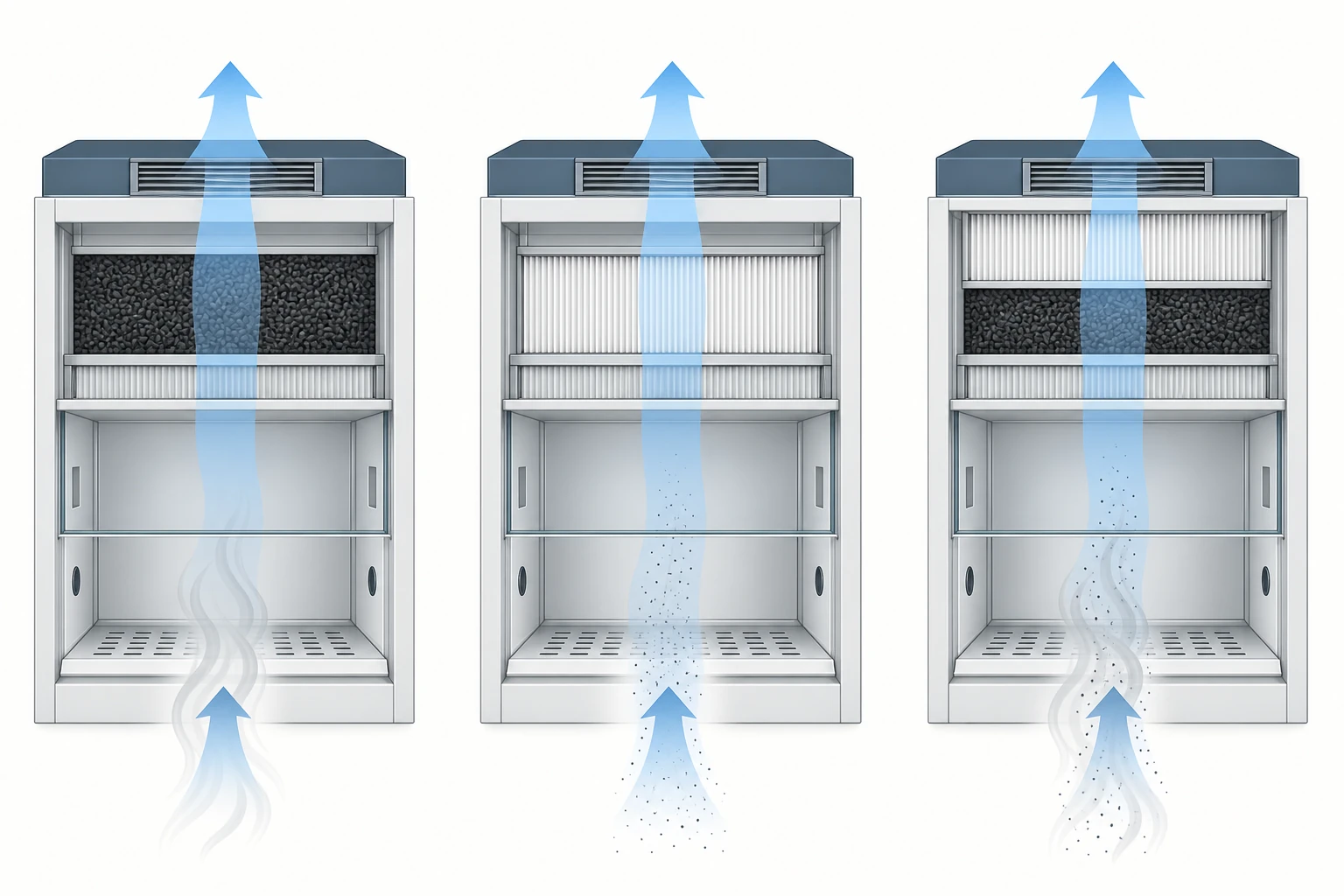
You need both stages when your process releases vapor and particles at the same time, and you need one when it releases only one of the two. The order follows from the hazard form that does the most work in your operation rather than from preference.
That single test prevents the two most common ordering mistakes we see, which are adding a second stage because it feels safer and arranging the stages the way a neighboring department arranged theirs. Neither of those is a reason.
The two-question test for combined filtration
Ask two questions about your process, and let the answers decide whether a second stage belongs in the specification. Does the operation release vapor or gas? Does the operation release particulate or aerosol? Answer both from the worksheet you built at the start, not from the material safety data sheet alone, because a liquid can release vapor while the same task also produces droplets.
Two no answers mean a single stage is enough. Two yes answers mean the specification needs two stages whose duties are different. One yes and one no means one stage is correct, and the other is a purchase that changes nothing about protection.
Gray areas deserve one extra check rather than a longer discussion. Heating, spraying, grinding and drying can turn a process that looks like one hazard form into a process that produces both, so treat any process whose output you cannot classify from the sheet as an assessment item rather than an order item.
Pre-filter, main filter, optional second stage: what each position is for
Each position in a filtration train has one job, and the vocabulary is standard. SEFA 9-2026 defines the primary filter as the filtration stage in a ductless system that encounters and removes the contaminant first, and the secondary filter as the backup stage that provides protection and containment after the primary filter has reached saturation.
A pre-filter is a coarse stage that keeps bulk material away from the stages that follow. It is a protective position rather than a treatment position, and its role is to stop airborne dust, mist, and droplets from consuming the capacity of whatever sits behind it.
A main filter is the stage that performs the treatment your process requires. It corresponds to the primary filter in the standard’s vocabulary, and it is the position from which the hazard form decides whether the medium is adsorptive or mechanical.
An optional second stage extends the treatment that is already happening. It may be a second adsorptive bed, a particle stage behind a particle stage, or a particle stage behind an adsorptive bed, and what decides its presence is the same two-question test. A second stage you add for your process is not the same thing as the secondary filter in the standard’s own vocabulary, which that standard requires to match the primary filter in media, efficacy and capacity where it applies. A stage added for reassurance, without a hazard to justify it, adds resistance, cost, and a maintenance item without adding protection.
Two real configurations, two different orders
Manufacturers build both orders. A particle-dominant train runs a pre-filter, then a particle stage, with an optional higher-efficiency particle stage or a supplemental carbon stage behind it, and that chain treats particulate as the process’s primary hazard.
A second manufacturer’s range documents the opposite arrangement. Its model matrix lists an adsorptive bed as the main filter, with a second adsorptive bed or a particle stage as the secondary filter depending on the model, and one model in the same range carries a particle stage as its main filter. That chain treats vapor as the primary hazard and adds particle protection where the application needs it.
| Configuration | Filter sequence | Typical dominant hazard | Where the order comes from |
|---|---|---|---|
| Particle-dominant chain | Pre-filter, then particle stage, with optional higher-efficiency particle medium or supplemental carbon behind it | Powder, fume, aerosol, biological particles | The particle stage carries the duty, so it sits in the treating position |
| Vapor-dominant chain | Pre-filter, then adsorptive main bed, then a second adsorptive bed or a particle stage in the second position | Solvent vapor, acid vapor, odors | The adsorptive bed carries the duty, and the secondary stage extends it or adds particle cover |
Neither column is the correct answer in general. Each is the correct answer for the hazard form that dominates, which is why a specification that names a fixed order without naming the process cannot be reviewed on its merits.
When the order is wrong: particles ahead of the carbon bed, vapor ahead of the particle stage
Order errors produce two different kinds of damage. When particle-laden air reaches the carbon bed before any particle stage has touched it, the particles settle across the medium and occupy surface the vapor needed, so the adsorptive stage loses usable capacity to material it cannot remove. That mechanism is the engineering reason the particle positions come first.
Vapor ahead of a particle stage produces a different failure with the same shape. The particle stage removes nothing from the vapor load that reaches it, so the vapor continues through the unit, and the particle stage picks up oily or sticky aerosols it was not specified to handle.
Getting the order right starts with the stage that performs the primary removal, protecting that stage upstream, and adding a downstream stage only if the second question also answered yes. Decide the dominant hazard form first, then the medium, then the position. Two different things answer to similar names here: the second stage you add for your process, and the secondary filter as the standard defines it, which has to match the primary filter in media, efficacy and capacity. That order of decisions is what the next section turns into a specification.
The stage count and the sequence of the stages follow from the dominant hazard form rather than from preference. Name that form first, then write the medium for the treating position and the purpose of every other position before your specification leaves your desk.
Choose the verification route for each stage on its own merits; the containment testing method itself is covered in containment testing rather than here.
Matching the Medium to Your Process and Enclosure
Match the medium to the hazard form your process releases, then let the enclosure size and operating conditions adjust what you can buy. The hazard form chooses between an adsorptive stage and a particle stage. Everything else chooses which version of that stage is available in the housing you can accommodate.
This ordering matters because buyers routinely run it backwards. They start from a model number, a bench footprint or a budget figure, and then discover that the process they intended to run needs a stage the chosen enclosure cannot carry.
A decision table by hazard form, from solvent vapor to nanoscale powder
The table below maps the common hazard forms to the stage that does the work and to the extra handling each form deserves. Read your worksheet against it, then confirm the result through the supplier’s review of your process.
| Hazard form | Primary stage that does the work | Additional consideration |
|---|---|---|
| Solvent and reagent vapor from open handling | Adsorptive stage | Mixed solvents in one session need a family that covers the mixture |
| Acid or corrosive vapor, and odors | Adsorptive stage, produced for that chemical function | Corrosive vapor can attack the housing as well as the medium |
| Condensed fume and metal thermal fume | Particle stage | The stage loads with solid material rather than with vapor |
| Dry powder weighing, transfer and sieving | Particle stage, which is the particulate side of every vapor vs particulate filter decision | Transfer technique determines how much of the material becomes airborne |
| Spraying, coating and aerosol deposition | Particle stage, with adsorptive cover where the formulation carries solvent | Both forms usually appear in the same task |
| Biological and radioactive particulate | Particle stage at the rated performance level, inside an enclosure approved for the agent | Housed inside an approved enclosure rather than in a general-purpose hood |
| Engineered nanoparticles and very small powders | Particle stage at a higher-rated level inside a dedicated enclosure | Enclosure integrity and transfer practice decide the outcome |
| Combination process steps that do two of the above | Two stages: an adsorptive stage and a particle stage | Order follows the stage that performs the primary removal, and this application second stage is not the secondary filter of the standard’s own vocabulary |
No cell here is empty, because every hazard form this page covers has a primary stage named against it. A hazard form that no row describes belongs in front of the supplier before the order, not after it.
Powders, aerosols and nanomaterials: where a particle stage stops being optional
A particle stage stops being optional as soon as the process generates solid material that can stay airborne. Weighing a fine powder releases material that an adsorptive stage cannot touch, and grinding, sieving, spraying and blasting generate the same form in larger quantity. Skilled handling reduces what becomes airborne but does not change which stage removes it.
Nanoscale material changes the enclosure requirement rather than the rating you need to chase. The published efficiency figure of a particle stage is stated at the most penetrating particle size, which means material smaller than that particle size is captured more efficiently and not less, so the efficiency rating is not the limiting factor for nanoscale work; the enclosure and the required performance level are. What decides the outcome is whether the material stays inside the work zone, how it is transferred, and whether the installed particle stage has been verified. Our comparison of enclosure families in fume hood vs biosafety cabinet covers why a particle-rated enclosure and a chemical enclosure are not interchangeable.
Small-volume and benchtop work: the same logic at a smaller scale
The same two-question test applies to a compact benchtop enclosure that a full-size unit cannot fit. The medium decision is identical, and what changes is how much vapor or particulate the smaller unit can carry before the medium needs attention.
Small volume is not a license to skip the hazard assessment, and small size is not a guarantee that a general-purpose enclosure will fit the task. A benchtop enclosure with a fixed medium serves the hazard form it was built for, and the same unit cannot be converted into a different treatment by changing the label on the order.
Where the work belongs on a bench rather than under a full-height hood, the packaging of the same decision is covered in benchtop filtered enclosure, and the medium logic you have already worked out carries across unchanged.
Worked example: a plating and surface-prep bench, from process sheet to medium specification
Consider a small metal finishing bench that runs four steps in one session: alkaline cleaning, an acid dip, solvent wipe-down, then hand transfer of a fine polishing powder. It is a teaching scenario rather than a project record, and all quantities are illustrative rather than measured.
| Question from the method | Bench answer | Consequence for the specification |
|---|---|---|
| What does the cleaning step release? | Alkaline mist and water vapor | A vapor and mist load rather than a solvent load |
| What does the acid dip release? | Acid vapor above the bath | Vapor that needs a chemical-specific adsorptive family |
| What does the wipe-down release? | Solvent vapor at room temperature | A second vapor load with a different chemistry |
| What does the powder transfer release? | Fine solid particles | A particle load the adsorptive stage cannot touch |
The two-question test answers yes to vapor and yes to particulate, so a single stage cannot cover this bench. An adsorptive stage alone removes the cleaning, acid and solvent vapor and passes the polishing powder straight through; a particle stage alone catches the powder and removes none of the three vapor loads. Our reading puts a particle position first, where the transfer step is heaviest and where a coarse pre-filter protects what follows, then the adsorptive main bed for the three vapor loads.
Order matters in the other direction too, because running the acid vapor through a particle stage first would remove nothing from it and would leave the particle stage to collect deposits it was not specified for. Drop the powder transfer and keep only the three wet steps, and the specification collapses to one stage while the acid dip still determines the family. Change the acid chemistry and the family changes while the stage count stays the same, which is the point of separating the two decisions.
What reaches the order is a short list: one particle position with a pre-filter ahead of it, one adsorptive bed selected for the acid and solvent chemistry, both stages at specified performance and construction grades, a named verification path for each stage, and the process sheet attached. The exact grade, housing and monitoring package come back from the supplier against that documented process, which is what makes the quotation reviewable by your EHS function.
Conditions that change the answer: heat, humidity and mixed process steps
Heat changes what your process releases and what your medium meets. Warming a vessel raises the amount of vapor the same volume of liquid gives off, and heating work inside an enclosure is restricted for reasons that belong to the enclosure’s approved use rather than to the filter alone.
Humidity and mixed workloads shorten the useful service of an adsorptive bed without changing its ability to adsorb at all, so a stage that works in a dry single-chemical process reaches its endpoint sooner in a humid room where several solvents run in one session. Neither the mechanism nor the medium is at fault; the load is simply larger.
Mixed process steps create the most common mismatch of all, because a single bench often alternates between two hazard forms on different days. If both forms appear in the same enclosure across a normal week, the enclosure needs both stages, and the answer is not to alternate media inside one housing. Decide the set of hazard forms the enclosure must cover before you choose the enclosure, then select the medium for each stage inside it.
The stage your process needs, and the family or performance level that matches it, follow from the two lists in your worksheet. Check that the enclosure you are considering can carry those stages. Take the completed table and the process sheet to the supplier, and before you sign the order, check that every stage has a position, a purpose and a verification method attached to it.
Who Decides, Approves and Records the Medium
Three parties carry the decision, and none of them can carry it alone. You supply the process data, the supplier reviews that data and states an approved range, and your facility’s EHS function sets the test plan that keeps the approval honest over the working life of the unit.
The order of those three moves is not administrative. An approval issued against a vague process description protects nobody, and a test plan written without knowing the medium cannot check the right thing.
You supply the process data, not a filter part number
The first input is a process description rather than a product code, and it has to come from the people who run the work. List the chemicals you handle, what each operation releases, roughly how much of it the hood will see, and how often the operation runs. Add the conditions that change the release: heating, spraying, boiling, grinding, and the humidity and temperature of the room.
Absence of a number is itself a decision input. If you cannot state how much solvent a typical session releases, the practical response is to measure or record it rather than to describe the work as light use, because the review that follows depends on what you submitted.
Contaminated air is returned to the room in a ductless configuration, and the unit is approved against documented conditions rather than against a general description of laboratory work. Supplying the data is therefore the part of this chain only you can perform. The supplier cannot know your chemistry, and your EHS officer cannot reconstruct your process from a purchase order.
The supplier reviews the process and states an approved range
The second move belongs to the supplier, who takes your documented process and answers it in writing. SEFA 9-2026 defines SEFA Form 9-A as an operating certificate consisting of a user questionnaire and a manufacturer’s response, and it requires that form to be completed and permanently displayed on ductless fume hoods and ductless enclosures. What you are asking for is a response that names the medium family or grade and the range of work the unit is approved to handle; a delivery note confirming the order number will not serve that purpose.
The approved range is the operative part. Every later question, including whether the unit still suits the work, is answered against the conditions that were reviewed rather than against the hardware in the room. Ask what changed in the response when you amend your chemical list, and keep the answer with the questionnaire. A review has a date, so check that it describes your current use before you rely on it in a purchase.
Your EHS function owns the test plan and the record
The third move sits with your facility, and the standard names the role: SEFA 9-2026 states that the user’s facility EHS officer is responsible for establishing test plans to verify proper function throughout the life of the unit. The obligations do not stop at the installation date, and they do not transfer to whoever supplied the enclosure.
The institutional requirement follows the same division for the equipment such a policy covers: a deficient hood must be fixed, the responsible line manager has to keep the hood inside its safety limits until the repair is done, and each hood must carry a monitor that displays its performance to the user.
Establishing the plan means deciding in advance which checks run at which interval, who reads the result, and where it is filed. The test plan belongs at the start of the project, because a verification route invented after an incident has no history to show anyone.
Why an approval only covers the conditions that were declared
An approval is scoped to the declared use rather than to the equipment. Add a chemical, raise the daily volume, or introduce a heating step, and the earlier response no longer describes what the unit is being asked to do. The medium in the housing has not changed, and the basis of its approval has.
That gap is the ordinary route by which a correctly specified hood becomes an incorrectly used one. Nobody intends the change; the process simply evolves while the paperwork stays still. The fix is procedural rather than technical: a trigger that forces a fresh review, and a place to record it.
The review and record fields need to be defined consistently across a site that runs several hoods, which is the subject of inspection and records. What you choose to do next is decide who on your site owns the trigger to re-review the approval when the chemistry changes.
Who supplies each input in the chain, and where the response and the test plan are filed, are decisions you can make before anything is installed. Before you place the order, confirm that all three roles have a named owner and that the approval you receive names the medium for your documented conditions.
Two Verification Regimes for Activated Carbon vs HEPA Fume Hood Filters
Two verification regimes stand behind a working installation, and they answer different questions. Containment verification checks whether the enclosure keeps material inside it. Medium verification checks whether the stages still remove what they were bought to remove. Both produce a document with a pass result on it, which is why the two get confused: a passing enclosure test read as proof of medium performance leaves the medium unverified, and a passing medium test read as proof of containment leaves the operator exposed.
Containment verification answers a different question than medium verification
Containment verification tests the enclosure as an operating system. The measurements are airflow and tracer gas observations, including the face velocity at the working opening and a containment test that checks whether material escapes to the operator.
The verification method has its own page: containment testing, and it is not repeated here. What matters for medium selection is the boundary: containment tells you that the hood is capturing and moving air as designed, and it says nothing about whether the filtration stages are still removing the contaminants in that air. Read either document as a substitute for the other and you have made a false inference rather than a conservative assumption.
| Property | Containment verification | Medium verification |
|---|---|---|
| Question it answers | Does the enclosure keep material inside it | Does this stage still remove the form it was bought to remove |
| What is measured | Airflow at the working opening, and tracer gas behavior with a test manikin and leak meter | Breakthrough and sampling on an adsorptive stage, or penetration of a challenge aerosol on a particle stage |
| Evidence a pass gives you | The hood is capturing and moving air as designed | This stage removes its design contaminant from the airstream passing through it |
| What a pass does not prove | That the stages are still working, and a vapor vs particulate filter question cannot be answered by a containment result at all | That the hood delivers the contaminated air to the stage rather than to the operator |
| Who reads the result | Your facility’s test plan, and the person who clears a deficiency | Your facility’s test plan, with one result per stage and one criterion per result |
The reverse relationship holds with equal force. Medium verification confirms that a stage removes its design contaminant from an airstream passing through it, and it says nothing about whether the hood delivers that contaminated air to the stage instead of the operator’s breathing zone. Reading either document as a substitute for the other is a false inference, not a conservative assumption.
How a carbon stage is checked: breakthrough detection and sampling
A carbon stage is verified through breakthrough detection and sampling, and the stage retains material on its surface, so the sign of a spent bed appears in the air leaving it rather than in its appearance.
The detection routes are sampling routes. SEFA 9-2026 describes a saturation-detection monitoring device that must detect the manufacturer-approved contaminant, and it provides for sampling the exhaust of the primary filter bed rather than the exhaust of the whole unit when a secondary stage is fitted. A continuous sensor and a periodic sample from the same bed are two instruments measuring one condition, and the sample is what establishes the result.
A carbon stage therefore needs a criterion before it needs an alarm. Deciding what counts as the endpoint is part of the test plan your EHS function establishes, and the recognized means of detection are the ones the unit’s approval names for your chemistry. A device that reports a value without a stated criterion gives you data rather than a decision.
How a particle stage is checked: integrity testing with a photometer and a challenge aerosol
A particle stage is verified by challenging the installed medium and measuring what gets through. We introduce a challenge aerosol upstream of the filter and measure penetration downstream with a photometer, using a challenge such as DOP or PAO.
The test addresses leak paths rather than gradual wear. A particle medium fails at a frame, gasket or seal before it fails across the face of the medium, so the verification measures the installed assembly and not a sample of media. An undamaged filter in a housing with a compromised seal passes every bench test and fails the operator.
The consequence for procurement is that the installed stage needs the test rather than the carton. Testing is done on the assembly in the enclosure, with the airflow condition it will work under, so the result describes your unit rather than the specification of the part. Where the assessment identifies nanoscale or powder work, we treat that integrity test as a routine part of hood maintenance rather than a one-off acceptance step.
Why one passing result never substitutes for the other
The two results are independent because they measure different properties of the same installation. Medium verification confirms removal and containment verification confirms capture, so one can be true while the other is false, and neither can be inferred from the other.
The practical arrangements keep them separate. Routine checks such as face velocity readings belong to the containment side, and a low or high reading is a containment problem to investigate rather than evidence about the filter medium; see face velocity checks for that failure path. A hood whose enclosure performance has dropped is repaired as an enclosure, while the medium test result stands on its own.
The operating consequence is a test plan with two tracks and two sets of records: for each stage, which test verifies it and who reads the result, and separately how the enclosure gets checked and how a found deficiency is cleared before use resumes.
Which regime settles each question on your unit, and which test matches each stage, are decisions you can make from that stage’s purpose. Before you sign off an installation as verified, check that both tracks have a result and that neither result is being used to cover the other.
What to Put in the Specification and the RFQ
Three fields carry the whole decision into purchasing: what medium each stage uses, what order the stages sit in, and how each stage will be verified. An order that names only a category leaves those three open, and an open order comes back as a quotation whose differences you cannot inspect. Write them as fields rather than as prose, because a field forces a value and a value is what makes two quotations comparable.
The medium field: family or performance grade, never just a category name
Carbon is specified by chemical family because no public grading system for adsorptive media appeared in the sources for this page. The medium a supplier proposes is answered against your chemistry rather than against a grade number, and manufacturer literature organizes adsorptive media by the chemical groups they treat. Our instruction to a buyer follows from that gap: ask for the chemical function rather than the word carbon, name your chemistry, and check the family the supplier proposes against the process sheet.
Treat the medium choice as a cost-shape decision as well, because an adsorptive stage and a particle stage consume different consumables at different rates and the running cost follows that difference rather than the purchase price.
Particle media work in the opposite way, and the difference is useful. Those two ordering fields are the whole difference between a named category and a specified product, and the recommended practice is explicit that the purchase order is where they belong. Ask for a particle filter without those two fields and you have named a product category, not a product, which is why two quotations can both say the word and still describe different goods.
The order and configuration field
The order field records what each position in the unit does, and the vocabulary for those positions is standard. The same vocabulary distinguishes a primary filter as the stage that removes contaminant first and a secondary filter as the backup that protects after the primary stage has reached saturation. Ask the supplier to state the sequence against that vocabulary: the pre-filter, the stage that performs the primary removal, and any secondary or optional stage, with a purpose attached to each position.
The order field is also where the two real configurations meet. A particle-dominant chain and a vapor-dominant chain put a different medium in the treating position, so the field is where your dominant hazard form becomes visible to the person pricing the job. A quotation that reverses your stated order has answered a different question from the one you asked, and the field is what makes the reversal visible before delivery.
The verification and record fields
The verification field names the test for each stage, using the split between containment and medium performance. For an adsorptive stage the field reads as breakthrough detection and sampling, and for a particle stage it reads as an integrity test of the installed medium, with the enclosure checks listed separately.
The record field names what gets filed and who holds it. The questionnaire you submitted, the supplier’s approved response, and the results of the agreed tests together form the traceable set, and your own records system is where that set lives. Two details belong in the request rather than settled later: how the detection means for your adsorptive stage will be checked, because an installed monitor without a stated criterion answers nothing, and the same question for the particle stage, so that the routine test is planned before commissioning rather than discovered at the first deficiency.
What the regulations do and do not decide about your filter medium
Federal occupational safety rules do not choose your filter medium. Searches of 29 CFR 1910.1450, its Appendix A, and 29 CFR 1910.94 for the terms HEPA, carbon, filter and ductless produce no requirement about ventilation hood filter media in the text searched. The same terms return nothing in the text of 29 CFR 1910.1000, whose three limit tables were not part of the text searched. The three occurrences of filter in the ventilation standard sit in respiratory-protection classifications rather than in hood requirements.
Read that result as a scope boundary rather than as permission. The regulations set exposure limits and general obligations, and they leave the medium to the documented process, the supplier’s approved range, and your facility’s policy. Their silence does not lower the standard the enclosure has to meet, and an exhaust standard that says nothing about media still expects the air to be clean.
The route through that gap is the one taken from the first section. Document the process, obtain an approved range for a named medium, and let your EHS function establish the tests that keep the approval true. Being able to show that chain is what answers an auditor who asks why this hood carries this medium.
Your next step: the two-column worksheet and the eleven fields to hand over
The worksheet and the field list are what you carry out of the decision. The worksheet separates vapor and gas from particles and aerosols; the field list turns that separation into values a supplier can price and your EHS function can approve.
| Field | What to write | Where the value comes from |
|---|---|---|
| Dominant hazard form | Vapor and gas, or particulate and aerosol, or both | Your two-column worksheet |
| Process sheet | Chemicals, operations, approximate load, frequency, heating or spraying | Your own records |
| Stage count | One stage or two | The two-question test |
| Stage order | Pre-filter, primary stage, secondary or optional stage, with a purpose for each | The dominant hazard form |
| Adsorptive medium | Chemical family proposed for your chemistry | The supplier’s response |
| Particle medium | Performance level and construction grade | The review of your process |
| Performance field | The rated level required for the application | The hazard form and the material |
| Containment checks | Face velocity and containment testing arrangements | Your facility’s test plan |
| Medium verification | Breakthrough detection and sampling, or an integrity test | Matched to each stage |
| Monitoring means | How each stage’s condition will be detected, with a stated criterion | The approved range |
| Records | Questionnaire, approved response and test results, with a named holder | Your EHS function |
Eleven fields is a short specification, and each one has a failure mode you have already read about. Leave the hazard form blank and the order becomes a guess; leave the grade blank and the comparison becomes meaningless; leave the verification blank and the installation arrives with nothing to check it against later. An order that carries the same decision as the review documents is one your facility can audit, and the equipment family that will carry the selected stages is described on the ductless fume hood with configurable carbon or HEPA filtration page, with the wider range of laboratory enclosures listed under laboratory fume hood systems.
Write the medium family or the performance and construction grade, the stage order, and the verification method into the order; that is what turns “Activated carbon vs HEPA fume hood filter” from an argument into a specification your EHS reviewer can approve.
Frequently Asked Questions
Is an activated carbon or HEPA filter better?
Neither one is better, because they remove different things. A vapor vs particulate filter split is what the answer depends on: an adsorptive stage removes vapor and gas, and a particle stage removes particulate and aerosols, so ask which form your process releases.
Can a HEPA filter remove chemical vapors?
No. Molecules pass through the medium that captures particles, so vapor continues through a particle stage and needs an adsorptive stage instead. Selecting a particle stage for a solvent operation leaves the vapor release unaddressed.
Should the carbon filter go before or after the HEPA stage?
Decide which stage performs the primary removal first, then place the other stage where it is doing useful work. Both orders exist in real products: a particle-dominant chain puts the particle stage in the treating position, and a vapor-dominant chain puts the adsorptive bed there.
Do fume hoods typically have HEPA filters?
Not by default, and not never. Whether a hood carries particle media depends on the hazard form it handles, so vapor-only chemistry is served by an adsorptive stage while powder, aerosol and biological work needs a particle stage, and mixed processes need both.
How often do I need to replace the filter medium?
No fixed interval can be quoted, because the timing follows from what your operation puts into the stage and from the limits your supplier approved for that use. What you can settle now is the detection method that will show the endpoint when it arrives.
Who is responsible for choosing and documenting the medium?
Three parties hold the duty between them: you describe the process, the supplier answers that description in writing, and your facility’s EHS function sets the tests and keeps the file.
Leave a Reply