




Key Takeaways
- The category line is chemistry, not acidity — heat and concentration turn perchloric into an extreme oxidizer, which is what splits the two categories.
- The liner temperature ladder (~60/~100/~150/>250 °C) is vendor-asserted guidance — attributed per vendor, not a standard requirement.
- Heated perchloric work means the dedicated-perchloric category, always — the authorities converge on this (NFPA 45-2015 §12.1, ANSI/ASSP Z9.5-2012 §3.2.5, as reproduced; verify current editions).
- Wash-down is conditional for digestion, integral for perchloric — run the five-axis test; a rinse connection is not a wash-down system.
- White powder in a perchloric hood is a stop-work signal — organic perchlorate residue that may be explosive; specialists handle the cleanup.
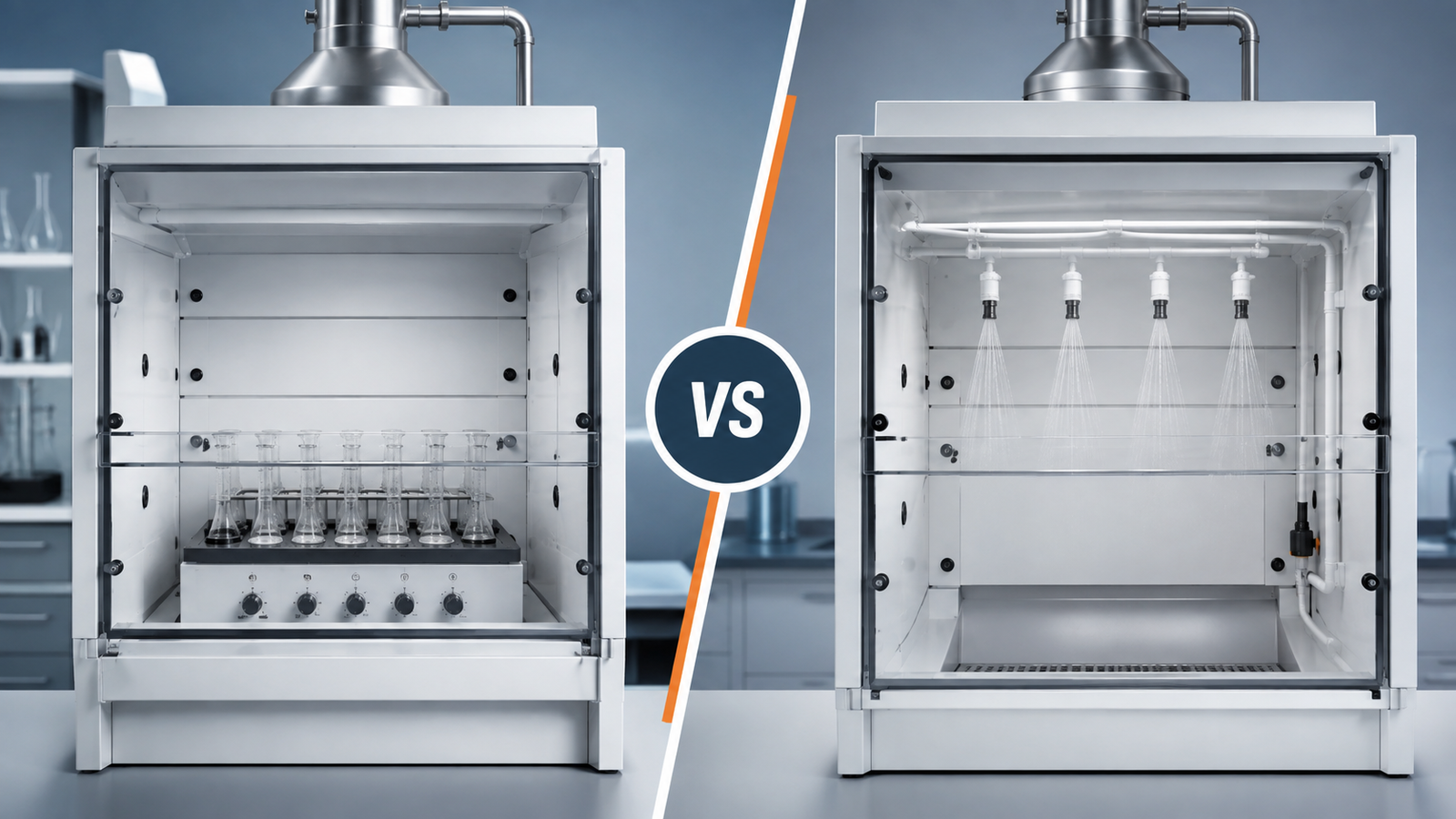
As its makers define it, a digestion-class fume hood is a ducted enclosure built for heated, concentrated, non-perchloric mineral-acid work — while a dedicated perchloric hood is a wash-down system built around one acid’s condensation chemistry. Two special-purpose hoods sit side-by-side, and buyers mix them up surprisingly often. One is built for acid digestion — the hot, acid-driven sample preparation that comes before trace-metal analysis. The other exists because a single acid changes character so completely under heat that it needs a category of its own. Choose wrong one way and you overspend; wrong the other way, and you take on a hazard you never budgeted for. Both categories raise the same question: does a wash-down system come with the hood, or is it specified separately? This guide walks the decision chain — acid species, temperature, residue, exhaust, and waste — so you can decide the category before you compare hardware.
What Acid Digestion Work Is — and Why It Strains a Standard Hood
What “acid digestion” means in an analytical lab
In an analytical lab, acid digestion is — as digestion-equipment makers define it — the step that turns a solid sample into something an instrument can read: the matrix is heated in concentrated mineral acids until it dissolves, ahead of ICP-MS, ICP-OES, or atomic-absorption trace analysis.
The labs in this territory are recognizable: geology and rare-element labs digest rocks and ores, biochemistry teams prep trace-metal samples, environmental and wastewater labs digest soils and effluents, and food-safety labs use the same chemistry hunting for contaminants such as mercury.
| Digestion scenario | What it stresses in a hood |
|---|---|
| Geology and rare-element labs (rocks, ores) | Mixed-acid corrosion load |
| Biochemistry trace-metal prep | Residue and trace cleanliness at ppb/ppt |
| Environmental and wastewater (soils, effluents) | Mixed acids on frequently repeated hot runs |
| Food-safety testing (e.g., mercury) | Corrosion load plus residue cleanliness |
Why digestion strains a standard hood
Digestion punishes a general-purpose hood in two ways. The first is corrosion: the routine digestion acids — hydrochloric, sulfuric, hydrofluoric, and nitric — will, in one corrosion-equipment maker’s words, “immediately rust and corrode any exposed metal,” which is why a fully metal-free chamber is this category’s baseline argument. The second is design intent: what separates a digestion hood from a standard hood is not the airflow principle but the materials and engineering that survive sustained hot corrosive vapor.
For trace-metal work there is a quieter failure: one manufacturer’s trace-analysis guidance warns that rust flakes and corrosion products released inside the chamber can contaminate samples at the parts-per-billion and parts-per-trillion levels those methods exist to measure — the analysis gets invalidated by the hardware meant to protect it.
Two special-purpose categories, one recurring mix-up
Vendors keep the two categories strictly apart. One competitor’s digestion hood page states outright that the product is “not suitable for handling perchloric acid applications.” XICHENG defines its digestion hoods the same way: made-to-order equipment for heated, concentrated, or frequently repeated non-perchloric mineral-acid work.
Both categories appear side by side in our guide to the main types of fume hoods, yet they answer different questions. The rest of this article draws the line between them: what each is for, where the boundary sits, and when each needs wash-down. Your next step: match your own lab to one of these profiles before you compare any hardware.
The Chemistry That Draws the Line: Acid Digestion vs Perchloric Acid Fume Hood
Nitric acid and aqua regia: the off-gas problem
The off-gas chemistry is where digestion stops being “an acid, but hotter.” Nitric acid is the workhorse: one manufacturer’s educational guide estimates it appears in roughly 90% of digestion protocols, and the vapor it releases follows an ugly arc — nitric oxide forms, oxidizes to nitrogen dioxide, and the mixture keeps regenerating a corrosive micro-atmosphere while posing a delayed pulmonary hazard (that vendor’s estimate, not a survey result).
Aqua regia is harder on everything downstream of the chamber: working with it releases nitrosyl chloride and chlorine gas, both of which attack metal ductwork and filtration media.
HF: the sash-and-visibility chemistry
Hydrofluoric acid is the clearest demonstration that chemistry, not preference, dictates materials: HF attacks tempered glass, frosting sashes opaque over time — which is why digestion hood makers specify polycarbonate sashes. XICHENG’s product guidance makes the same call: wherever HF exposure is possible, the sash is polycarbonate. When the acid decides the window material, the specification conversation has already changed.
Where perchloric acid crosses the line
In one manufacturer’s chemistry framing, perchloric acid behaves as a strong acid at room temperature and below roughly 72% concentration — demanding, but still inside the corrosion problem digestion hoods are built to solve — then changes character: heated above roughly 150–160 °C or concentrated beyond ~72%, it becomes an extreme, unstable oxidizer, a different hazard class rather than a stronger version of the same one.
That is the boundary XICHENG’s own product page draws: a digestion hood is not a substitute for a dedicated perchloric hood, and adding an optional rinse connection to a digestion hood does not create that system. The standards texture agrees, with an edition caveat: ANSI/ASSP Z9.5-2012 §3.2.5, as reproduced in Flow Sciences’ white paper, places >85% acid in the required-perchloric-hood column and recommends digestions in perchloric hoods; the 2012 edition no longer treats sub-72% room-temperature use as fume-forming — verify the current edition. Map your own acid list against this chemistry and you can decide which side of the line your work sits on.
Key takeaways:
- Acid species decides vapor and droplet behavior; behavior decides the category.
- Nitric and aqua regia make digestion a vapor problem (NOx, NOCl, Cl₂); HF makes it a materials problem (glass sash → polycarbonate).
- Perchloric’s line is its oxidizing behavior under heat and concentration — not its acidity.
- A rinse connection does not turn a digestion hood into a perchloric system.
Temperature Is the Switching Variable
Liner temperature ratings — vendor-asserted, attributed line by line
One manufacturer’s (Unicorn’s) engineering guidance — vendor-asserted, and explicitly not a standard requirement — puts the liner ladder at:
| Liner | Max continuous temp (vendor-asserted, Unicorn) | Watch-outs |
|---|---|---|
| uPVC | ~60 °C | Tightest ceiling of the four |
| Polypropylene | ~100 °C | A standard digestion-chamber option (XICHENG material directions) |
| PVDF | ~150 °C | The mid-range step |
| 316 stainless | >250 °C | Vendor caveat: can pit in HCl/aqua-regia service |
The same vendor tells the story that makes the ladder bite: a uPVC liner selected purely for acid resistance distorted at hot-block temperatures approaching boiling. Read it as vendor-asserted guidance — a starting frame, not a compliance table.
Apparatus temperature is not hood temperature rating
XICHENG’s specification guidance draws the distinction that prevents most mis-orders: the temperature of the apparatus inside the hood is not the hood’s temperature rating. Local radiant and conducted heat load the work surface, liner, sash, and seals differently — a 100 °C hot block does not make a 100 °C hood. The useful question is not “how hot is my block?” but “what does each component see as heat travels through this setup?”
Temperature as the class-switching variable
Temperature decides more than liner life; it decides the category. Digestion-class hoods exist precisely for heated, non-perchloric acid work; the ladder above is their design grammar. Perchloric is the red line: NFPA 45-2015 §12.1, as reproduced in Flow Sciences’ white paper, confines perchloric heated above ambient to hoods specifically designed for it — verify the current edition.
That is why hot acid fume hood selection is less about picking a liner from a table than matching the whole temperature path: what is heated, how hot, in which acid. If the acid is perchloric and the work is heated, the digestion ladder no longer applies — the job has crossed into the dedicated-perchloric category. Your next step: map the whole temperature path — block, radiant surfaces, dwell time — before you choose a liner.
Key takeaways:
- The liner ladder (~60 / ~100 / ~150 / >250 °C) is vendor-asserted guidance, attributed per vendor — not a standard requirement.
- Apparatus temperature ≠ hood temperature rating; heat loads each component differently.
- Heat and concentration are what move perchloric acid from “strong acid” into a category of its own.
Residue and Crystallization: Why Perchloric Acid Is a Different Category
From vapor to crystal: the condensation mechanism
Corrosion explains why digestion needs special materials — not why perchloric acid gets a category of its own. That explanation is residue. Heated perchloric acid vaporizes — and a fume hood is, by design, a condensation machine — recondensing on interior hood surfaces and inside the ductwork. What deposits there is not harmless scale: as the University of Illinois’ background, reproduced in Flow Sciences’ white paper, describes the mechanism, these are shock- and friction-sensitive perchlorate salts, accumulating quietly run after run.
The mechanism contains its own remedy — the vendor’s point that perchlorate salts are water-soluble, so an integrated wash system dissolves deposits before they accumulate into a hazard; which is why wash-down is not an accessory in this category.
One sentence of history
In 1947, an explosion involving 75% perchloric acid and an acetic anhydride bath — recounted in Flow Sciences’ white paper — demonstrated this mechanism in the worst possible way. That is all the history this decision needs.
The <72% caution line — per-authority, never merged
Perchloric acid is not simply dangerous above 72% and safe below it — the authorities draw the caution line differently, and the positions belong side by side, not averaged:
- University of Calgary (as reproduced in the white paper): 60–72% perchloric reacts with alcohols and certain organics to form very unstable perchlorate esters — at room temperature.
- University of Illinois (same reproduction): three conditions keep even sub-72% acid dangerous — dehydrating agents can drive it anhydrous; elevated temperature can condense shock-sensitive salts in the duct; organics can form explosive esters. (Azeotrope note: aqueous perchloric does not concentrate past ~72.5% by evaporation alone.)
- British Columbia’s Ministry guideline, the broadest reading: a designated perchloric hood is mandatory whenever the acid is handled — no qualifiers.
- ANSI/ASSP Z9.5-2012 §3.2.5 (as reproduced in the white paper, introduced earlier), the narrowest reading: >85% acid required into perchloric hoods, digestions recommended into them; the 2012 edition no longer treats sub-72% room-temperature use as fume-forming. Verify the current edition — 2003 drew the line differently.
- Flow Sciences’ author — a manufacturer; weigh the interest — recommends all perchloric work in a perchloric hood absent definitive institutional assurance of no risk.
So when the working question is perchloric vs acid digestion hood: the authorities converge on heated work and deliberately disagree on the cold, dilute margin — a margin your chemical hygiene review resolves. Run the positions above against your own concentrations and temperatures, and you can decide whether residue — not corrosion — is what drives your category choice.
What Are the Acid Digestion Fume Hood Requirements That Actually Matter?
“Requirements” framing: chemistry-driven, not a codified standard
Start with what a search of this topic actually surfaces: only vendors’ option and spec lists — no codified requirements standard surfaced on the digestion side, in contrast to the perchloric standards. The absence reflects the decision itself: digestion “requirements” are chemistry-driven choices made project by project from your exposure path. XICHENG’s specification guidance states the method plainly — do not select by name or liner material alone; review the complete exposure path component by component: liner, work surface, sash, fasteners, seals, fixtures, collar, duct, fan.
Chamber material, work surface, sash
Compared with a general-purpose lab hood, a digestion-class chamber is a different object. XICHENG builds its chambers in PVC/uPVC, polypropylene, or reviewed combinations, with work-surface options of 25 mm epoxy resin or 30 mm phenolic resin with a marine/retaining edge — and, as the chemistry above established, a polycarbonate sash wherever HF is in the picture. One competitor ships U-PVC/PP chambers with polycarbonate sashes. Another’s comparison table lists fully coved, seam-free welded corners against seamed ones.
Whether polypropylene or stainless steel wins a given trade-off is a materials-comparison question we treat separately in our PP vs stainless steel fume hood comparison; here the only question is which attributes your acid profile demands.
Wash-down and drain trough as specifiable options
This is what makes the title question interesting: on digestion hoods, wash-down is an option, not a given. One competitor ships its digestion product without wash-down as standard. Another lists “exhaust wash-down with drain trough” under its recommended options for acid digestion operations. XICHENG frames the same reality at project level: washing, drainage, and exhaust treatment are defined project interfaces — nothing a category name includes by default.
Exhaust interfaces and the specification conversation
The same project logic governs the air side. Competitor digestion hoods sell the blower separately, with external blower installation treated as an installation requirement. XICHENG publishes reference airflow figures — 800–1000, 1000–1200, and 1200–1500 cfm across its 1200/1500/1800 mm widths — explicitly as preliminary planning directions, not installed guarantees; they are conversation starters, not commitments. The remote fan, duct, and any scrubber are coordinated interfaces; final configuration is fixed by approved drawing and component schedule. Line up these five decisions with your own exposure path, and you can decide each specification line deliberately.
Key takeaways:
- No codified standard surfaced for digestion-hood requirements; the spec follows your exposure path, component by component.
- Chamber material, work surface, and sash are chemistry decisions: PVC/PP families, epoxy or phenolic surface, polycarbonate sash under HF.
- Wash-down and drain trough are specifiable options for digestion — decide them deliberately, don’t assume them.
- Exhaust is an interface project: external blower, reference airflow, approved drawing.
When Only a Perchloric Hood Qualifies
The authority positions, side by side
Heated perchloric work is where the authorities converge:
- NFPA 45-2015 §12.1 (as reproduced in the white paper): perchloric heated above ambient — only in hoods specifically designed for it.
- University of Illinois (same reproduction): heating perchloric above ambient — specialized wash-down hood required.
- ANSI/ASSP Z9.5-2012 §3.2.5 (as reproduced, introduced earlier): >85% acid required into perchloric hoods; digestions recommended into them — a 2012-edition reading; verify the current edition.
- British Columbia’s guideline: designated perchloric hood, mandatory, no qualifiers.
- Flow Sciences’ author: manufacturer position (interest noted) — all perchloric in a perchloric hood absent definitive assurance of no risk.
What a dedicated perchloric hood integrates
XICHENG’s dedicated perchloric hood is designed around the condensation risk: coved, continuously welded interior surfaces; a reachable, cleanable baffle zone; spray piping; a collection trough; a drain; and a dedicated exhaust interface. Wash coverage is specified per surface — work chamber, baffle faces and rear zones, exhaust transition, collar, duct, and fan side — and the specification says plainly that nozzle presence does not prove coverage. Type 316 stainless is the common construction direction — with the explicit caution that the grade is not a universal compatibility claim; per-component review remains required. The integrated wash-down is the category’s core functional component — one manufacturer’s reporting ties its mandate to NFPA 45 Ch. 7.12, as that vendor reports the standard — verify the current edition.
The dedicated-exhaust rule and the requirements hand-off
Exhaust is where the two categories fully part company. For a dedicated perchloric hood, an independent, non-manifolded exhaust route is a design premise, not a preference — and the white paper records the consensus that perchloric exhaust is always separate from other chemical exhaust. One vendor’s reported rule set is blunt: dedicated un-manifolded duct; shortest, most-vertical routing; PTFE-family sealants only; spark-resistant or induced-draft fans; and no fire dampers.
The deep detail lives one click away: trigger conditions, the specification checklist, and a project-confirmation workflow for a dedicated perchloric hood are covered step by step in our perchloric hood requirements guide. The boundary holds both ways — XICHENG’s perchloric product page states that none of the alternatives should be used for heated perchloric work unless the complete special-purpose system has been evaluated and approved. If your procedure heats perchloric acid, your next step is the dedicated-perchloric category — before you compare anything else.
The Wash-Down Decision: Acid Digestion vs Perchloric Acid Fume Hoods
The asymmetry, stated plainly
So — the title question. For a digestion hood, wash-down is a specification decision — the option-not-default picture from the spec section above. For a dedicated perchloric hood, the authorities treat wash-down as integral — the category’s core functional component, the mechanism-level remedy for deposits that would otherwise accumulate toward a hazard. The same words — “wash-down system” — mean something different on each side of the line.
The digestion-side test: when to specify wash-down
No rule book mandates it, so decide deliberately. The test has five axes. Acid load: how much acid, how aggressive. Temperature: how hot, against the ladder above. Run frequency: daily digestions or an occasional campaign. Residue protection: the trace-metal contamination risk flagged earlier — residue between runs can invalidate the next result, so cleaning between runs is already discipline. Cleaning cost: manual cleaning labor, weighed against a plumbed rinse. If two or more axes run hot, specify the wash-down option. If your work is cool, dilute, and occasional, it can wait — treating it as a project interface keeps that door open at specification stage.
The perchloric-side operating logic — attributed, not merged
Two statements, two sources, kept apart. Flow Sciences’ white paper describes the operating rhythm: the wash-down runs daily or after each procedure, with a typical cycle of at least 10 minutes run with the hood empty, covering hood and ductwork — one manufacturer’s operating description, not a standard. Separately, XICHENG’s specification frames the wash-water inlet as a per-project process interface — pressure, flow, water quality, isolation valves, activation, and controls defined project by project — and states plainly that there is no universal inlet pressure, nozzle count, or wash duration. The coverage principle travels with the purchase: coverage is a per-surface schedule from chamber to fan side; nozzle presence does not prove coverage.
The rinse-connection trap
Here is the buyer-protection point: a rinse connection is not a wash-down system. XICHENG’s product boundary says adding an optional rinse connection to a digestion hood does not create a perchloric wash-down system — and its perchloric page states the other half: heated perchloric work requires the complete special-purpose system, evaluated and approved. If perchloric acid has any realistic chance of reaching the hood or exhaust, the rinse fitting is not the answer. The category decision is. For the digestion side, run the five-axis test before you decide.
Key takeaways:
- Wash-down is a conditional, specifiable option for digestion; it is integral to the dedicated perchloric category.
- A rinse connection does not create a perchloric wash-down system.
- The “at least 10 minutes” cycle is Flow Sciences’ operating description only — one manufacturer’s rhythm, not a standard.
- There is no universal wash duration: the wash-water inlet is a per-project interface.
Exhaust, Waste and Maintenance Boundaries
Exhaust paths: what differs between the categories
On the digestion side, exhaust is an interface project: remote fan, duct, and any scrubber coordinated case by case, default not included, final configuration fixed by an approved drawing. On the perchloric side, the same interface hardens into specification: an independent, non-manifolded route is a design premise, and the vendor-reported rule set above (dedicated un-manifolded duct through no fire dampers) applies. Duct routing and fan selection are an engineering discipline of their own; this article stops at the exhaust interface and treats them as a project decision to be engineered.
Ductless is not the escape route
The tempting shortcut fails on both categories. Untreated activated carbon is largely ineffective against the low-molecular-weight inorganic acid gases digestion produces — HCl, HF, and the nitrogen oxides. Hot, open-vessel, multi-sample digestion overwhelms even impregnated carbon. And chlorine with nitrogen dioxide oxidatively degrades carbon beds, an exotherm that carries spontaneous-combustion risk. For perchloric, the white paper’s author does not recommend carbon-based ductless at all: captured perchloric acid plus charcoal is an organic-peroxide redox risk, and even dilute use deserves a health-and-safety review first. How to judge ductless filters honestly, and when a ductless hood is and is not safe, are covered in our ductless filter-selection guide and our ductless-safety explainer.
Waste and effluent paths
Wash water has to go somewhere — an engineering decision, not a default. On the perchloric side, one manufacturer’s reporting routes wash effluent to a dedicated holding tank; wet scrubbers and recirculation are not standard equipment — gas handling and effluent treatment are separate engineering decisions. On the digestion side, waste handling is likewise a defined project interface. If your wash-down spec includes a drain, your plumbing spec needs a destination.
White powder: the stop-work boundary
One maintenance signal outranks every specification argument here: white powder inside a perchloric hood or its ductwork. In improperly maintained perchloric hoods, that powder is organic perchlorate salt and peroxide residue — and it may be explosive. The documented response is to stop and summon hazard specialists for decontamination, not to wipe and continue. UC Riverside’s perchloric-acid EHS procedure is one example of institutional guidance on the topic. A complete periodic maintenance and re-evaluation checklist for special-purpose hoods is its own topic; this article defines only the stop-work trigger. And radioisotope work layers radiological containment requirements on top of this entire decision — outside this comparison. Before you sign a specification, decide where the wash water goes and who owns the stop-work call.
Decision Checklist and the Specification Conversation
The decision chain in one pass
Run the seven steps in order and the category answers itself. One: acid species and temperature — nitric, aqua regia, HF, and other non-perchloric acids, at what temperature. Two: vapor and droplet behavior — NOx, NOCl, and Cl₂, plus HF’s attack on glass. Three: crystallization and residue risk — does the acid condense into hazardous deposits? Four: liner attributes — what your acid profile demands, component by component. Five: exhaust path — interface project or dedicated non-manifolded route. Six: wash-down — conditional test on the digestion side, integral on the perchloric side. Seven: waste handling — holding tank, treatment, destination.
A worked example
Take a geo lab digesting silicate ores in HF plus aqua regia on a 120 °C hot block, three runs a week. Acid species: non-perchloric — the digestion side of the line. Temperature: a 120 °C block sits above polypropylene’s ~100 °C vendor rating on paper — which is exactly why the apparatus-versus-hood-rating caveat matters, and why this becomes a supplier conversation rather than a table lookup. Vapor: nitric off-gas plus aqua regia’s chlorine, and HF in the picture means a polycarbonate sash. Residue: trace-metal cleanliness applies, so cleaning between runs is already discipline. Exhaust: an interface project — fan, duct, and scrubber coordinated, nothing included by default. Wash-down: three aggressive runs a week tip the five-axis test — specify the option, with the drain trough. Waste: a defined destination for rinse effluent, set at specification stage. Swap the acid for heated perchloric, and the same chain lands elsewhere: the dedicated-perchloric category, wash-down integral, exhaust dedicated.
Questions to bring to a supplier
Turn the chain into a script. “What is my full exposure path — liner, work surface, sash, fasteners, seals, fixtures, collar, duct, and fan?” “Are washing, drainage, and exhaust treatment included, or project interfaces to define?” “If wash-down is specified: what are the inlet pressure, flow, water quality, valve, and activation parameters for my project?” “What does the approved drawing and component schedule fix — and leave open?” A supplier who answers those four in specification language is one you can build with.
Where to go next
If your chemistry lands on the digestion side, the acid digestion fume hood product page is the starting point for the made-to-order conversation. If the chain above moved you to the perchloric category, start from the perchloric acid fume hood page instead — and take the requirements guide with you. The acid digestion vs perchloric acid fume hood decision is, in the end, a chemistry decision — and with the chain and the script above, you can decide it deliberately.
Key takeaways:
- The chain: acid species & temperature → vapor/droplet behavior → crystallization/residue → liner → exhaust → wash-down → waste.
- Heated perchloric work means the dedicated perchloric category — always.
- Heated non-perchloric acid work means a digestion-class hood, with wash-down decided by the test, not assumed.
Frequently Asked Questions
Is it safe to mix digestion acids?
Conditionally: some mixtures are designed chemistry — aqua regia is nitric plus hydrochloric by design, and that reaction releases nitrosyl chloride and chlorine gas, which attack metal ductwork and filters. The line not to cross is unplanned perchloric combination — per the University of Calgary’s position (as reproduced in Flow Sciences’ white paper), even 60–72% perchloric reacts with alcohols and certain organics to form very unstable perchlorate esters at room temperature. Mixing is chemistry to plan.
Which liner handles higher temperature — PP or PVC?
Per the vendor-asserted guidance cited earlier: polypropylene is rated to roughly 100 °C, uPVC to roughly 60 °C — and the same vendor recounts a uPVC liner distorting at near-boiling hot-block temperatures. The caveat travels with the numbers: apparatus temperature is not the hood’s rating.
Does a digestion-class hood need an external blower?
Plan it as part of the project from the start: competitor digestion hoods sell the blower separately, with installation treated as a requirement, and on XICHENG’s side the fan, duct, and any scrubber are coordinated project interfaces with final configuration fixed by approved drawing.
Can cold, dilute perchloric acid go in an ordinary hood?
Conditional — and your institution decides. The 2012 reading of ANSI/ASSP Z9.5 §3.2.5 (as reproduced in Flow Sciences’ white paper) no longer treats sub-72% room-temperature use as fume-forming. But the University of Illinois’ background names three conditions where sub-72% acid stays dangerous; British Columbia’s guideline requires a designated perchloric hood with no qualifiers; and the white paper’s author recommends perchloric hoods for all perchloric work absent definitive institutional assurance of no risk. Health-and-safety review first — deliberately not a yes/no.
Do I need wash-down on a digestion hood?
Conditionally — an option, not a default: vendors ship digestion hoods without it, list it under recommended options, and XICHENG treats washing and drainage as project interfaces. Decide with the five-axis test above. And the trap: a rinse connection is not a wash-down system — if perchloric acid can enter the process or exhaust, the digestion-side system is not the relevant one.
What should I do if I find white powder in the hood?
Treat it as a stop-work signal: in improperly maintained perchloric hoods, white powder is organic perchlorate salt and peroxide residue — it may be explosive. The documented response: stop and summon hazard specialists for decontamination — not wipe and continue; cleanup belongs to specialists.
Leave a Reply