





Key Takeaways
- Working in a fume hood is a behavior, not a setting. How to use a fume hood safely comes down to keeping an approved layout intact and routing problems — not picking a fan speed or sash height from the internet.
- A fume hood is an engineered ventilation enclosure that draws airborne contaminants away from the breathing zone. That containment holds only while your body stays out, nothing blocks the flow path, and the institution-approved working state is respected.
- Start only with approvals in place. Generic operation knowledge never authorizes an unapproved chemical, a special-hazard application, or a ductless hood’s filtration claims; those route to EHS and to the ductless hood requirements.
- Mid-session changes are routing decisions. An alarm, a low-flow reading, or a new chemical means stop, report, and follow your SOP — never mute, reset, adjust, or replace parts yourself.
- Ending is a handoff, not a sash close. Cap containers, route waste through approved steps, set the sash per your configuration, and pass observations to the responsible party.
How to Use a Fume Hood: The Five-Step Session
The question behind “how to use a fume hood” is practical: how does a normal work session run inside an approved hood, from standing in front of it to the handoff when you leave? A normal session is a behavior chain with five beats: confirm the work is approved, arrange the space around the airflow path, keep that arrangement intact, route any mid-session change, and end the session the way your institution requires. Each beat gets its own section.
Using a hood safely is a work practice. Choosing a hood type, running a pre-use inspection, deciding a working sash height, servicing the cabinet, and qualifying ductless filtration are separate tasks with their own procedures. If your search was “how to use a chemical fume hood safely,” the safety lives in every step of the chain below — approval, arrangement, routing, and handoff — not in a single separate step.
Who should read this? Anyone about to run laboratory work at a hood their institution has approved — bench scientists, technicians, and students under supervision, plus the training and EHS staff who support them. It assumes you can find your hood’s label and your institution’s operating requirements; where that fails, the session stops and the question goes to EHS or a supervisor.
Use the five beats as your default session script. A chemical fume hood contains what the airflow captures; the practices below keep that capture working. The practices below cover running a work session, not buying, inspecting, sizing, or repairing a hood.
Start Only With an Approved Work Scope
An approved work scope is the prerequisite for every step. Without it the practices below have nothing to protect: generic technique applied to a situation your institution has not checked.
Confirm the Hood and the Task Are Already Approved
Four things must already be true before the session starts. You are trained for the work, the hood is appropriate for the chemicals and the process you will handle, the marked working opening and the airflow range your institution specifies are known to you, and any special-hazard use has been cleared by EHS. These preconditions come from your institution, not from the procedure itself.
Institutions phrase this sequence differently, but the decision is the same: approval is a state, not a guess. If any of the four is missing, the correct move is to ask the responsible party rather than infer the answer from a label or from an internet recommendation.
Approval comes first because every behavior below assumes a hood whose airflow, controls, and working state have already been verified for the work in front of you; asking “is this approved” after the chemicals are open is asking at the worst possible time.
When the Generic Procedure Stops Applying
Generic hood knowledge covers ordinary chemical work in a conventional hood. It does not authorize an unapproved chemical, a special hazard such as perchloric acid or radioisotope work, or the filtration claims of a ductless hood, each of which carries its own approval path.
The safe behavior for all three cases is to stop and route: take the question to EHS or your supervisor instead of adapting the technique. Working around an approval gap is how a containment routine becomes a false sense of safety.
Where the Session Ends
Inspection and its records, working-opening and airflow math, face velocity and testing, maintenance and service, and hood type selection all stay with their owner pages, and each of those pages carries its own depth. When a session touches one of those territories, the table below names the page that carries the depth.
A session is either in scope or it routes to EHS or your supervisor before anyone touches the hood.
Set Up the Work Zone Around the Airflow Path
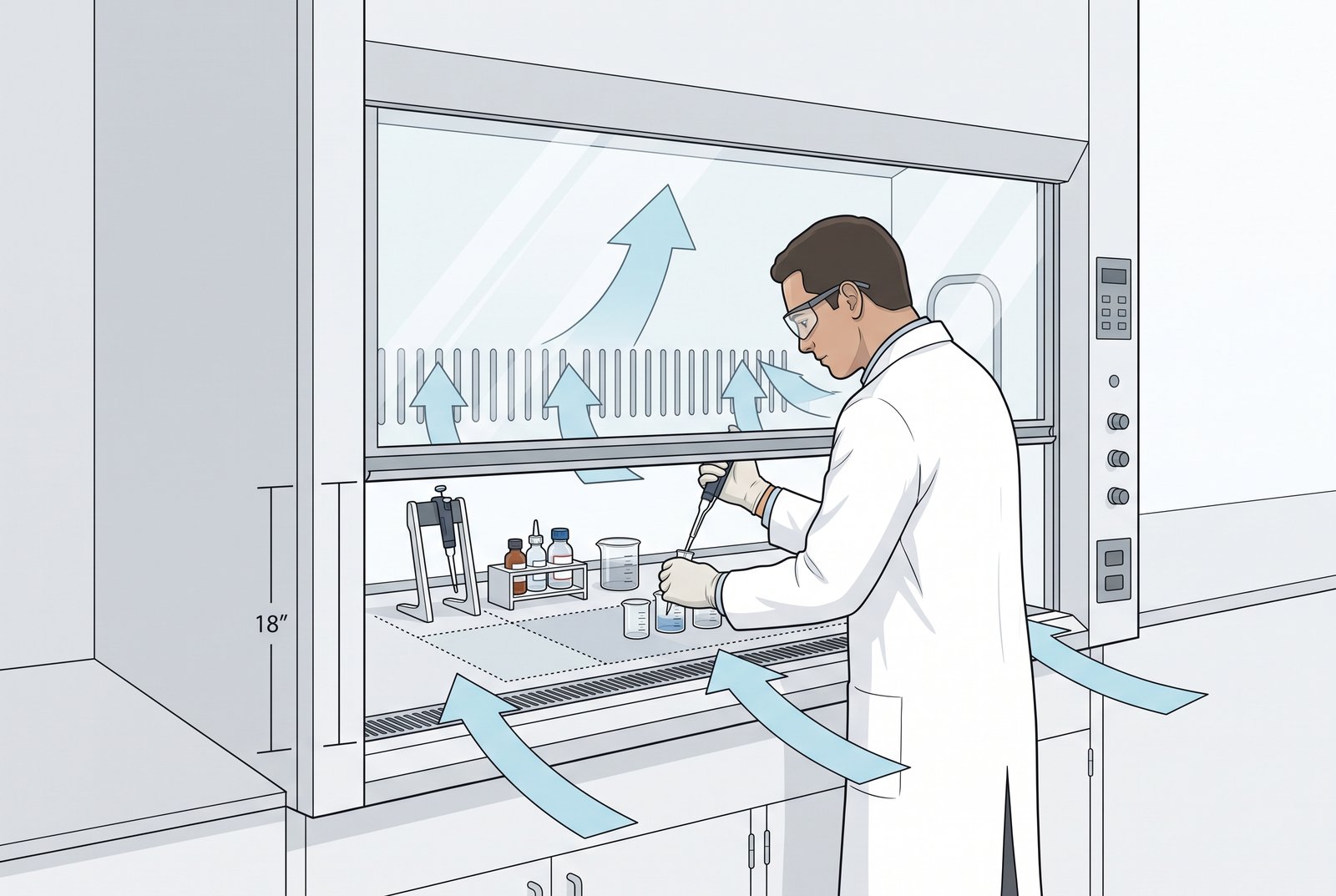
A fume hood contains airborne contaminants because air moves across the work surface and into the exhaust. Setup is the step where you arrange your body, materials, and equipment so that flow stays intact for the whole session.
The flow does three jobs: it carries vapors and particulates away at the breathing zone, keeps a stable capture pattern across the work surface, and moves releases into the exhaust before they spread. Each setup rule protects one of those jobs, and a rule that saves two minutes but breaks the pattern saves nothing.
Place Your Body Behind the Sash Plane
Work from outside the sash plane: your head stays out of the opening, and only your arms and hands reach through to the work surface. Eye protection still follows your institution’s requirements for the process — the hood does not replace it.
Positioning is a standing decision, not a one-time choice. The body-and-opening relationship is set by your institution’s sash-height rule and holds for the whole session.
Keep Work and Items at the Distance Your Institution Specifies
Many institutions give a simple example: keep the work and items in active use at least 6 inches behind the sash plane, measured from its inside edge. That figure is one worked example; your hood label or institution sets the setback that applies to your cabinet.
Large equipment follows the same logic on a different axis. Institutions give elevation examples that differ — at least 2 inches above the base in one guidance, more than 1 inch in another — so base elevation and setback stay separate decisions your institution approves rather than one merged rule.
Keep Baffles, Airfoil, and Slots Clear
Baffles, the airfoil at the front of the opening, and the exhaust slots route the airflow that does the containment. Nothing in the work zone should block them: no stacks of boxes against the rear baffle, no cords or tubing draped across the slots, no paper wedged where air has to pass.
Clearing the path is an arrangement act, not an adjustment act. Never modify baffles, dampers, or controls — those changes belong to authorized personnel only.
Believe the clearance rule even when nothing looks wrong. Flow redistribution does not announce itself: a blocked slot quietly shifts capture duties onto other slots, and the first sign of the imbalance is a reading or a smell, not a message on the display.
Keep Only What the Session Needs
Bring into the work zone only what the current procedure uses, and keep those containers closed while you are not dispensing from them. A hood is not a storage cabinet and not an evaporation station; unused chemicals and wastes leave through the mechanisms your institution provides, not through the airflow.
Clutter is a common way a good setup fails: each extra item makes it more likely that something drifts into the flow path before you notice. When in doubt, move it out.
The “session needs” test applies continuously, not once. As the procedure moves from weighing to reaction to workup, the items in the zone should change with it; anything that has finished its role goes back to its storage location right away, not at the end of the day.
The approved airflow path stays open when the body is behind the sash plane, work sits at your institution’s distance, the slots stay clear, and only the needed items are inside.
Work With the Flow: Keep the Arrangement Intact Through the Session
Setup gets the session started; behavior keeps it working. The setup you just built has to survive contact with real work, because movement, dispensing, and small mid-session decisions all shift the airflow if you let them.
Move Slowly and Deliberately Around the Hood
Fast movements, quick passes past the opening, and cross drafts from doors or passing people push air out of the capture zone. Keep your own motion slow and deliberate, and keep foot traffic away from the front of the hood while chemicals are open.
The sash follows the same rule. Move the sash slowly and deliberately: intentionally, never as a shortcut.
The mechanism is simple: containment depends on a stable boundary between room air and hood air at the opening. Body motion, passing traffic, and door drafts all tear at that boundary; keeping them away is not caution for its own sake, it is protection of the capture pattern.
Don’t Lean In; Keep the Shield Relationship
Keep your body and head out of the opening while you work. The sash and the airflow form a shield relationship, and that relationship ends the moment you lean across the plane to reach further.
A display that looks fine changes nothing: it does not prove the hood will protect a head that is inside the opening. The same distinction between a reading and containment applies at the sash.
Close Containers When You’re Not Dispensing
An open container adds vapor to the air continuously, not only while you pour. Close the vessel between transfers, and cap wastes the same way.
Closing a lid costs seconds and removes a continuous source from the airflow path. Containment is easier to keep intact when nothing is silently feeding the airstream.
Watch the Session for Creep
Sessions drift: a notebook arrives, a second beaker joins the first, a tubing line crosses the slots, and a documented setback quietly drifts into a much shorter one. Watch for that drift and correct it by rearranging, not by justifying.
The best-practice habits of lab hood safety — tidy zones, capped vessels, deliberate motion — belong to this phase of a session. They are behaviors, and behaviors need refreshment mid-session, not just at setup.
Creep is a standing behavior, not a one-time inspection task — which is why it belongs here rather than in a checklist. Correct it the way you maintain any setup: move the item, restore the distance, confirm the slots, and continue.
What a Normal Reading Leaves Unproven
A normal airflow reading or indicator reports how the hood is operating. Breathing-zone containment is established by airflow measurement and testing, and the work itself stays inside what your institution has approved.
Face velocity is a different task: the approved numbers come from airflow measurement and testing, not from a display.
A reading is one input among several: a normal reading supports continuing under approved conditions, and the display and the flow pattern remain different sources of information.
The arrangement either stays intact or it visibly stops being intact, and that break is what the next steps respond to.
When the Session Changes Mid-Work: Route, Don’t Fix
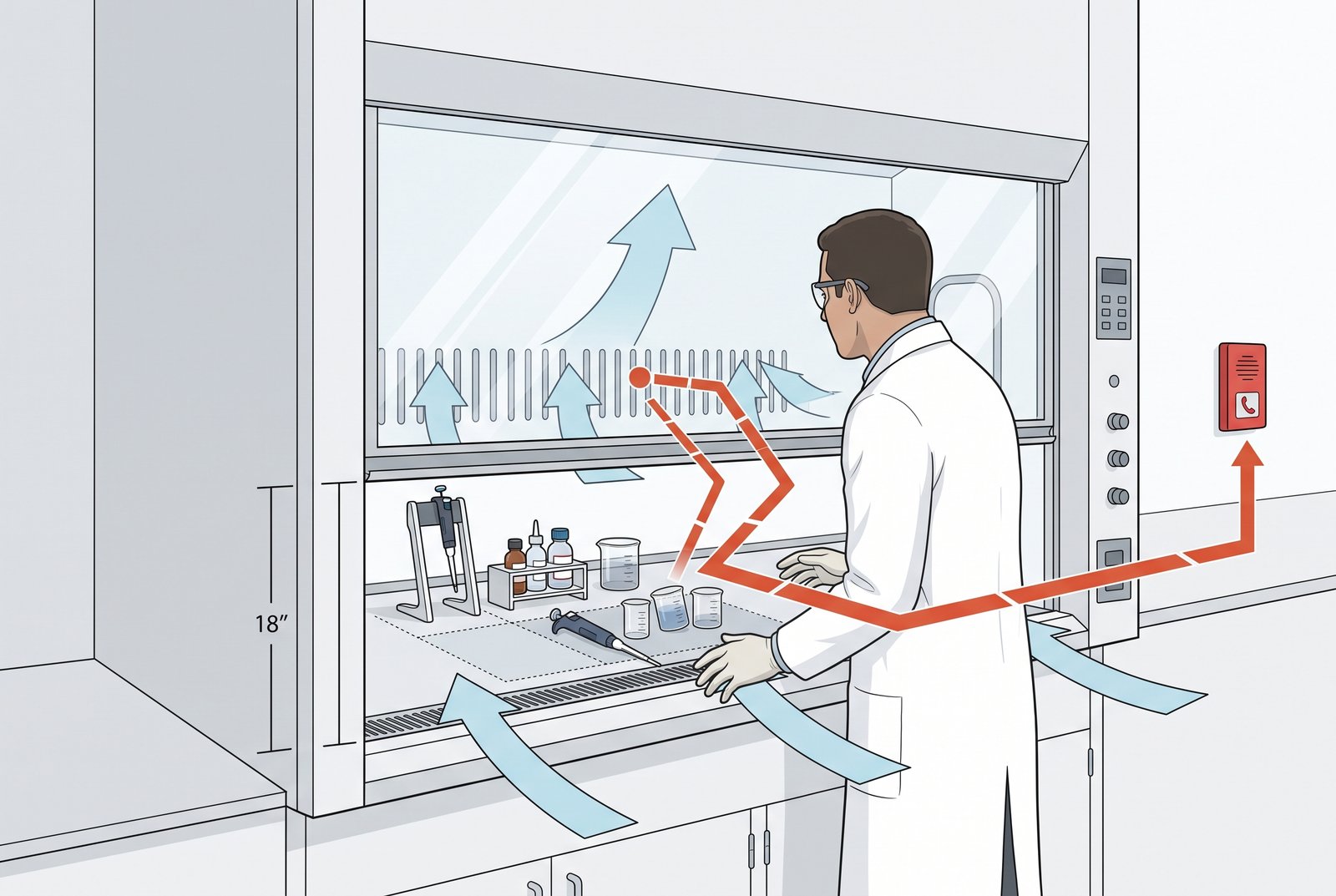
Mid-session changes are the real test of hood behavior. When the situation changes, the correct response is not to improvise with the equipment — it is to decide whether the work may continue at all.
A New Chemical or New Condition Is a New Approval Question
Swapping a chemical, changing a process step, or altering the hazard profile restarts the approval question from the scope section. Replacing a filter and continuing is a shortcut, not a rule: filter-media suitability and monitoring are separate questions from the session itself.
Treat a material change as a stop point. The person who approved the original conditions, not the person at the hood, decides whether the new conditions are acceptable.
The approval question is decided by whoever approved the original conditions: the operator stops, reports the change, and waits for that answer rather than deciding it. The habit to build is the pause itself, because the pause is what keeps the boundary honest.
Alarm or Airflow Change: Stop, Report, Follow Your SOP
An alarm or a changed airflow reading means stop all work until the condition is corrected under your institution’s procedures. Do not mute it, reset it, adjust the fan, move the baffle, or swap a filter to make the session continue.
In fume hood safety, the correction chain is stop, report, and follow your SOP — preserve the situation for the people authorized to fix the hood. Stop-use and escalation detail belongs to inspection and maintenance procedures.
Treat an alarm as a status signal from the hood’s monitoring chain, not as a test of your patience. The people who service that chain are the only ones who can clear it, and your contribution is the report, not the reset.
Spills, Splashes, or Fire Potential: Use the Institution Plan
Spills, splashes, and fire potential follow your institution’s emergency plan, not a generic cleanup script. Cleanup and response steps depend on the chemical, the quantity, and your facility’s procedures.
Your decision in the moment is to protect people and route the response to trained personnel.
Power and Utilities Failure: Know the Lab-Specific Plan
For work with the most hazardous chemicals, your laboratory has a specific action plan for events like a power loss that stops the exhaust. Know that plan before you start the session, and follow it when the event happens.
Shutdown and power-loss steps are lab-specific, and a wrong sequence can be worse than none.
Confirm the utility plan before you start, not during the event: knowing who to call, what to stop, and where to wait turns a power event into an execution of a plan you already know.
Classify any mid-session change as continue, escalate, or stop-and-report — and never self-correct the hood.
End the Session and Hand Off the Way Your SOP Specifies
A session ends with a handoff, not with a sash close. The closeout has four parts: contain the materials, set the hood into its required state, pass the space along, and stay clear about what “finished” does not mean.
Close Containers and Route Waste Through Approved Steps
Cap every container you opened, and route waste through the mechanisms your institution provides — its waste containers, its satellite accumulation points, or its documented disposal route. Closing the sash is not the same as having processed the waste.
The order matters: materials leave the hood’s airflow responsibility before the hood returns to its resting state, so a stray open vessel cannot quietly evaporate overnight.
Set the waste routing before the session, not at the last open container: know which waste container or collection point your facility designates for the material in use, so closeout stays quick and nothing waits on a decision.
Set the Sash According to Your Configuration and Procedure
The correct sash state at the end of work depends on your hood’s configuration and your institution’s procedure. Some facilities direct a full close; others specify a different state for their equipment — the decision belongs to your configuration and institution.
Closeout is not an energy discussion: the engineering states behind sash position belong to sash-height selection.
Sash state is part of the handoff state, so it belongs in the closeout sequence. If the next user or the space depends on a specific state, you set it — per configuration and institution, not per habit.
Hand Off the Space and Pass On What You Noticed
Hand the space to the next user or to your supervisor in the state your SOP expects, and pass along anything you noticed — an odd sound, a flickering indicator, a change in airflow feel. Observations belong to the responsible party, not to your private memory.
A handoff note is not the inspection record system; it is the courtesy and the duty that close an honest session.
What Closeout Covers
Setting the sash and walking away does not return the hood to service, decontaminate it, shut down its exhaust, or waive any periodic testing. Those are separate decisions made by authorized people with their own procedures.
The distinction protects you: a session is finished when the materials are contained, the state follows procedure, and the handoff is done — not when the last person closes the glass.
Closeout leaves the hood in the state your institution requires and hands the session off cleanly; it does not certify the hood.
Worked Example: How to Use a Fume Hood in One Normal Session
The Scenario and Its Assumptions
Walk one session to see the decisions in order. The scenario is deliberately generic: your institution approves procedure X for vapor-releasing work, assigns it to hood type Y, and labels working state Z — the exact distances, elevations, and sash state come from your cabinet label and your SOP, not from this example.
That placeholder discipline is the point: this walkthrough shows the decision chain, and your institution supplies every number in it.
The Session Step by Step
Beat one, approval: the hood is the approved type for the procedure, the working state is marked, and no special-hazard review applies. Beat two, arrangement: stand behind the sash plane, place the active vessel at your institution’s setback, confirm the slots and airfoil are clear, and keep only what the procedure needs.
Beat three, the work: move slowly, cap containers between transfers, and watch for creep. Beat four, a change: the airflow indicator reads low; you stop, report, and follow your SOP instead of resetting anything. Beat five, closeout: cap the vessels, route the waste through the approved mechanism, set the sash per your configuration, and hand the space over with your notes.
Notice what each beat does not require: no meter readings to interpret, no baffle positions to adjust, no filter changes to authorize, and no speed numbers to judge. The chain is deliberately equipment-neutral, because the decisions it trains are the same across configurations.
How Different Conditions Change the Outcome
Swap one condition and the chain reroutes: an unapproved chemical stops the session at beat one, and a persistent alarm hands the stop-use decision to inspection and maintenance. A ductless hood moves the qualification question to the ductless requirements before any of this applies.
The principle behind every branch is the same start, the same beat order, and a different owner at the point where the session diverts. A full session therefore replays as five beats, and each changed condition reroutes the chain at a named branch.
Fume Hood Tasks and Where Each One Lives
Match the Task to the Page That Owns It
Running the session is one of several fume-hood tasks. Buying, inspecting, sizing, testing, servicing, and qualifying a hood are separate tasks with separate procedures.
The “when” column is the decision test: name the task, and the table names the page that carries it.
| What you’re doing | Page to use | When |
|---|---|---|
| Choosing a hood type or comparing designs | Hood type selection guide | Before you buy or specify |
| Deciding between a fume hood and a biosafety cabinet or laminar flow hood | Fume hood vs biosafety cabinet comparison | When the enclosure choice itself is the question |
| Pre-use inspection, stop-use conditions, records | Fume hood inspection checklist | Before a session checks out or flags a fault |
| Working opening, sash height, airflow and CFM | Fume hood sash height and airflow | When you need the engineering state behind the sash |
| Face velocity design or acceptance testing | Face velocity requirements and ASHRAE 110 testing | When numbers or test results are the question |
| Maintenance, repair, decontamination service | Fume hood maintenance checklist | When the hood needs service or return-to-service clearance |
| Ductless qualification and filtration | Ductless fume hood safety | Before relying on a ductless cabinet for a chemical |
| Running a normal work session | Safe fume hood use rules | For daily behavior inside an approved hood |
Any hood task routes to the page that carries it rather than to one universal manual.
FAQ: Exhaust, Splash and Fire Questions
Are Fume Hoods Safe for Open Flames?
There is no generic yes. Whether an open flame is acceptable inside a hood depends on the chemical, the process, and the approvals your institution has already granted, and a hood is not a fire barrier that makes flame work automatically safe.
Route flame and ignition questions to EHS before the session; the answer is decided there, not by a generic rule.
Can a Fume Hood Protect Me From Chemical Splashes?
No. A fume hood controls airborne contaminants in the airstream, not splashes; the eye protection and other PPE your institution assigns remain your splash defense.
Keep the two protections separate: the hood handles the air, the PPE handles the splashes, and neither substitutes for the other.
Can I Put a Paper Towel in a Fume Hood?
Under the same rules as any other item: keep it out of the flow path and never wedge material into baffles, slots, or the airfoil. Paper gets no pass to block airflow.
When in doubt, move it out; the airflow path asks the same respect from paper as from anything else.
The three residual questions have scoped answers and stay out of the rest of the procedure.
Your Next Step
Run the five beats on your next session: confirm the approval, arrange the zone, hold the arrangement, route changes, and hand off per your SOP. That is what how to use a fume hood means in practice — a repeatable behavior, not a setting you tune once.
Before the next person learns how to use a fume hood in a lab, leave behind a session that starts from the same approvals yours did.
Your next step is to take the five-beat chain to an approved hood and practice it with the numbers your institution supplies.
Start with the smallest approved session you can run — one vessel, one approved chemical, one beat at a time. The chain is a habit before it is a procedure.
Leave a Reply