


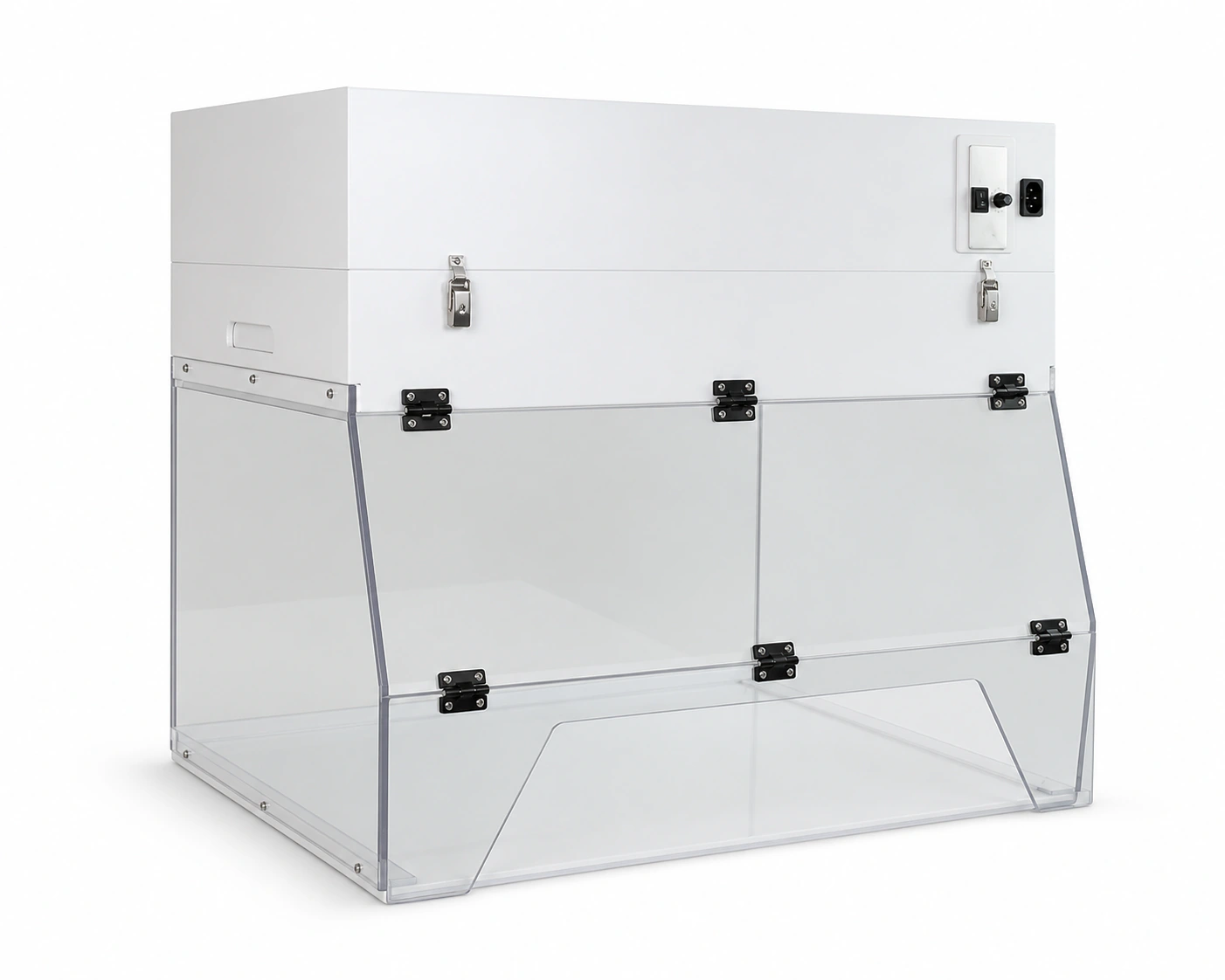
Description
Product Information:
A portable ductless fume hood combines a compact work enclosure, an integral fan and a process-selected filter package for use on an existing laboratory bench. Room air enters through the front opening, sweeps the work zone, passes through the configured molecular, particulate or combined filter stages, and returns to the laboratory without an external exhaust connection. This arrangement is intended for defined small-scale work where the contaminant, equipment envelope, bench, power supply and filter lifecycle can all be reviewed before use.
Portable Benchtop Ductless Fume Hood for Compact Filtered Containment
The reason to consider the portable benchtop fume hood is not simply that it occupies less space than a conventional floor-mounted hood. Its purchasing role is to provide a self-contained filtered work zone where a suitable laboratory bench already exists and installing an exhaust duct is impractical or unnecessary for the reviewed process. The unit is made to order around the intended work, so the enclosure size, construction, filtration, fan, monitoring, power connection and handling method are coordinated as one configuration rather than selected as unrelated accessories.
What Is
The benchtop ductless fume hood uses inward airflow to move airborne material away from the operator and toward the filter housing. A prefilter may protect the main stage from larger particulate. Chemical-specific activated carbon may be selected for compatible vapors, while a particulate stage may be selected for powders or aerosols that can be retained by that filter class. A combined arrangement can address both physical forms only when the stage order, seals, media specification and replacement criteria are defined for the complete process.
The transparent enclosure supports visibility and keeps the physical work zone separate from normal bench activity. The selected front access arrangement must still provide enough opening for the apparatus and operator task without compromising the intended air path. Exterior width therefore answers only one part of the fit question. Chamber depth, internal height, clear access, equipment placement and the open volume around the filter return all influence whether the compact hood can perform its intended role at a particular location.
Because filtered air returns to the room, the laboratory remains part of the operating boundary. Room ventilation, background contaminants, supply-air disturbance, traffic in front of the opening and clearance above the filter outlet can affect the practical installation. The enclosure should be treated as one exposure-control component within the laboratory’s chemical hygiene and ventilation plan, not as a substitute for process assessment or room-level controls.
What Portable Means for a Portable Ductless Fume Hood
Portable describes a configuration that can be relocated under an approved shutdown and handling condition. It does not mean the hood can be moved while the fan is running, while hazardous material or unsecured apparatus remains inside, or while a loaded filter can be disturbed without control. Some projects need a unit that stays on one bench after installation; others need a product that can be disconnected and moved when empty; a third group may require a coordinated mobile stand. Those are different supply and operating conditions and should be identified in the quotation.
A genuine relocation plan begins with the complete unit, not the enclosure width alone. The buyer must account for total weight, center of gravity, lifting or gripping points, bench edge clearance, cable routing, feet or restraints and the condition of installed filters. The destination bench must provide the required footprint, support and service access. After a move, the hood is inspected, reconnected and checked under the defined operating procedure before chemical work resumes. These controls preserve flexibility without turning mobility into an unsupported safety claim.
Product Selection Summary
A compact filtered enclosure is suitable for product selection only when five conditions can be resolved together: the process can be supported by an available filter mechanism, the apparatus fits the working envelope, the existing bench supports the complete configured unit, the location provides suitable power and room-air conditions, and any planned relocation can follow a controlled shutdown procedure. A favorable answer to only one condition, such as no available duct connection, is not enough to select the portable ductless fume hood.
When to Choose a Portable Ductless Fume Hood
The portable ductless fume hood family is a practical starting point for defined, repeatable small-scale work with known vapors, compatible particulate or both. The buyer should be able to describe each chemical or material, its physical form, concentration, quantity, operating temperature, generation rate, task duration and frequency. Those facts establish whether molecular carbon, particulate filtration or a combined stage deserves further evaluation and whether the expected load is realistic for a compact filter housing.
The benchtop ductless fume hood format is most useful when an existing work surface can provide the required footprint and support, and when the apparatus remains within the clear opening and chamber envelope. It can also suit laboratories that expect future layout changes, but only when the supplied configuration, handling method and destination locations have been reviewed. A fixed benchtop installation remains valid when portability is not required.
Key Product-Family Data
The table below puts the main buying fields ahead of detailed construction and filter options. `Reference` identifies a planning direction rather than a guaranteed stocked model. The quotation and approved drawing define the configuration supplied for each project.
Do Not Select a Portable Ductless Fume Hood by Name Alone
`Ductless` describes where the captured air goes; it does not prove that the selected filters can retain a particular contaminant. Carbon media varies by formulation and operating condition, and its usable capacity depends on concentration, humidity, temperature, contact time and accumulated load. A particulate filter addresses compatible particles but does not remove vapor merely because both are airborne. Mixed processes require the stages to be assessed together rather than assuming that a generic carbon-plus-HEPA label covers every release.
`Portable` also requires a defined condition. A configuration that can be relocated when empty and isolated is not automatically safe to move with installed apparatus, chemicals or loaded filters. If the project expects movement between benches, each destination must meet the same support, clearance, power and room requirements, and the operating checks must be repeated after relocation.
Do not shortlist the portable benchtop fume hood when outdoor discharge is mandatory, the contaminant is not supported by an available filter, release is uncontrolled or too great for a practical service plan, the equipment blocks the intended airflow path, or the bench cannot support the complete unit. In those cases, a ducted or larger purpose-built enclosure should be evaluated before cabinet options are discussed.
Information Required for a Project-Ready Quotation
Provide the process name, complete chemical and material list, vapor or particulate form, maximum concentration and quantity, operating temperature, generation method, task duration and frequency. Include the apparatus dimensions, required access, proposed bench size and construction, available load capacity, surrounding clearances and every intended installation location.
The configuration also depends on site voltage and frequency, plug or hardwired preference, cable-routing limits, desired airflow and filter-condition indication, chemical-sensing requirement, alarm or communication needs and the intended mobility state. Quantity, destination, documentation requirements and any project-specific test or certification request should be stated before the final schedule is prepared. These inputs allow the enclosure, filter package, fan, controls, connection and handling arrangement to be defined together instead of corrected after manufacture.
Key Specifications and Benchtop Fit
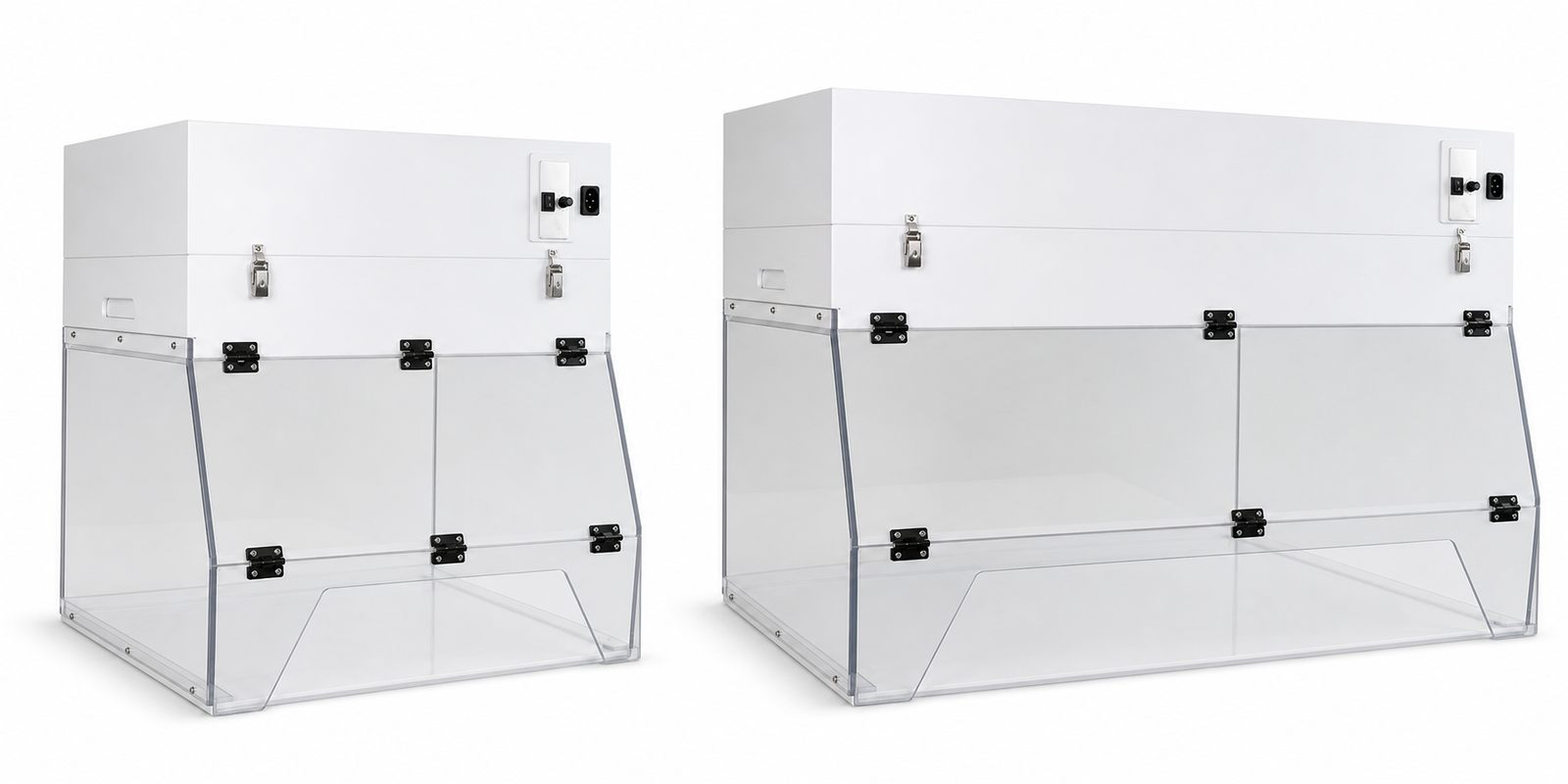
Physical selection starts with three different envelopes: the outside dimensions that occupy the bench, the internal chamber that contains the apparatus, and the clear opening through which the task is performed. None can be inferred reliably from nominal width alone. The filter housing, hinges, front panels, power connection and service direction also require space beyond the apparent work area.
Reference Planning Configurations
The following dimensions provide realistic planning references for compact portable hoods. They help compare bench footprint and usable chamber before a project drawing is prepared. They are not guaranteed stock dimensions, and they do not establish weight, clear opening, airflow, electrical load or permitted movement. The approved production drawing and configuration schedule govern the supplied unit.
| Nominal Planning Width | Reference Exterior W x D x H | Reference Chamber W x D x H | Fit Question It Helps Answer |
|---|---|---|---|
| 24 in | 24 x 18.5 x 29.5 in 610 x 470 x 749 mm |
23 x 17.75 x 17 in 584 x 451 x 432 mm |
Can a compact apparatus and required hand access fit within the smallest planning envelope? |
| 32 in | 32 x 18.5 x 29.5 in 813 x 470 x 749 mm |
31 x 17.75 x 17 in 787 x 451 x 432 mm |
Is more horizontal work width needed without increasing the reference depth and height? |
| 48 in | 48 x 24 x 36.25 in 1219 x 610 x 921 mm |
47 x 23.25 x 24 in 1194 x 591 x 610 mm |
Does the apparatus need a wider, deeper and taller chamber that still remains bench-mounted? |
Metric values are rounded planning conversions of the listed inch dimensions. The quotation should identify the selected exterior size, internal size and clear opening in one unit system, together with the drawing revision that controls manufacture.
Compare Outside Size, Chamber Size and Clear Opening Separately
Exterior width determines how much bench frontage the enclosure occupies, but the upper fan and filter housing may determine the total height and overhead service clearance. Exterior depth affects the remaining usable bench area, the distance from the operator to the work zone and whether the back of the enclosure can remain clear of walls, shelving and utility rails. Overall height must be checked against shelves, ceiling elements and the space needed to remove filters in the specified direction.
The chamber envelope is smaller than the exterior because panels, framing, filter plenums and hardware consume space. The apparatus should fit with room for stable placement, operator access and an unobstructed path from the front opening toward the filter intake. A vessel that technically fits inside can still be unsuitable if it sits too close to the opening, interrupts the inward flow, blocks the rear or upper path, or forces the user to work outside the intended zone.
The clear opening is a separate manufacturing field. Buyers should provide the largest component that must pass through it, the access needed during the task and any preferred front-panel position. The final drawing should show opening width and height, panel travel or hinge sweep and the work-surface elevation above the supporting bench.
Bench and Equipment Fit Checklist
The supporting bench must be level, stable and suitable for the complete operating mass, not just the empty transparent enclosure. The load review includes the top housing, fan, filter media, work surface, cables, utilities, contained apparatus and normal process materials. Point loads at feet or support rails may be more important than total mass, so the bench manufacturer or project engineer should confirm how the load enters the frame and worktop.
Measure the proposed bench at every intended location. Record usable width and depth, worktop thickness and material, support positions, allowable load, edge distance, wall or shelf clearance, power location and the path for disconnecting the cable. If relocation is required, also document doorways, lifts, changes in bench height and the handling equipment available. The center of gravity and approved lifting or gripping points must come from the selected unit, not from the reference width.
For apparatus fit, submit the maximum width, depth and height, mass, heat release, connection points and operating movements. Note whether lids open, arms rotate, hoses bend or samples must be transferred through the opening. A compact hood should not be enlarged by placing active equipment partly outside the enclosure or by removing front components that shape the designed air path.
Construction and Filter Configuration
A portable benchtop ductless fume hood is selected as a complete exposure-control assembly rather than as an enclosure with a generic filter added afterward. The body and work surface must tolerate the substances that can contact them, while the filter train must match the contaminants that can become airborne. A chemically suitable enclosure does not compensate for the wrong filter, and an appropriate filter does not correct an incompatible work surface, seal or transparent panel.
Enclosure, Viewing Panel and Work-Surface Options
Clear polycarbonate can provide broad visibility and useful impact resistance for the viewing enclosure. Standard PVC may suit applications that require a rigid plastic body, while static-dissipative PVC can be considered where charge accumulation is part of the process review. A polypropylene work surface provides another direction for wet or corrosive laboratory work. These are selectable construction directions, not a universal compatibility statement.
Material selection should be made component by component. Identify routine chemicals, cleaning agents, splash exposure, vapor concentration, temperature, contact time and any abrasive particles. Then confirm the body panels, transparent sections, work surface, seals, fasteners, fan-side components and filter housing against that exposure. If a process can attack one exposed component, selecting a resistant material for the main enclosure alone is not sufficient.
The final configuration should also define panel thickness, joint method, front-opening arrangement, work-surface edge detail, spill-management features and access for cleaning. Transparent panels need enough stiffness to hold their geometry, and the work surface must support the apparatus without creating an obstruction at the front opening or filter intake.
Molecular Filtration for Vapors
Molecular filtration uses adsorbent media selected for a defined vapor or gas challenge. The process review should list each chemical, its expected concentration, the quantity used, evaporation or generation rate, duration, frequency, mixtures and any temperature that can change vapor release. That information is needed to select the carbon formulation, media mass, bed depth and replacement method.
Generic activated carbon is not equally effective for every substance. Some compounds require impregnated media, a different sorbent or an exhaust-to-outdoors approach. High loading, rapid generation, mixed contaminants and substances with poor adsorption characteristics can shorten useful service life or make a compact recirculating enclosure unsuitable. Filter life therefore cannot be promised from hood width or operating hours alone.
Where vapor treatment is selected, the order schedule should state the target contaminant group, filter designation, media type, nominal media quantity, installation orientation and replacement trigger. The operating plan should define how breakthrough risk is assessed, who authorizes continued use and how spent media is handled.
Particulate Filtration for Powders and Aerosols
Particulate filtration can be configured for processes that release suitable nonbiological powders or aerosols. The particle size distribution, loading rate, moisture, electrostatic behavior and potential to clog or react with the media must be reviewed before a HEPA-stage direction is selected. A prefilter may protect the final filter from larger debris and extend the interval between service events.
A particulate filter does not remove vapors, and the presence of a HEPA stage does not turn the enclosure into a biological safety cabinet. Biological containment, product protection, sterility, infectious material work and certified cabinet performance require equipment designed and validated for those purposes. The selected filter grade, seal arrangement, test method and replacement direction remain project-confirmed fields.
Combined Filter Stages
A combined arrangement may be appropriate when a defined task produces both particulate matter and filterable vapors. The stages must be ordered according to the actual contaminant path, because the first stage can protect or burden the stage behind it. Prefilter type, particulate grade, carbon formulation, media quantity, seals and bypass control all affect the complete treatment path.
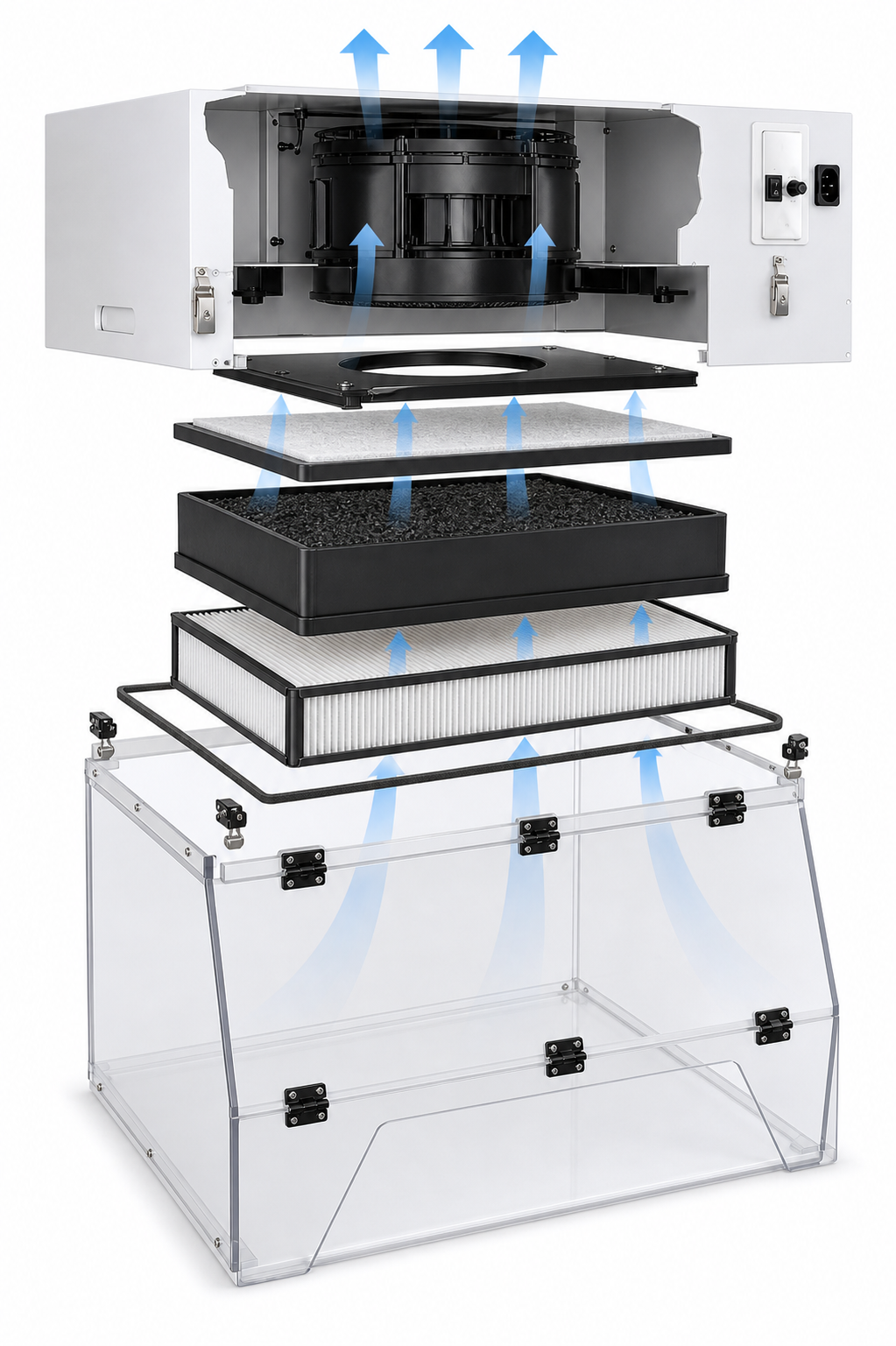
The illustration shows the functional separation between stages; it does not prescribe one universal sequence. A vapor-only application may not need a particulate final stage, while a mixed aerosol and vapor process may require a prefilter and carefully ordered treatment stages. The approved configuration should identify every installed stage, its orientation and its replacement access so the delivered filter path can be checked without dismantling unrelated components.
Filter access is part of product selection. Confirm whether media is removed from the top, front or rear; the overhead and side clearance needed for the task; the method used to isolate or bag a loaded filter; and whether the enclosure must be moved to reach the service area. If servicing requires relocation, the handling method must account for the loaded filter and any contamination remaining inside the chamber.
| Filter Direction | Process Information to Confirm | Configuration Fields to Record |
|---|---|---|
| Molecular media | Chemical identity, concentration, quantity, generation rate, duration, frequency, mixtures and temperature. | Media formulation, media quantity, bed arrangement, replacement trigger and spent-filter procedure. |
| Particulate media | Particle type, size range, loading, moisture, electrostatic behavior and biological status. | Prefilter, final-filter grade, seal method, test basis, loading indication and change procedure. |
| Combined stages | Vapor and particulate sources, simultaneous release, cross-reaction risk and expected loading of each phase. | Stage order, individual media specifications, bypass control, access direction and monitoring plan. |
Once the material and filter path are defined, the next selection question is whether the fan, inward airflow and monitoring package can maintain a usable operating condition with the chosen filter resistance. Those functions must be evaluated as one system rather than as independent accessories.
Airflow Path, Monitoring and Electrical Requirements
The enclosure, fan, filters and controls form one recirculating airflow system. Room air enters through the front opening, moves across the work zone, passes into the collection path and travels through the selected filter stages before returning to the room. The fan must overcome the resistance of the complete installed filter package while maintaining the operating condition defined for the selected opening.
How the Recirculating Air Path Works
Inward air at the front opening helps carry released contaminants away from the operator and into the treatment path. That movement depends on the opening geometry, fan setting, filter resistance, apparatus placement, room drafts and the way the task is performed. Large equipment, rapid hand movements or containers placed close to the opening can disturb the intended path even when the fan is running.
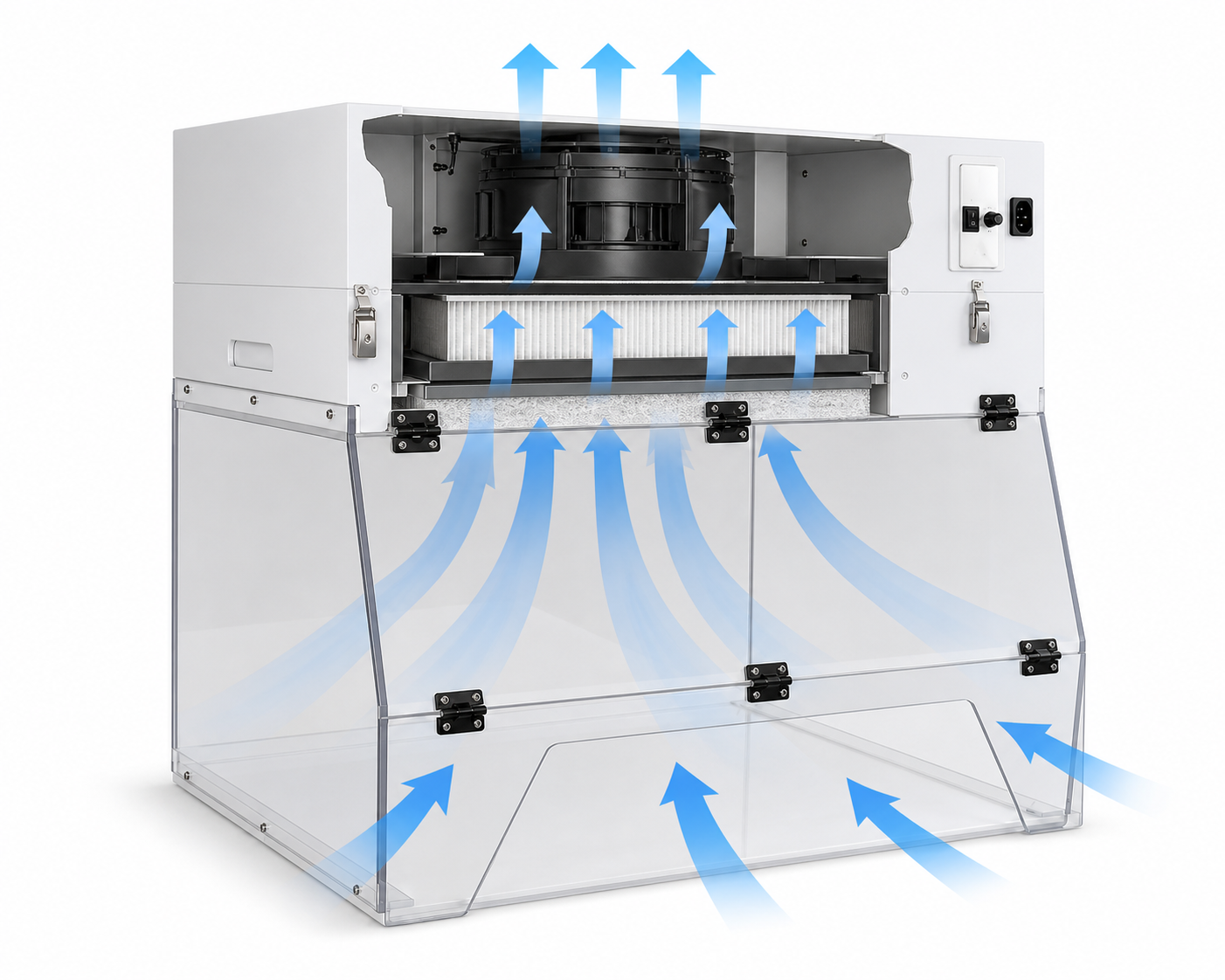
The illustration defines the functional path, not a guaranteed velocity profile. The selected hood should be checked under the opening condition, apparatus arrangement and fan/filter state used for the actual process. Equipment must remain clear of the intake and discharge paths, and the room must accept the returned air without creating disruptive cross-drafts at the face.
Because a ductless hood returns treated air indoors, airflow alone does not establish contaminant control. The filter mechanism must be suitable for the complete contaminant profile, and the operating procedure must keep releases within the capacity and intended use of that configuration.
Airflow Status, Filter Condition and Chemical Sensing Are Different
Airflow status indicates whether air movement or an airflow-related condition remains within the configured operating range. Depending on the selected control package, this may be based on velocity, pressure, fan condition or another defined input. It helps identify loss of flow, an incorrect fan state or increasing system resistance, but it does not directly measure every contaminant leaving the filter.
Filter-condition monitoring estimates or detects a change associated with filter loading, pressure resistance, service time or another selected indicator. It can support maintenance planning, but the signal must be interpreted according to the installed media and sensing method. A particulate filter can become loaded in a way that affects resistance, while molecular media can approach chemical breakthrough without producing the same pressure change.
Chemical sensing, when selected and technically suitable, addresses a different question: whether a target substance or chemical group is detected at the monitored point. Sensor range, selectivity, interference, location, calibration and alarm threshold must match the application. One sensor cannot be assumed to recognize every vapor or mixture.
The quotation should state which functions are included, which measured variable each function uses, where the sensor is located, how alarms are presented and what response is required. This prevents a display, warning light or hour counter from being interpreted as broader protection than it provides.
Power and Cable Routing at Every Location
Electrical requirements must be resolved for each bench where the hood may be used. Confirm supply voltage, frequency, plug or hardwired termination, connected load, protective isolation and whether any convenience outlets or internal services are included. The cable must reach the approved connection without crossing the work opening, creating a trip path or being pinched during panel operation.
A planned relocation route needs the same electrical review as the original location. The receiving bench must provide the correct supply, support, clearance and room-air conditions. Extension leads, improvised adapters and inaccessible disconnects should not become part of normal operation unless they are specifically reviewed and approved for the installation.
Airflow, filter monitoring and power details should appear together in the approved configuration schedule. This allows the purchaser to compare not only whether the hood fits the bench, but also how its operating condition will be established, observed and restored after filter service or relocation.
Applications, Suitability and Product Selection
A portable ductless fume hood is best suited to defined, repeatable work that can be contained within a compact chamber and matched to a documented filter path. The decision starts with the process, not with the convenience of avoiding ductwork. The purchaser should be able to describe what is released, how much is released, how often the work occurs and what equipment must operate inside the enclosure.
Good-Fit Applications
Suitable candidates can include small-scale transfer, dispensing, weighing, sample preparation, inspection or instrument-support tasks involving known contaminants and controlled quantities. The apparatus must fit inside the chamber with adequate working access and without blocking the inward airflow, intake path or filter route. The room and supporting bench must also accept the selected enclosure, power connection and filtered air return.
Molecular filtration may suit defined vapor work when an appropriate adsorbent is available and the expected loading remains within the selected media capacity. Particulate filtration may suit suitable nonbiological powders or aerosols when the particle characteristics and filter-loading behavior are understood. Combined stages can be evaluated when both phases are present and their order, interaction and service implications can be defined.
Relocation can be useful in laboratories that need the same compact enclosure at more than one approved bench. Each location still requires a completed fit and service review. The portable ductless fume hood should be shut down, electrically isolated, cleared of process materials and handled according to the approved configuration before it is moved.
When a Portable Ductless Fume Hood Is Not a Good Fit
Select an externally ducted enclosure such as a ducted benchtop fume hood, or another engineered control, when outdoor discharge is required by the substance, process, facility rule or exposure-control strategy. A ductless configuration should also be rejected when no suitable filter medium is available, expected loading is too high for practical service, breakthrough cannot be managed, or the contaminant profile is unknown or changes unpredictably.
The portable benchtop fume hood is not a biological safety cabinet, clean bench, glove box, explosion-protection enclosure or general room-ventilation substitute. It should not be used to claim biological containment, product sterility, inert-atmosphere control or certified explosion protection. The room still needs ventilation appropriate to the laboratory and a response plan for releases, alarms and filter service.
Physical fit can also disqualify the portable ductless fume hood. Do not proceed if the bench cannot support the configured load, the apparatus blocks the air path, the opening does not permit safe manipulation, overhead filter access is unavailable, the cable cannot be routed safely or traffic creates persistent cross-drafts. If frequent movement is expected but a controlled handling and recommissioning procedure is impractical, a dedicated fixed hood at each location may be the better solution.
Select the Configuration in This Order
- Define the process. Record substances, quantities, release form, loading pattern, temperature, duration, frequency and credible off-normal conditions.
- Choose the treatment mechanism. Determine whether molecular, particulate or combined filtration is technically suitable and define the media direction, stage order and service trigger.
- Fit the apparatus and task. Compare the equipment envelope and operating movement with the chamber, clear opening and intended work zone.
- Confirm the bench and location. Check support area, load capacity, edge clearance, overhead service space, room return, nearby drafts and operator access.
- Define airflow and monitoring. State the opening condition, acceptance metric, monitoring functions, alarms and records needed for commissioning and routine checks.
- Resolve electrical supply. Confirm voltage, frequency, termination, load, isolation, cable length and routing at every approved position.
- Define the mobility state. Specify fixed placement, relocation when empty or another approved handling condition together with restraints and post-move checks.
- Approve the supplied scope. Close construction, filters, controls, accessories, spares, drawings, operating documents and acceptance responsibilities before manufacture.
This order prevents a convenient footprint or attractive filter label from becoming the primary selection criterion. If the process cannot be matched to a defensible treatment mechanism, later decisions about size, controls and mobility do not make the portable ductless fume hood suitable.
Information Needed to Configure the Portable Ductless Fume Hood
Send the chemical or material list with safety data where available; concentration, quantity, temperature and release form; process duration and frequency; equipment dimensions and movement; desired working opening; bench dimensions, material and load information; room and service clearances; intended installation points; electrical supply; monitoring and alarm requirements; relocation need; quantity and delivery destination.
Useful supporting documents include process photographs, equipment drawings, bench layouts, room plans, utility schedules and the laboratory’s operating or exposure-control criteria. Where several tasks will share one enclosure, identify the worst credible vapor and particulate loading rather than submitting only the lightest routine use.
The resulting quotation should identify the proposed enclosure size and construction, chamber and opening, filter stages, fan and monitoring scope, electrical connection, permitted mobility condition, service access, supplied accessories and unresolved technical conditions. The approved drawing and configuration schedule then define the portable ductless fume hood that will be manufactured for the project.
Installation, Relocation and Filter Lifecycle
A benchtop ductless enclosure does not need an exhaust-duct connection, but it still needs a controlled installation. The bench, room, electrical supply, service clearances, filter access and operator position affect whether the selected configuration can be used and maintained as intended. Relocation adds another operating state that must be planned rather than improvised.
Prepare the Bench and Room
Confirm that the worktop is level, stable, chemically appropriate and large enough for the complete footprint without unsupported overhang. Verify the allowable distributed and point loads against the configured hood, installed filters, internal apparatus and normal process materials. The enclosure should sit far enough from the bench edge to remain stable while preserving the operator position and any required restraint or fixing arrangement.
Keep the front opening away from doors, supply diffusers, high-traffic aisles, fans and other sources of cross-draft. Allow the filtered discharge to return to the room without being blocked by shelves, walls or stored objects. Provide the top, rear and side clearances required for filter replacement, cleaning, electrical isolation and removal of service panels.
The power connection should be accessible without routing the cable across the work opening or a normal walkway. Confirm the supply and isolation method before placing equipment in the chamber. If utilities or convenience outlets are included, their location and permitted use should appear on the approved drawing.
Commission the Selected Configuration
Before use, compare the delivered product with the approved configuration schedule. Check enclosure materials, work surface, filter types and stage order, fan and controls, monitoring functions, power details and supplied accessories. Filters must be correctly seated, sealed and oriented, with packaging or transport restraints removed according to the instructions.
Operate the hood under the defined opening and fan setting, then verify the selected airflow or acceptance metric using the specified method. Confirm the response of airflow indication, filter-condition functions, chemical sensing and alarms that are included in the order. The commissioning record should identify the installed filter set, instrument used, test arrangement, measured result, alarm checks and any corrective action.
Place representative apparatus in the intended work position and verify that it does not obstruct the air path, front access or filter intake. Operating instructions should identify the usable work zone, opening position, pre-use check and response to an alarm or power loss.
Relocate Only Under the Approved Condition
Movement begins with shutdown. Stop the process, close and remove chemicals, clear unsecured apparatus, allow any required purge or settling period and isolate electrical power. Disconnect cables and utilities without pulling on the enclosure, fan housing or control components. Loose panels, filters and accessories must be secured according to the handling instructions.
The approved configuration should state whether the unit may be relocated with filters installed, only when filters are unloaded or only after filters are removed and contained. Loaded media can retain hazardous substances and may release them if tilted, shocked or handled incorrectly. The relocation plan must therefore address filter condition, enclosure residue, lifting points, center of gravity and the equipment needed to support the complete mass.
Do not lift by the front panel, fan housing, cable, controls or filter cover unless the portable ductless fume hood documentation identifies that component as a handling point. Keep the enclosure in its approved orientation and protect transparent panels from twisting and impact. A portable label does not make a large configured unit suitable for one-person lifting.
Plan Filter Change and Recordkeeping
Replacement timing depends on contaminant identity, loading, media quantity, operating pattern and the selected monitoring method. Elapsed time alone does not establish remaining capacity, and pressure resistance alone may not reveal molecular-media breakthrough. The service plan should combine the applicable monitoring signal with process records, inspection and the replacement criteria defined for the selected filter.
Before a filter change, identify the retained contaminants and the PPE, isolation, containment and disposal procedure required for the loaded media. Confirm that the service area provides enough clearance to remove the filter in its intended direction without passing it over clean equipment or occupied work. Replacement filters should match the approved type, dimensions, seals and stage order.
Keep a record of installation date, process use, alarms, monitoring results, movement events, inspections, filter changes and the identifiers of replacement media. These records support troubleshooting and help determine whether the selected configuration remains appropriate as laboratory work changes.
Related Laboratory Fume Hood Options
The Laboratory Fume Hoods range includes compact and full-size enclosures with different exhaust, filtration and installation methods. The correct alternative depends on whether outdoor discharge, chamber capacity or compact filtered recirculation is the controlling requirement.
Ducted Benchtop Fume Hood
Choose a Ducted Benchtop Fume Hood when the apparatus fits a compact bench-mounted enclosure but the contaminant should be discharged through the building exhaust system. This direction avoids dependence on a recirculating filter for substances, mixtures or loading conditions that are unsuitable for compact molecular or particulate media.
Full-Size Ductless Fume Hood
Evaluate a Full-Size Ductless Fume Hood when filtered room-air return remains appropriate but the process needs a larger fixed chamber, coordinated cabinet arrangement, greater apparatus clearance or a service layout that exceeds a compact benchtop enclosure.
General-Purpose Steel Fume Hood
A General-Purpose Steel Fume Hood provides a conventional full-size ducted direction for laboratory chemical ventilation. It is the stronger shortlist candidate when the project already includes an exhaust system, coordinated laboratory furniture and a defined make-up-air strategy.
Frequently Asked Questions
Is a portable ductless fume hood safe for every chemical?
No. Suitability depends on the complete contaminant profile, concentration, quantity, generation rate, temperature, task duration, mixtures and selected filter media. Some substances adsorb poorly, create excessive loading, require outdoor discharge or need another containment method. A chemical and process review is required before the filter package is selected.
How is a carbon filter different from a HEPA filter?
Carbon and other molecular media adsorb selected vapors or gases, while a particulate filter captures suitable airborne particles. Neither mechanism replaces the other. A mixed process may require multiple stages, but the media formulation, particulate grade, order, seals and service plan must match the actual release.
What bench information is required before ordering?
Provide usable width and depth, worktop material and thickness, frame or support positions, allowable load, edge distance, overhead and side clearances, power location and any fixing restrictions. Also provide the apparatus envelope and operating movement so the chamber and clear opening can be checked separately from the outside footprint.
When should a ducted benchtop fume hood be selected instead?
Select the ducted alternative when the process requires outdoor discharge, the contaminant cannot be matched to a suitable recirculating filter, loading would make filter service impractical, breakthrough cannot be managed or facility rules require connection to an exhaust system.
Contact the Xicheng Engineering Team Today
Send the chemical and process list, vapor or particulate loading, apparatus dimensions, bench and room layout, desired filtration direction, electrical supply, monitoring requirements and intended relocation condition. XICHENG will prepare a portable benchtop ductless fume hood configuration and quotation covering the enclosure, filter stages, airflow and monitoring scope, bench interface, service access and confirmed supply boundary.
Shenzhen Office: No. 34 Zhenxing Road (Shengtaian Heavy Industrial Park B), Loucun, Guangming New Dist, Shenzhen, Guangdong, China
WhatsApp: +86 181 2647 8161
Engineering Mailbox: fanalax34@gmail.com