




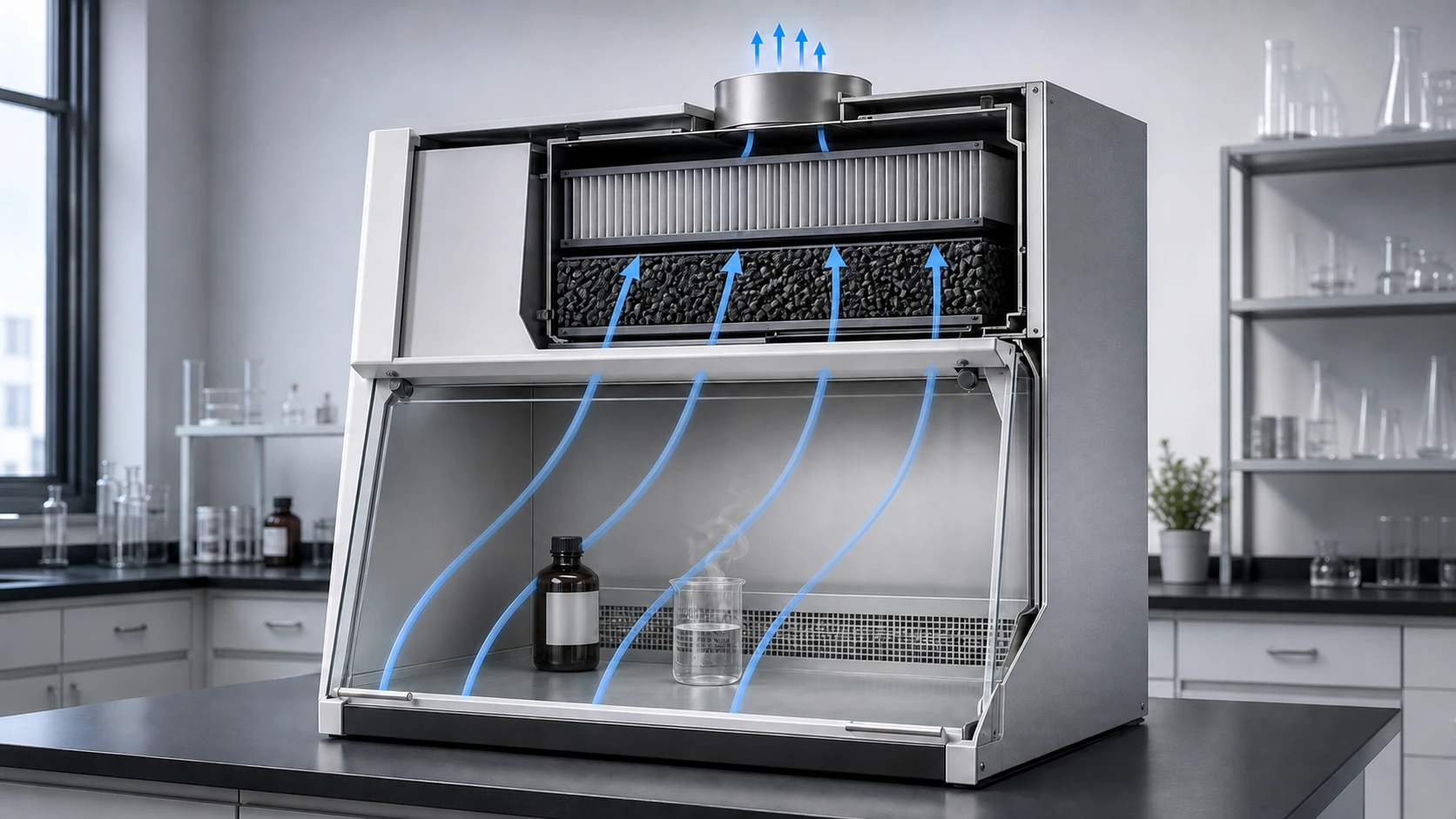
Key Takeaways
- Match the media to a documented contaminant load, not to the cabinet name. Ductless fume hood filter selection is the process of turning contaminant form, chemistry and usage into a filter package you can monitor and replace on evidence.
- Start with physical form. Vapors and gases need molecular media; particles need HEPA; mixed streams need both in defined stage order.
- Compatibility is verified, not assumed. A manufacturer chemical assessment plus your institution’s EHS sign-off decides the final package.
- Airflow signals prove movement, not chemical retention. Plan saturation detection and a defined response before you order the hood.
- Some work must not go ductless. Hydrofluoric acid, heated perchloric acid, radioisotopes and defined fire or explosion hazards belong in dedicated or ducted systems.
Selecting a ductless fume hood is one decision; selecting its filter package is a separate one that decides whether recirculated air stays acceptable. Our guide to fume hood types covers the system families; ductless fume hood filter selection means converting what actually enters the hood — contaminant form, chemical identity, concentration, quantity and exposure time — into a media combination with defined monitoring and replacement logic. The reference face velocity of 0.4–0.6 m/s on XICHENG’s ductless family sizes the airflow; it does not tell you which media will retain your contaminant. Labs that skip the filter decision chain end up with a cabinet that moves air and a filter that moves nothing but time.
Direct Answer: Ductless Fume Hood Filter Selection Starts With the Contaminant Load
Ductless fume hood filter selection starts with four inputs, not with a filter catalog. First, the physical form of the contaminant: vapor or gas, particulate, or a mixture of both. Second, the chemical identity of every component, including carrier solvents and reaction products. Third, the concentration and the maximum credible quantity used in one task and across a working day. Fourth, the exposure time: task duration, frequency, and the room environment where the hood sits.
Each input points to a media family. Molecular carbon media adsorbs reviewed vapors and gases; impregnated or specialty media adds chemisorption for reactive gases such as ammonia, acid vapors or formaldehyde; HEPA filtration intercepts compatible particulates; a defined combination handles mixed streams. As a screening reference, some filter suppliers treat molecular weight above roughly 30 g/mol and boiling point above roughly 60 °C as the working range of standard activated carbon — below either threshold, breakthrough risk rises and the chemical needs explicit confirmation. No manufacturer publishes this guide as a replacement for its own compatibility data.
| Input | What it decides | Media direction it points to |
|---|---|---|
| Physical form | Capture mechanism: molecular vs particle vs both | Carbon / HEPA / defined combination |
| Chemical identity | Media family and compatibility check | Standard, impregnated or specialty media |
| Concentration and quantity | Load magnitude and breakthrough risk | Media mass, stage count and monitoring choice |
| Exposure time and room | Accumulated load and site conditions | Service interval logic and humidity review |
Keep the numbers honest. The 0.4–0.6 m/s reference face velocity is a sizing and commissioning field, not a containment guarantee. HEPA classes such as H13 (≥99.95% at the most penetrating particle size) and H14 (≥99.995%) describe particle efficiency per EN 1822-1 / ISO 29463; they say nothing about vapor retention. XICHENG does not publish filter life or capacity figures here, and neither do we: those values belong to the chemical assessment for your specific load.
After this module you can name the four inputs your filter decision needs and the media family each input points to — before you open a filter catalog or request a quote.
Step 1 — Profile the Contaminant Stream Before Any Filter Choice
Filter media is selected for what reaches the filter, so the first deliverable of ductless fume hood filter selection is a written contaminant profile, not a cabinet drawing. XICHENG’s own selection order starts with the contaminant stream and fixes cabinet width last. The five decisions that precede cabinet size are contaminant identity, maximum credible load, capture mechanism, continued-use evidence, and the room and maintenance boundary.
Physical Form Decides the Capture Mechanism
Break the stream into physical forms before touching any filter: true vapor or gas, particulate, aerosol, or a mixture. Vapor and gas need molecular media; particulate needs HEPA-class filtration; an aerosol can carry both a droplet phase and a volatile component, so its stages must be assessed together. A carbon layer does not intercept particles merely because both are airborne, and a particulate layer does not adsorb vapor — the two mechanisms are not interchangeable.
Unknown mixtures, reaction products, or contaminants that no available media can retain flip the decision toward ducted exhaust (see our ducted vs ductless fume hood comparison). If you cannot state the physical form of every component, you cannot run the rest of this chain, and no filter catalog will fix that gap.
Build a Loading Baseline
For each chemical in the task, record: exact identity including carrier solvents, physical form, concentration, quantity per batch, operating temperature (for example, 20–25 °C for room-temperature work), task duration and frequency. Then derive the maximum credible load — the worst documented case within a defined period, usually a daily peak or a batch maximum — because capacity depends on concentration, humidity, temperature, contact time and accumulated load, not on the chemical name alone.
Suppliers and your EHS officer will judge feasibility from these fields. Manufacturers commonly frame ductless guidance around limited chemical counts and modest volumes: Labconco, for example, cites on the order of 500 mL per chemical as a working reference, and stresses moderate exposure times. Treat that as a screening input, not a permission limit, and add the installation site’s relative humidity to the table — water vapor competes for adsorption sites, and some suppliers flag relative humidity above roughly 50% as the point where the competition becomes visible. Record the task timing with numbers: for example, 2 hr per day on defined days per week.
| Loading baseline field | What you record | Why it drives filter selection |
|---|---|---|
| Chemical identity | Exact name, grade, carrier solvents | Media family and compatibility check |
| Physical form | Vapor / gas / particulate / aerosol / mixture | Capture mechanism (carbon vs HEPA vs both) |
| Concentration | % in the mixture or an estimate in mg/m³ in the task stream | Breakthrough risk and media loading |
| Quantity per batch | Mass or volume per batch operation | Load magnitude for capacity review |
| Temperature | Process temperature at the source | Evaporation rate and adsorption behaviour |
| Duration and frequency | Hours per day, days per week | Accumulated load over the service period |
| Room humidity | Typical % RH at the installation site | Water competition for adsorption sites |
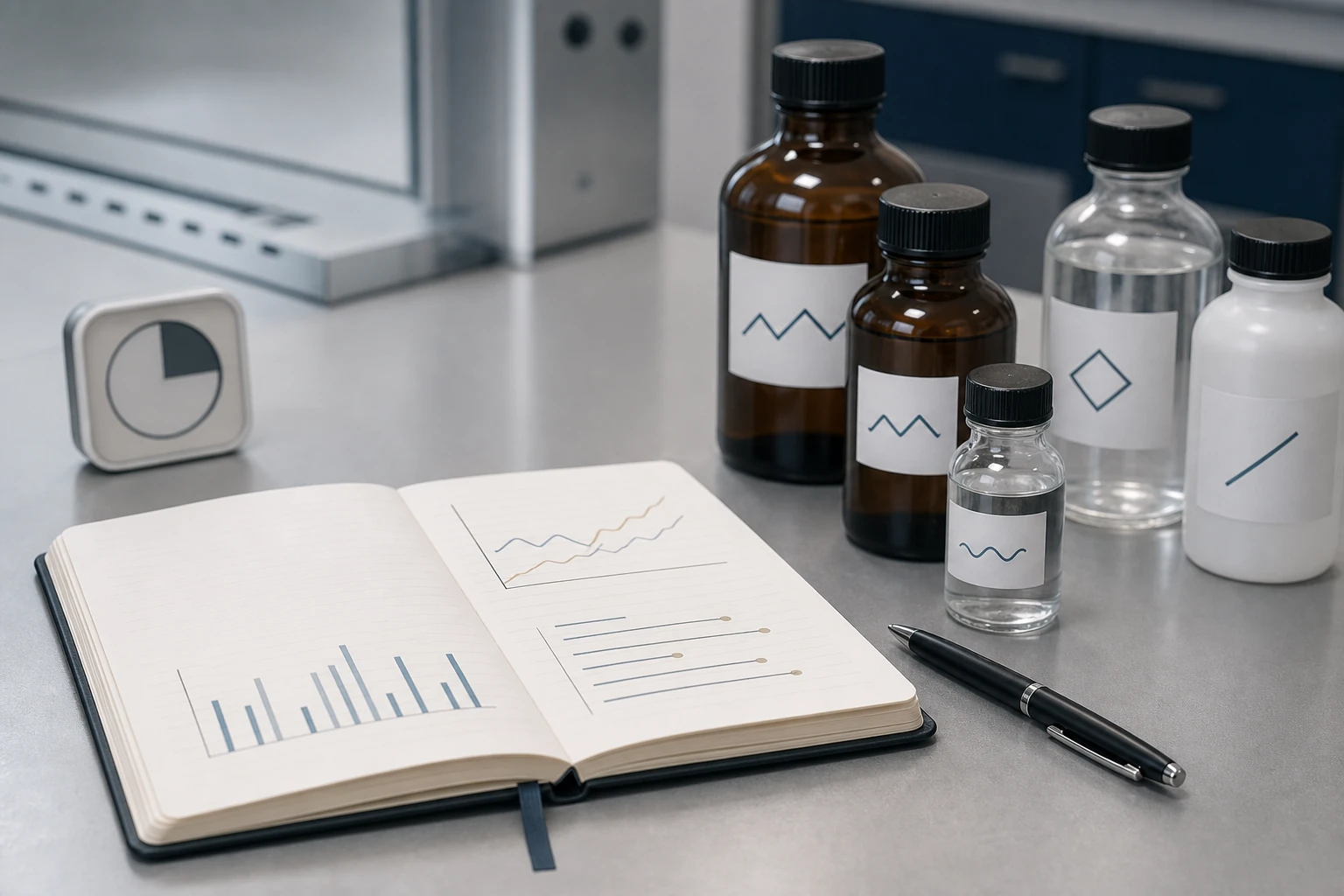
After this module you can name every field of your one-page loading baseline — the document your supplier and your EHS officer will ask for first.
Step 2 — Filter Media Map: What Each Stage Can and Cannot Do
With the profile in hand, the next step in ductless fume hood filter selection is mapping each contaminant form against the media families that can plausibly retain it. Four media families carry nearly all ductless fume hood filter selection work: standard activated carbon, impregnated or specialty media, HEPA-class particulate media, and combined arrangements with a prefilter.
Activated Carbon
Activated carbon adsorbs vapors and gases onto a high-surface-area, microporous matrix. Molecules are held by physical adsorption on the surface and inside pores, which is why the mechanism is described as adsorption, not absorption. As a general trend confirmed in peer-reviewed studies, compounds with higher molecular weight and higher boiling point adsorb more readily; lightweight, low-boiling or strongly polar compounds adsorb weakly and reach breakthrough sooner.
Adsorbed mass is not a permanent fixture. Usable capacity depends on concentration, humidity, temperature, contact time and accumulated load, so a carbon stage is never “carbon works for everything” — it is “this carbon formulation, at this load, until saturation”. Saturation is inevitable for every real task; the engineering question is whether you can detect it and respond with a defined action.
Impregnated and Specialty Media
Plain carbon is weak for many reactive gases, which is why filter suppliers offer impregnated or blended media that add chemisorption. Acid-impregnated carbon targets alkaline gases such as ammonia and amines; alkali- or metal-impregnated types target acid gases and hydrogen sulfide; aldehyde-specific media exist for formaldehyde work. Peer-reviewed work confirms the mechanism: phosphoric-acid-impregnated carbon measurably improves chemical-filter efficiency for airborne molecular contaminants.
Matching a chemical family to an impregnation is a manufacturer data question. The filter chart shows the family; the chemical assessment confirms the individual compound and its concentration. Budget that assessment whenever your list includes reactive gases — a generic “carbon” label is not a compatibility statement.
HEPA and Prefilters
HEPA-class media intercept particles and do not adsorb vapor. EN 1822-1 classes H13 (≥99.95% overall efficiency, ≤0.05% penetration) and H14 (≥99.995%, ≤0.005%), measured at the most penetrating particle size around 0.1–0.2 µm, are common screening references; ISO 29463-1 relabels the same performance families as ISO 35 H and ISO 45 H. A prefilter, such as EU3-class coarse media with roughly 85% arrestance, protects the main stage from larger particulate and extends its service.
A HEPA stage never compensates for a missing molecular stage, and a prefilter never compensates for a clogged main stage. Each stage has its own loading limit and its own replacement condition, and the label “carbon plus HEPA” says nothing about stage order, media grade, mass or seals.
Stage Order and Combined Arrangements
Where vapor and particulate coexist, the stages are coordinated as one package: prefilter, molecular stage and particulate stage in a defined order, with separate replacement criteria for each. Adding more layers is not a substitute for matching mechanisms to the process — XICHENG configures combined arrangements only when stage order, shared loading and separate replacement conditions are defined together.
Combined arrangements double the monitoring obligation. Every stage can saturate independently, so the monitoring plan in the next modules must name the evidence for each stage instead of a single “the filter” signal.
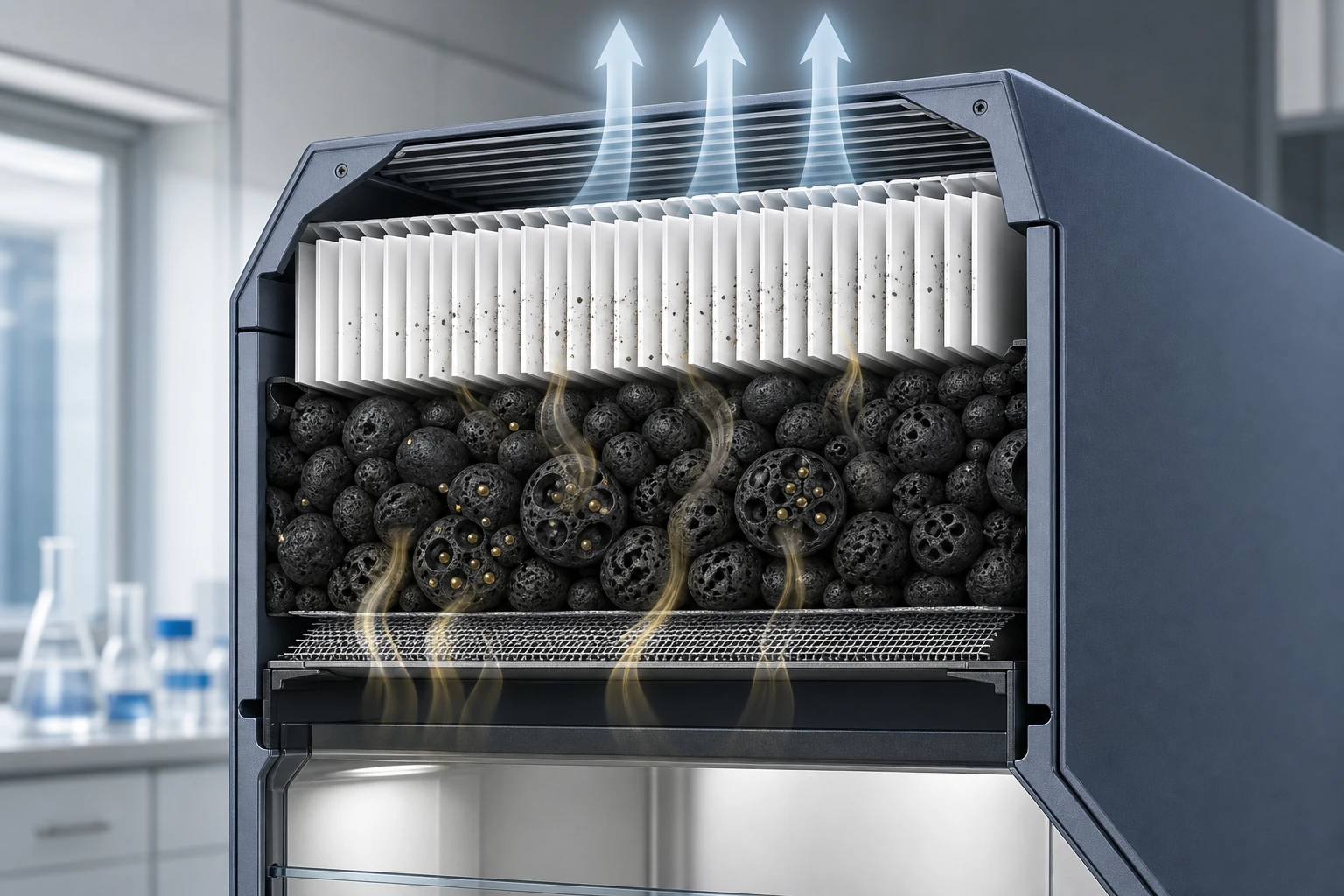
After this module you can list the candidate media families for your profile and state precisely what each stage can and cannot retain — the boundary that stops a generic “carbon plus HEPA” label from overreaching.
Step 3 — Chemical Compatibility: Judgement Criteria, Not Just a Chart
The ductless fume hood chemical compatibility question is a judgement about your specific compounds, not a lookup of the cabinet’s name. Compatibility is the verified ability of the installed media to retain a chemical under the documented load, so every compound in the baseline gets its own check: molecular properties, site conditions, and a formal confirmation from the filter supplier and your institution’s EHS program.
Molecular Weight, Boiling Point and Polarity
Adsorption strength follows chemical properties you can tabulate before calling anyone. Higher molecular weight and higher boiling point generally mean stronger adsorption, as peer-reviewed studies of activated carbon show; lightweight, low-boiling and strongly polar compounds adsorb weakly and break through sooner. The screening table below uses standard physical constants; some suppliers compress the same idea into a “molecular weight above roughly 30 g/mol and boiling point above roughly 60 °C” working rule for standard activated carbon.
| Compound | Molecular weight (g/mol) | Boiling point (°C) | Screening read |
|---|---|---|---|
| Toluene | 92.1 | 110.6 | Strong candidate for standard carbon |
| Hexane | 86.2 | 68.7 | Good candidate; check capacity |
| Ethanol | 46.1 | 78.4 | Compatible at lower capacity |
| Acetone | 58.1 | 56.1 | Borderline: below 60 °C, expect earlier breakthrough |
| Methanol | 32.0 | 64.7 | Marginal: low molecular weight and polarity weaken affinity |
A borderline entry is not automatically rejected, but it makes the chemical assessment a requirement, not a courtesy. Never assume two solvents in the same family exhaust a filter at the same rate.
Humidity, Temperature and Contact Time
The site changes the chemistry. Relative humidity above roughly 50% lets water compete for adsorption sites, and peer-reviewed studies show VOC capacity falling as humidity climbs; hot processes raise evaporation and loading; short air-contact time in a small carbon bed reduces the chance of capture. Record temperature, humidity and bed contact expectations in the baseline you built in Step 1.
These variables explain why two labs running identical solvents can have different filter service outcomes. The supplier’s capacity model needs your site conditions, not the average conditions from a brochure.
Mixtures and Solvent Changes
Mixtures change the picture in one extra way: displacement. When a heavier compound enters a bed that already holds lighter compounds, the heavier molecules can push the lighter ones off their binding sites, causing premature breakthrough even when the bed is far from its mass capacity. Suppliers who document this effect advise treating the filter as partially exposed whenever you switch solvents.
Practical rule: after any change to the solvent list, re-check both the new compound and the previously used compounds against the compatibility chart, and treat the installed media as partially loaded until the assessment says otherwise.
Confirming With a Chemical Assessment
Every filter supplier runs a structured chemical review: you submit the chemical list, concentrations, quantities and usage pattern, and the review models vapor load against the media’s retention data. The peer-reviewed guidance is unambiguous that ductless hoods should be used only with chemicals the manufacturer has approved for the unit. Labconco, Esco and others publish the same message: the compatibility guide is a reference, not an approval list, and the on-site safety officer retains final responsibility.
Your deliverable from this module is a written request: chemical list, loading baseline, site humidity and temperature, and the specific filter families you are screening. Send it to the supplier and to your EHS program before any purchase conversation proceeds.
After this module you can screen every compound in your baseline against the candidate media, flag the borderline entries, and name which items require the formal chemical assessment before selection continues.
Step 4 — Ductless Fume Hood Filter Selection Matrix: Match Load to Media
A ductless fume hood filter selection matrix converts the profile into a shortlist: each row is a contaminant condition, and each cell states the media direction and the next action. This matrix is a screening tool, not a capacity certificate — every row that survives it still goes to the supplier’s chemical assessment with your loading baseline attached.
Read the Matrix With Your Data
| Contaminant condition | Media direction | Screening note | Next action |
|---|---|---|---|
| Vapor of a mid-to-high-boiling organic solvent (e.g., toluene, 110.6 °C; hexane, 68.7 °C) | Standard activated carbon, optionally blended | Strong adsorption expected by molecular weight and boiling point | Confirm capacity with chemical assessment |
| Acid vapor or gas (e.g., HCl, acid fumes) | Acid-resistant housing + impregnated carbon for the gas family | Impregnation chemistry varies by manufacturer | Confirm impregnation matches the specific gas |
| Ammonia or amine vapor | Acid-impregnated carbon (chemisorption) | Plain carbon is weak for alkaline gases | Confirm with assessment; check concentration |
| Formaldehyde / aldehyde vapor | Aldehyde-specific specialty media | Standard carbon alone is often insufficient | Confirm media code for the compound |
| Vapor from a low-molecular-weight or low-boiling compound (e.g., methanol, 64.7 °C; acetone, 56.1 °C) | Specialty or blended media; capacity expected lower | Convertible borderline cases need explicit supplier data | Assessment is mandatory; some loads revert to ducted |
| Fine particulate only (powder weighing, dust) | HEPA stage with prefilter | HEPA classes H13/H14 as screening reference | Confirm particle type and loading with supplier |
| Mixed vapor and particulate | Defined combination, stage order fixed | Each stage keeps its own replacement criteria | Assessment plus stage-specific monitoring plan |
| Unknown or unlisted mixture | None — stop | No defensible media claim possible | Ducted hood or specialist review |
Use the four inputs from Step 1 as the row selector: if the row for your form and chemical family is missing, that is a veto signal, not a gap to ignore. If two rows apply to one task, the task is a mixed stream and the combination row governs. Compounds below the 60 °C screening line, or with low molecular weight and strong polarity, force the borderline row’s mandatory assessment.
Common Matrix Outcomes and Next Actions
Three exits close every row. The clean exit: the row points to a media family, you attach the baseline, and the chemical assessment confirms capacity — selection proceeds to monitoring planning. The combination exit: two or more rows apply, the stages are coordinated, and you plan separate replacement evidence for each stage. The veto exit: the row says stop, the compound is unlisted, or no media family can be named — the answer is a ducted hood, and the next module explains when that verdict is final.
Most failures in real projects are not wrong media; they are skipped rows. Laboratories that record fifteen chemicals but assess two, or that switch solvents without re-reviewing the bed, discover the gap at the monitoring stage, which is the most expensive point to find it.
After this module you can name a shortlist of media directions for your profile plus the exact next action for each row — assessment request, combined stage plan, or veto.
Step 5 — Monitor, Detect Breakthrough, Replace on Evidence
The filter package is only as good as the evidence that it still works. Inward airflow proves air is moving; it does not prove that the carbon still retains your vapor. ANSI/ASSP Z9.5-2022 makes the same point at the standard level: adequate face velocity is not the only performance criterion, and containment is verified through multiple approaches. A monitoring plan names, for every stage, the signal, the threshold source, the response and the responsible person.
Face Velocity and Airflow Signals
The reference face velocity of 0.4–0.6 m/s (about 80–120 ft/min in US practice) on XICHENG’s ductless family is a sizing and commissioning field, not a containment guarantee (see our face velocity requirements guide for the acceptance context). Z9.5-2022 requires hoods to carry a flow indicator or alarm that alerts when airflow deviates high or low by up to 20%, and it insists that face velocity readings be combined with other containment evidence such as smoke testing, exposure assessment or tracer gas checks.
Face velocity tells you about the fan and the opening, not about the filter. Filter resistance grows as the media loads, so a falling flow reading can signal loading — but the reverse is not true: a steady flow reading says nothing about chemical retention. Set the alarm’s measurement principle, setpoint, calibration and response before the hood is ordered; XICHENG evaluates airflow, pressure, filter-condition and chemical sensing per project instead of promising a fixed monitoring package. Record room temperature and humidity in the same monitoring file — for example, 20–25 °C at 45–60% RH for a typical lab.
Saturation and Breakthrough Detection
Chemical evidence must come from a separate channel. Industry practice includes on-board VOC sensors or photoionization detectors sampling downstream of the main filter, probes installed between primary and secondary filter layers, sample ports for manual measurement, and load-based calculations that compare accumulated use against the assessed capacity. Some suppliers add a secondary or safety filter so a primary-stage breakthrough is still captured before air returns to the room.
The deciding rule is practical: if the contaminant has no defensible detection or calculation path, the process has no defensible recirculation claim. Odor is a useful informal warning, but it is not quantitative and it is not a detection method. Choose the evidence channel for each stage before you order, and record the supplier’s calibration and threshold guidance with the machine’s documentation.
Replacement Logic, Records and Disposal
Replacement is triggered by evidence and review cycles, not by the calendar alone: alarm events, scheduled re-testing, and load re-assessments after any change to the chemical list. Z9.5-2022 frames the review cycle: newly installed or modified systems are commissioned at the as-installed condition before use, mechanical components are tested periodically and at least annually, and test instruments follow ASHRAE 110 or manufacturer specifications with factory calibration within one year.
Keep records that make the next review possible: filter identifiers, installation and replacement dates, load changes, alarm events and assessment documents, since the standard’s laboratory ventilation management plan expects complete and permanent records. Used filters are potentially hazardous waste; plan containment during changeout — gloves, sealed bags, a defined handling route — and dispose according to your institution’s hazardous waste rules, which XICHENG’s filter-lifecycle decision field also treats as part of the project scope.
| Signal | What it proves | Threshold / source | Response | Responsible |
|---|---|---|---|---|
| Inward airflow or face velocity alarm | Air is moving; resistance or sash has changed | Z9.5-2022 §4.3; project setpoint | Re-check sash, opening and fan; find the cause; re-verify before resuming | Lab user / EHS |
| Downstream VOC sensor or PID reading | Vapor present downstream of the stage | Supplier calibration + project setpoint | Stop work at the defined threshold; replace or re-test the stage | Lab user + EHS |
| Interstage probe or sample port | Primary-stage breakthrough | Supplier procedure | Activate the secondary-stage response or replace the primary stage | Lab user / service |
| Odor or irritation | Possible breakthrough (informal only) | Not quantitative | Verify with instrumentation before continuing | Lab user |
| Scheduled review / load calculation | Accumulated load vs assessed capacity | Chemical assessment + records | Replace per plan or re-assess the load | EHS / facility |
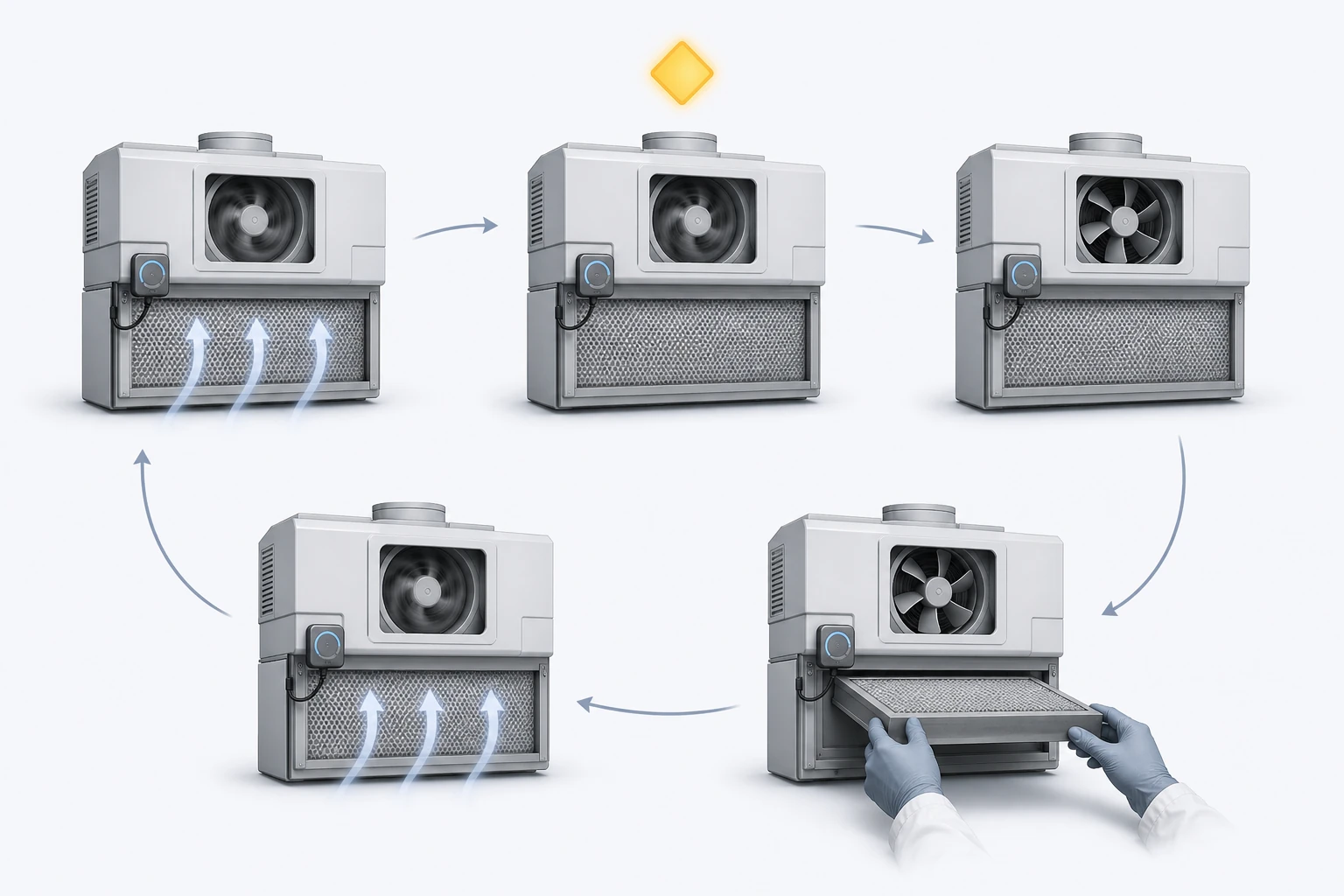
After this module you can assemble a monitoring and response plan for every stage — signal, threshold, response and owner — and you can now recognize which processes have no defensible monitoring path at all.
Step 6 — When a Ductless Filter Package Is Not the Answer
The selection chain has a final gate: some processes must not be forced into a general ductless configuration, and some institutions will not allow one at all. Run this exclusion check before you invest in assessments, because no filter package, monitoring plan or work practice converts these cases into safe recirculation.
Absolute Exclusions
| Work | Why it is excluded | Where it belongs |
|---|---|---|
| Hydrofluoric acid work | Vapor attacks glass viewing panels; systemic toxicity of fluoride exposure is not removable by filtration | Dedicated ducted HF hood with compatible liner and materials |
| Heated perchloric acid | Condensed perchloric acid can form shock-sensitive salts; NFPA 45 requires dedicated perchloric acid hoods with wash-down | Dedicated perchloric acid hood, ducted |
| Radioisotope handling | Contamination control and decay requirements exceed filter-package scope | Purpose-built containment per your radiation safety program |
| Defined fire or explosion hazards | No general filter package addresses ignition or overpressure | Ducted or special-purpose hood with the required electrical and fire controls |
| High-temperature digestion, boiling, melting | Load and temperature exceed the media’s credible operating envelope (per Esco and Labconco guidance) | Ducted hood or specialist review |
XICHENG’s ductless family page states the same boundary in product terms: heated digestion, perchloric work, radioisotope handling and defined fire or explosion hazards should not be forced into a general ductless configuration. Anything above roughly 70% perchloric acid concentration falls into the dedicated-hood category in supplier guidance; NFPA 45’s wash-down requirement applies to perchloric hoods that must be ducted.
Institutional Policy and Your CHP/LVMP
Institutional rules vary more than the chemistry does. Florida Atlantic University’s EHS policy prohibits ductless fume hoods outright, citing exposure potential through filter breakthrough and desorption; Cornell’s EHS program runs an annual face-velocity and containment testing program for its hoods. Both positions are defensible, and neither is a universal law — which is exactly why your first compatibility check is your own institution’s chemical hygiene plan (required by OSHA’s laboratory standard, 29 CFR 1910.1450) and its laboratory ventilation management plan (the framework ANSI/ASSP Z9.5-2022 expects laboratories to maintain).
Ask three questions before any vendor conversation: does my institution allow ductless hoods, does my process fit the chemical-review requirement, and who signs off the final filter package? If the answer to the first is no, the rest of this guide is moot for your facility.
When Ducted Is the Stronger Path
When the veto triggers, the stronger path is usually a ducted fume hood, not a different filter. Unknown or frequently changing chemical lists, high, variable or uncontrolled release, mandatory outdoor discharge, and any process with no available media all point to ducted exhaust, and our ducted vs ductless fume hood comparison walks through that system decision. A portable benchtop ductless fume hood (reference planning widths of 24 in, 32 in and 48 in) is also not an escape hatch — it must pass the same filter-suitability review, and XICHENG’s benchtop family is only appropriate after that review is complete.
Choose ducted first when the exclusion list, the institutional policy or the monitoring gap decides against recirculation. Choosing a ductless package after a veto is usually choosing a second remediation project.
After this module you can run the exclusion and policy checklist, and you know when the verdict is final: no filter package converts an excluded process, and no portable format bypasses the same review.
Worked Example: 90-Day Solvent Task → Filter Package
This worked example runs ductless fume hood filter selection end to end with a specific, realistic case: a synthesis lab plans a 90-day solvent weighing and dilution task. Every number below is an example input for the exercise — your real assessment uses your real values, and the output of the chain is a package pending supplier confirmation, not a capacity promise.
The Task and Its Loading Table
The task runs 4 days per week, 2 hr per day, at room temperature (20–25 °C) on a bench without powder work. The working mixture is made fresh each batch: toluene 60% (about 200 mL), acetone 25% (about 80 mL), ethanol 15% (about 50 mL), roughly 330 mL per batch. Room humidity typically sits near 45% RH, with occasional periods above 60% RH in the humid season. The lab records those numbers in the loading baseline:
| Loading-baseline field | Recorded value (example) |
|---|---|
| Chemical identity | Toluene / acetone / ethanol mixture with carrier solvents |
| Physical form | Vapor only; no particulate operations |
| Concentration | 60% / 25% / 15% by volume in the working mixture |
| Quantity per batch | About 330 mL total, mixed fresh |
| Temperature | 20–25 °C at the source |
| Duration and frequency | 2 hr/day, 4 days/week, 90-day cycle |
| Room humidity | 45% RH typical, >60% seasonal peaks |
Resulting Filter Package and Monitoring Plan
Walk the chain. Form: vapor only, so the capture mechanism is molecular; a prefilter still makes sense for bench dust, and HEPA is not triggered unless powder work is added. Media map: toluene (92.1 g/mol, 110.6 °C) is a strong carbon candidate; ethanol (46.1 g/mol, 78.4 °C) is compatible at lower capacity; acetone (58.1 g/mol, 56.1 °C) sits below the 60 °C screening line, which makes it the assessment trigger. Compatibility: all three clear the molecular-weight read, but the mixture introduces displacement risk — toluene is heavier than acetone, so any switch in proportions means treating the bed as partially exposed. The matrix exit is the assessment exit: a blended or mixed-bed molecular stage plus prefilter, with capacity, mass and service interval confirmed by the supplier’s chemical assessment using this loading table and the site humidity.
The monitoring plan follows the response table: a face-velocity alarm at the project setpoint (Z9.5-2022’s ±20% alert band), a downstream VOC sensor or sample port at the supplier’s calibration guidance, a review of load records at defined intervals within the 90-day cycle, and a re-assessment trigger whenever proportions, solvents or humidity change materially. Nothing in this plan predicts filter life; it defines the evidence that exists until the assessment’s service recommendation is received.
What Changes if Conditions Change
Change the acetone share to 50 percent: the borderline compound now dominates the load, so expect earlier breakthrough risk and raise monitoring frequency; the assessment must re-run with the new proportions. Move the task into a season above 60% RH: water competition lowers available capacity, so the review interval shortens and humidity joins the weekly records.
Replace ethanol with methanol (32.0 g/mol, 64.7 °C): the marginal compound forces a mandatory re-assessment, and the existing bed is treated as partially exposed from the displacement rule. Add powder weighing to the same task: a HEPA stage enters with its own loading and replacement criteria, and the stage order is re-defined with the supplier.
After this example you can run the chain with your own numbers: form, loading table, media direction, assessment trigger, monitoring plan — and you can now recognize exactly which of your inputs change the output.
Filter Selection Data Your Supplier and EHS Need
Selection ends with a written request, not a verbal conversation. Send one data package to your filter supplier and your EHS program, and both parties can evaluate the same facts. The table below assembles every field produced by this guide into the RFQ packet; a supplier that refuses to review these inputs is telling you how their assessment actually works.
| Data package item | What to include |
|---|---|
| Chemical list | Exact names, grades, carrier solvents, reaction products |
| Physical forms | Vapor / gas / particulate / aerosol / mixture per chemical |
| Concentrations | Percent in the working mixture or estimated mg/m³ in the task stream |
| Quantities | Volume or mass per batch, batches per day |
| Timing | Task duration per day, days per week, planned service period |
| Site conditions | Room temperature, relative humidity, background ventilation |
| Monitoring expectation | Airflow alarm, VOC sensor / PID, sample ports, alarm integration |
| Institutional constraints | Ductless policy of your institution; CHP / LVMP status; responsible sign-off |
| Standards in scope | Z9.5-2022, ASHRAE 110 or NFPA 45 applicability for your process |
| Service constraints | Access for filter changeout, spare storage, disposal route and waste rules |
Send the same package to your EHS officer and ask for the sign-off path in writing. The hard truth from this guide: the final capacity verdict is not the buyer’s to invent, the manufacturer’s chemical assessment and your institution’s EHS program own it, and no article replaces that confirmation. What you own is the chain that produces a reviewable request — and that chain is exactly what separates a defensible project from a filter-catalog guess.
You can now close the loop the way a defensible project closes: send the package, receive the assessment, and let the retention data plus your EHS sign-off set the final package. That is ductless fume hood filter selection as a repeatable process — profile, map, screen, assess, monitor — not a guess. Include the reference values your supplier will evaluate the request against: face velocity around 80–120 ft/min and ambient conditions such as 20–25 °C at 45–60% RH. If your project is at the configuration stage, the XICHENG ductless fume hood page lists the reference sizes and the configuration fields your assessment will need, and XICHENG evaluates airflow, filter-condition and chemical-sensing options per project.
FAQ
Can I use acetone in a ductless fume hood?
Acetone (58.1 g/mol, 56.1 °C) sits below the 60 °C screening line used by many suppliers, so it is a borderline compound, not a routine load. Confirm it on the manufacturer’s compatibility chart, expect earlier saturation than for heavier solvents, and raise monitoring frequency accordingly (see Step 3 and Step 5).
Can I use methanol in a ductless fume hood?
Methanol clears the boiling-point read at 64.7 °C but its low molecular weight and polarity weaken adsorption, so the chemical assessment is mandatory, not optional. Suppliers may recommend a specialty media blend; some loads revert to ducted exhaust.
How do I know when to replace the carbon filter?
Replacement is evidence-based, not calendar-based: the supplier’s assessed service recommendation for your load, alarm events from the detection channel you installed, and load re-assessments after any change to the chemical list. No fixed month count applies to all tasks, and any supplier that quotes one without your baseline is over-simplifying.
Which chemicals can a ductless fume hood handle?
Only the chemicals the manufacturer has approved for the installed media, after the chemical assessment. Mid-to-high-boiling organics are the common territory; reactive gases need impregnated or specialty media; low-molecular-weight volatiles are borderline; the Step 6 exclusions (HF, heated perchloric acid, radioisotopes, fire or explosion hazards) never qualify.
Is a ductless fume hood safe for my lab?
Safety is a property of the documented package — contaminant profile, filter selection, monitoring evidence and institutional policy — not a property of the word “ductless”. If your institution allows ductless hoods and the full chain passes review, it can be a defensible engineering control; if any link fails, the verdict is a ducted hood.
How is filter saturation detected?
Through the detection channel you planned in Step 5: downstream VOC sensors or photoionization detectors, interstage probes between filter layers, sample ports for manual checks, or load-based calculations against the assessed capacity. Airflow and pressure readings alone do not prove chemical retention.
Leave a Reply