




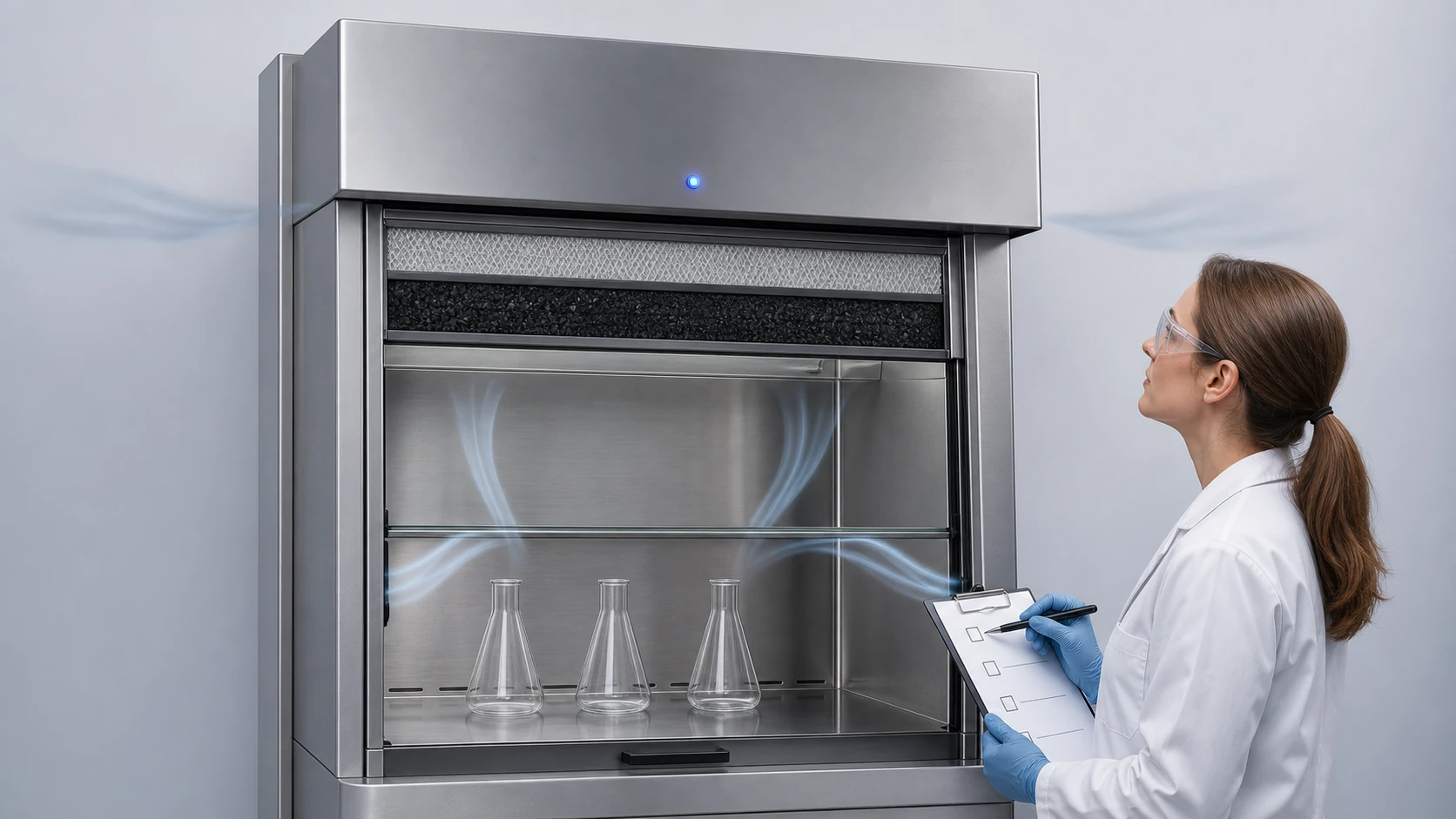
Key Takeaways
- Safety is a condition, not a label. A ductless fume hood is safe only when three things are verified for your exact work: your institution’s policy, the chemical review, and the monitoring evidence chain.
- “Ductless” describes where the air goes — it does not prove the filter retains your contaminant. Every vapor, gas and particle must be checked against the configured media before use.
- Start with known chemicals. The application should be defined, repeatable, laboratory-scale and reviewed against manufacturer-approved media; changes to the chemical list mean a new review.
- Airflow signals prove movement, not chemical retention. Plan saturation and breakthrough detection with defined alarms and responses before the hood is ordered.
- Institutional policy decides the envelope. Some institutions prohibit ductless hoods outright; others require approval or annual testing — check your EHS policy and CHP before any purchase conversation.
Are ductless fume hoods safe? The honest answer is that safety is not a property of the cabinet; it is a condition you have to verify for each specific application. A ductless fume hood recirculates laboratory air through a filter package instead of exhausting it outdoors, so whether it is safe for your work depends on three verified conditions: the policy of your institution, the compatibility of your chemicals with the configured media, and the monitoring evidence that tells you when the filter is no longer performing. This guide walks those three checks in order, then shows the boundary where a ductless hood stops being the right tool at all.
Direct Answer: Are Ductless Fume Hoods Safe? Only When Three Conditions Are Verified
A ductless fume hood can be a safe and practical engineering control for defined, repeatable laboratory work — and it can be an exposure risk when the wrong chemicals, an unapproved process, or a missing monitoring plan is installed in an otherwise identical cabinet. The distinction is not the brand or the enclosure; it is whether three conditions are verified for your exact work.
1. Institutional policy. Your EHS department, chemical hygiene plan (CHP) and laboratory ventilation management plan (LVMP) decide the envelope. Some institutions explicitly prohibit ductless hoods, others allow them only with prior approval, and still others fold them into annual testing programs. Section 3 of ANSI/ASSP Z9.5-2022 puts the same management structure in place: a laboratory ventilation management plan, a designated responsible person, and a chemical hygiene plan built on OSHA’s Laboratory Standard (29 CFR 1910.1450) incorporated into the LVMP.
2. Chemical review. The media in the hood must be confirmed against every chemical that will be used or generated in it. A peer-reviewed article in the *Journal of Chemical Health and Safety* (DiBerardinis et al.) states the limit plainly: ductless hoods should only be used with known chemicals that the manufacturer has approved for use, and they are best suited to laboratory-scale quantities — on the order of 1 L (about 1000 mL) or less per task. A carbon filter does not retain every vapor, and a HEPA stage does not adsorb vapor at all; compatibility is verified per compound, not assumed from the cabinet name.
3. Monitoring evidence. Safe operation requires a defined way to know when the filter is approaching saturation and a defined response when it does. Airflow signals prove that air is moving, not that the carbon still retains your contaminant. The monitoring chain — flow indicators, alarms, saturation detection, and the response when an alarm sounds — must exist before the hood is ordered, not discovered after an odor or a bad air sample. The Z9.5 framework anchors the chain with flow alarms set to warn on roughly ±20% deviation from the design range, verification by multiple containment-testing methods, and periodic retesting at least annually; the annual retest is also where instrumentation calibrated within 1 year of use is re-validated.
| Verification | What it answers | Check before ordering |
|---|---|---|
| Policy | Is a ductless hood permitted for my lab, and under what conditions? | EHS policy, CHP, LVMP; written approval if required |
| Chemical review | Can the configured media retain every chemical used or generated? | Manufacturer chemical assessment per compound and load |
| Monitoring | How will I know the filter is failing, and what do I do then? | Flow alarm, saturation detection, defined response and records |
Manufacturers that sell filtered hoods usually add a fourth condition: face-velocity sizing on the order of 80–120 ft/min (0.4–0.6 m/s) at the opening, a range Z9.5-style practice treats as a starting point, not a containment guarantee. And no vendor’s brochure replaces the two signatures that matter: the filter supplier’s chemical assessment for your load and your institution’s EHS review.
After this module you can decide your own answer to “are ductless fume hoods safe?”: yes, when policy, chemical review and monitoring are all verified — and not yet, until they are. You can now name the three verifications and the questions each one answers before you order anything.
How Ductless Hoods Work: Recirculation, Filtration and the Room Boundary
Before the three verifications, it helps to see exactly what a ductless hood does — and what it does not do. This is not a physics review; it is the boundary that makes “safe” a condition instead of a label. (For the full system families, our guide to fume hood types covers the wider picture; this module stays on the recirculating path.)
The Recirculating Air Path
A ductless fume hood combines a work enclosure, an integral fan and a selected filter package in one air path: laboratory air enters through the defined sash opening, sweeps contaminants away from the operator’s breathing zone, passes through the configured filtration section, and returns to the room. The first stage may remove larger particulate or protect the main media — a coarse prefilter (EU3 class, roughly 85% arrestance) is a common choice — while molecular carbon, HEPA, or a combined arrangement then addresses the contaminant form it was selected for.
Sizing fields give the air path its numbers: XICHENG’s full-size reference family spans 800 mm to 1600 mm cabinet widths with planning footprints such as 24 in, 32 in and 48 in on the portable side; the electrical reference is 110–240 VAC at 50/60 Hz; and the common face-velocity practice of 80–120 ft/min (0.4–0.6 m/s) sizes the opening flow. The treated stream leaves the upper housing and mixes with room air. The exact stage order, media grade, filter mass and fan duty are configuration fields — they are not established by the word “ductless” alone, as XICHENG states on its ductless fume hood product page.
The Room Is Part of the Operating Boundary
Because the treated stream returns to the laboratory, the room itself becomes part of the operating boundary: background ventilation, return-air location, clearance above the outlet, and the procedure for responding to odor, alarm or suspected breakthrough all belong to the installation review, not to the cabinet. Equipment placed above the hood, ceiling obstructions or a poorly located supply diffuser can interfere with discharge and recirculation even when the cabinet fits the floor plan. The same logic applies to the portable benchtop format, which XICHENG positions only after the same filter-suitability review and only where the bench, power supply and room conditions support the complete configured unit.
What “Ductless” Does and Does Not Prove
“Ductless” describes where the captured air goes; it does not prove that the selected filters retain a particular contaminant. Carbon media varies by formulation and operating condition, and its usable capacity depends on concentration, humidity, temperature, contact time and accumulated load. A particulate filter addresses compatible particles but does not remove vapor merely because both are airborne. Inward airflow must be maintained at the defined opening, the selected media must retain the stated contaminant under the expected load, and the user must know when continued operation is no longer acceptable — those three functions together, not the cabinet name, define the safe operating condition.
After this module you can explain the recirculating path in one paragraph and name the room-level conditions that belong to the installation review — the foundation for the enabling conditions checked next.
When Ductless Fume Hoods Work Well: Defined Processes, Known Chemicals
The same recirculating design that makes a ductless hood flexible also defines where it works: applications that can be fully characterized. XICHENG positions its ductless family for “defined, repeatable laboratory work with known chemicals or compatible particulates, controlled quantities and a manageable release rate” — and its portable benchtop format only after the same filter-suitability review has been passed. If your process is not yet that defined, the safety question is not answered; it is deferred.
Known Chemicals Confirmed Against the Filter
The first condition of ductless use is that every chemical in the task — including carrier solvents, mixtures and reaction products — is known, documented, and confirmed against the installed media by the filter supplier. The peer-reviewed guidance in the *Journal of Chemical Health and Safety* (DiBerardinis et al.) puts this as the first disadvantage of ductless hoods relative to ducted systems: you must know every chemical that will be used or generated in it. If the list is open-ended, mixed, or expected to change, a ducted hood removes the dependence on that knowledge.
Some institutions encode the same boundary in policy. The University of Michigan’s EHS program, for example, states that ductless chemical fume hoods are only applicable for “nuisance vapors and dusts that do not present a fire or toxicity hazard” — a conservative framing that shows how the “known chemicals” requirement can be tightened by the institution that owns the risk.
Laboratory-Scale Quantities
Ductless hoods are engineered around laboratory-scale work, not production or large-batch operations. The JCHAS article characterizes them as effective for laboratory quantities on the order of 1 L (about 1000 mL) or less per chemical per task; manufacturers’ own guidance lands in a similar range, with Labconco citing roughly 500 mL per chemical as a working reference. These are screening magnitudes, not permission limits: the definitive answer for your load comes from the manufacturer’s chemical assessment, which factors concentration, humidity, temperature, contact time and accumulated load.
Stable, Repeatable Tasks With Controlled Release
The third condition is stability: the same chemicals, in the same quantities, at the same release rate, repeated on a predictable schedule. Filter capacity is consumed by accumulated load, so a task that runs 2 hr per day at 20–25 °C and 45% RH behaves differently from a task that spikes irregularly. A defined routine lets you set a monitoring interval, recognize a change in the pattern, and respond before saturation becomes an exposure. High, variable or uncontrolled release — the cases XICHENG’s own decision table flags — exhaust capacity faster than any practical response can keep up, and push the decision toward ducted exhaust or another engineered control. Institutional face-velocity references in the 80–120 ft/min range apply to the same review as a sizing field, not as a retention guarantee.
After this module you can check your application against the three enabling conditions: fully known chemicals confirmed with the supplier, laboratory-scale quantities (1 L or less per task as a screening reference), and a stable, repeatable release pattern. If all three hold, the chemical review in the next module determines the boundary; if any fail, the exclusions later in this guide apply sooner.
Chemical Review: Molecular Weight, Humidity and Verifying Filter Compatibility
The chemical review is the second verification in the safety chain, and it is a judgement about your compounds, not a lookup of the cabinet’s name. Compatibility means the verified ability of the installed media to retain a chemical under your documented load. Every compound in your list gets the same treatment: chemical properties first, then site conditions, then a formal confirmation from the filter supplier and your EHS program.
Molecular Weight, Boiling Point and Polarity
Adsorption strength follows physical properties you can look up before calling anyone. Peer-reviewed studies of activated carbon show a consistent trend: compounds with higher molecular weight and higher boiling point adsorb more readily, while lightweight, low-boiling or strongly polar compounds adsorb weakly and break through sooner. Filter suppliers compress the same idea into a screening rule — molecular weight above roughly 30 g/mol and boiling point above roughly 60 °C as the comfortable working range of standard activated carbon — which is a diagnostic habit, not a standard, and never replaces the supplier’s compatibility data for your compound.
| Compound | Molecular weight (g/mol) | Boiling point (°C) | Typical screening read |
|---|---|---|---|
| Toluene | 92 | 111 °C | Strong adsorption candidate for standard carbon |
| Acetone | 58 | 56 °C | Boundary case; boiling point below the 60 °C screening line, explicit confirmation needed |
| Methanol | 32 | 65 °C | Light and polar; outside the comfortable molecular-weight range, explicit confirmation needed |
| Ethanol | 46 | 78 °C | Moderately volatile; capacity lower than heavier organics, confirmation advised |
| Hexane | 86 | 69 °C | Heavier alkane; better standard-carbon candidate than acetone |
The table is illustrative of how the screening works, using standard physical constants; it is not an approval list for any filter. The read changes with concentration, humidity and load — which is why the confirmation step at the end of this module, not the table, is the decision.
Humidity, Temperature and Accumulated Load
The same carbon that adsorbs your vapor also adsorbs water. Peer-reviewed work on VOC adsorption shows that at high relative humidity, water molecules compete with the target chemical for adsorption sites and reduce usable capacity; temperature shifts adsorption behaviour as well. The practical consequence for a lab: record the relative humidity at the installation site (many suppliers flag roughly 50% RH and above as the point where competition becomes visible), keep process temperature in the loading baseline (for example, 20–25 °C for room-temperature work), and treat “the filter” as a component whose performance is a function of the environment, not a fixed property.
Mixtures and Chemical Changes
A compatibility review covers the whole system, not just the headline chemical. Carrier solvents, stabilizers and reaction products all reach the filter; a mixture can behave differently from its components — including the displacement effect, where a heavier compound pushes a previously adsorbed lighter one off the media. Practical rules follow: document every component, treat a change to the chemical list as a trigger for a new review, and when the process generates products you cannot name, treat that as an exclusion signal rather than a paperwork gap.
Confirming With a Chemical Assessment
The review concludes with the two confirmations that make the answer defensible. First, the filter supplier’s chemical assessment for your specific list, quantities and conditions — the industry-standard step, offered by manufacturers under names like “chemical assessment,” “chemical guide,” or free qualification services. Second, your institution’s EHS sign-off through the CHP and LVMP process (see the policy module below). Neither step is a formality: the supplier confirms media suitability, and your EHS confirms the institutional envelope. Until both are documented, the chemical review is incomplete and the safety condition is not yet verified.
After this module you can run the chemical review yourself: tabulate each compound’s molecular weight, boiling point and polarity; add humidity, temperature and load; flag mixtures and planned changes; and name the two confirmations (manufacturer assessment + EHS) that close the review.
Monitoring and Breakthrough: The Evidence Chain That Keeps Ductless Safe
The third verification — monitoring — is the one that keeps the first two true over time. A filter approved at installation is only safe until the evidence says otherwise, so the monitoring plan names the signals, the thresholds, the response and the owner. What it must not do is confuse airflow with chemical retention.
Face Velocity and Airflow Signals Are Not Retention Proof
An airflow or pressure signal can prove that air is moving or that resistance is changing; it cannot prove that the carbon media still retains the target vapor. ANSI/ASSP Z9.5-2022 makes the same point structurally: average face velocity is not the only criterion for acceptable performance, and containment is verified with multiple approaches — smoke visualization, face velocity testing, exposure assessments and tracer-gas testing. XICHENG states the practical version on its product page: airflow or pressure signals show air movement and changing resistance, but chemical breakthrough or saturation requires a suitable detection, calculation or replacement method for the selected contaminant.
Face-velocity practice (a common institutional reference range is 80–120 ft/min at the opening, as our face velocity guide explains in the verification context) sizes the airflow; it does not certify the filter. Similarly, operating guidance such as Illinois’ DRS — work with the task at least 6 in inside the opening, because eddy currents at the front edge fall off at about that depth — supports inlet airflow discipline without making any claim about the filter.
Breakthrough and Desorption Explained
Saturation happens to every real filter; the question is whether it is detected. Breakthrough is the point at which the filter no longer retains a meaningful fraction of the contaminant, and desorption is the release of previously retained chemical — the two failure modes that institutional policies such as Florida Atlantic University’s prohibition cite by name. Both are gradual processes in practice: capacity declines with accumulated load, and a change in the chemical mix can displace retained compounds. Because they are silent without instrumentation, the monitoring plan is the only layer between a saturated filter and the breathing zone.
Detection Paths: Sensors, Probes and Sampling Ports
Industry practice offers several detection paths, and the choice belongs to your chemical review. Continuously monitored sensor systems sample the discharge air and alarm near saturation thresholds — the model used by established manufacturers such as Erlab and available in various instrument forms. A probe installed between the primary and secondary filter layers detects primary-stage breakthrough before the stream leaves the cabinet, a layout documented by suppliers including Unicorn and Labconco’s two-stage design. Sampling ports allow scheduled verification by external measurement, and photoionization detectors (PID) are a known path for continuous concentration measurement in patent and application literature. The common thread: each path needs a measurement principle, a setpoint, a calibration routine, an alarm response and a communication method — the exact fields XICHENG uses to scope monitoring per project. None of these are baked into the word “ductless.”
Z9.5 Monitoring: Alarms, Annual Testing and Records
The standard layer is not optional software; it is the management structure around the hardware. Z9.5-2022 requires flow indicators and alarms on all hoods, capable of warning when flow deviates by up to 20 percent; commissioning and testing at “as-installed” conditions before use; periodic tests of mechanical components at least annually or more often as needed; and training of hood users before use. Institutional programs operationalize the same ideas — Cornell’s annual inspection and testing program measures average face velocity against Z9.5, performs a visual performance check referencing ASHRAE 110 qualitative indicators, reviews housekeeping and utilization, and posts a warning tag when a hood fails. The monitoring row of your safety checklist (next modules) should name the hardware AND the institutional program that re-tests it.
| Signal | What it proves | What it does not prove | Detection path / standard anchor |
|---|---|---|---|
| Face velocity / airflow | Air is moving at the opening | Filter chemical retention | Z9.5 §4.3.1 multi-method verification; institutional annual tests |
| Flow alarm (±20% band) | Flow deviated from set range | Whether media still retains contaminant | Z9.5 §4.3.3; alarm response procedure |
| Pressure / filter resistance | Media loading is changing | Which contaminant is breaking through | Resistance trend log; change-out planning |
| Sensor / probe reading | Discharge concentration relative to setpoint | Absolute safety of any reading | Calibrated sensor or inter-stage probe; setpoint from assessment |
| Odor or visible change | Subjective warning | Quantitative exposure estimate | Response procedure: stop, isolate, escalate |
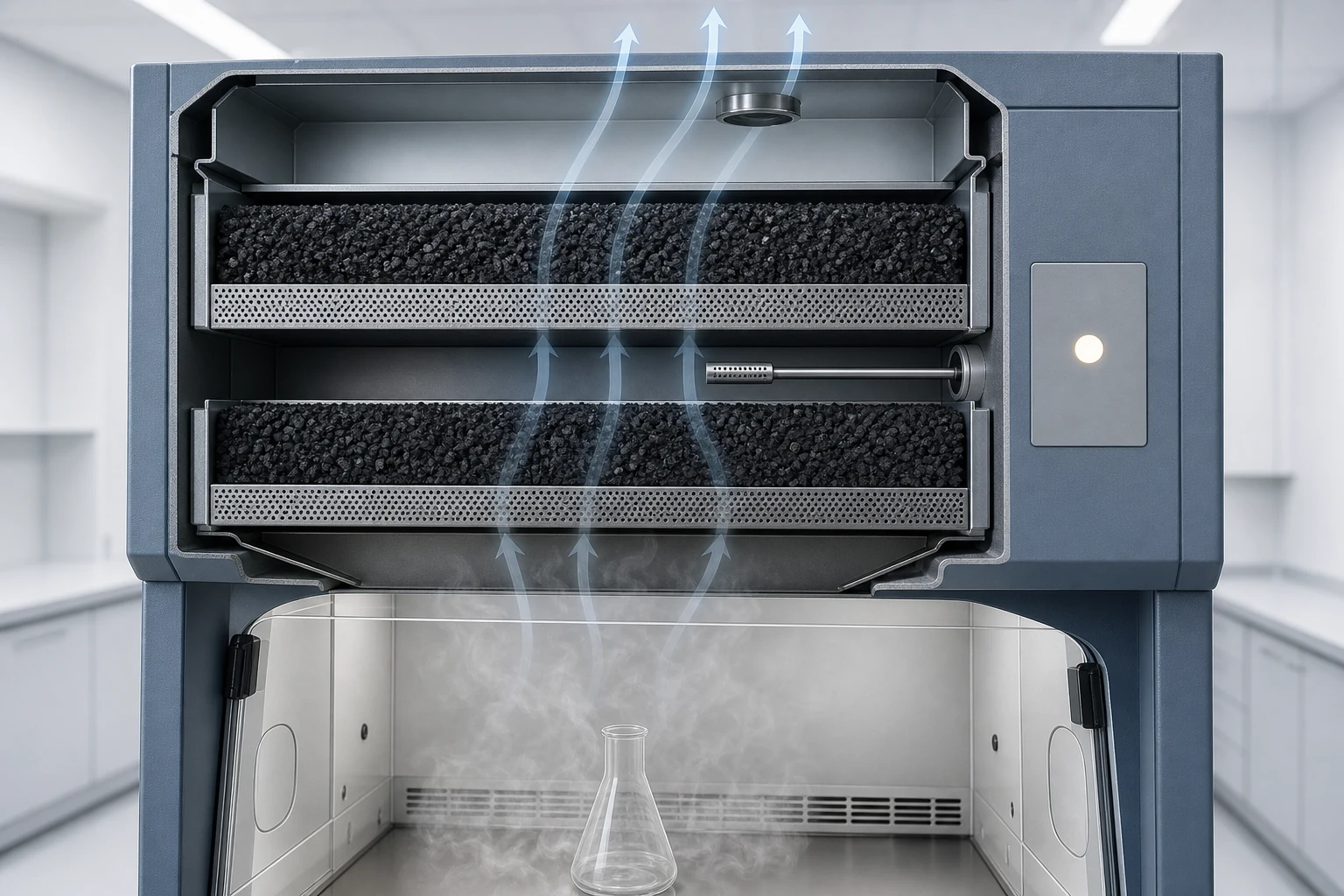
Breakthrough detection layers in a ductless fume hood filter section
After this module you can write the monitoring row of your verification and decide what each signal means before you order: named signals (face velocity on the order of 80–120 ft/min, a ±20% flow-alarm band, resistance trend), setpoints from the chemical assessment, the Z9.5 annual retest anchor with instrumentation calibrated within 1 year, and the response action for each signal.
Are Ductless Fume Hoods Safe in Your Facility? Policy, CHP and Responsibility
The third verification — institutional policy — is the one most guides skip, and it is often the fastest to resolve. Research institutions publish their positions publicly, and the positions differ sharply. Reading your own institution’s policy is a five-minute check that decides whether the rest of this guide’s purchase conversation is even permitted.
Policy Varies Sharply Between Institutions
The spectrum below is real, documented policy language from university EHS programs, presented for what it is: institutional positions, not a national rule. They exist to show the range you must expect:
| Institution | Stated position on ductless fume hoods (2026-08-31 access) |
|---|---|
| Florida Atlantic University (EHS P&P #29) | Prohibited — cites potential employee exposure through filter “breakthrough” and/or desorption |
| Ohio State University (EHS, 2023-10-04) | Acquisition prohibited in laboratory environments — cites flammable-saturated filters, filter degradation and disposal exposure, and inadequate handling of some volatile/toxic chemicals |
| Virginia Commonwealth University (EHS/OHS) | Prohibited unless pre-approved by EHS-OHS staff; conventional hoods reference 80–120 ft/min operation |
| University of Kentucky (OHS) | May not be used without approval of the directors of Environmental Management and OHS; campus guidance references 100 ft/min average face velocity and 12 in–18 in operating sash heights for conventional hoods |
| UNC Chapel Hill (EHS Manual 05.19) | Approved use only “when ducted hoods cannot be reasonably utilized or accommodated”; filter changes paid and documented by the PI |
| University of Illinois Urbana-Champaign (DRS) | Not recommended — limitations on chemical use and required maintenance; campus velocity range 80–120 ft/min with a vertical-sash operating maximum typically 18 in |
| University of Virginia (EHS) | Not generally recommended; should never be used to contain highly toxic materials |
| University of Michigan (EHS) | Not an acceptable alternative to ventilated hoods; only for nuisance vapors and dusts without fire or toxicity hazard |
| Cornell (EHS 2.1.2) | Managed through the annual fume-hood inspection and testing program |
Two lessons follow. First, “policy differs by institution” is not a hedge — it is the accurate state of the field, and the trend is visible: institutions that expect diverse, changing research chemistry default to ducted ventilation. Second, the same document that restricts you also defines the escape route: several policies show that approval is possible, and Cornell demonstrates that a ductless programme can live inside an annual testing framework — its sticker program treats an inspection sticker more than 1 year old as the trigger to schedule re-testing. Even the approval paths quantify their terms: UNC’s policy requires alarms calibrated to ±20% of designed airflow, annual face-velocity acceptance in the 90–120 ft/min operating range (within +20%/−10% of the design rating), and a standard operating sash of 18 in.
The deciding text is your institution’s — check it before any quote, and ask for the written condition (approval, testing, or prohibition).
Your CHP and LVMP Decide the Safe Envelope
Whatever the hood type, the operating framework is standardized. OSHA’s Laboratory Standard (29 CFR 1910.1450) requires the employer to develop and implement a chemical hygiene plan covering engineering controls, work practices and PPE. ANSI/ASSP Z9.5-2022 builds the ventilation side: a laboratory ventilation management plan, a designated responsible person per operation, the CHP incorporated into the LVMP, and — for filtered air-cleaning systems — design and approval by a responsible person (§10.2). Z9.5 also requires a flow indicator or alarm on every hood, warning when flow deviates by up to 20%, and periodic component testing at least annually. In practice this means a ductless hood decision is signed by the same people who own your lab’s exposure controls. If your institution has no LVMP or the responsible person cannot be named, that gap is a safety finding in itself.
What OSHA Does and Does Not Say
OSHA’s Laboratory Standard does not contain a ductless-hood provision, which surprises many buyers — there is no federal line that says “ductless hoods are approved” or “ductless hoods are banned.” What 1910.1450 does require is outcome-based: laboratory-scale work, exposure below permissible limits, and a CHP that documents the controls used to get there. Institutions therefore decide the hood question under their own policies, and their answers differ — which is exactly why the range in the table above exists. The federal requirement and the institutional policy are two layers of the same verification: the first sets the exposure obligation, the second sets the permitted equipment.
After this module you can complete the policy verification: locate your institution’s written position (approval, restriction or prohibition), confirm the CHP and LVMP are current with the responsible person named, and record the answer before any supplier conversation.
Lifecycle Safety: Filter Changes, Disposal and Chemical Change Management
A ductless hood’s safety record is written during operation, not at installation. Three lifecycle tasks decide whether the verified conditions stay verified: the filter change itself, the disposal of used media, and the review triggered by any change to the chemical list. Each is a documented procedure, not an afterthought.
Safe Filter Change Procedure
Changing a spent filter is the moment of highest direct exposure risk, because the media you are removing may be saturated with the very chemicals the hood was protecting against. A defensible procedure has four elements: shut down and isolate the hood according to the manufacturer’s instructions; wear the personal protective equipment specified for the process (the same assessment that justified the media defines the change-out PPE); handle the spent filter as a potentially contaminated item, never as inert waste; and document the change with date, filter identity and the load that led to replacement.
The load record matters because it is the number behind the replacement: a filter that served a task using up to 1 L (about 1000 mL) of solvent per batch, run 2 hr per day, accumulates loading differently from a filter that served occasional small tasks — and the record is what your EHS officer will check against the change-out schedule. XICHENG configures filter-removal clearance and service access as part of the project schedule precisely because replacement is an operating event, not a facilities errand.
Used Filter Disposal and Records
Saturated media can retain significant chemical mass — the same OSU policy statement that prohibits ductless hoods in its labs cites special handling and disposal requirements as one of its reasons. Disposal is therefore governed by your institution’s hazardous waste program and the manufacturer’s disposal guidance, and the records that matter run in both directions: the filter log (what was changed, when, under what load — e.g., a task at 20–25 °C and 45% RH) and the chemical usage log (what went in). The records are also part of the audit trail your EHS officer and inspector will ask for; several institutional programs reviewed for this guide require exactly this documentation to be maintained by the lab.
Chemical Change Management
Every change to the chemical list — a new compound, a different solvent ratio, a process step that generates a new product — invalidates the prior chemical review until the change is assessed. The displacement effect cuts both ways here: a heavier compound can release a previously adsorbed lighter one, so a “small” substitution can end the protection of an apparently healthy filter. The operating rule is simple: introduce no new chemical without repeating the compatibility confirmation and checking the change against your institution’s protocol, exactly as the manufacturer DO/DON’T guidance and multiple institutional policies instruct.
The change review should also re-examine the monitoring record — a task that ran 2 hr per day for weeks built an accumulated load that the previous assessment priced in, and a ±20% flow-alarm response (Z9.5 §4.3.3) is the first line that will flag the difference. Some institutions make explicit change review an express condition of approval; every responsible one expects it, and the Z9.5 framework reinforces the same discipline with instrumentation calibrated within 1 year of use and records kept with the LVMP.
After this module you can name the three lifecycle controls — controlled change-out, hazardous-waste disposal with records, and chemical-change review — and confirm each has an owner in your lab before the hood is installed.
When Not to Use a Ductless Fume Hood: The Exclusion List
The exclusion list is the safety boundary of this guide, and it is deliberately separate from the enabling conditions: the enabling conditions describe the ideal candidate, while the exclusions describe the cases where no amount of configuration effort makes a ductless hood the right answer. XICHENG’s own product guidance draws the same line — high-temperature digestion, perchloric-acid work, radioisotope handling, and defined fire or explosion hazards “should not be forced into a general ductless configuration.”
| Exclusion | Why it applies | Alternative direction |
|---|---|---|
| Your institution prohibits ductless hoods | Policy is the envelope; approval documents are required where they exist | Approval path if defined; otherwise ducted hood (see FH-B02 ducted vs ductless) |
| Unknown, variable or open-ended chemical list | You must know every chemical used or generated (JCHAS) before media can be confirmed | Ducted hood; exhaust removes the dependence on media knowledge |
| Highly toxic, high-acute-hazard or select-carcinogen work at meaningful scale | Institutions (e.g., UVA) explicitly exclude “highly toxic” containment from ductless hoods; burden of proof is high | Ducted hood with verified containment; dedicated enclosure |
| Heating, boiling, acid digestion or extreme heating steps | Manufacturer DO/DON’T guidance (e.g., Esco) excludes heating and boiling; heated perchloric acid has its own standard path | Dedicated perchloric acid hood with wash-down (see NFPA 45); ducted hood |
| Perchloric acid (especially heated, ≥72% concentrations per institutional practice) | Shock-sensitive perchlorate formation requires wash-down capable, dedicated systems | Perchloric acid hood with wash-down and dedicated ductwork |
| Radioisotopes or radioactive work | Decontamination and containment requirements exceed recirculating envelopes | Radiation-compatible dedicated hoods under radiation safety program |
| Defined fire or explosion hazards | No laboratory hood is rated to contain explosions (UMN fact sheet); flammable-loaded filters add fire risk | Explosion-rated or dedicated systems; review before any hood choice |
| High, variable or uncontrolled release rates | Capacity is consumed by accumulated load faster than responses can keep up | Ducted hood or process redesign |
| Facility or regulation requires outdoor discharge | Recirculation is structurally incompatible with the requirement | Ducted hood connected to compliant exhaust |
Absolute Exclusions
The rows above that carry “dedicated system” answers are absolute exclusions: heated perchloric acid, radioisotope handling, and defined fire or explosion hazards are outside the ductless envelope by design, and no filter selection repairs that. These are the applications where the word “special-purpose hood” exists — the same family that Z9.5-2022 treats as a distinct category with its own special requirements alongside ductless hoods. On perchloric acid the numbers line up across sources: manufacturer DO/DON’T guidance (Esco) flags concentrations above 70%, Kentucky’s institutional practice cites ≥72%, and NFPA 45 requires a dedicated wash-down-capable hood for heated work. On loading, treat the assessed capacity as a real budget: when cumulative load approaches 100% of the assessment basis, the filter is spent regardless of how the air feels.
High-Hazard, Unknown or Uncontrolled Loads
The second group is not a hard hardware exclusion but a decision rule: when the chemical list cannot be completed, the process generates products you cannot name, or the release rate cannot be bounded, the media confirmation that the safety chain depends on cannot be performed. Multiple institutions compress the same idea into policy — “nuisance vapors and dusts that do not present a fire or toxicity hazard” (Michigan), or “known chemicals that the manufacturer has approved for use” (the JCHAS criterion). If your load cannot be described, the honest answer is ducted, not “ask the supplier for a bigger filter.”
When Ducted Is the Stronger Path
The fallback is not a compromise; it is the engineering control the contaminant should leave the building. A ducted hood moves the treated stream outdoors, which removes the filter-saturation failure mode and the media-knowledge dependence entirely — at the cost of installation, energy and building ductwork. It also returns the face-velocity question to familiar ground: ducted hoods are commissioned to the same 80–120 ft/min reference ranges, but the containment test (e.g., ASHRAE 110) verifies the whole system rather than a filter stage. Our ducted vs ductless comparison covers the system trade-off in depth; for the purposes of this guide, the decision rule is: when any exclusion row applies to your process, the conversation moves to ducted or dedicated systems before the cabinet-width discussion.
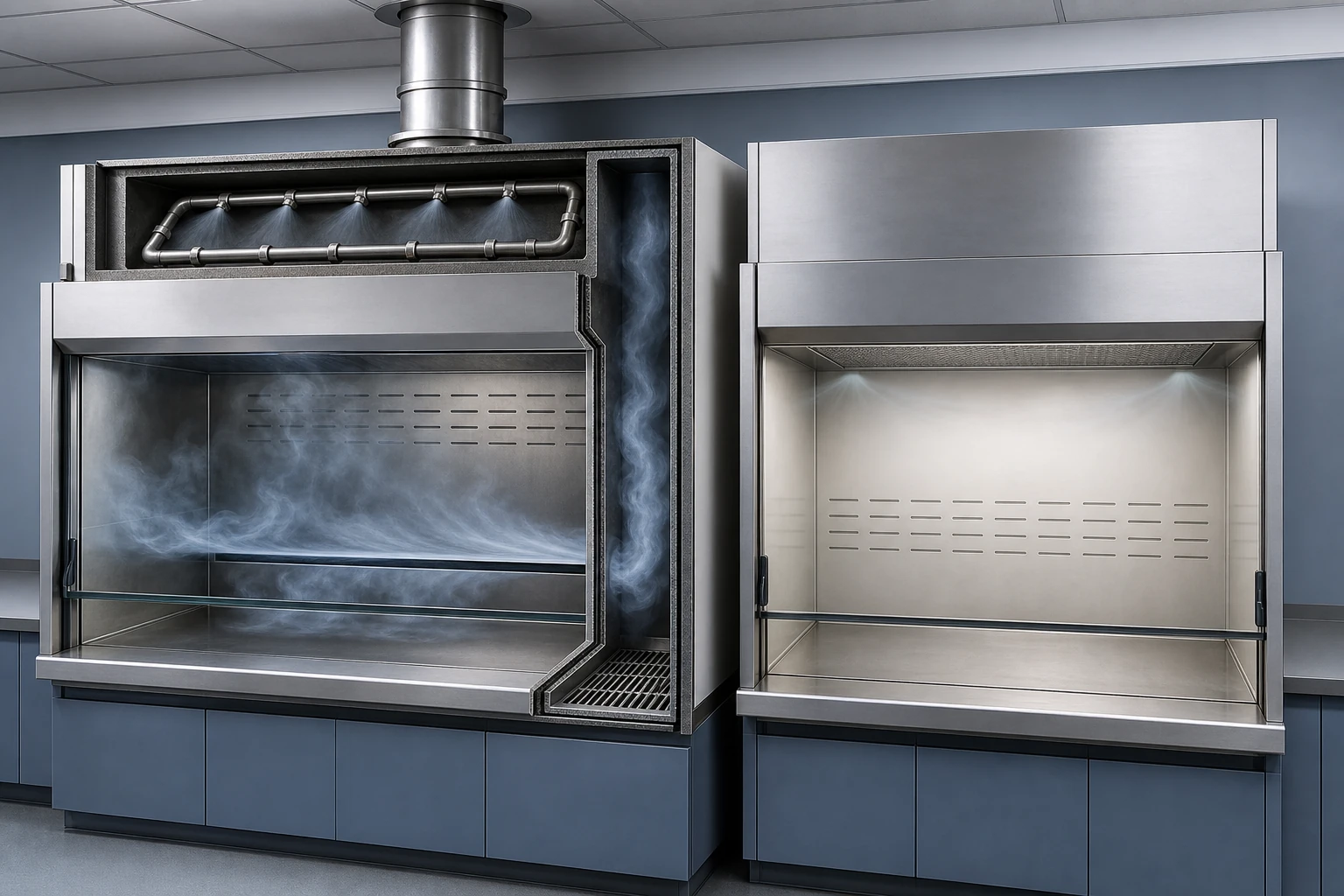
When a ductless fume hood is not the answer – dedicated system paths
After this module you can run the exclusion check: every row either clears with documented evidence or routes your process to a ducted or dedicated system — which is the point where “is it safe?” becomes “which system is correct?”
Safety Verification Checklist: Three Questions Your EHS Can Sign Off
This guide started with one question — are ductless fume hoods safe? — and answered it with three verifications. The checklist below turns that answer into a document your EHS officer can sign, which is the only version of “safe” that matters for your lab.
| Verification | Checklist items | Evidence you should be able to show |
|---|---|---|
| Policy | Written institutional position obtained; CHP and LVMP current; responsible person named; approval documented if required | Policy excerpt or approval email; CHP/LVMP section references |
| Chemical review | Every chemical (including carriers and products) listed; supplier chemical assessment completed; humidity, temperature and load recorded; mixtures and changes flagged | Assessment document; loading baseline with concentration, quantity, duration and frequency fields |
| Monitoring | Flow indicator and alarm defined (face velocity on the order of 80–120 ft/min with a ±20% alarm band per Z9.5; XICHENG’s monitoring is evaluated per project: measurement principle, setpoint, calibration, alarm response, communication); saturation/breakthrough detection chosen; response procedure written | Monitoring specification; alarm response procedure; record-keeping plan |
| Lifecycle | Change-out procedure with PPE and isolation; disposal path confirmed with EHS and manufacturer; chemical-change review rule in place | SOP for change-out; disposal authorization; change-review checklist |
Three practical notes close the checklist. First, if the monitoring row cannot be completed — no practical way to detect loss of airflow, filter loading or chemical breakthrough for your process — the exclusion table in the previous section applies and further quotes are a waste of budget. Second, treat every item as a document, not a conversation: the paper trail is what an audit, an inspector, or a new safety officer will ask for.
Third, share the completed list with your supplier before configuration: a responsible supplier will confirm media compatibility, monitoring options and service requirements against it. That confirmation is exactly the conversation our ductless fume hood product page is designed to start, with the portable benchtop format as the option for small work zones that have passed the same review.
Once the review passes, our filter selection guide covers the media-combination choices in depth — matching contaminant form, chemical family and load to carbon, HEPA or combined stages with their monitoring and replacement logic.
Worked Example: Walking One Task Through the Three Verifications
Consider a weighing and dilution task run 2 hr per day, 4 days per week at 20–25 °C and roughly 45% RH. Policy: the lab’s EHS page shows the institution allows ductless hoods only with prior approval; the approval email and the CHP section naming the responsible person are filed. Chemical review: the list contains formaldehyde and phenol; the supplier’s chemical assessment confirms an aldehyde-specific media for the volume used (well within the 1 L — about 1000 mL — laboratory-scale reference), and the loading baseline records concentration, quantity, task duration and frequency.
Monitoring: the configuration includes a ±20% flow alarm (Z9.5 §4.3.3), a sensor between the primary and secondary carbon stages, and the annual retest is on the institutional schedule — every row of the checklist above now has evidence behind it. Now change one element: the lab proposes switching the carrier solvent to an unassessed mixture. That single change re-opens the chemical review and the monitoring setpoint review before work resumes — which is the change-management rule from the lifecycle module doing its job. The example’s numbers are illustrative inputs for the walk-through, not a recommendation for any specific task.
So: are ductless fume hoods safe? Yes — for defined, laboratory-scale work with known chemicals, an approved institutional envelope, and a monitoring chain you can actually respond to. Not yet — until policy, chemical review and monitoring evidence are verified and on file, and not at all when your process belongs to the exclusion list. Your next step is clear: run the three verifications; the answer your lab needs will be written on its own checklist.
FAQ
Can I use a ductless fume hood for formaldehyde or phenol work? These are exactly the cases that require a completed chemical review before any other answer: formaldehyde is a low-molecular-weight aldehyde that needs aldehyde-specific or assessed media, and both chemicals must be in the manufacturer’s approved list for the configured filter. The review applies the same laboratory-scale boundary as the rest of this guide (about 1 L, or 1000 mL, per task), and the handler’s own EHS guidance — plus several institutional policies in this guide — treats such compounds as requiring explicit confirmation, not a default permission.
Are ductless fume hoods OSHA-approved? There is no OSHA provision that approves or bans ductless hoods by name. The Laboratory Standard (29 CFR 1910.1450) sets outcome-based obligations — a chemical hygiene plan, exposure below permissible limits — and institutions decide permitted equipment under their own policies, which is why the policy check comes first in this guide.
How do I know when the filter is saturated? You know through the monitoring evidence you defined before installation: a flow or pressure signal shows air movement and resistance but not chemical retention; saturation and breakthrough need a defined detection method (sensor, probe between filter stages, or sampling), a setpoint, and a written response. If no practical detection method exists for your process, that is an exclusion signal, not an installation detail.
How often should ductless fume hood filters be replaced? There is no honest universal interval; replacement follows the chemical assessment, the accumulated load, and the monitoring evidence for your specific application — for laboratory-scale quantities (about 1 L, or 1000 mL, per task) the assessment rather than a calendar date sets the change-out trigger. This is also why our filter selection guide treats replacement logic as part of the filter package rather than a calendar date. Industry figures like “6–24 months” are vendor guidance for vendor conditions and should not be applied to your load.
Are ductless fume hoods allowed in universities? Some are and some are not: the institutional spectrum in this guide runs from outright prohibition (FAU, Ohio State) through approval-required (VCU, Kentucky, UNC) to managed annual testing (Cornell). The only general rule is that there is no general rule — read your own institution’s policy and CHP before the purchase conversation.
What is the difference between ductless and ducted fume hood safety? A ducted hood removes the contaminant from the building, which eliminates the filter-saturation failure mode entirely but pays for it in energy and installation; a ductless hood trades that removal for recirculation through assessed media — at similar face-velocity reference ranges (80–120 ft/min) but with the safety burden shifted to chemical review and monitoring, including ±20% flow-alarm responses and saturation detection. The practical answer depends on your process, which is why this guide’s three verifications replace the binary “safe or not” question with a checklist.
Leave a Reply