





Key Takeaways
- An explosion-proof fume hood is a ducted enclosure modified to remove electrical ignition sources from its components — it is not a blast-containment shell.
- Explosion-proof fume hood requirements start with the room, not the chemicals — standard outlets in the lab signal a standard environment, and an EP hood beside a standard spark source can negate its own value.
- The factory ships a modified hood, not a certified one — certification is contingent on the field installation (licensed electrician, wiring, conduit), your room classification, and the documentation layer.
- The 25% LEL threshold is the one rule that matters, as transcribed — keep vapor below 25% of the LEL and the exhausted enclosure stays out of the electrical classification unless an unusual hazard exists; verify current editions.
- Nothing is waived and nothing is assumed — monitoring, training and in-hood discipline survive the rating; ductless EP units are not automatically safer; confirm component, scope and drawing details before the quote.
The term “explosion-proof” reads like a promise that the hood will survive or contain an explosion. That reading is wrong, and correcting it matters more than any specification detail: an explosion-proof fume hood is a ducted laboratory enclosure whose electrical components are configured so they cannot act as an ignition source for flammable vapors, and it is not built to contain a blast.
Explosion-proof fume hood requirements follow a room-first decision chain rather than a product label: what the term commits to, whether your room classification calls for an explosion-proof unit at all, who owns each layer of the result, and what to confirm before a quote. No explosion-proof fume hood ships with a factory certificate for the whole unit, and no product name assigns a Class, Division or Zone rating; those outcomes depend on the field installation and the room assessment that the modules ahead walk through in order.
What Explosion-Proof Fume Hood Requirements Promise: Ignition-Source Control
Start with the label itself, because buyers often read it as a strength rating. In the fume-hood market the term names an engineering choice about electricity: the hood’s electrical components are selected and arranged so they cannot create a spark inside the enclosure. The rest of this module separates that meaning from the claims that get attached to it.
The Real Meaning: Removing Electrical Ignition Sources From the Hood’s Electrical Components
Labconco’s engineering articles on explosion-proof fume hoods state the mechanism plainly: a hood is made explosion-proof by removing the potential for creating a spark. In practical terms the unit ships without the wiring, switches and receptacles a standard hood carries, and the light is an explosion-proof rated fixture, typically delivered without a bulb. What remains is a ducted enclosure whose electrical risk has been changed at the component level before it ever reaches your site.
XICHENG’s product page says the same thing in specification language. It describes its explosion-proof fume hood as a ducted laboratory enclosure “configured for flammable vapor applications where the project hazard assessment requires control of electrical ignition sources.” Two manufacturers describing one mechanism is the working definition this guide uses throughout — and it is an industry and manufacturer definition, not a regulatory one. A vendor’s brochure does not create code; regulatory meaning arrives later, through your installation and your room classification.
What Ships From the Factory and What Is Configured Later
The factory state matters because it shows what the term does and does not deliver on arrival. XICHENG’s component guidance is explicit: electrical devices “may be removed, moved outside the classified boundary or selected with suitable markings,” and each device is configured by location and required rating. The hood arrives as an enclosure prepared for that configuration work, not as a finished wiring package with every decision already made.
That gap between shipping state and working state is deliberate, and it is the first place buyers over-read the label. Wiring, switches, receptacles and their ratings belong to the site — the licensed electrician and the room assessment — which a later module assigns to its owners. For this module the point is narrower: if a quote presents an explosion-proof fume hood as complete and certified on arrival, the term is being oversold.
Where the Meanings Converge
Read the term as convergent language rather than as one vendor’s slogan. Labconco’s two engineering articles and XICHENG’s product page describe the same mechanism — removing spark potential from the hood’s electrical components — and both stop at the same boundary: the modification does not make the enclosure blast-resistant.
That convergence lets this guide treat the definition as settled without adopting any single brochure. When a later module asks whether your room needs an explosion-proof fume hood at all, the answer will come from your room and your hazard assessment, not from re-litigating the label. If you can now restate the definition — a ducted enclosure whose electrical components cannot ignite the vapor — you hold the reference point that every “explosion-proof” claim in the next module gets checked against.
What an Explosion-Proof Fume Hood Does Not Promise
With the positive meaning settled, the boundary work begins. The term says nothing about surviving an explosion, about the strength of the cabinet, or about a rating for the whole assembly, and confusing those limits with the real meaning is where safety planning goes wrong.
It Prevents Ignition; It Does Not Contain a Blast
An explosion-proof fume hood is not a blast-containment enclosure. XICHENG’s product page states the boundary in its own FAQ: the explosion-proof fume hood name “does not mean that the cabinet can contain a blast.” Labconco and Fisher American make the same point in their myth articles — the hood is engineered to prevent an ignition, not to contain one — and the sash is glass, with no blast-rated structure behind it.
State that limit once and hold it, because it changes procurement. If a project brief asks for a hood that will contain an explosion, no explosion-proof fume hood satisfies that request, and no component rating turns a laboratory enclosure into a containment vessel. A containment requirement belongs to a separate hazard-assessment conversation about barriers and process controls, not to a more expensive version of this product category.
Ratings Apply to Specific Electrical Components, Not the Whole Hood or Room
The second limit is scope. Where an explosion-proof rating exists, it applies to a specific electrical component — a light fixture, a switch, a motor — and not to the hood as an assembly. PSA Laboratory Furniture’s myth review puts it directly: the rating applies only to specific components, not the entire hood. The cabinet, the duct system and the room as a whole stay outside that certificate’s reach.
XICHENG’s component certificate makes the same boundary explicit: the certificate covers the identified model and does not certify the cabinet, another device, the fan or duct system, or the field installation. Treat any document that appears to certify the whole enclosure as a reason to read its scope line, because the industry convention is component-level, and a hood certificate never certifies the room.
The Name Assigns No Class, Division or Zone
Third, the product name is not a classification. Hazardous-location vocabulary such as Class I, Division 2 describes a room’s atmosphere under the electrical classification system in NFPA 70, as transcribed by the manufacturers cited in this guide — verify against the current edition before relying on it. XICHENG’s page states the consequence directly: the explosion-proof fume hood name does not assign a Class/Division or Zone rating.
That separation protects you from the most expensive mistake in this category: buying a named product as a substitute for a room assessment. If your facility has not classified the room, that fact — not the product name — is the starting point for the decision the next modules walk through. The label follows the assessment; it never replaces it.
Standard Hoods Still Carry Their Own Physical-Protection Role
None of the above says a standard fume hood is flimsy. Under correct use a laboratory fume hood provides its own physical protection: the enclosure, the sash and the exhaust capture contain spills and fumes and give the operator a working barrier, which institutional guidance describes as physical protection against fire and explosion hazards in normal operation. That protective role is real, and it is separate from an explosion-proof rating.
Keep the two statements apart. A hood can be a well-built enclosure that protects you in normal use and still be an ordinary electrical environment; the explosion-proof modification addresses ignition sources, not cabinet strength. When you read claims about a rugged or heavy-duty cabinet, that tells you about construction quality — and it does not tell you that the hood is explosion-proof, which is a statement about its electrical components and its room. By the end of this module you can name what the term does not promise — no blast containment, component-level scope, no Class, Division or Zone from the name — and you are ready for the question that decides everything else: whether your room requires an explosion-proof fume hood at all.
When Do Explosion-Proof Fume Hood Requirements Apply to Your Lab?
The trigger is not found on the chemical label. It is found in the room: an explosion-proof fume hood exists because the atmosphere around it could carry flammable vapor at a concentration a spark could ignite. Work the decision from the space outward, and most projects resolve toward a standard hood.
The Deciding Factor Is the Room, Not the Chemicals
Fisher American’s myth article on explosion-proof fume hoods states the determining factor directly: the room classification, not just the substances in use (as transcribed; the article cites OSHA 29 CFR 1910.307 in the same discussion — verify against the current edition). The same chemical can be routine in one room and part of a classified atmosphere in another, depending on how much is released, how the space is ventilated and how it has been rated.
Labconco reaches the same point from the dilution side. A small amount of solvent evaporating into a large ventilated room stays far below a dangerous concentration, while identical work in a tight enclosure behaves differently — which is why the room’s atmosphere, not the bottle on the bench, is what the classification measures. Start the decision with the room, then bring the work into that frame.
Start From the Default: Electrically Unclassified Unless an Unusual Hazard Is Identified
The starting assumption is not “explosion-proof everything.” Kewaunee’s fume-hood FAQ, quoting NFPA 45, states that laboratory fume hoods are electrically unclassified under NEC Article 500 in normal operation (as transcribed; verify against the current editions of both documents). That default means an ordinary electrical environment is the norm, and a classified one is the exception that has to be demonstrated.
The exception is an unusual hazard: work that can push vapor concentrations toward the flammable range inside or around the hood. When a hazard assessment identifies that condition, the electrical-equipment question changes. Notice the burden of proof — the room needs a documented reason to be special, not a reason to be ordinary.
The Outlet Heuristic: Standard Receptacles and Switches Signal a Standard Environment
A practical first check needs no calculation. If the room has standard electrical outlets and switches on the wall, it is not an explosion-proof environment (Labconco and Fisher American, as transcribed). An explosion-proof fume hood placed beside ordinary receptacles and standard light switches sits inside the atmosphere its components were configured to avoid.
The manufacturers put it plainly: an explosion-proof hood has no business in a room full of standard electrical components, because a spark from that room can reach the same vapor the hood is controlling. If you can see standard outlets, pause and ask why the project is considering explosion-proof equipment at all before paying for components the surrounding room will not support.
In a Classified Explosion-Proof Lab, Every Ventilation Device Goes EP-Rated
The rule flips once the room is genuinely classified. Labconco states that all ventilation equipment in an explosion-proof laboratory must be EP-rated as well, regardless of the kind of work going on inside the hood (as transcribed). The room drives the equipment, not the reverse — a standard exhaust fan or blower in the same classified atmosphere is its own ignition source.
Plan for that before the project starts: fans, motors, switches and any electrical device inside the classified space are part of the equipment decision, not accessories. Each of those belongs to a responsibility layer this guide assigns later. By the end of this module you can run the room-first check yourself: start from the room, trust the unclassified default, run the outlet heuristic, and treat a genuinely classified room as an all-EP zone — which is the frame the next module’s one threshold refines.
The 25% LEL Threshold and the Decision Sequence Behind It
Once the room’s default is set, one number refines the question. That number is not a face velocity and not a ventilation constant — it is the flammable-concentration line the electrical classification cares about, and it is the only numeric rule this guide relies on.
The Only Numeric Rule: Vapor Below 25% of the LEL Keeps an Exhausted Enclosure Out of Class I Division 2
NFPA 70’s rule, as transcribed by Labconco and Fisher American, is that an exhausted enclosure which keeps vapor below 25% of the lower explosive limit (LEL/LFL) is treated as outside Class I, Division 2 — verify against the current edition before relying on it. Below that concentration the atmosphere cannot support ignition from the electrical equipment, which is the condition the classification is built around.
That single threshold carries the numeric weight of this article. No face-velocity figure, no airflow constant and no dilution coefficient appears anywhere else in the body; those numbers belong to other guides. Keep the 25% line framed as a transcribed rule with a verify-current-editions note rather than as statute — it draws the line between an ordinary exhausted hood and one that needs classified electrical treatment.
Two Rules, Two Layers: The NFPA 70 Enclosure Rule and the NFPA 45 Hood-Interior Exemption
NFPA 70 and NFPA 45 answer different questions, so they do not contradict each other. NFPA 70 (as transcribed by Labconco and Fisher) classifies the exhausted enclosure by the vapor concentration it maintains — the 25% LEL line above. NFPA 45 (as transcribed by Kewaunee) says the hood interior is electrically unclassified in normal laboratory use unless an unusual hazard is identified.
Read them as layers rather than as rivals. NFPA 45 governs what happens inside the hood in ordinary operation, where the default is unclassified; NFPA 70 governs how the enclosure and the room rate when concentrations rise. A hood can be unclassified inside under NFPA 45 while the surrounding classified room still demands EP-rated equipment under NFPA 70 — which is the all-EP rule from the previous module restated in code terms. Verify both against current editions before you build a decision on them.
The Decision Sequence in One Path
When you need to decide whether explosion-proof fume hood requirements touch your project, run the path in order and stop at the first step that settles it:
- Start from the default. Your lab and its hoods are electrically unclassified unless an assessment says otherwise (NFPA 45 via Kewaunee, as transcribed).
- Run the outlet heuristic. Standard receptacles and switches in the room mean a standard environment, and an explosion-proof hood there is likely misplaced.
- Ask the concentration question. Can vapor in or around the exhausted enclosure approach 25% of the LEL during the work you plan?
- If the answer is yes or uncertain, treat it as an unusual hazard and obtain a room classification from a qualified assessor before specifying explosion-proof equipment.
- When the path is not clear, consult EH&S. The decision line is a professional assessment, not a product page or a name on a spec sheet.
The Dilution Arithmetic Belongs to Professionals
Knowing whether vapor stays below 25% LEL is not a label question — it is a calculation professionals run before the equipment decision. Labconco’s worked example, based on the dilution-factor method from the Industrial Ventilation manual, uses methanol evaporating at roughly 2 pints per hour at 70 °F and arrives at a minimum airflow near 22 CFM to stay under the 25% LEL line. That example is Labconco’s and single-source; treat it as an illustration of how the check is run, not as arithmetic to copy for your own lab.
The reason this article does not hand you the formula as a do-it-yourself exercise is that the inputs — evaporation rate, temperature, enclosure behavior and exhaust performance — are process data only your operation can supply, and the output feeds a ventilation design decision. The airflow-calculation side of that boundary is covered in our separate fume hood airflow calculation guide; this page stops where the professions split. Below 25% LEL the enclosure stays out of the electrical classification, and the arithmetic that proves it belongs to a ventilation professional. By the end of this module you can state the one rule, read the two standards as layers, and follow a single path to its conclusion — consult a qualified assessor when the room leaves the default. The next module assigns who is responsible for each layer once that decision is yes.
Who Is Responsible: The Four Layers Behind an Explosion-Proof Fume Hood
Once the decision is yes — your room leaves the default — the work splits into layers with different owners. Asking “who certifies this hood” is the wrong question, because the honest answer is that no single party does; the useful question is which layer you are looking at and who carries it.
The Four-Layer Responsibility Table
Four distinct owners carry an explosion-proof fume hood project: the factory that builds a modified hood, the licensed electrician who completes its electrical configuration on site, the qualified assessor who classifies the room, and the project team that keeps the compliance documentation. The table below is this guide’s synthesis — no single source states all four layers, so every cell carries its own attribution.
| Layer | Responsibility sits with | Source wording (as transcribed) |
|---|---|---|
| 1. Cabinet factory state | Manufacturer (XICHENG or another hood maker) | Modified hood supplied without wiring, switches or receptacles; no whole-unit certification ships in the crate, as Labconco’s engineering articles state; XICHENG’s product page carries no third-party whole-unit certification claim |
| 2. Field electrical configuration | Licensed electrician | Wiring, components, conduit, switch and receptacle placement per state and local code, per Labconco’s and Fisher American’s installation guidance |
| 3. Room hazardous-location classification | Qualified assessor | Class I, Division 1 or 2 per NFPA 70 as transcribed; the room, not the product name, carries the rating, per Fisher American’s transcription of NFPA 70; consistent with XICHENG’s component-certificate scope |
| 4. System-level compliance documentation | Project team with EHS | Component certificates with limited scope, acceptance tests, airflow records — compliance is documented, not automatic, per PSA Laboratory Furniture’s compliance analysis; XICHENG’s component-certificate scope |
Read the table as a division of labor, not a list of options. If a project lacks one of the four owners — no electrician scoped, no assessor engaged, no one keeping the record — that missing layer is where the “explosion-proof” claim will fail, no matter how the hood itself was built.
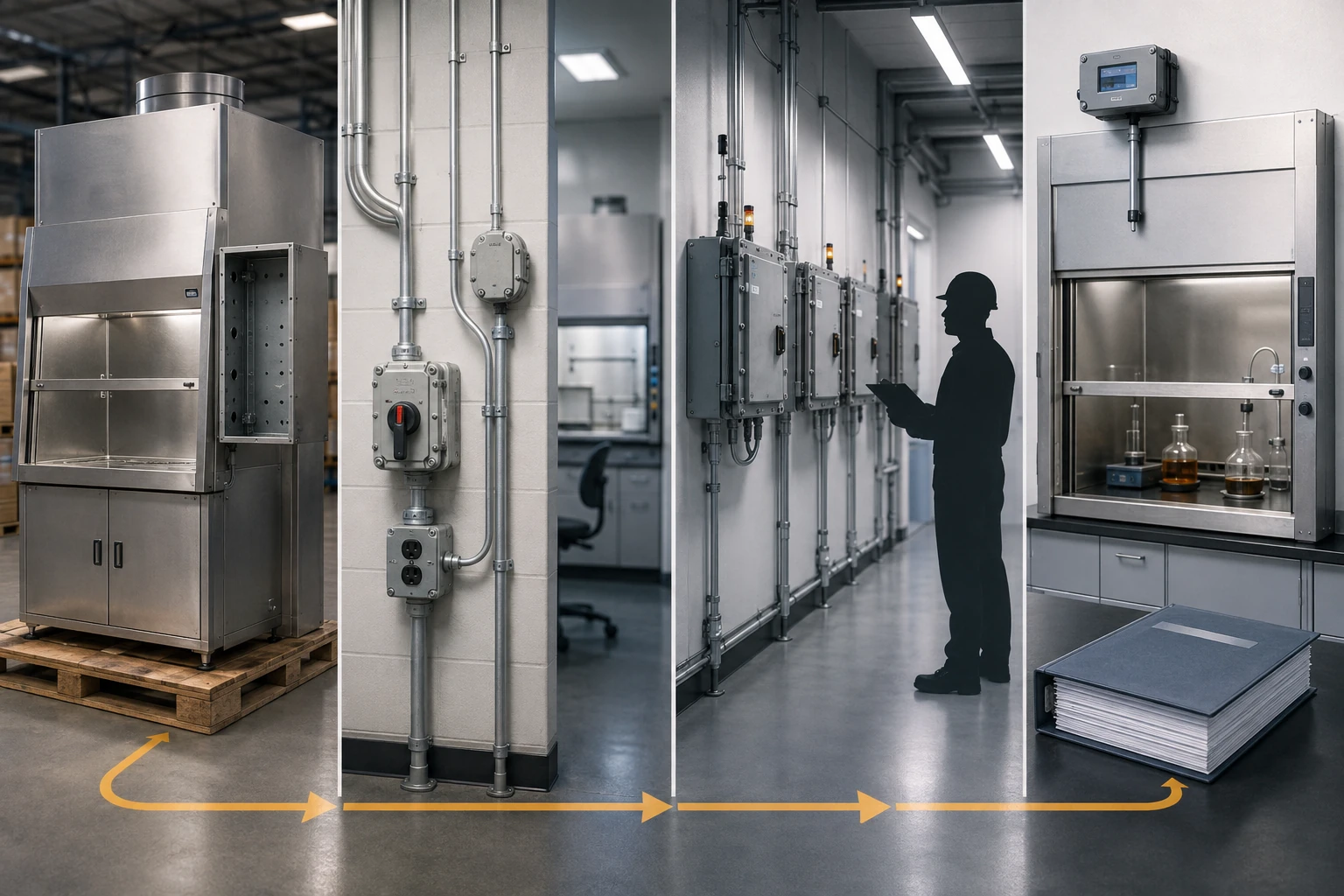
Layer 1 — The Factory: A Modified Hood and No Certification in the Crate
The factory’s contribution is the cabinet and its electrical configuration: an explosion-proof light fixture in place, no wiring, no switches and no receptacles delivered, and devices selected by the location and rating the project will confirm. Labconco states the factory boundary directly — any certification of the hood as explosion-proof would be contingent on its installation, so the crate does not carry one. XICHENG’s page makes the same negative point in practice: it presents no whole-unit UL, CE or third-party certification, and certificates appear only as component-level items in the quote process.
Do not read that as a quality gap. The factory cannot certify what it does not control — the field wiring, the room and the documentation all arrive after the cabinet leaves the plant. If a supplier offers a whole-unit “explosion-proof” certificate with the crate, that is the claim to question first, because it contradicts the way every layer in this guide attributes responsibility.
Layer 2 — The Field: Licensed Electrician, Field Wiring, Conduit and Switch/Receptacle Placement
Layer 2 is where the hood’s electrical components are installed, and it belongs to a licensed electrician working to state and local code — not to the hood supplier and not to general lab staff. The field work includes running the wiring in metal conduit, placing an explosion-proof switch inside the room (or a standard switch outside the classified boundary), and mounting the receptacles on the wall: explosion-proof outlets are too large for standard corner posts, so they go on wall surfaces where the enclosure can support them.
The physical installation around this electrical work — positioning the cabinet, connecting services, commissioning — is a separate workflow with its own requirement set. Our fume hood installation workflow article covers that process from the room side; this guide’s field layer stops at the electrical boundary and at who holds the license for it.
Layers 3–4 — Room Classification and Compliance Documentation
Layer 3 is the room. A qualified assessor determines whether the space is a hazardous (classified) location — Class I, Division 1 or 2 under NFPA 70, as transcribed by Fisher American; verify against the current edition before relying on it. This is the layer that turns a decision into a requirement: the same modified hood in an unclassified room is an over-specified cabinet, and in a classified room it is one electrical device among many that must suit the rating. XICHENG’s component certificate keeps its scope to match: it covers the identified model and does not certify the cabinet, another device, the fan or duct system, or the field installation — and the fan and motor may sit outside the laboratory, with a motor described as explosion-proof not by itself making an unsuitable fan or duct construction acceptable.
Layer 4 is the record. Acceptance tests, airflow documentation and the limited-scope component certificates form the compliance file the project team owns with EHS; component-level listings exist on the market — for example, UL-listed Class I, Division 1 fan and filter units, which this guide knows only from snippet-level sourcing — but none of them adds up to a whole-hood or whole-room certificate. By the end of this module you can name the owner of each of the four layers and the document that proves it, which means you stop asking the factory for a whole-hood certificate and instead line up the electrician, the assessor and the documentation trail before the quote. The next module turns to what survives the rating: monitoring, training and in-hood discipline.
What an Explosion-Proof Rating Does Not Waive: Monitoring, Discipline and the Ductless Question
An explosion-proof rating changes the electrical components of a hood and the room it serves. It does not remove the operating duties that apply to every fume hood — and in some ways it adds a few, because the flammable work that justified the rating is still happening.
Monitoring and Training Survive the Rating
PSA Laboratory Furniture’s myth review makes the point across two of its eleven myths: ventilation design stays fundamental, and airflow monitoring does not disappear because the hood carries an EP rating. Face-velocity alarms and airflow indicators remain necessary on an explosion-proof hood, and operator training is still required — compliance is documented and maintained, never automatic (as transcribed; PSA is a manufacturer source). The airflow-monitoring semantics of that duty, including the measurement details, belong to our fume hood face velocity requirements article; this page only flags that the duty survives.
The practical consequence is that an EP hood does not simplify your monitoring program. The alarm that tells you the exhaust has failed matters more, not less, when the hood’s job is to keep flammable vapor below a concentration the room can tolerate; budget for the airflow instrumentation and for the trained operators who respond to it.
In-Hood Discipline With Flammables
The usage rules that apply to any hood handling flammables still apply inside an explosion-proof hood. The University of California, Santa Cruz environmental health and safety manual lists them as a matter of routine: no electrical receptacles or spark sources inside the hood while flammables are in use, no permanent receptacles installed in the hood at all, a barricade or shield for work with explosion or implosion risk, and continuous monitoring during the procedure. Treat that list as one institution’s manual — presented as an example, not as a regulation — because your own SOP governs your lab.
Read the discipline together with the rating. An explosion-proof hood removes ignition sources from its own electrical components, but it does not remove the spark sources you bring into it: a power strip, an unapproved device or an open flame reintroduces exactly the ignition the room classification was meant to exclude. The barricade rule matters for the same reason — the rating prevents ignition, it does not contain the event if one occurs.
The Ductless Caution: EP-Rated Ductless Is Not Automatically Safer
PSA’s myth review flags a specific over-simplification: an explosion-proof ductless hood is not automatically safer than a ducted one, and for flammable workloads a ducted exhaust usually performs better (as transcribed; manufacturer analysis). XICHENG’s selection guidance says the same from the product side — start with a ducted configuration when contaminants must be discharged through a building exhaust, and consider ductless only after the substances, filter media, loading, monitoring and replacement plan are confirmed. The ductless safety boundary and filter selection each have their own guides: our article on whether ductless fume hoods are safe covers the general question, and ductless fume hood filter selection covers how filter packages are chosen and monitored.
The reason the caution belongs in an explosion-proof discussion is that the EP label answers a different question than the exhaust strategy does. A ductless unit can carry EP-rated components and still leave you managing saturated filter media in a flammable service, where the filter itself becomes a variable the room classification never accounted for. By the end of this module you can list what an explosion-proof rating does not waive — airflow monitoring, training, in-hood spark discipline and the ducted-exhaust default for flammable work — and you can separate the electrical question from the ventilation and filter questions before you order.
Before You Order: The Explosion-Proof Pre-Order Confirmation Checklist
The order conversation is where the four layers from the previous module become concrete. A useful quote does not start with a price; it starts with the process facts and the room facts that let an engineer configure the hood, its components and its scope of supply. Bring those to the conversation and the quote answers the right question; leave them out and you will be comparing cabinets instead of configurations.
Flammable-Vapor Process and Hazardous-Location Requirements Come First
The first submission item is the process itself, not the cabinet size. XICHENG’s quote and consult framing asks for the flammable-vapor process and the hazardous-location requirements before any configuration work begins — the hood is configured for flammable-vapor applications where the project hazard assessment requires control of electrical ignition sources, so the assessment has to exist before the configuration can. That ordering protects you: a supplier cannot responsibly quote an explosion-proof configuration without knowing what vapor, at what rate, under what procedure, in what room.
State the room facts in the same breath. Whether the space is classified, under which division or zone the assessor placed it, and what the surrounding electrical environment looks like determine which components are even candidates. Process first, room second, configuration third — that is the sequence this checklist locks in.
The Pre-Order Information List
XICHENG’s Laboratory Fume Hoods category guidance publishes the information list a project should submit before a quote. Treat it as a submission checklist, not as a sizing tool — you are supplying facts for an engineer to work with, not performing the engineering:
- Chemical inventory and quantities, with the operating temperature of the work.
- The procedure, the equipment envelope it needs, and the required work opening.
- Utilities available at the hood location and the proposed hood location itself.
- Exhaust airflow and static pressure expectations, plus the room air-balance strategy.
- Duct routing and emissions requirements, monitoring and alarm expectations, and under-cabinet needs.
- Any CAV-VAV plans for the space.
Walk the list before contacting a supplier. Every item is a fact your lab already holds or an engineer can confirm; none of them is a number this page supplies, because the correct values are project data.
Component Schedule, Scope of Supply and Drawing Scope
The third group pins down who supplies what. XICHENG’s component guidance describes electrical devices as configured by location and required rating — possibly removed, moved outside the classified boundary, or selected with suitable markings — so the quote has to state which devices are included and which are site work. The fan and motor may be outside the laboratory and can be supplied with the hood, as separate equipment, or by the owner’s contractor; an explosion-proof motor does not by itself make an unsuitable fan or duct construction acceptable, so the fan, duct and motor scope belongs in the written scope of supply.
Confirm the drawing scope in the same pass. XICHENG specifies no fixed dimensions or standard sizes — the hood is made to suit the apparatus envelope and confirmed on project drawings — so the deliverable list should name which drawings (apparatus envelope, component layout, duct and fan interface) will be issued for review. If a quote cannot state its component schedule, its scope of supply and its drawing scope, it is not yet a spec you can review.
Boundary Sentences and Selection Handoff
Two boundary notes keep this article inside its lane. First, the exhaust strategy default is ducted: start with a ducted configuration when contaminants must be discharged through a building exhaust, and consider ductless only after substances, filter media, loading, monitoring and replacement are confirmed — the ductless guides linked in the previous module carry that question. Second, special-chemistry service is a separate decision: a hood for perchloric-acid work is a dedicated wash-down system with its own requirement set, covered in our perchloric acid fume hood requirements article — this page does not develop that comparison.
If you are still choosing among cabinet types rather than confirming an explosion-proof configuration, the laboratory fume hoods category page and our types of fume hoods guide cover general selection. By the end of this module you can assemble the pre-order submission: process and room facts, the information list, the component and scope confirmations, and the drawing scope — which is the material you take into the specification review in the final module.
Your Next Step: Take the Four-Layer Check to a Specification Review
You now hold the whole decision chain this article promised at the opening. This final module restates it once, without adding new numbers, and then points to the conversation that turns the check into a quote.
The Decision Line in One Place
- What the term means: an explosion-proof fume hood is a modified hood whose electrical components cannot ignite the vapor — a promise about ignition sources, not about strength.
- What it does not mean: no blast containment, no whole-unit factory certification, no Class, Division or Zone assignment from the name, no automatic compliance.
- When one is required: the room decides — start from the electrically unclassified default, run the outlet heuristic, keep vapor below the 25% LEL line, and treat a genuinely classified room as an all-EP zone.
- Who is responsible: the four layers — factory-modified hood, on-site licensed electrician, room classification by a qualified assessor, and the compliance documentation the project team keeps with EHS.
- What survives the rating: airflow monitoring, training, in-hood spark discipline and the ducted-exhaust default for flammable work.
- What to confirm before you order: the flammable-vapor process, the hazardous-location requirements, the pre-order information list, the component schedule, the scope of supply and the drawing scope.
That recap is deliberately free of new figures. Every number this page uses — the 25% LEL threshold and the attributed methanol example — is already stated above with its source and its boundary, and the checklist items are facts your project supplies, not constants this article asserts.
The Specification-Review Conversation
The productive next step is not to order from a spec sheet but to bring the four-layer check to a specification review. Take the assembled submission — process and room facts, the information list, the component and scope confirmations — to XICHENG’s engineering team and ask for the configuration, component interface list, scope of supply and drawing scope that match your project, via the quote or consult contact on the explosion proof fume hood product page. If your project is still in general selection, the laboratory fume hoods category page is the wider starting point.
That review is where the layers close: you bring the room classification and process facts, the supplier returns a component schedule and scope that fit them, and the electrician and the documentation plan complete the loop on site. Nothing in that conversation promises a blast-proof cabinet, a whole-unit certificate or a price on this page — and if a supplier offers one, you now know which question to ask first. Explosion-proof fume hood requirements are met by the four layers working together, not by a label on a cabinet.
Frequently Asked Questions
What Does Explosion-Proof Mean for a Fume Hood?
In the fume-hood context, “explosion-proof” means the hood’s electrical components are configured so they cannot act as an ignition source for flammable vapors — delivered without wiring, switches or receptacles, with an explosion-proof rated light fixture typically without a bulb. It is an industry and manufacturer definition, not a regulatory one, and it is not a blast-containment promise.
Is an Explosion-Proof Fume Hood Blast-Resistant, or Will It Contain an Explosion?
Neither. The sash is glass and there is no blast-rated structure; manufacturers state the hood is engineered to prevent an ignition, not to contain one. As XICHENG’s product page puts it, the explosion-proof fume hood name does not mean that the cabinet can contain a blast.
Do I Need an Explosion-Proof Fume Hood for My Lab?
Run the room-first check: your lab starts electrically unclassified unless an assessment says otherwise; if the room has standard outlets and switches it is not an explosion-proof environment; vapor below the 25% LEL line keeps an exhausted enclosure out of the electrical classification. If the room leaves the default or the answer is uncertain, consult EH&S or a qualified assessor before specifying the hood.
Who Certifies an Explosion-Proof Fume Hood?
No single party certifies the whole unit, because certification is contingent on the field installation. The factory ships a modified hood without a whole-unit certificate; a licensed electrician completes the wiring, conduit and switch placement; a qualified assessor classifies the room; and the project team keeps the component certificates, acceptance tests and airflow records. A component certificate covers the identified model and does not certify the cabinet, another device, the fan or duct system, or the field installation.
Are Ductless Explosion-Proof Fume Hoods Safe?
An explosion-proof ductless hood is not automatically safer than a ducted one, and for flammable workloads a ducted exhaust usually performs better (manufacturer analysis, as transcribed). The EP rating answers the electrical question; the exhaust strategy is a separate decision, and the ductless safety and filter-selection questions have their own guides on this site.
What Should I Submit Before Ordering an Explosion-Proof Fume Hood?
Submit the flammable-vapor process and hazardous-location requirements first, then the information list — chemical inventory and quantities, operating temperature, procedure, equipment envelope, work opening, utilities, hood location, exhaust airflow and pressure, room air balance, duct routing, emissions and monitoring expectations — and confirm the component schedule, scope of supply and drawing scope with the supplier. Those facts let an engineer configure the hood for your project instead of quoting a generic cabinet.
Leave a Reply