





Key Takeaways
- A fume hood is a ventilated enclosure that captures and removes hazardous vapors, gases, fumes and dust from the work area before they reach the user — the working definition behind any what is a fume hood question.
- It protects people, not products. Contaminated air is drawn away from the user; the incoming air is not filtered, so the sample inside is not protected by the hood.
- Ducted exhaust is treated before release. The air path runs hood → ductwork → treatment section (scrubber or activated carbon, sized by chemical load) → fan → roof stack; ductless hoods filter and recirculate instead.
- Face velocity is a screening reference, not a legal number. Institutional references are about 100 fpm standard flow and 70 fpm low flow at an 18-inch sash, with 80–120 fpm certification ranges common; ASHRAE 110 testing is the real acceptance check.
- Use triggers are concrete. Toxic compounds, compounds with a boiling point below 120 °C, and operations that can exceed exposure limits belong inside a fume hood.
What Is a Fume Hood?
If you are asking what is a fume hood, the short, useful answer is that it is a ventilated enclosure that captures and removes hazardous vapors, gases, fumes and dust from the work area before they reach the user. It is one of the local exhaust ventilation (LEV) devices a laboratory relies on to control airborne chemical exposure at its source.
A Definition You Can Use
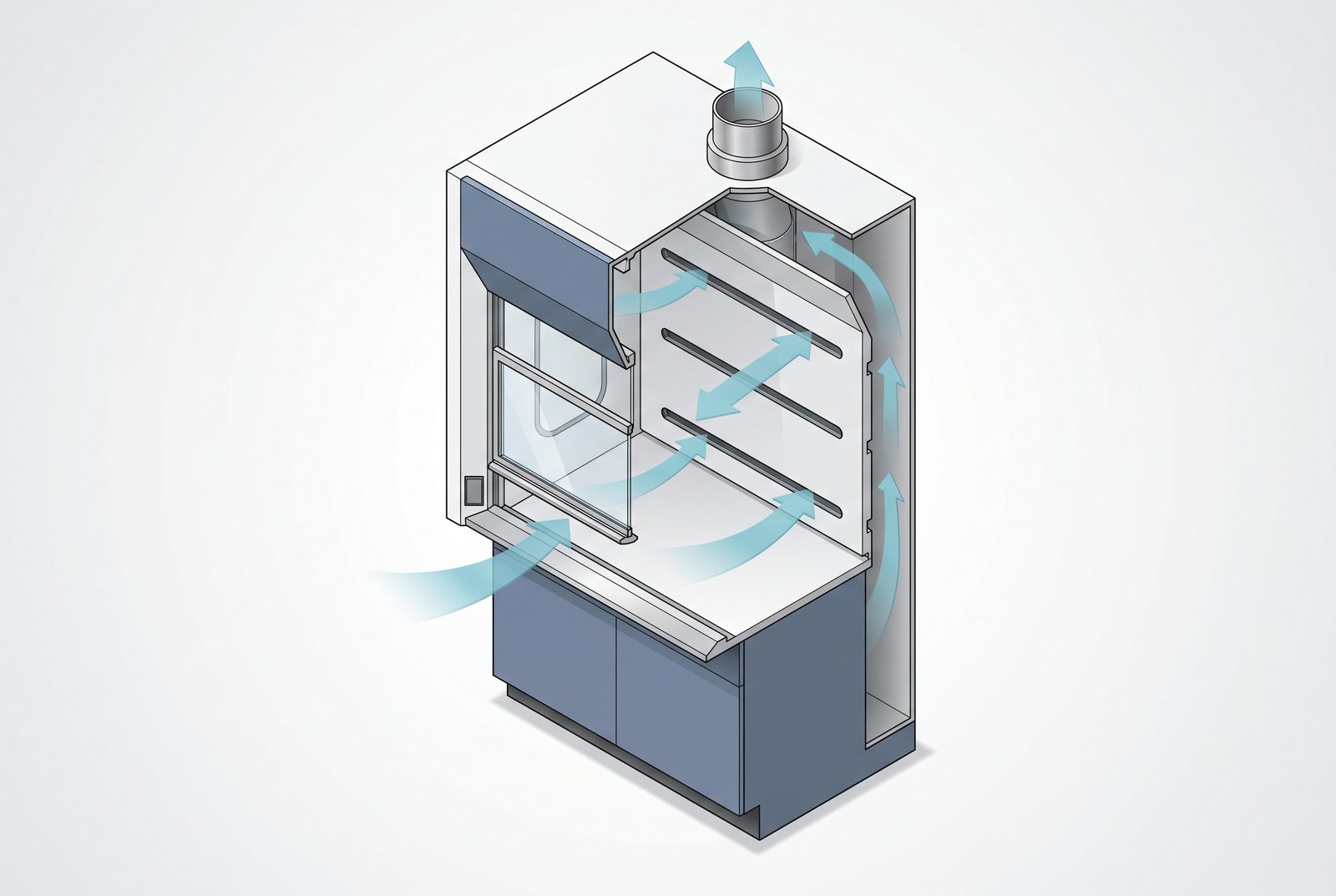
The working definition used by laboratory safety programs is consistent across institutions: a fume hood is a ventilated enclosure in which gases, vapors and fumes are captured and removed from the work area. An exhaust fan draws air through the open front of the hood, across the work surface and out through connected ductwork. That continuous inward flow keeps contaminated air from spilling back into the room air the user breathes.
A hood does not treat the general air supply of the room. It creates a local containment zone around the work being done, which is why it is classed as local exhaust ventilation rather than general ventilation. That distinction matters when comparing a fume hood with devices that move filtered air in other directions.
What It Is Not
A laboratory fume hood is not a kitchen range extractor, and it is not a biosafety cabinet, even though all three move air around a work zone. A kitchen extractor removes cooking effluent with no containment requirement and no face velocity standard. A biosafety cabinet filters air to protect the sample and the environment as well as the person, which a fume hood does not attempt.
Keeping the category straight matters for procurement and for safety reviews: in laboratory practice, the term fume hood refers to the LEV enclosure, not to a vented cooktop or a clean-air device. That separation sets up two questions: what the hood is used for, and how its airflow does the job. From here you can decide which device type your application needs.
What Is a Fume Hood Used For?
A fume hood is used for one job: controlling airborne exposure to hazardous substances at the point where the work happens. It does this by capturing contaminated air close to the source and moving it out of the breathing zone, which is why laboratories put volatile chemistry, dust-generating work and operations near exposure limits inside a hood rather than on an open bench.

Exposure Control Is the Job
The primary purpose is personnel protection through source capture. When you work inside the enclosure, the inward airflow at the open front keeps gases, vapors and fumes from drifting into the room and into your airway. This is different from wearing a respirator, which filters air at the person; a fume hood removes the hazard before it reaches anyone.
Institutional guidance frames the same point as a use rule: fume hoods are for operations with toxic compounds, compounds with a boiling point below 120 °C, or any work that can push concentrations past exposure limits. The exact thresholds and the safe-use routine belong to the linked safe-use guide, but the trigger conditions are consistent across laboratory safety programs.
The Hazards It Handles
Fume hoods handle airborne hazards in four forms: gases, vapors, fumes and dust. A gas is a substance already in the air at room temperature; a vapor is the airborne form of a liquid; fumes are fine particles, usually from heating or combustion; dust covers larger suspended particulates. All four can be drawn into the hood opening and carried away through the exhaust system.
That range is why hoods appear across chemistry, materials handling and sample prep rather than in one narrow process. The enclosure does not judge the hazard class; it contains whatever is generated inside the work zone and removes it continuously. What varies is the exhaust route, which the mechanism module explains next.
Usually Separate from HVAC, Not Recirculated
A ducted fume hood’s exhaust is normally separate from the building heating, ventilation and air conditioning (HVAC) system and is not recirculated into the laboratory. The hood’s air leaves through its own ductwork and exhaust path, so it does not ride the same supply air loop that conditions occupied rooms.
That independence carries a running cost: exhaust air is conditioned air that leaves the building, and it is one of the main energy loads of a laboratory. Control strategies such as constant air volume (CAV) vs variable air volume (VAV) change the energy profile significantly, and that comparison is covered by the CAV vs VAV airflow control guide when you need to budget or spec it. You now have a clear statement of what the hood is for and which two questions to answer about your own application.
How Does a Fume Hood Work?
How does a fume hood work in practice? The hood creates a continuous inward airflow that carries contaminated air away from the user and out of the work zone, and every component exists to shape that flow. The mechanism is the same whether the hood is ducted or ductless; only the exit route differs.
The Airflow Path
Room air enters through the open front of the hood, crosses the work surface, and leaves through the exhaust connection. The path is: air is drawn in through the sash opening, sweeps over the work being done, passes through interior baffle outlets at the back, and continues into the hood’s exhaust connection.
Two details make the path work. First, the hood opening is the only meaningful intake, so the speed of air at the front is what keeps contaminants inside. Second, the interior baffles create the pressure balance that moves air evenly toward the exhaust instead of recirculating it inside the enclosure. The same capture-and-remove arrangement is described in the standard description of a fume hood as a local exhaust ventilation device.
The Sash and the Baffles
The movable front sash is the operator’s main control. It slides vertically, horizontally, or in a combination of the two, and it acts as a physical barrier between the user and the work zone while the airflow does the capture. Lowering the sash reduces the opening area, which raises face velocity on constant-volume systems or saves energy on variable-volume systems.
The interior baffles are adjustable slots at the back of the hood that manage where air exits. They can be positioned to favor the bottom, middle or top of the work zone, which matters because heavier vapors and lighter fumes behave differently. A blocked baffle breaks the exhaust path and destroys containment, which is why baffle position is a routine check in any hood walkthrough.
After the Hood: Treatment, Then a Fan, Then a Roof Stack
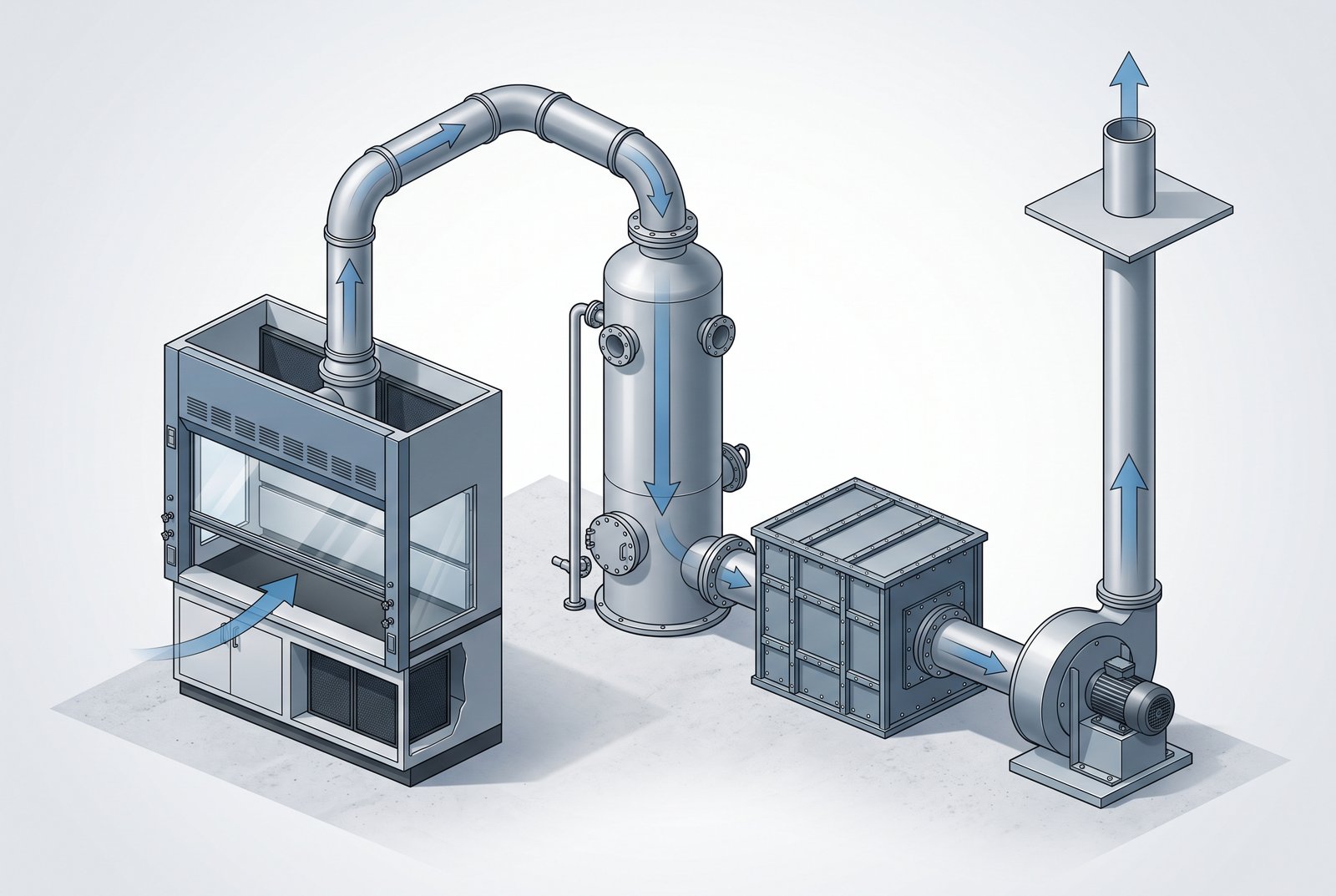
The exit route answers a common question: where does all that extracted air go? In a ducted hood, the air leaves the building through a system that does not dump raw effluent straight to the atmosphere. The air passes from the ductwork through a treatment section sized for the chemical load — commonly a scrubber or an activated carbon stage — then through the exhaust fan, then up a roof stack to the atmosphere. That treatment-first sequence is the standard lab-exhaust arrangement, and the full path and its variables are explained in the where ducted fume hood exhaust goes guide.
A ductless hood skips the building ductwork: the air passes through filters inside the hood and returns to the room. Both routes rely on the same inward flow at the front, and the full air path for either configuration shows where containment would fail.
What a Fume Hood Protects
A fume hood protects the person doing the work, and that is the boundary to remember: the hood’s contaminated air is drawn away from the user, but the incoming air is not filtered, so the hood does not protect the product or the sample sitting inside the work zone. The table below separates the common enclosure types by what each one protects.
Personnel Protection Is the Design Goal
The design objective is personnel protection through controlled airflow, not sample protection and not room sterilization. When the hood operates correctly, the inward flow at the sash keeps hazardous vapors, gases, fumes and dust away from the user’s breathing zone and carries them into the exhaust path. Every component — sash, baffles, monitor, fan — exists to preserve that one function.
| Device | Protects the person | Protects the product/sample | Airflow direction | Typical job |
|---|---|---|---|---|
| Fume hood | Yes (design goal) | No — room air is not filtered before the work surface | Room air in through the sash, out through the exhaust | Chemical vapors, gases, fumes, dust |
| Biosafety cabinet | Yes | Yes (filtered supply air) | Filtered air over the work, exhausted or recirculated through HEPA | Biological agents, cell and sample work |
| Laminar-flow clean bench | No — air flows toward the user | Yes (HEPA-filtered air over the work) | Filtered air across the work surface toward the operator | Product protection only, no biohazard |
| Glove box | Yes (physical barrier) | Yes (sealed isolation) | Isolated atmosphere, no exchange with the room | Air-sensitive or highly hazardous materials |
The boundary row to read first is the fume hood row: people protected, product not. That one line decides whether a fume hood is even the right enclosure for your operation. This is also why the hood is judged by containment, not by how clean the room air looks. A hood can pass a visual check while its airflow has degraded, which is why face velocity and alarms matter.
No Product or Sample Protection
The incoming air is room air; it is not filtered before it crosses the work surface. A fume hood therefore does not protect the sample from contamination, and it does not keep sterile or ultra-clean work clean. Product or sample protection is the job of a biosafety cabinet, a laminar-flow clean bench or similar filtered enclosure, where the supply air is filtered before it reaches the work.
That distinction changes equipment selection immediately: if the work is biologically hazardous or must stay particle-free, a fume hood is the wrong enclosure even though it looks similar. The fume hood vs biosafety cabinet comparison explains where laminar-flow hoods fit alongside both.
Part of a Safety Program, Not the Whole Program
A fume hood is one layer of protection, not a substitute for the rest of the safety program. The hood controls airborne exposure at the source; it does not remove the need for correct handling procedures, personal protective equipment, training or emergency planning. Treating the hood as the entire program is where most avoidable exposure incidents start.
Institutional guidance states the same boundary in reverse: the hood provides adequate protection for most laboratory processes if it is used correctly. That qualifier is the whole point — correct use includes sash position, keeping the work inside the enclosure, and not defeating the airflow. The complete safe fume hood use rules are one click away, and what a hood does and does not protect is settled before one is ordered or installed.
Ducted vs Ductless Fume Hoods: Two Exhaust Routes
Fume hoods divide into two families by what happens to the air after it leaves the enclosure: ducted hoods send it out of the building through the exhaust system, and ductless hoods filter it inside the hood and return it to the room. Both are sash-fronted enclosures with the same inward airflow at the front; the difference starts at the exhaust connection.
| Route | Where the air goes | Treatment | Typical fit | Decision owner |
|---|---|---|---|---|
| Ducted | Out through building ductwork to a treatment section, then a fan, then a roof stack | Scrubber, activated carbon or other stage sized for the chemical load | Fixed hoods in labs with chemical exhaust capacity; hazardous or high-volume work | The ducted vs ductless comparison and the hood type selection guide |
| Ductless (recirculating) | Through filters inside the hood, then back into the lab room | Carbon or HEPA-type filters inside the hood; no building exhaust duct | Smaller loads, limited bench space, no duct run available | Filter compatibility and chemistry review drive the decision |
The Ducted Route
In a ducted hood, the air leaves through hard ductwork connected to the building exhaust system. An exhaust fan maintains the required flow, and the air is routed through a treatment section sized for the chemical load before it reaches the roof stack. This is the arrangement the earlier mechanism module described, and it is the route used when hazardous chemicals demand building-level exhaust capacity.
The ducted route’s practical cost is its infrastructure: ductwork, fan, treatment stage and roof penetration all belong to the project budget, and the exhaust system must be sized as a whole rather than as a cabinet alone.
The Ductless Route
A ductless hood filters the contaminated air inside the hood and returns it to the laboratory. The filters must match the specific chemistry being used, because carbon media, particulate filters and other stages capture different hazards, and filter capacity and saturation need ongoing attention.
The ductless route fits lighter chemical loads, smaller spaces and locations where no duct run exists. It does not remove the need for a chemistry review; it changes where the control step happens — inside the hood instead of in the building exhaust system.
How to Tell Which Route You Have
The fastest check is the duct: a ducted hood has a hard duct leaving the top or rear into the building structure, while a ductless hood has no such connection and contains visible filter housings. The nameplate or the airflow-control label also states the venting method. Facilities documentation — drawings, ventilation schedules, maintenance records — gives the definitive answer for an installed unit.
The two routes have different selection logic, and the full ducted vs ductless fume hood comparison covers chemical compatibility, cost and installation, while the types of fume hoods selection guide maps every hood family and structure.
When Should You Use a Fume Hood — and When Not?
The trigger for using a fume hood is exposure risk, not process convenience. Institutional laboratory guidance is concrete about it: use a fume hood when working with toxic compounds, when a compound has a boiling point below 120 °C, or when the operation can push contaminant concentrations past applicable exposure limits. If none of those conditions applies, an open bench may be acceptable — which is why the “when not” half matters as much as the “when” half.
Institutional Triggers
The most-cited institutional rule comes from university environmental health and safety practice: fume hoods are required for toxic compounds and for compounds with a boiling point below 120 °C, and effective local ventilation must be provided and used when materials would otherwise exceed exposure limits in the laboratory. Exposure-limit references come from bodies such as OSHA, NIOSH and ACGIH, which is why the rule travels with a citation rather than as a made-up number.
The University of Washington Environmental Health and Safety guidance states the boil-below-120 °C trigger and the exposure-limit condition in the same breath. That is a use threshold you can apply in a planning conversation today.
When a Fume Hood Is Not the Whole Answer
A fume hood answers the exposure-control layer; it does not answer the rest of the operation. Unknown chemistry should not be assumed safe inside any enclosure, large hazards can overwhelm a hood’s capture capacity, and a hood whose airflow has failed is no protection at all until it is repaired and re-tested. The safe-use rules detail these boundaries, and the protection-boundary section linked them.
If the material is not hazardous or the operation produces no airborne contaminant, the hood is unnecessary equipment and its operating cost buys nothing. The decision is to match the control to the hazard, not to default to a hood for every bench activity.
Substitutes and Adjacent Equipment
When a fume hood is the wrong tool, the replacement is another containment device, not “less safety.” Turbulence-sensitive or sealed work may suit a glove box; biologically hazardous or sterile work belongs in a biosafety cabinet or a laminar-flow clean bench; open-ventilation hazard can sometimes be handled with other local ventilation. The boundary table above already distinguished these devices by what each protects.
The practical rule: name the hazard class first, then pick the enclosure that matches it. You now have the use triggers and the substitution logic to decide whether a fume hood should appear in your process at all.
Face Velocity and Alarms: Screen Numbers, Not Guarantees
Face velocity is the speed of air drawn into the hood opening, measured in feet per minute (fpm). It is the most visible number on a fume hood, and it is also the most misused: institutional references treat it as a screening and certification reference, not as a legal performance guarantee. The real acceptance evidence comes from tracer-gas testing under ASHRAE 110, and no single number on a label replaces that test.
What Face Velocity Measures
Face velocity measures the average speed of air entering through the open sash. Higher velocity at the opening means stronger inward capture, all else being equal, but the number only describes the front plane; it says nothing about how air behaves inside the hood, around obstacles, or near moving people. That is why trained containment testing, not a handheld meter reading, is the acceptance standard.
For an operator, face velocity is a quick health check: if the reading sits far below the hood’s posted reference, airflow has degraded and the hood needs investigation before use. For a designer, it is an input, not an output.
Institutional Reference Ranges
Institutions quote reference values with an explicit sash condition, almost always at an 18-inch sash height. The University of Washington table is typical: standard-flow hoods at about 100 fpm and low-flow hoods at about 70 fpm at 18 inches, with certification readings commonly seen between 80 and 120 fpm depending on the hood and the test.
| Reference | Value | Condition | Source |
|---|---|---|---|
| Standard-flow hood (institutional) | ≈100 fpm | 18-inch sash | UW EHS institutional reference |
| Low-flow hood (institutional) | ≈70 fpm | 18-inch sash | UW EHS institutional reference |
| Common certification range | 80–120 fpm | Factory/field acceptance readings | Multiple laboratory-safety sources |
These are institutional conventions, not statutes: the number your institution specifies comes from its design criteria, and the pass/fail evidence comes from ASHRAE 110 testing, not from a ceiling-mount gauge. The fume hood face velocity requirements guide breaks down what 60, 80 and 100 fpm mean when you need the full treatment.
Monitors and Alarms
Modern hoods carry an airflow or face-velocity monitor as standard equipment, with visual and audible alarms for airflow that is too high, too low, or a sash raised past its working limit. An institutional alarm set point commonly triggers at about 80% of the design flow: below that, the hood flags low airflow rather than waiting for a dangerous reading. Filter saturation alarms on ductless units add a second warning layer.
Alarms tell you that something changed; they do not test containment. A hood that alarms needs follow-up under the safe-use rules before it returns to service. Treating the alarm silence as proof of performance is the mistake to avoid.
The full picture — what a fume hood is, how its airflow works, and what the numbers mean — lets you walk a lab, read a hood’s health from its monitor and label, and know which decision belongs here and which belongs to a selection guide or a test report. That is the working answer to the what is a fume hood question you can carry into a procurement, a safety review or a new-build conversation.
Frequently Asked Questions: What Is a Fume Hood and How Do You Use It?
The questions below are the ones buyers, facility teams and new laboratory staff ask most often. Each is answered in one or two sentences here because the full treatment already lives in a module above or in the linked guide noted with it.
When should you not use a fume hood?
Do not use a fume hood for operations it cannot contain — work that creates no airborne hazard does not need one, a hood with failed or alarming airflow must be taken out of service until repaired and retested, and product-protection or sterile work belongs in a filtered enclosure instead. The safe-use guide linked in the protection-boundary module above covers the refusal conditions in full.
What can be used instead of a fume hood?
Depending on the hazard: a biosafety cabinet for biological agents, a laminar-flow clean bench for product-protection work, or a glove box for sealed or air-sensitive operations. The fume hood vs biosafety cabinet comparison above explains where laminar-flow hoods fit alongside both.
Where do the fumes from a fume hood go?
In a ducted hood, the air goes through a treatment section sized for the chemical load — commonly a scrubber or activated carbon stage — then through the exhaust fan, then up a roof stack to the atmosphere. In a ductless hood, the air passes through filters inside the hood and returns to the room; the full path is covered in the exhaust-destination guide linked in the mechanism module above.
How do you know if a fume hood is working properly?
Check the airflow or face-velocity monitor for a reading near the hood’s posted reference and no active alarm, confirm the baffles are unobstructed and the sash is at the working position, and rely on ASHRAE 110 containment testing rather than a gauge reading alone. The face-velocity guide linked above breaks down what the numbers mean.
If you are planning a purchase or a renovation, the next step is to compare laboratory fume hood options against your own operating conditions. Bring the process chemicals and expected quantities, the hood width and workstation needs, the exhaust route available at the site (ducted capacity or ductless-only), the face velocity your institution requires, and the project’s budget scope and location. That set of inputs, matched against what is a fume hood and how each route behaves, is what turns this explainer into a concrete shortlist.
Leave a Reply