




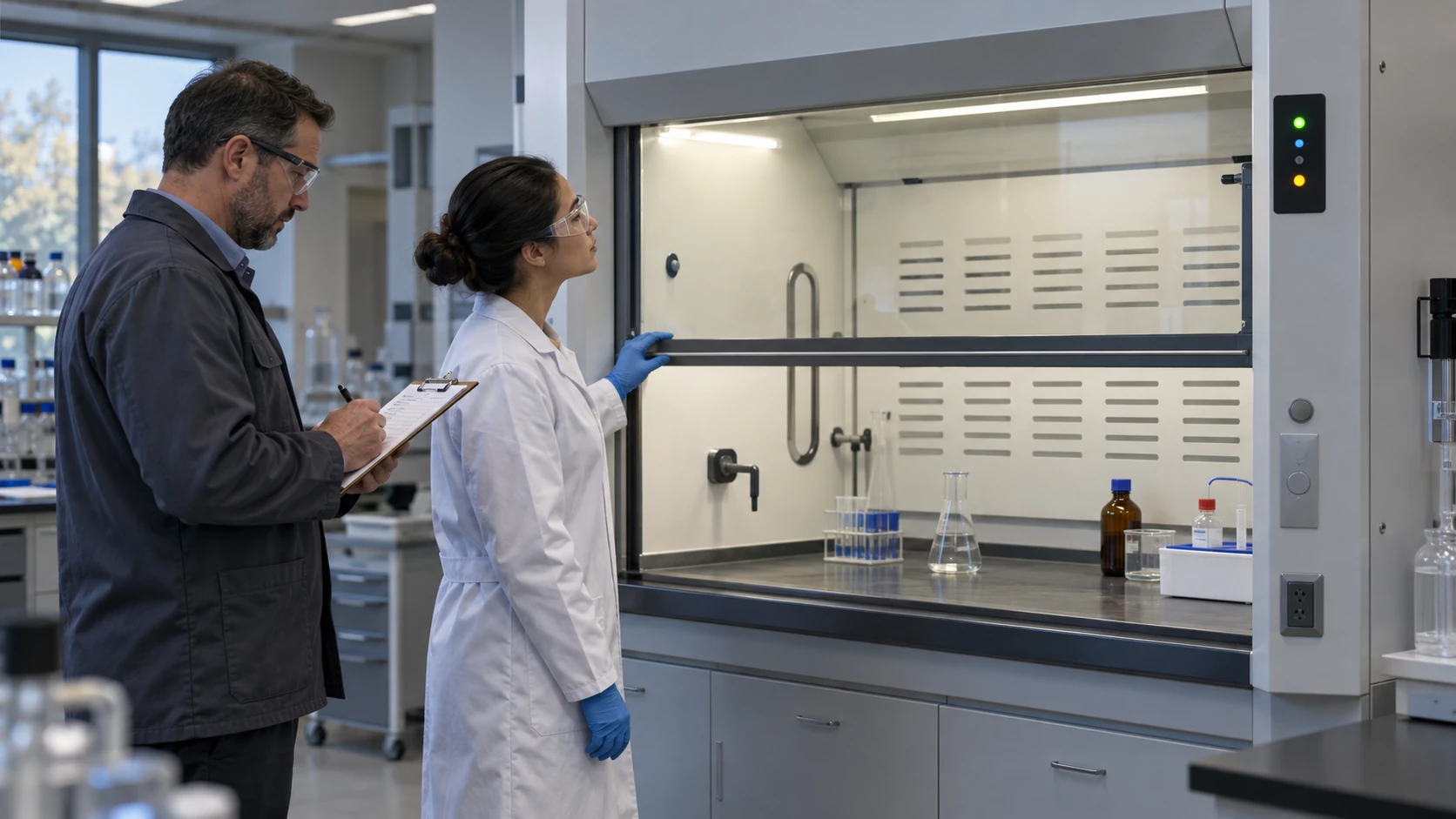
Key Takeaways
- A fume hood maintenance checklist is the written program that decides who checks, repairs and records each hood — the frequency follows your institution, not a universal number.
- The annual obligation in the rule text is a review of the chemical hygiene plan, not a hood certification — and the widely quoted “maintained, monitored and routinely tested” line sits in a non-mandatory appendix.
- Record the cabinet reading and the instrument status on separate lines — otherwise drift and instrument failure look identical on paper.
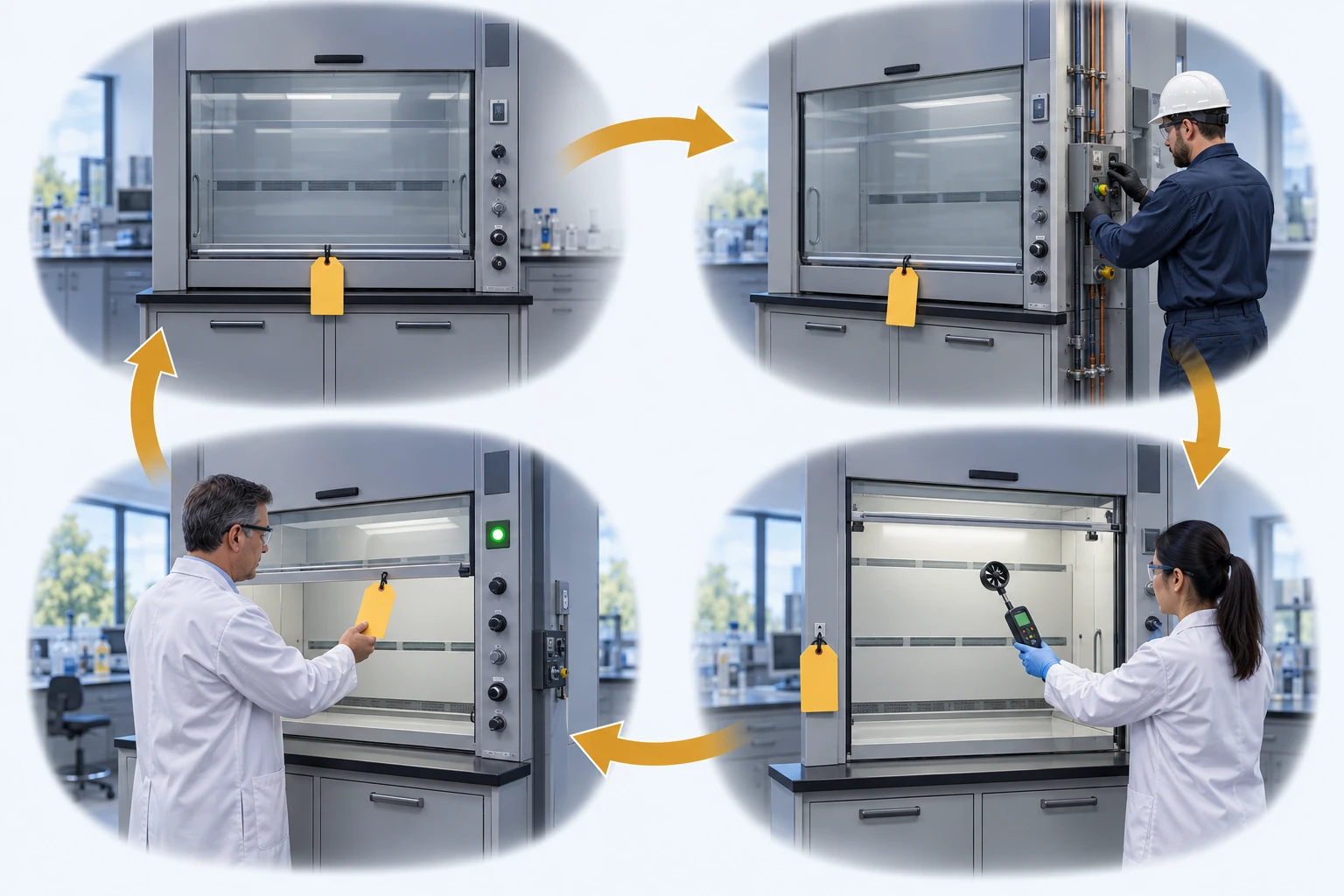
- Out of service is a four-step loop: stop use, repair, retest, clear — a completed repair is not by itself permission to work at the hood again.
- Before anyone enters the cabinet or the duct, decontaminate and check the chemical history — perchloric acid and radioisotope use change what the maintenance job is.
Most maintenance arguments in a laboratory start in the wrong place. Someone asks how often the hoods should be serviced, and the answer they get is a number with no author behind it. The number is not the problem. The missing authority is.
This page treats the maintenance program as three separate layers: what a regulation actually puts in writing, what advisory guidance recommends, and what your own institution writes on top of both. Keep the layers apart and the schedule question answers itself far more often than people expect.
What a Fume Hood Maintenance Checklist Has to Decide First
A fume hood maintenance checklist is the working document that assigns each hood action to a named role, a defined trigger and a record line. It is not a list of parts and it is not a calendar. A federally defined laboratory-type hood is an enclosure on five sides with a movable sash or a fixed partial enclosure on the remaining side, and everything the checklist covers hangs off those moving and sealed surfaces.
Three decisions have to be made before any frequency is worth discussing.
the three questions a maintenance program answers
Who is allowed to touch the hood? The institutional answers differ, and they differ for defensible reasons. One campus puts preventive maintenance in the facilities group and certification in the environment, health and safety office. Another campus places checking, certifying and pre-repair tagging in a single office. A third keeps testing with the safety office and repair with facilities. Those are not contradictory findings; they are three different assignments of the same duties.
What happens when an instrument says something is wrong? A hood whose monitor is in alarm is a decision point, not a maintenance item. It needs a stop-work action, an escalation target and a record line long before it needs a service interval.
Who decides the interval, and on what evidence? The frequency of a maintenance program follows the institution’s chemical hygiene program, the standards the institution has adopted, and the manufacturer’s documentation for the specific hood. None of those three is a universal number, and quoting one as if it were is the most common error in this subject.
what this page does not cover
This page covers the maintenance and service side of hood ownership: mechanical parts, liners and work surfaces, sash and stops, alarms and airflow indicators, sensors, dampers and controllers, fan and duct observations, the out-of-service loop, and the records that hold it together.
It does not cover the daily and pre-use inspection routine, which is the routine the user runs before starting work, and it does not cover hood types and selection. Performance thresholds, test protocols, and the design of special hood types are handled in their own places.
| What you are looking at | Which layer owns the answer | Where it lands |
|---|---|---|
| A sentence in a regulation that mentions hoods | Codified requirement | The rule text, read closely |
| A widely quoted maintenance recommendation | Non-mandatory guidance | Advisory practice, not an obligation |
| A campus certification calendar | Institutional policy | Your written program |
| A service interval on a vendor page | Commercial recommendation | Your program’s decision to make |
The sequence matters more than the length of the document. If the layer is wrong, every action downstream inherits the error, and the program spends its energy defending a number instead of running hoods.
You can decide which of the three layers each line of your current checklist belongs to, and which lines belong to no layer at all. That classification is the load-bearing part of the program; the schedule is a consequence of it.
What 29 CFR 1910.1450 Actually Requires of a Fume Hood
Start with the text. The laboratory standard, 29 CFR 1910.1450, is the paragraph most often quoted at hood owners, and it is worth reading at its own address: the full text of the standard. What it says about hoods is thinner than the folklore suggests, and that gap is where conflicting maintenance advice comes from.
| Layer | What it contains | How it is written | What it obliges you to do |
|---|---|---|---|
| The rule text | The chemical hygiene plan, employee information and training, exposure monitoring, and the records that go with them | Mandatory language for the employer | Comply and keep the records |
| Appendix A of the same section | Laboratory practice guidance, including the sentence about hoods being maintained, monitored and routinely tested | Advisory, written in `should` | Treat as guidance, not obligation |
| Your institution on top | Certification calendars, performance testing, preventive maintenance frequency, tagging rules | Institution policy and adopted standards | Follow your program, not a generic interval |
what the rule text says about records and the chemical hygiene plan
Where monitoring measurements are taken to track employee exposure, the employer has to keep an accurate record for each employee. Those records are kept, transferred and made available under 29 CFR 1910.20, which is where the retention rules live rather than in this section.
That structure gives the first correction worth making to a fume hood maintenance procedure: this section’s records obligation is built around employee exposure, not your service tickets. Nothing here requires a work order, a tag number or a filter-change log. Your program may need all three, but because your institution or an adopted standard decided so.
The one annual duty in the mandatory text is a review of the chemical hygiene plan itself. The employer has to review and evaluate the effectiveness of the plan at least annually and update it as necessary. The subject of that sentence is the plan, not the hood.
where the “maintained, monitored and tested” sentence comes from
The sentence almost everyone is quoting — that chemical hoods should be maintained, monitored and routinely tested for proper performance — sits in Appendix A of the same section. That matters because Appendix A is labeled non-mandatory, and the section states that the information in its appendices is not intended, by itself, to create obligations not otherwise imposed.
Guidance still carries weight, and a serious program will follow most of it. What a program should not do is translate `should` into `shall`. When a policy claims the regulation requires routine testing, and the requirement lives in a non-mandatory appendix, the policy has borrowed authority it does not have.
Appendix A also assigns monitoring duties to a role: the chemical hygiene officer is to monitor the facilities and the chemical fume hoods to ensure that they are maintained and function properly. That is a job title with defined responsibilities, not a claim that a safety office performs every hood task.
what institutions add on top of the rule
Everything you wanted when you opened this page — how often a hood is tested, who signs the certification, which department turns a wrench — comes from the third layer. Campuses differ on the record: some give annual preventive maintenance to facilities and certification to a safety office; others place checking, certifying and pre-repair tagging in one office.
Treat those differences as design choices with reasons, not as errors to resolve. The rule text sets a floor and a recordkeeping frame; your institution adds the calendar, the sign-off and the division of labour. When a sentence in your program describes a duty, you can state which layer it came from, and whether the authority you cite actually says what the sentence claims.
Who Maintains the Hood, and Who Only Uses It
Most failed maintenance programs are not short of effort. They are short of a division of labour that everyone has actually read. The matrix below is not a national standard and names no universal interval; it separates the five things that happen to a hood from the four roles that can own them, which is the part that transfers between institutions.
| Action | Whose it normally is | What the user side does | If it is missing |
|---|---|---|---|
| Pre-use confirmation and fault reporting | The person at the hood, under the institutional requirement | Confirm the hood is not in alarm and report faults | Work proceeds at a hood that is telling you something |
| Routine housekeeping and chemical hygiene inspection | The institutional program; national guidance suggests quarterly where personnel turnover is frequent and semiannual otherwise | Keep the work area and chemical storage inspectable | Drift hides equipment faults |
| Performance testing and certification | A testing body, a facilities group, or the EHS office, depending on campus | Make the hood and room accessible; adjust nothing before the test | Certification lapses and the real performance state is unknown |
| Preventive maintenance and repair | Facilities, the vendor, or the manufacturer | Report and tag; never repair structure | A degraded hood stays in service because it still opens |
| Records and master inventory | The institutional program, with a named owner | Supply the chemical and usage history that records cannot recover later | The next repair is uninformed and unsafe |
The matrix earns its keep at the second question, not the first. A campus that puts preventive maintenance with facilities and certification with a safety office is not contradicting a campus that gives all three to one office; the two have answered a different question about who carries liability. Note down which answer your site uses, in writing.
who owns the schedule
No national interval governs hood maintenance, so the honest answer to how often a hood should be maintained is that the interval belongs to your institution. The evidence is on the record: ventilation quality is expected to be evaluated at installation and monitored regularly, with national guidance putting the minimum at every three months and requiring reassessment whenever local ventilation devices change; housekeeping and hygiene inspections are advised quarterly where personnel turnover is frequent and semiannually elsewhere; and campus documents assign the planning function to facilities or to a safety office. The inspection program itself is treated as a routine part of laboratory safety rather than a separate discipline in the national laboratory practice guidance.
Those sources support a planning duty, not a universal number. Preventive maintenance belongs on a regularly scheduled basis, and the schedule should name its owner: a staff group, a campus program, or an external service that reports into one of them.
who may repair, and who may only report
Campus documents draw the line between a damaged hood and a hood that needs adjustment, and the line matters more than the wording. Because pressure-sensing and airflow instrumentation measures the system rather than the cabinet, a repair that resets an instrument can hide a fault that is still present. Inspection and repair are separate duties on that basis, and the person who observes a fault is not always cleared to correct it.
Structural repair is outside user scope. A broken sash glass, a missing side panel, a missing baffle or a missing air foil is referred to the manufacturer or an external vendor. You can flag a part as damaged or missing long before you can decide who may replace it.
what the user must never change
Some devices are not adjustable at the hood, no matter how convenient an adjustment looks. Hood alarms and monitors should never be turned off, because the monitor is the only continuous evidence of hood performance between tests. Dampers, actuators and controllers are the same category: maintenance items for facilities or the vendor, and their settings are not a user-adjustable field.
The same rule covers repairs. An out-of-service hood must be tagged so that use stops, and an institution needs a procedure that prevents the equipment from being restarted while the repair or the retest is outstanding. The general pattern for those procedures sits with the institutional requirement rather than at the bench.
You can determine which of the four roles owns each line of your current program — and, more usefully, which lines currently name nobody at all.

Mechanical Parts, Liners and Sash: What Actually Wears Out
A hood fails its mechanical checks long before it announces anything on a display. The moving and sealed surfaces take the abuse: sash travel, hinges, stops, baffles, the air foil, liners, work surfaces and seals. This section is about what a user or a lab walk-through can see and record, and where that observation has to stop and turn into a service call.
| Part | What you can see | When it stops being observation | What to record |
|---|---|---|---|
| Sash, hinges and stops | Track condition, travel, damaged glass, missing parts | Broken glass, or a hood that no longer seats | Sash height as found, plus a fault note |
| Baffles and exhaust slots | Debris, dust build-up, blocked slots | A baffle missing, loose, or removed to clear it | Who checked the slots, and when |
| Air foil | Deformation, gaps, corrosion at the leading edge | Any deformation, which changes how air enters | Condition as found, with the date |
| Liners, work surfaces, seals | Cracks, blisters, corrosion, lifted or hardened seals | Every crack or lifted seal; these are containment surfaces | Location and extent of damage |
| Counterweight and pulley hardware | Slack or frayed cable, noisy travel, imbalance | All of it; balance is part of sash behavior | Symptom, in the user’s words |
sash, hinges and stops
The sash assembly is the only part of the hood the user touches every day, which is why the daily routine belongs elsewhere. Maintenance treatment starts with the mechanism: hinges, the track, and the stops that limit travel. The height criteria themselves belong to sash height and airflow, and this page does not restate them.
What belongs here is what changes after damage. Broken sash glass and missing structural parts are routed to the manufacturer or an external vendor rather than handled in house. Sash hardware is also where powered options land: an automatic sash control turns a manual mechanism into a device with its own failure modes, so the maintenance question becomes who services the drive as well as who checks the glass.
liners, work surfaces and seals
Liners and work surfaces are frequently inspected and rarely recorded. There is a distinction worth keeping: cleaning is not an inspection. A surface can be spotless and still be cracked, blistered or detached from its substrate, and a seal can be clean while no longer sealing. Treat states, not appearances, as the observation target.
Powered sashes exist as a maintenance item in their own right, and where a drive unit is fitted, the hardware question sits with automatic sash control. On the cabinet itself, walk the liner, the work surface and each seal, and record cracks and lifted edges as measured facts with dates. Surface damage under aggressive chemistry is a professional assessment, not a cleaning job.
when structure damage means the manufacturer
Structural repair is not a general maintenance task in the sources for this page. A broken sash and missing parts such as side panels, baffles or the air foil are referred to the manufacturer or an external vendor, and the release point is the same: structural integrity is compromised, so the hood’s permission to operate has to be settled before the flaw is fixed.
The distinction matters practically. A hood with missing parts still opens, still closes and still satisfies a person in a hurry, yet it has stopped being the enclosure the performance testing measured. Classifying what you saw as structure damage rather than wear is what forces the escalation.
One observation also cuts the other way: a control panel that is not in alarm and shows no alerts is a user-level confirmation, not evidence that the hood is fit for work. An instrument reading and a cabinet fault are different findings, which is why they are recorded on separate lines — and separating them is the habit that makes the next section work.
You can flag each finding on this list as daily-observable, professional repair, or structure damage that goes to the manufacturer. Recording the sash height as found, with the date and the location of any damage, is what makes each of those three calls defensible when someone asks later why a hood was or was not taken out of service.
Alarms, Monitors and Sensors: Instrument Status Is Its Own Record
A monitored hood produces evidence every day, and most programs store almost none of it. The value of the instrument is not that it warns you; it is that the warning can be dated, attributed and compared. Treating device state as its own record line is what turns a panel into a maintenance input instead of a nuisance in the corner of the eye.
| Device | What it tells you | What it cannot tell you | Where it belongs in the record |
|---|---|---|---|
| Airflow monitor or alarm | Airflow state against its setpoint, continuously | Whether the cabinet is damaged | Device identifier, reading, alarm state at the time |
| Pressure gauge | Static pressure across the system | Whether the sensor is still accurate | Reading, plus the date it was last verified |
| Sash position signal | Where the sash was during a reading | Nothing about containment on its own | Sash position as found, recorded with the reading |
alarms and airflow indicators
Continuous monitoring is an expectation rather than an ornament. National laboratory practice guidance calls for each hood to carry a device that allows convenient confirmation of adequate performance before use, and campus programs build on that floor: one institution requires newly installed hoods and ducted cabinets to be equipped with a static pressure gauge and an alarm that monitors hood airflow continuously, and another requires a permanently installed monitor with a digital display and both audible and visual alarms on new or remodeled hoods.
Those requirements address new installations, while many sites inherit hoods placed before the rule in force. A continuous device is useful either way, and where one is not fitted, the paper tell-tale at the sash opening remains the fallback confirmation. The two are not equivalent: one produces a dated record, the other a moment of reassurance.
An alarm is never meant to be switched off. Disabling the monitor removes the only continuous evidence of hood performance between tests, and a silenced alarm is not a repaired hood — it is the removal of the signal that would have started a work order.
calibration and drift
Calibration is a maintenance task with its own definition of done, and it is not the same thing as inspection. A calibrating institution checks the monitor for airflow calibration accuracy and adjusts it as needed, which is a work package rather than a glance at a display. The setpoint behind the alarm is an institutional parameter too: one campus program calibrates alarms to alarm at plus or minus twenty per cent of designed airflow. That figure is that program’s own setting, not a universal value.
Drift changes how any reading should be read. A monitor that measures airflow measures the system, not the cabinet, so a drifting sensor makes the system look worse or better than it is. Where the sash is instrumented, the position signal follows the same logic: a reading taken at an unrecorded sash height cannot be compared with any later measurement. Face velocity thresholds and their interpretation belong to face velocity requirements.
why the instrument needs its own record line
Records separate what a device said from what the cabinet did, and that separation is the point. A campus program that lists airflow monitor and alarm status alongside smoke test status is telling you that instrument state is a field in its own right, not a footnote to a flow reading.
The maintenance consequence is practical. When the numbers move, the first question is whether the enclosure or the instrument changed. A record that holds only a flow value cannot answer it from the paper, so the next step is usually a repair call on the wrong asset. Two fields — the cabinet reading and the device state at the time — make a performance change attributable, and each is cheap to maintain.
You can recognize which of your hoods is monitored and which is merely instrumented, and see whether the hardware behind the reading — an airflow monitor or a sash position sensor — sits on a calibration schedule rather than on trust.
Dampers, Controllers, Fans and Ducts: What Stays in Facility Scope
The exhaust system behind a hood is maintained by someone, and the maintenance program has to say who that someone is. The boundary is usually drawn at the cabinet face: everything a user touches in normal work sits inside it, and the equipment that moves air sits outside it. Getting that boundary into writing prevents two failures at once — a user adjusting a damper, and a facility group adjusting a hood nobody told them had a chemical history.
| Item | What the user side does | Who owns the maintenance | Shutdown implications |
|---|---|---|---|
| Damper and control loop | Adjusts nothing; reports behavior | Facilities or the vendor | Control work often needs a planned outage |
| Airflow monitor, alarm and sensors | Confirms function; never disables | The calibrating group, per the campus program | Instrument work may not need an outage |
| Fan, motor and belts | Notes noise, vibration and smell; reports | Facilities, with the vendor for rebuilds | Belt, bearing and motor work requires an outage |
| Ductwork and its material | Notices dust, corrosion, leaks, staining at joints | Facilities, with the vendor for repairs | Duct repair requires an outage plus the decontamination step |
| Building side: makeup air, pressure balance | Reports doors that will not close, odors, drafts | Facilities; the balance itself is a separate engineering scope | Rebalancing affects neighboring rooms |
dampers, actuators and controllers
A damper is not a tap, and a control loop is not a setting a lab can tune for comfort. One campus program states plainly that the user does not touch the damper at all, and that is the right default: the valve or actuator position is part of the system’s design, not a per-experiment adjustment. Maintenance of the loop belongs to whoever owns the controls, whether an in-house facilities group or an external service.
The control scheme still matters to the maintenance program, because it changes the work. A constant-air-volume hood holds flow as the sash moves, and a variable-air-volume hood changes it deliberately, so the same symptom carries different meaning on the two systems. The differences between CAV and VAV control are worth reading before the first work order.
fans, belts and ductwork as observation items
Everything downstream of the cabinet is an observation item for the people who work at the hood, and a maintenance item for somebody else. Noise, vibration, belt squeal, a smell that was not there last week, dust streaks at a joint, corrosion at a low point: those observations have a home, provided the program tells users where to send them.
Where the observation turns into a project, the sizing and material work belongs to the engineering pages rather than to this one — exhaust fan sizing for the air-moving side and duct sizing and material selection for the ductwork itself. This page’s contribution is the trigger: a fan that has begun to sound different is a maintenance finding even when every hood still passes its checks.
planned shutdowns and notifications
Any work on the exhaust path is a shutdown decision, because a fan, a duct or a control loop serves more than one hood. The notification threshold is the part worth writing down in advance, since the decision will otherwise be made during the outage. One campus program requires the heads of affected departments and the safety office to be notified of any ventilation outage expected to exceed four hours.
That figure is that program’s threshold, and other institutions set their own. What transfers is the structure: a defined trigger, a named audience, and a record that the notification happened. Planned work on the air-moving side is also where the decontamination question in the next section becomes unavoidable, so the notification list and the repair list should be the same document.
Before you open a service request on the air side, name the owner and the notification path for the equipment you are about to touch, and provide the hood data the facilities group will ask for — location, make and model, date of the last check, monitored airflow and alarm status, and the chemical history of the hood.
Taking a Hood Out of Service and Returning It to Work
Most programs have a repair process and no release process. A hood gets fixed, the person who fixed it mentions it in passing, and the next user decides for themselves whether it is safe. The missing piece is the sequence between the two events, and it is short enough to write down.
| Stage | What has to happen | Evidence it happened | Who clears it |
|---|---|---|---|
| Stop work and tag | Close the sash, stop the work, tag the hood, notify the users | Tag on the hood, work stopped at the hood | The person who owns the badge or tag |
| Repair or adjustment | Carry out the repair and, for any hood opened up, work from a contamination assessment | Work record in the maintenance system | Facilities or the vendor |
| Retest | Bring the hood back to its performance criteria and re-certify | A dated test record that names the standard used | The testing or safety group |
| Clear for use | Remove the tag and return the hood to the inventory of usable hoods | Cleared status in the record, with the date | The office that certified it |
| Cannot be restored | Secure and mark the hood as out of service | A separate decision record | The institution, as a project decision |
tagging and stopping work
A tag is a communication device, and its content should be the performance finding: this hood did not meet the program’s criteria, so it is not to be used until corrective actions are complete. That is a specific claim about the hood rather than a general caution, which is why the tag names the condition. The federal guidance on hood faults follows the same order of operations — close the sash, tag the hood and take it out of service until the repair is finished, as set out in the OSHA laboratory hood quick facts.
The tag does not replace lockout or tagout. Applicable lockout and tagout procedures still apply to the service work itself, where the objective is different: preventing the equipment from being energized or restarted while somebody has their hands inside it. One stops use and the other stops startup.
repair, retest and clearance
Campus programs state it as a three-part condition rather than a single action: the hood must not be used until it has been repaired, retested, and cleared for use. Treat that as the definition of done for a fume hood repair checklist. The repair is one of three items, and it is not the one that returns the hood to service.
Repair and clearance are also separated from the reading that started them. A monitor that drifted is a calibration task rather than a repair, and it cannot be the evidence that closes out its own repair. After any repair or adjustment, the safety office is notified so the hood can be re-certified, and facilities then notify the responsible investigator and the safety office once the work is complete.
Two obligations run before anyone touches the internals of a hood that was opened up: contact the safety office before any service where perchloric acid has been used, and decontaminate all surfaces of the hood before repair work. The out-of-service loop ends with a tag removal, not with a wrench put down.
what to do when repair is not possible
Some hoods will not come back. A hood that cannot be repaired or brought into acceptable certification parameters is secured and marked as out of service, and that marking should be as durable as the condition. Leaving such a hood in the room with a paper tag invites the use the program was written to prevent. Whether it is replaced or removed from the inventory is a separate project decision, and the performance criteria and test protocol used at the retest step are worked through in the ASHRAE 110 test context.
You can run the loop in the order this section sets out: repair, then retest, then clearance — and you now have the two names a repair request must carry, the tag owner and the office that clears the hood, before anyone touches the cabinet or the duct above it. Where a repair changes installation conditions, the boundary sits with installation requirements, and where a shutdown changes how the room is supplied and balanced, that work belongs with makeup air and pressure balance.
Before Anyone Opens the Duct: Decontamination and Chemical History
The cabinet interior and the duct are the two places where maintenance work stops being routine. Both carry what the hood was used for, and both are entered by people who were not in the room when the chemistry happened. The precondition set below is the part of a fume hood repair checklist that protects other people rather than the hood.
| Precondition | Why it matters | Evidence it was met |
|---|---|---|
| Decontamination of surfaces | The work happens inside the containment envelope | A decontamination record, dated before the work starts |
| Chemical history review | Perchloric acid and radioisotopes change the job | A record search, plus a written clearance before opening up |
| Lockout and tagout | Isolation protects the people doing the work | The applicable procedure, executed and recorded |
| Re-verification triggers | Some events void the last test result | The trigger, the date, and the approver named |
decontamination before service
Decontamination is a precondition, not a courtesy, and the sources for this page are explicit about the scope: all surfaces of the hood must be decontaminated before repair work is carried out by the facilities group. The obligation belongs to the institution rather than to the technician, because the technician arrives after the chemistry has happened and cannot be expected to establish what the residue is.
That framing changes who owns the task. If a program treats decontamination as something the maintenance crew settles on arrival, the crew is being asked to assess a chemical history it has no record of. If the program treats it as an institutional precondition with a dated record, the repair starts on a known surface.
perchloric acid and radioisotope history
Perchloric acid is the clearest case in the whole subject. Where heated perchloric acid is used in a regular fume hood without a wash-down function, shock-sensitive metallic perchlorate crystals can form inside the ductwork and cause an explosion during maintenance work on the ventilation system. The hazard is not in the cabinet during normal use; it accumulates where the work goes.
The procedural answer is a history check rather than an inspection: contact the safety office before any service involving a hood where perchloric acid has been used, and where records indicate the use of perchloric acid or radioactive materials in a hood or an area served by local exhaust ventilation, contact the safety office as well. This is the strongest argument in this page for keeping an accurate chemical-use record: the record is the input to a safety decision that cannot be reconstructed later. Hood types built for these chemistries are handled separately — perchloric acid hood requirements and radioisotope hood requirements.
lockout and tagout
Isolation is what makes the repair safe to perform. Applicable lockout and tagout procedures have to be obeyed during service work, and the purpose is distinct from the purpose of the out-of-service tag: the tag keeps people from working at a hood, and the isolation keeps the hood from starting under somebody’s hands.
Institutions rarely lack a lockout and tagout procedure; what they lack is an agreement about who applies it to a hood and its associated fan. That agreement belongs in the same document as the decontamination record, because both have to be settled before the work starts rather than during it.
The re-verification triggers belong on the same page as the preconditions. Campus programs name the events that require a fresh test: before a newly installed hood is used, at least annually, and whenever a hood has been modified, with re-evaluation also expected after changes to local ventilation devices and after a hood has been taken out of service and returned. The intervals in those programs are institutional, and the structure is what travels — a named trigger, a named approver, and a record that ties a hood action to the person who authorized the next step. You now have the precondition set — decontamination, chemical history, isolation and the trigger list — that has to be satisfied before a hood is opened rather than after.
Worked Example: A Twelve-Hood Teaching Lab Builds Its Program
Here is a scenario that most institutions can recognize: twelve hoods, spread across six teaching laboratories, two per room, used for scheduled undergraduate practicals rather than by a single research group. The building has a facilities group that performs preventive maintenance and a campus safety office that certifies hoods. Nobody has counted what the program actually generates in a year.
the inputs you collect first
Six numbers define the whole calculation, and every one of them is either a decision the institution has already made or a figure with a named source. The first is the hood count: twelve. The second is the number of working weeks in the teaching year: forty. The third is the user-side confirmation rate, which this program sets at one check per hood on each working day of a five-day week. The fourth is its housekeeping rate, set at one pass per hood per week.
The fifth is the institutional inspection cycle, and here the program has a choice to make rather than a number to accept. National laboratory practice guidance advises quarterly housekeeping and chemical hygiene inspections for units with frequent personnel changes and semiannual inspections for others, so a teaching building with rotating cohorts sits in the quarterly group; a campus program, meanwhile, may run its own inspection and certification cycle at a different interval. The sixth input is the retention period for the test records the institution keeps.
the arithmetic of a twelve-hood program
Every figure below is derived from those inputs and nothing else. Choosing quarterly inspections instead of semiannual doubles the inspection line and leaves the other two unchanged.
| Action | Rate used in this scenario | Source of the rate | Records per year |
|---|---|---|---|
| Pre-use confirmation | 12 hoods × 5 working days per week × 40 weeks | This program’s own policy | 2,400 |
| Housekeeping pass | 12 hoods × 1 pass per hood per week × 40 weeks | This program’s own policy | 480 |
| Program inspection | 12 hoods × 4 per year (quarterly cycle) | Advisory practice for units with frequent personnel change | 48 |
| Total | — | — | 2,928 |
Two consequences follow from those totals. The first is that record volume is dominated by the daily confirmation, not by the technical work: 2,400 of the 2,928 lines come from the user-side check that most programs never write down. The second is that a five-year retention period on the inspection records turns 48 entries per year into 240 retained entries — and if the campus runs the quarterly cycle as two visits per hood per year, the same retention turns 96 entries into 480. Either way it is a data-management question long before it is a storage question.
The program can also invert the calculation. If the institution wants a single figure for what a hood costs it in attention per year, 2,928 lines across twelve hoods is 244 record lines per hood, and the number moves only when the program’s own rates move.
what changes when the count doubles
Double the hood count to twenty-four and every total doubles: 4,800 confirmations, 960 housekeeping passes, 96 inspections, 5,856 record lines. Nothing in the arithmetic breaks, which is exactly the problem with reading the table as a capacity plan. The per-hood workload is unchanged at 244 lines, so the numbers alone will never tell you that the program has stopped fitting.
What changes is the constraint. A quarterly inspection cycle over twenty-four hoods is 96 visits a year, and whether those visits exist depends on a testing team that may not have grown with the building. The same applies to repair capacity: the out-of-service loop in this page does not run faster because there are more hoods, and a queue of tagged hoods is a much larger finding than a queue of records.
You can estimate your own totals by substituting six inputs, and the most useful one to substitute first is your inspection cycle, because it is the only input that changes the record volume without changing the working week. Where the totals start feeding a capital request, budgeting the system is the next step; the short version is that hood count drives the record volume first and the service cost second.
The Records a Fume Hood Maintenance Checklist Has to Produce
A record is not a record because it is filed. It is a record because it can answer three questions about any hood in the building: what was done, who did it, and when it is next due for review. Programs that cannot answer those three from paper end up rebuilding their history from memory, which is the most expensive form of maintenance work there is.
| Record | Fields that carry the weight | Where it lives | Retention |
|---|---|---|---|
| Asset identification | Location, make and model, and the institution’s own identifier | Inventory or work-order system | Life of the asset |
| Reading and instrument state | Sash height as found, airflow reading, alarm and monitor status, smoke-test status | The certification or test record | Per the program’s own retention rule |
| Service action | What was done, what was changed, who did it and when | Work orders, with corrective actions closed out | With the asset history |
| Clearance | The retest result and the office that cleared the hood | The certification record | With the asset history |
| Chemical history | Perchloric acid and radioisotope use, decontamination records | Lab or EHS record | Long enough to outlive staff turnover |
the fields that survive an audit
The field list above is short on purpose. Location, make and model, the date of the check and the sash height as found are the sort of fields that stay useful for a decade, because none of them depend on how the work was performed. Instrument status sits alongside them rather than inside a comment box, which is what allows a later reader to separate a drifting monitor from a hood that has genuinely lost performance.
The weakest field in most programs is the one nobody chose. A free-text notes column accumulates whatever the technician had time to type, and it cannot be aggregated. The test is whether each field can be filtered: if you cannot ask the record set for every hood whose monitor was out of calibration last quarter, the field is decoration.
carrier, granularity and retention
Retention is a program decision, and the sources give it a shape. One campus program keeps tracer gas tests and velocity verification records for five years, and separately keeps all maintenance and repair records; records of inspections and corrective actions are maintained by the facilities group, at the granularity of the laboratory building. Certification records are documented through the work-order system that generates them, not in a parallel list.
That last detail is worth taking seriously, because it dictates the granularity you can actually query. A building-level archive is fine for trend analysis and useless for answering a question about one hood on a Tuesday. Matching granularity to the work — hood-level fields inside a building-level archive — is what makes the same record serve both jobs.
the questions an auditor asks
Auditors do not ask for the whole file. They ask a small number of questions that a complete record set answers immediately, and each one is a test of a specific field. Is there an asset list, and does it match what is physically in the rooms. Can the campus show what a named hood was used for, at the point where that history determines whether it is safe to open. Is monitor or alarm status recorded in its own field, rather than being folded into the airflow result. Can the program show a tracer gas or velocity verification inside its retention window. Can it show a hood that was taken out of service and cleared, with the date and the approver.
The same records also decide how the work is done rather than only how it is evidenced. Where the records show that perchloric acid or radioactive materials were used, the service request goes to the safety office before anyone opens the hood. That is the point at which a fume hood maintenance checklist stops being documentation and becomes the safety control it was supposed to be, and it is why the retention question has to be answered by the program owner rather than by the person filing the paper.
You can assemble the record set from the five rows above, and you can name the field that answers each auditor question before the question is asked. The hood maintenance checklist on your desk is only as good as the three questions its records can answer.

Frequently Asked Questions
does OSHA require annual certification
No. The text of 29 CFR 1910.1450 does not require a fume hood to be certified every year, and the word certification does not appear in the section at all. What the mandatory text does require annually is a review and evaluation of the effectiveness of the chemical hygiene plan, and its subject is the plan rather than the hood.
The sentence that most people are remembering — that hoods should be maintained, monitored and routinely tested — comes from Appendix A of the same section, which is written in advisory language and which the section itself describes as not creating obligations on its own. Annual certification is real practice in many institutions; the attribution is what needs care. Where you see it written into a policy, it is a campus program or an adopted standard that put it there.
how often should a fume hood be maintained
There is no single interval, and any page that gives you one is describing an institution rather than a rule. The frequency belongs to your institution’s program, the standards it has adopted, and the manufacturer’s documentation for the specific hood.
Where an interval is quoted with a source, treat it as an example with a scope rather than as a target. National laboratory practice guidance advises evaluating ventilation quality at installation, monitoring it regularly with a minimum of every three months, and reassessing whenever local ventilation devices change; the same guidance advises housekeeping and chemical hygiene inspections quarterly for units with frequent personnel changes and semiannually for others. Campus documents go further and say the interval varies by item, which is why the useful question is not “how often” but “who owns the schedule and on what evidence”.
can a hood in alarm stay in use
No. An alarm or a low-flow indication is a stop-work condition, and the sequence is the same everywhere in the sources: stop the work, turn off the equipment, close the sash, and report the fault so the hood can be tagged out of service.
The hood returns to use through three steps rather than one — it has to be repaired, retested, and cleared for use. That middle step is the one programs skip in practice, and a monitor that was quietly turned off will not tell anyone that the third step never happened.
If a maintenance program is going to be worth its records, it has to map onto the equipment it describes. Our laboratory fume hood systems pages set hoods, airflow monitoring and sash control in the same selection context, so the fields and the roles above can be matched to specific cabinets rather than kept as a document.
Leave a Reply